In fascinating, star-studded anecdotes, original Monkee Micky Dolenz takes readers from his starring role at age 12 as TV’s “Circus Boy,” to the open casting call that brought the Monkees together, through the creative conflicts that finally drove them apart. Along the way you’ll find hilarious anecdotes about his adventures as a Monkee―the girls, the parties, the celebrities―as well as the harder-edged realities of a life lived in front of a camera. — Amazon
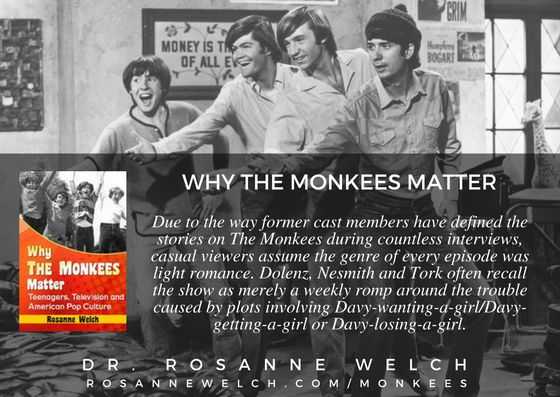
By using a variety of narrative structures, The Monkees innovation in narrative style helped the show stand out in its first season. Audiences learned to expect the unexpected, wrapped in what started out as seemingly familiar stories. These changing narrative structures became the signature of The Monkees, likely leading to its Best Comedy Emmy.
Jean Powergirl takes the host reigns and welcomes her guest Rosanne Welch, PhD to the show! They’ll be discussing Roseanne’s book, “Why The Monkees Matter: Teenagers, Television and American Pop Culture.”
Transcript:
Jean: So here we finally have television trying to deal with these difficult issues, but in a way that made a difference to people.
Rosanne: I think so. It made people start talking about those things in their own lives and that’s what TV’s always done. We credit Will & Grace with giving us a weekly gay character who came into people’s homes and it made people start talking about issues like gay marriage and gay adoption and things like that. So it’s really — people don’t realize — we think movies are influential, but you choose what movies you’re going to go see. You choose with your money to pay for those messages. So, often movies are preaching to a choir. TV comes into your home uninvited. You don’t know what you’re going to stumble upon when you change the channel and so there’s more of an ability to find things you didn’t think you wanted to know about.
Jean: Right, because it was there and it was free. So everyone’s going to sit down that evening — you’re not going out to a movie to watch something controversial and go “Let’s start flipping the channels. Oh look at these kids running around. That’s pretty funny”
Rosanne: Exactly. It attracted — the energetic feel of the show and that they were cute young boys made them pay attention.
A hit television show about a fictitious rock band, The Monkees (1966-1968) earned two Emmys–Outstanding Comedy Series and Outstanding Directorial Achievement in Comedy. Capitalizing on the show’s success, the actual band formed by the actors, at their peak, sold more albums than The Beatles and The Rolling Stones combined and set the stage for other musical TV characters from The Partridge Family to Hannah Montana. In the late 1980s, the Monkees began a series of reunion tours that continued into their 50th anniversary.
This book tells the story of The Monkees and how the show changed television, introducing a new generation to the fourth-wall-breaking slapstick created by Laurel and Hardy and the Marx Brothers. Its creators contributed to the innovative film and television of 1970s with projects like Bob & Carol & Ted & Alice, The Mary Tyler Moore Show, Laugh-In and Welcome Back, Kotter. Immense profits from the show, its music and its merchandising funded the producers’ move into films such as Head, Easy Rider and Five Easy Pieces.
Rosanne Welch, PhD has written for television (Touched by an Angel, Picket Fences) and print (Three Ring Circus: How Real Couples Balance Marriage, Work and Kids and The Encyclopedia of Women in Aviation and Space). In the documentary world she has written and produced Bill Clinton and the Boys Nation Class of 1963 for ABC NEWS/Nightline and consulted on PBS’s A Prince Among Slaves, the story of a prince from West Africa who was enslaved in the 1780s, freed by order of President John Quincy Adams in the 1820s and returned to his homeland.
Teenagers and Teenpics tells the story of two signature developments in the 1950s: the decline of the classical Hollywood cinema and the emergence of that strange new creature, the American teenager. Hollywood’s discovery of the teenage moviegoer initiated a progressive “juvenilization” of film content that is today the operative reality of the American motion picture industry. The juvenilization of the American movies is best revealed in the development of the 1950s “teenpic,” a picture targeted at teenagers even to the exclusion of their elders. In a wry and readable style, Doherty defines and interprets the various teenpic film types: rock ‘n’ roll pictures, j.d. films, horror and sci-fi weirdies, and clean teenpics. Individual films are examined both in light of their impact on the motion picture industry and in terms of their important role in validating the emerging teenage subculture. Also included in this edition is an expanded treatment of teenpics since the 1950s, especially the teenpics produced during the age of AIDS. — Amazon
Jean Powergirl takes the host reigns and welcomes her guest Rosanne Welch, PhD to the show! They’ll be discussing Roseanne’s book, “Why The Monkees Matter: Teenagers, Television and American Pop Culture.”
Transcript:
Rosanne: So, in fact, because we just lost Mary Tyler Moore a couple weeks ago there was a lot of discussion
Jean: God rest her soul
Rosanne:…about here show. Exactly and how she introduced a gay character on her show. She talked about birth control pills.
Jean: She was the working woman by herself. That’s why I watched it.
Rosanne: Exactly. Exactly.
Jean: I was shocked. She got a real job on her own.
Rosanne:…and she spent the night with boys without them coming to her apartment. We would see her come home wearing the same clothes she wore on the day before.
Jean: Oooo….Where’s my fainting couch?
Rosanne: So we were moving into that area where these things were going to be more open and so The Monkees couldn’t quite be blatant about it, but they could be subtle about the things they were saying.
Jean; Right and actually I do like the subtlety. I think it is an artistic thing that I appreciate.
A hit television show about a fictitious rock band, The Monkees (1966-1968) earned two Emmys–Outstanding Comedy Series and Outstanding Directorial Achievement in Comedy. Capitalizing on the show’s success, the actual band formed by the actors, at their peak, sold more albums than The Beatles and The Rolling Stones combined and set the stage for other musical TV characters from The Partridge Family to Hannah Montana. In the late 1980s, the Monkees began a series of reunion tours that continued into their 50th anniversary.
This book tells the story of The Monkees and how the show changed television, introducing a new generation to the fourth-wall-breaking slapstick created by Laurel and Hardy and the Marx Brothers. Its creators contributed to the innovative film and television of 1970s with projects like Bob & Carol & Ted & Alice, The Mary Tyler Moore Show, Laugh-In and Welcome Back, Kotter. Immense profits from the show, its music and its merchandising funded the producers’ move into films such as Head, Easy Rider and Five Easy Pieces.
Rosanne Welch, PhD has written for television (Touched by an Angel, Picket Fences) and print (Three Ring Circus: How Real Couples Balance Marriage, Work and Kids and The Encyclopedia of Women in Aviation and Space). In the documentary world she has written and produced Bill Clinton and the Boys Nation Class of 1963 for ABC NEWS/Nightline and consulted on PBS’s A Prince Among Slaves, the story of a prince from West Africa who was enslaved in the 1780s, freed by order of President John Quincy Adams in the 1820s and returned to his homeland.
The article provides a quick historical survey of the work of several prominent female screenwriters across the first century of filmmaking, including Anita Loos, Dorothy Parker, Frances Goodrich and Joan Didion. In all of their memoirs and other writings about working on screenplays, each mentioned the importance of (often) being the lone woman in the room during pitches and during the development of a screenplay. Goodrich summarized all their experiences concisely when she wrote, ‘I’m always the only woman working on the picture and I hold the fate of the women [characters] in my hand… I’ll fight for what the gal will or will not do, and I can be completely unfeminine about it.’ Also, the rise of female directors, such as Barbra Streisand or female production executives, such as Kathleen Kennedy, prove that one of the greatest assets to having a female voice in the room is the ability to invite other women inside. Therefore, this paper contributes to the scholarship on women in film and to authorship studies.
The title is a riff on a series of one-act plays I worked on in college called “Honey, You Know I Can’t Hear You When the Water’s Running” written by Robert Anderson (author of the plays Tea and Sympathy and was Oscar-nominated for the screenplays A Nun’s Story and I Never Sang for my Father.)
You can read and download the entire journal, edited by Louise Sawtell, Stayci Taylor, which includes other fine articles have a global reach, covering questions of gender in screenwriting practice; reflections on the Irish film industry; Female Screenwriters and Street Films in Weimar Republic; Narrative and Masculinity in The Long Goodbye; How Hollywood Screenplays Inscribe Gender.
The editors had also asked all contributors to create video abstracts for each piece. Thanks to Doug’s help, mine came out pretty good:
Forty-two years ago today — September 11, 1966 — Del Mar was renamed “Clarksville” as part of a promotion for the Monkees’ TV show to debut the following night. The Sunday event marked the first time the foursome performed in public.
Ron Jacobs was a DJ at L.A. radio station KHJ at the time. “One of Boss Radio’s most exciting promotions was staging an actual ‘Last Train to Clarksville,’ ” he says on his website. “A few hundred KHJ winners rode to ‘Clarksville,’ the city of Del Mar.”
“The tenth callers would get two free tickets to the Last Train to Clarksville,” recalls KHJ promotions associate Barbara Hamaker in the Michael Nesmith biography Total Control.
“To this day I don’t know how we did it,” continues Hamaker. “I was the one who had to type up all the releases and all of the stuff that was involved in getting kids onto the train…we used some Podunk town called Del Mar.”
Jean Powergirl takes the host reigns and welcomes her guest Rosanne Welch, PhD to the show! They’ll be discussing Roseanne’s book, “Why The Monkees Matter: Teenagers, Television and American Pop Culture.”
Transcript:
Jean:Your saying that part of thing was that this was just this era was the dawn of trying to show people more real life situations as opposed to fantasy like, for example, you cited in your book, the “Look Who’s Coming to Dinner” film about an interracial couple, which is this huge production back then and this was already happening in film, but not so much in TV, right?
Rosanne: Now, TV is interesting. I have to give credit, of all things, afternoon soap operas are some of the places where controversial stuff happened first. AIDS stories were first done. Gay characters were first introduced. People didn’t take the soaps seriously because they were just for housewives to watch.
Jean: Right.
Rosanne: … bit as those things seeped into daytime TV then they slowly can seep into nighttime television and usually in the hipper, younger, new programming.
A hit television show about a fictitious rock band, The Monkees (1966-1968) earned two Emmys–Outstanding Comedy Series and Outstanding Directorial Achievement in Comedy. Capitalizing on the show’s success, the actual band formed by the actors, at their peak, sold more albums than The Beatles and The Rolling Stones combined and set the stage for other musical TV characters from The Partridge Family to Hannah Montana. In the late 1980s, the Monkees began a series of reunion tours that continued into their 50th anniversary.
This book tells the story of The Monkees and how the show changed television, introducing a new generation to the fourth-wall-breaking slapstick created by Laurel and Hardy and the Marx Brothers. Its creators contributed to the innovative film and television of 1970s with projects like Bob & Carol & Ted & Alice, The Mary Tyler Moore Show, Laugh-In and Welcome Back, Kotter. Immense profits from the show, its music and its merchandising funded the producers’ move into films such as Head, Easy Rider and Five Easy Pieces.
Rosanne Welch, PhD has written for television (Touched by an Angel, Picket Fences) and print (Three Ring Circus: How Real Couples Balance Marriage, Work and Kids and The Encyclopedia of Women in Aviation and Space). In the documentary world she has written and produced Bill Clinton and the Boys Nation Class of 1963 for ABC NEWS/Nightline and consulted on PBS’s A Prince Among Slaves, the story of a prince from West Africa who was enslaved in the 1780s, freed by order of President John Quincy Adams in the 1820s and returned to his homeland.
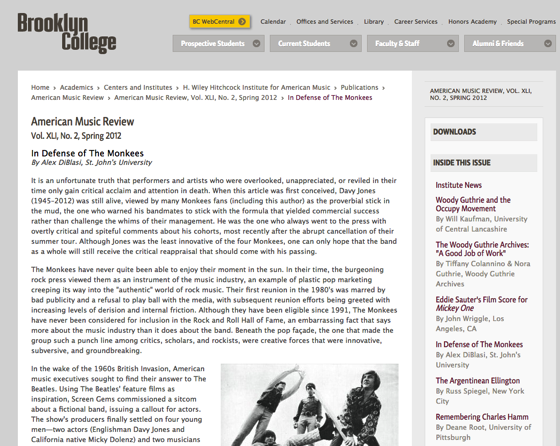
Due to the way former cast members have defined the stories on The Monkees during countless interviews, casual viewers assume the genre of every episode was light romance. Dolenz, Nesmith and Tork often recall the show as merely a weekly romp around the trouble caused by plots involving Davy-wanting-a-girl/Davy-getting-a-girl or Davy-losing-a-girl.
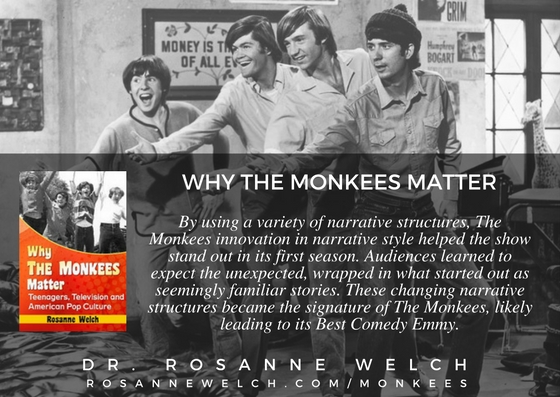
It is an unfortunate truth that performers and artists who were overlooked, unappreciated, or reviled in their time only gain critical acclaim and attention in death. When this article was first conceived, Davy Jones (1945–2012) was still alive, viewed by many Monkees fans (including this author) as the proverbial stick in the mud, the one who warned his bandmates to stick with the formula that yielded commercial success rather than challenge the whims of their management. He was the one who always went to the press with overtly critical and spiteful comments about his cohorts, most recently after the abrupt cancellation of their summer tour. Although Jones was the least innovative of the four Monkees, one can only hope that the band as a whole will still receive the critical reappraisal that should come with his passing.
The Monkees have never quite been able to enjoy their moment in the sun. In their time, the burgeoning rock press viewed them as an instrument of the music industry, an example of plastic pop marketing creeping its way into the “authentic” world of rock music. Their first reunion in the 1980’s was marred by bad publicity and a refusal to play ball with the media, with subsequent reunion efforts being greeted with increasing levels of derision and internal friction. Although they have been eligible since 1991, The Monkees have never been considered for inclusion in the Rock and Roll Hall of Fame, an embarrassing fact that says more about the music industry than it does about the band. Beneath the pop façade, the one that made the group such a punch line among critics, scholars, and rockists, were creative forces that were innovative, subversive, and groundbreaking.


![08 : TV vs. Movies : “Why The Monkees Matter” Interview with Jean Power [Video] (1:03)](https://rosannewelch.com/wp-content/uploads/2017/06/rmw-power-08-tv-movies.jpeg)

![07 : Mary Tyler Moore and The Monkees : “Why The Monkees Matter” Interview [Video] (0:40)](https://rosannewelch.com/wp-content/uploads/2017/06/rmw-power-07-mary-tyler-moore.jpeg)


![06 : From Soap Operas to Primetime : “Why The Monkees Matter” Interview [Video] (0:51)](https://rosannewelch.com/wp-content/uploads/2017/06/rmw-power-06-soaps-primetime.jpeg)