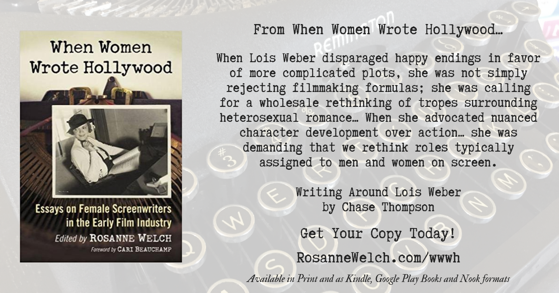
When Lois Weber disparaged happy endings in favor of more complicated plots, she was not simply rejecting filmmaking formulas; she was calling for a wholesale rethinking of tropes surrounding heterosexual romance… When she advocated nuanced character development over action… she was demanding that we rethink roles typically assigned to men and women on screen.
* A portion of each sale from Amazon.com directly supports our blogs
** Many of these books may be available from your local library. Check it out!
† Available from the LA Public Library
Here’s a great Forbes article by Shelley Zalis that our Dean recently shared about the power of women supporting women in their professional worlds.
It illustrates ideas already in place within the alumni and current students in our Stephens College MFA in TV and Screenwriting from “Finding your Squad” to “Amplifying other Women” to “Taking the ‘work’ our of ‘Networking’”. — Rosanne
I always say a woman alone has power; collectively we have impact. Traditionally we have been taught to be competitive with one another, because there was such a scarcity of jobs at the top. It’s so clear that strategy doesn’t work. The truth is that raising each other up and channeling the power of collaboration is truly how we’ll change the equation—and have a lot more fun along the way.
There is a boys’ club where women never felt comfortable, so we decided to create a Girls’ Lounge more than six years ago where everyone feels like they belong. We discovered two things:
There is power in the pack. You realize your strengths make the table better.
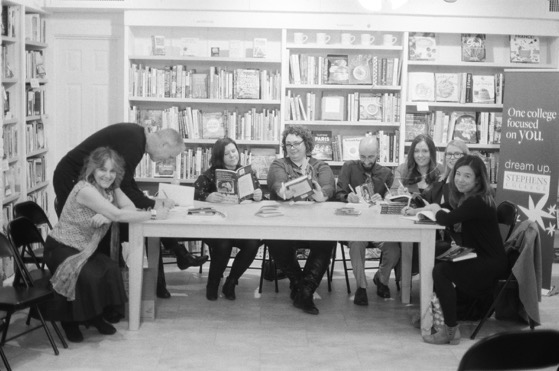
On Saturday, November 3rd, 2018 several of the contributors to When Women Wrote Hollywood gathered at the Skylark Bookshop in Columbia, Missouri for a signing and launch party that functioned like a mini-reunion of the Stephens College MFA in TV and Screenwriting Class of 2017.
Many thanks to all who came to hear them each speak with passion about the research subjects who became whole chapters in this book of essays on female screenwriters from the Silent Era into the 1940s.
* A portion of each sale from Amazon.com directly supports our blogs ** Many of these books may be available from your local library. Check it out! † Available from the LA Public Library
It was a double-header for the 2nd year MFA candidates when they were visited by two writers from The Big Bang Theory and Young Sheldon on consecutive nights this week. On the first night, Eric Kaplan (also a former David Letterman staff writer) came at the invitation of student CJ Ehrlich.
This one allowed me to riff on some of my favorite female science fiction writers across time, whether they be novelists or television writers. It also opened up a good conversation on what art we support and include in our lives – and what that art says to us and about us. — Rosanne
Transcript:
So she’s James, right? There there’s your buddy James. This is a marvelous new book about her life. So really gets into the story of what she was doing and why. I really like autobiographies or biographies because it’s fun. You learn so much about a historical period when you read someone’s individual story and how they worked in the world and society as it was allowing them at the time. So this is actually a book about Alice Sheldon. This lady, Alice Mary Norton, had to be Andre because the boy’s name right? Andre is writing all of these books and look at her again, not the face you imagine when you think of a science fiction writer. She looks like somebody’s great aunt. But why shouldn’t your great-aunt write a really good book, right? Why did we not allow those two things to live in our brain at the same time? So I think it’s really interesting and her stuff is really fascinating. You know we’re all into swords and all that sort of thing. She’s doing the whole Game Of Thrones thing long before we get involved in that right? So we need to give her a little more credit.
* A portion of each sale from Amazon.com directly supports our blogs ** Many of these books may be available from your local library. Check it out!
Sadly she died early in 1948. He lived another 15 years and when he did an oral history and did interviews about his work, when they brought her up, because the good a good historian would look at the names on the things and ask him — he would say “Oh Jeanne. She wasn’t such a good writer but you know I kept her around because she needed that money. — immediately writing her out of the history of the business she had helped to found right? So this is what happens. This is how women fall out of history so easily. We interview the guys and the guys want you to remember how brilliant they are right and that’s really sad. “Who lives? Who dies?” It matters who tells your story. You have to be in charge of your own story.
Dr. Rosanne Welch discusses the women in her new book “When Women Wrote Hollywood” which covers female screenwriters from the Silents through the early 1940s when women wrote over 50% of films and Frances Marion was the highest paid screenwriter (male or female) and the first to win 2 Oscars. Yet, she fails to appear in film history books, which continue to regurgitate the myth that male directors did it all – even though it’s been proven that the only profitable movies Cecil B. de Mille ever directed were all written by Jeannie Macpherson film ever won for Best Picture was written by Robert E. Sherwood (who people have heard of, mostly due to his connection to Dorothy Parker) and Joan Harrison.
* A portion of each sale from Amazon.com directly supports our blogs ** Many of these books may be available from your local library. Check it out! † Available from the LA Public Library
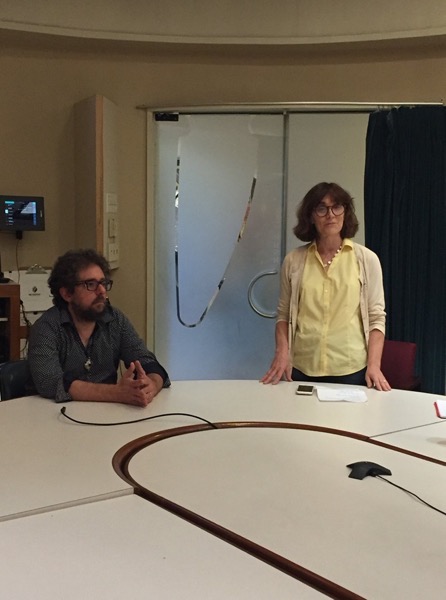
On Saturday both Stephens College MFA in TV and Screenwriting cohorts had the chance to work in teams on the concept of rebooting a show from the 1970s that involved the Egyptian goddess.
As any writer does, we invited a technical consultant – Dr. Marissa Stevens – to give the teams some historical background in the culture of ancient Egypt before they broke into groups to brainstorm their new ideas.
Cindy Chupack has won two Emmys and three Golden Globes as TV writer/producer whose credits include “Sex and the City,” “Better Things,” “Divorce,” “Modern Family,” “Everybody Loves Raymond,” and most recently Showtime’s darkly comic hour “I’m Dying Up Here.” She is the author of two comic memoirs: the New York Times bestseller The Between Boyfriends Book: A Collection of Cautiously Hopeful Essays, and The Longest Date: Life as a Wife. Last year she directed her first episode of television for “I’m Dying Up Here,” and her first feature, OTHERHOOD, starring Angela Bassett, Patricia Arquette, and Felicity Huffman. OTHERHOOD is a comedy Chupack co-wrote that premiered this week in select theaters and on Netflix.
It feels very paint by numbers so it seems so easy – but it’s not. As soon as I get good and comfortable I want to take a risk. To challenge myself.
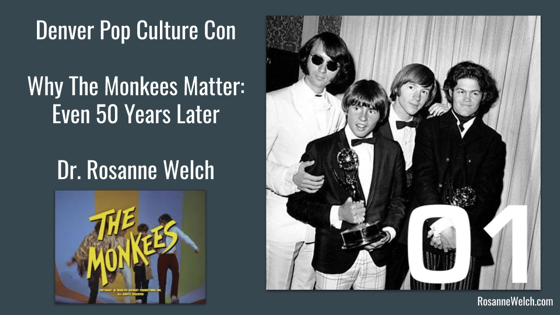
Wherever you go, you find Monkees fans and the Denver Popular Culture Con was no different. Amid rooms full of caped crusaders and cosplay creations, I was initially not sure how many folks would attend a talk on a TV show from the 1960s – but happily I was met by a nice, engaged audience for my talk on Why the Monkees Matter – and afterward they bought books! What more could an author ask for?
A hit television show about a fictitious rock band, The Monkees (1966-1968) earned two Emmys–Outstanding Comedy Series and Outstanding Directorial Acheivement in Comedy.
Capitalizing on the show’s success, the actual band formed by the actors, at their peak, sold more albums than The Beatles and The Rolling Stones combined, and set the stage for other musical TV characters from The Partridge Family to Hannah Montana. In the late 1980s, the Monkees began a series of reunion tours that continued into their 50th anniversary.
This book tells the story of The Monkees and how the show changed television, introducing a new generation to the fourth-wall-breaking slapstick created by Laurel and Hardy and the Marx Brothers.
Its creators contributed to the innovative film and television of 1970s with projects like Bob & Carol & Ted & Alice, The Mary Tyler Moore Show, Laugh-In and Welcome Back, Kotter. Immense profits from the show, its music and its merchandising funded the producers’ move into films such as Head, Easy Riderand Five Easy Pieces.
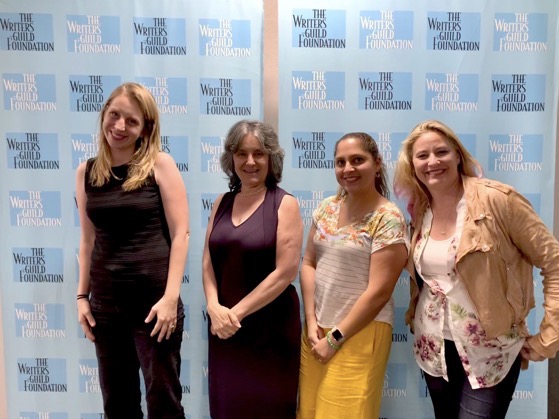
I thank them for being so honest and real about describing the way they balance the lives they love and the work they love. It’s never easy for any of us and sometimes that’s the best lesson of all. Though each of the writers talked about how the skills of being a mother are so perfectly attuned to the nurturing and multitasking required of showrunners in television.
We also learned about offices that have nurseries provided for their writing staff and the fact that, as with all things in life, moms have to make tough decisions between being on set when your pilot is filming or catching your 2nd grader’s talent show… But we also all admitted that it’s a privilege to make the stories that are watched by other people’s children – and to share stories with your own children all their lives. — Rosanne
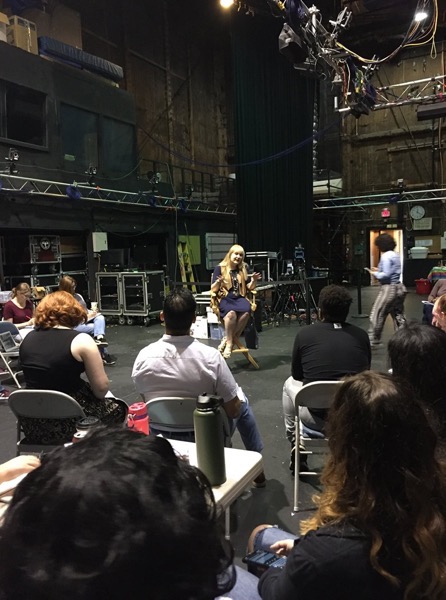
Talking TV writing and motherhood with writers/producers and working moms Julia Brownell (THIS IS US), @jamiedenbo (AMERICAN PRINCESS), Valentina Garza @totalvaligirl (JANE THE VIRGIN), and moderator @RosanneWelch.



![13 Alice Sheldon and Alice Mary Norton from The Sisterhood of Science Fiction – Dr. Rosanne Welch [Video] (1 minute)](https://rosannewelch.com/wp-content/uploads/2019/08/scifi-rmw-cpp-13.jpeg)
![15 Who Tells Your Story? from “When Women Wrote Hollywood” with Dr. Rosanne Welch [Video] (44 seconds)](https://rosannewelch.com/wp-content/uploads/2019/08/csuf-rmw-w3h-15.jpeg)
![Producer/Screenwriter Cindy Chupack on the “How I Wrote That” Podcast from the Stephens MFA in TV and Screenwriting Program [Podcast]](https://rosannewelch.com/wp-content/uploads/2019/08/hiwt-stephens-logo-1.png)