Puritan nonconformist Anne Hutchinson was a wife, mother, and midwife who lived in the Massachusetts Bay Colony and gained fame by challenging the colony’s leadership with her own interpretation of Puritan theology. She also threatened the social hierarchy by demonstrating her willingness and ability to operate outside traditional female cultural boundaries. Hutchinson’s actions not only gained her notoriety in her own lifetime but also helped to transform the “Puritan Way” in the American colonies. – Volume 1
You Can Please Some of the People Some of the Time… None of the People All of the Time: A History of the Art of Adaptation in Movies like Dune, The Godfather, Harry Potter and More!
Dr. Rosanne Welch speaks on A History of the Art of Adaptation in Movies like Dune, The Godfather, Harry Potter and More! at the California State University, Fullerton Library
Part of the program series for Dune by Frank Herbert: A 50th Anniversary Celebration.
Lots of true Tolkien fans – deeply angry that such a thing should happen and there should be focus on a character when other stuff was being thrown out. This is a choice for screenwriters and directors as they try to decide to bring something to film. The Hobbit had been made in animation several years earlier — 1977 — and it’s only 77 minutes long. So, would you rather have that version or the new version with an extra elf that doesn’t really exist. Now make up your mind. What I love about this is that made by Rankin-Bass the same company that gave us Rudolph the Red-Nosed Reindeer. Who himself was an adaptation of a song. A song turned into a beloved Christmas story. So, you can adapt from anything.
About this talk
Dr. Rosanne Welch (RTVF) speaks on the craft of history of film adaptations from the controversy of the silent film Birth of a Nation (protested by the National Association for the Advancement of Colored People in 1915) to Breakfast at Tiffany’s (to which author Truman Capote famously said, “The only thing left from the book is the title”) to The Godfather . Naturally, the behemoth in adaptation – Harry Potter (which depended on the relationship created by adapter Steve Kloves and author J.K. Rowling) will be discussed, as will the subject of this month’s celebration: Dune.
Date: Wednesday, October 14, 2015 Time: 1:00pm – 2:00pm
About Dr. Rosanne Welch
Dr. Rosanne Welch is a professor in the Low Residency MFA in Screenwriting Program from Stephens College, California State University, Fullerton, Mount San Antonio Community College and Cal Poly Pomona. In 2007, she graduated with her Ph.D. in 20th Century U.S./Film History from Claremont Graduate University. She graduated with her M.A. in 20th Century United States History from California State University, Northridge in 2004.
Welch is also a television writer/producer with credits for Beverly Hills 90210 , CBS’s Emmy winning Picket Fences and Touched By An Angel . She also writes and hosts her own podcasts on 3rdPass.media, her first one titled “Mindful(I) Media with Dr. Rosanne Welch.”
Disney has honored Pocahontas in film, and she is a staple of the public school curriculum and is a symbol of a good Native American. We think we know her, but the events of her life have grown beyond the bounds of history. She has become a myth, one useful in telling a particular version of the American past. Even historians cannot always be sure what is true and what is not when it comes to Pocahontas. In many ways, she is the American version of Eve, the progenitor of a new race of humans and a new destiny for her people and for Euro-Americans. – Volume 1
I teach several classes for the Stephens College Low-Residency MFA in Screenwriting, including History of Screenwriting. In fact, I created the curriculum for that course from scratch and customized it to this particular MFA in that it covers ‘Screenwriting’ (not directors) and even more specifically, the class has a female-centric focus. As part History of Screenwriting I, the first course in the four-class series, we focus on the early women screenwriters of the silent film era who male historians have, for the most part, quietly forgotten in their books. In this series, I share with you some of the screenwriters and films that should be part of any screenwriters education. I believe that in order to become a great screenwriter, you need to understand the deep history of screenwriting and the amazing people who created the career. — Dr. Rosanne Welch
Edison Kinetoscopic Record of a Sneeze (1894)
The earliest surviving copyrighted motion picture, the Edison Kinetoscopic Record of a Sneeze is a short film made by W. K. L. Dickson in January 1894 for advertising purposes. Often referred to as “Fred Ott’s Sneeze,” this is is one of the world’s earliest motion pictures and America’s best known early film production. The star is Fred Ott, an Edison employee known to his fellow workers in the laboratory for his comic sneezing and other gags. This item was received in the Library of Congress on January 9, 1894, as a copyright deposit from Dickson.
Two other Edison experimental films on the Library’s YouTube site – DICKSON GREETING (May 1891) and NEWARK ATHLETE (May or June 1891), predate The Sneeze. The Sneeze was submitted for copyright as 45 frames from the motion picture printed as positive prints on paper rather than as a reel of film. The prints were mounted on cardboard and submitted to the Copyright Office in this form. The video of the Sneeze on loc.gov and YouTube was later rephotographed and turned into a moving image from these mounted frames.
SUMMARY Film made for publicity purposes, as a series of still photographs to accompany an article in Harper’s weekly.
OTHER TITLES Sneeze Fred Ott’s sneeze
CREATED/PUBLISHED United States : Edison Manufacturing Co., 1894.
NOTES Copyright: W. K. L. Dickson; 9Jan1894; 2887.
Performer: Fred Ott.
Camera, William Heise.
Filmed ca. January 2-7, 1894, in Edison’s Black Maria studio.
SUBJECTS Sneezing. Publicity. Motion picture industry–Public relations–United States. Actuality
RELATED NAMES Dickson, W. K.-L. (William Kennedy-Laurie), 1860-1935, production. Ott, Frederic P., performer. Heise, William, camera. Thomas A. Edison, Inc. Hendricks (Gordon) Collection (Library of Congress) Paper Print Collection (Library of Congress)
“1960s TV Censorship and The Monkees” gives a brief overview of where censorship standards were in the era – and how The Monkees pushed the envelope with its mentions of the Vietnam War – and Sunset Strip riots – and even with the outrageous storytelling behind “Frodis Caper”, the episode that celebrated the saving of an alien plant that very closely resembled a marijuana plant…
Writer Treva Silverman said the staff got away with such jokes because the network executives were just old enough not to understand any of the references. Presented at Stephens College MFA in Screenwriting classes on Friday, August 5, 2016
Transcript:
They had a couple of other big names come in. And then this was Treva’s explanation to me about why they got away with it. Network guys thought they were hip and cool, but they had no idea what was going on. And these guys knew it. She defined herself as a hippy as did Peter Meyerson like I said and she said she started smoking pot during the course of working on the show and when she went home to New York to visit her relatives they were like, ahhh…scandalized. She said, “Well, that’s just what everyone is doing.” So, I wanted to mention that we’re not done with censorship on television briefly. If you know Amy Schumer recently had this sketch canceled from her show. It was censored. She wasn’t to air it and it was anti-gun thing based on all the mass shootings. We still obviously knew about the “wardrobe malfunction” and what can and can’t be shown of a woman on television and of course, George Carlin went to court over The 7 Dirty Words You Can’t Say on Television. Dexter, of course, think how violent that is. We worry so much about what sex we show on TV but look how much violence we show and I think Gilda Radner, who I love dearly, is pretty brilliant because she talked about the violence on television back in the day. So we’re still not done with that. If you’re interested in censorship on TV, these are some books that are fun to look at that talk about this period of time. And so, if you want to look into that, that’s what they are. And that’s the flat out presentation.
Dr. Rosanne Welch is a professor in the Low Residency MFA in Screenwriting Program from Stephens College, California State University, Fullerton, Mount San Antonio Community College and Cal Poly Pomona. In 2007, she graduated with her Ph.D. in 20th Century U.S./Film History from Claremont Graduate University. She graduated with her M.A. in 20th Century United States History from California State University, Northridge in 2004.
Welch is also a television writer/producer with credits for Beverly Hills 90210 , CBS’s Emmy winning Picket Fences and Touched By An Angel . She also writes and hosts her own podcasts on 3rdPass.media, her first one titled “Mindful(I) Media with Dr. Rosanne Welch.”
Among the many technical terms students confront when studying the aesthetics of television, the one they seem to remember most is metatextuality, which in laymen’s terms happens when a character breaks the fourth wall with an aside to the audience, thereby acknowledging that someone, the audience, is watching and admitting they know they are playing a character in a fictional world.
You Can Please Some of the People Some of the Time… None of the People All of the Time: A History of the Art of Adaptation in Movies like Dune, The Godfather, Harry Potter and More!
Dr. Rosanne Welch speaks on A History of the Art of Adaptation in Movies like Dune, The Godfather, Harry Potter and More! at the California State University, Fullerton Library
Part of the program series for Dune by Frank Herbert: A 50th Anniversary Celebration.
Of course, we all know, gee whiz, the biggest adaptation of the last ten years has been the whole set of Tolkien books. I’m just going to look at The Hobbit for a minute because when it became a movie they invented an entire character who doesn’t appear in the book at all. Just made her up, because there weren’t enough chicks involved in this story, right? They thought “Oh no, we need to do something about that.” So Tauriel doesn’t exist in the books, but they wanted to have a little bit of a love story. They wanted to have a female character largely because one of the more popular female characters in The Lord of The Rings adaptation is Eowyn, right? Everybody — well that’s Tauriel. Excuse me. She’s so important she got on one of the posters. It’s Eowyn, right? And she stood out in the whole Lord of the Rings saga because of what line? (Laughs) “I am no man!” Wham. What a great moment, right? That’a a moment everybody…so, they knew in making The Hobbit a film, they had to have some sort of female character who could bring that to the new production.
About this talk
Dr. Rosanne Welch (RTVF) speaks on the craft of history of film adaptations from the controversy of the silent film Birth of a Nation (protested by the National Association for the Advancement of Colored People in 1915) to Breakfast at Tiffany’s (to which author Truman Capote famously said, “The only thing left from the book is the title”) to The Godfather . Naturally, the behemoth in adaptation – Harry Potter (which depended on the relationship created by adapter Steve Kloves and author J.K. Rowling) will be discussed, as will the subject of this month’s celebration: Dune.
Date: Wednesday, October 14, 2015 Time: 1:00pm – 2:00pm
About Dr. Rosanne Welch
Dr. Rosanne Welch is a professor in the Low Residency MFA in Screenwriting Program from Stephens College, California State University, Fullerton, Mount San Antonio Community College and Cal Poly Pomona. In 2007, she graduated with her Ph.D. in 20th Century U.S./Film History from Claremont Graduate University. She graduated with her M.A. in 20th Century United States History from California State University, Northridge in 2004.
Welch is also a television writer/producer with credits for Beverly Hills 90210 , CBS’s Emmy winning Picket Fences and Touched By An Angel . She also writes and hosts her own podcasts on 3rdPass.media, her first one titled “Mindful(I) Media with Dr. Rosanne Welch.”
I teach several classes for the Stephens College Low-Residency MFA in Screenwriting, including History of Screenwriting. In fact, I created the curriculum for that course from scratch and customized it to this particular MFA in that it covers ‘Screenwriting’ (not directors) and even more specifically, the class has a female-centric focus. As part History of Screenwriting I, the first course in the four-class series, we focus on the early women screenwriters of the silent film era who male historians have, for the most part, quietly forgotten in their books. In this series, I share with you some of the screenwriters and films that should be part of any screenwriters education. I believe that in order to become a great screenwriter, you need to understand the deep history of screenwriting and the amazing people who created the career. — Dr. Rosanne Welch
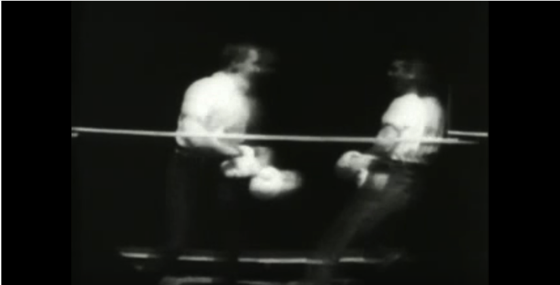
Men Boxing is an 1891 American shortblack-and-whitesilentactuality film, produced and directed by William K.L. Dickson and William Heise for the Edison Manufacturing Company, featuring two Edison employees with boxing gloves, pretending to spar in a boxing ring. The 12 feet of film was shot between May and June 1891 at the Edison Laboratory Photographic Building in West Orange, New Jersey, on the Edison-Dickson-Heise experimental horizontal-feed kinetograph camera and viewer, through a round aperture on 3/4 inch (19mm) wide film with a single edge row of sprocket perforations, as an experimental demonstration and was never publicly shown. A print has been preserved in the US Library of Congress film archive as part of the Gordon Hendricks collection.[1][2]— Wikipedia
Learn more about Thomas Edison and Early Movies with these books and videos
* A portion of each sale from Amazon.com directly supports our blogs ** Many of these books may be available from your local library. Check it out!

![More on Adapting The Hobbit from A History of the Art of Adaptation [Video] (0:44)](https://rosannewelch.com/wp-content/uploads/2017/03/adapt-39-more-hobbit.jpeg)


![Wrapping Up The Monkees from 1960’s TV Censorship and The Monkees [Video] (1:26)](https://rosannewelch.com/wp-content/uploads/2017/02/monkees-censorship-22-conclusion.jpeg)


![Adapting Tolkien from A History of the Art of Adaptation [Video] (1:02)](https://rosannewelch.com/wp-content/uploads/2017/02/adapt-38-tolkien.jpeg)