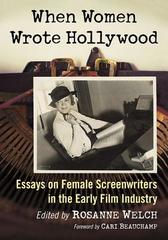
Months of research went into the creation of the essays in “When Women Wrote Hollywood.” Here are some of the resources used to enlighten today’s film lovers to the female pioneers who helped create it.
“At eighteen I must have been regarded as a woman, writes the author in this colorful memoir, for I was one of the first women reporters, maybe as an all-around police beat, sports, sin and society reporter the first in the world.” “Although she chose what was considered a man’s career, she never forgot that she was a woman, and in her recollections, she also finds time to discuss her youghful flirtations, her bittersweet marriage to Ike St. Johns, a profound love affair, her difficulties with being simultaneously a wife, mother and coreer woman, as well as more serious personal problems. The result is a blockbuster of a story which catches the reader up in its drama and excitement and involves him in a personal confrontation with the events.” — Amazon
* A portion of each sale from Amazon.com directly supports our blogs
** Many of these books may be available from your local library. Check it out!
† Available from the LA Public Library
Subscribe to Rosanne’s Channel and receive notice of each new video!
Transcript:
Likewise this young woman — and these are all from early Hollywood, because they come out of this book, so they’re in my brain right now — Sarah Mason married this gentleman, Victor Herrmann. Before she married him she’d written 15 films. Together they wrote three or four and they won an Oscar for adapting a book called Little Women and then he became a director. He directed for another thirty years. He never wrote another film. She wrote 35 more films. He outlived his wife and when he went to give his oral history, he talked about how he trained her to write and how if it wasn’t for him she wouldn’t have had a career. That is how she is remembered in history because her own husband was her unreliable narrator. So I really have to think about interviews when we use them as the only piece of research.
A Note About This Presentation
A clip from my keynote speech at the 10th Screenwriters´(hi)Stories Seminar for the interdisciplinary Graduation Program in “Education, Art, and History of Culture”, in Mackenzie Presbyterian University, at São Paulo, SP, Brazil, focused on the topic “Why Researching Screenwriters (has Always) Mattered.” I was especially pleased with the passion these young scholars have toward screenwriting and it’s importance in transmitting culture across the man-made borders of our world.
To understand the world we have to understand its stories and to understand the world’s stories we must understand the world’s storytellers. A century ago and longer those people would have been the novelists of any particular country but since the invention of film, the storytellers who reach the most people with their ideas and their lessons have been the screenwriters. My teaching philosophy is that: Words matter, Writers matter, and Women writers matte, r so women writers are my focus because they have been the far less researched and yet they are over half the population. We cannot tell the stories of the people until we know what stories the mothers have passed down to their children. Those are the stories that last. Now is the time to research screenwriters of all cultures and the stories they tell because people are finally recognizing the work of writers and appreciating how their favorite stories took shape on the page long before they were cast, or filmed, or edited. But also because streaming services make the stories of many cultures now available to a much wider world than ever before.
Many thanks to Glaucia Davino for the invitation.
* A portion of each sale from Amazon.com directly supports our blogs ** Many of these books may be available from your local library. Check it out! † Available from the LA Public Library
Months of research went into the creation of the essays in “When Women Wrote Hollywood.” Here are some of the resources used to enlighten today’s film lovers to the female pioneers who helped create it.
Garson Kanin, who broke into show business as a saxophone-playing high school dropout and went on to write ”Born Yesterday,” direct ”The Diary of Anne Frank” and become the co-writer of two classic Tracy-Hepburn movies, died on Saturday at his home in Manhattan. He was 86.
He died after a lengthy illness, according to a spokeswoman for the family. His wife, the actress Marian Seldes, whom he married in 1990, was with him.
In a life filled with work — ”I become physically ill if I don’t work for three days,” he once said — Mr. Kanin wrote or directed 32 plays, acted in 8, worked on 29 films and wrote more than a dozen books of fiction and nonfiction, as well as hundreds of short stories and articles that were translated into numerous languages.
* A portion of each sale from Amazon.com directly supports our blogs
** Many of these books may be available from your local library. Check it out!
† Available from the LA Public Library
Subscribe to Rosanne’s Channel and receive notice of each new video!
Transcript:
So unreliable narrators are something we have to look at when we’re doing our own research or study about films. In this case, we have a woman named Jeannie Macpherson and a gentleman who you may or may not have heard, if if you know about early American films Cecil B. DeMille. Mostly if I teach this woman’s work people have heard of him they have never heard of her because when he outlived her and gave an interview to the Academy of Motion Pictures in oral history, he said — after she was long dead — she didn’t do much work I did most of it. She had some nice ideas but I was the one who did all the real work. But if you do the research, all the movies that he made that were blockbusters she wrote and when she didn’t write his films they did not make money. Why would he have kept her on board for 20 years of filmmaking if she did so very little but she didn’t live long enough to give her own oral history and he did.
A Note About This Presentation
A clip from my keynote speech at the 10th Screenwriters´(hi)Stories Seminar for the interdisciplinary Graduation Program in “Education, Art, and History of Culture”, in Mackenzie Presbyterian University, at São Paulo, SP, Brazil, focused on the topic “Why Researching Screenwriters (has Always) Mattered.” I was especially pleased with the passion these young scholars have toward screenwriting and it’s importance in transmitting culture across the man-made borders of our world.
To understand the world we have to understand its stories and to understand the world’s stories we must understand the world’s storytellers. A century ago and longer those people would have been the novelists of any particular country but since the invention of film, the storytellers who reach the most people with their ideas and their lessons have been the screenwriters. My teaching philosophy is that: Words matter, Writers matter, and Women writers matte, r so women writers are my focus because they have been the far less researched and yet they are over half the population. We cannot tell the stories of the people until we know what stories the mothers have passed down to their children. Those are the stories that last. Now is the time to research screenwriters of all cultures and the stories they tell because people are finally recognizing the work of writers and appreciating how their favorite stories took shape on the page long before they were cast, or filmed, or edited. But also because streaming services make the stories of many cultures now available to a much wider world than ever before.
Many thanks to Glaucia Davino for the invitation.
* A portion of each sale from Amazon.com directly supports our blogs ** Many of these books may be available from your local library. Check it out! † Available from the LA Public Library
Months of research went into the creation of the essays in “When Women Wrote Hollywood.” Here are some of the resources used to enlighten today’s film lovers to the female pioneers who helped create it.
JAN ZILLIACUS was the daughter of the pioneer American film director Laurence Trimble, owner of Jean, the Vitagraph dog, who won international fame long before Rin-Tin-Tin.
“Father wanted six boys and all he got was this miserable girl,” she said. “So he treated me like a boy. He gave me no quarter at all. I was breaking horses at the age of 10 and 11. I was very strong. I didn’t go to school properly – I had tutors from time to time. But somebody had to be chased by wolves, and the actresses didn’t like the idea.”
* A portion of each sale from Amazon.com directly supports our blogs
** Many of these books may be available from your local library. Check it out!
† Available from the LA Public Library
We’re pleased to present a new slideshow designed by graphic artist Phoenix Bussey, a Stephens College undergrad, using photos taken by MFA candidates during the last few years of workshops. We think it tells our story well. Write. Reach. Represent.
Subscribe to Rosanne’s Channel and receive notice of each new video!
Transcript:
Stories have always transmitted culture. If we go far back to the cave paintings of many ancient cultures, to Gilgamesh, to the griots of Africa, we have always used stories to move forward our culture, right, and movies are just the most current version of doing that.
So why do we forget who the storytellers are? That doesn’t make any sense to me, right, and I think there are some reasons that we can fix both in our own casual discussions of films and in the teaching that people might do about what is important, right? One of the first things I discovered in my research is this issue of unreliable narrators. Often we find when people are interviewed to discuss films they chose not to credit anyone who will take away their own fame.So this is one of the most egregious quotes. Alfred Hitchcock, who everyone seems to recognize — you say that you’re watching a Hitchcock film — but he did not write any of his films. He had many other writers who worked for him. This photograph is a woman named Eve Unsell and she’s from the early 1920s in Hollywood. At one point, she was sent to England to work in the studio there and she trained this young man who knew nothing about how films were made and when he wrote about her in his biography, he didn’t mention her name so you could research her. He only said “a middle-aged American woman.” He wrote her out of history as nothing but a middle-aged woman and yet she taught him everything he knows. So, in fact, his movies are Eve Unsell movies but we don’t think that way.
A Note About This Presentation
A clip from my keynote speech at the 10th Screenwriters´(hi)Stories Seminar for the interdisciplinary Graduation Program in “Education, Art, and History of Culture”, in Mackenzie Presbyterian University, at São Paulo, SP, Brazil, focused on the topic “Why Researching Screenwriters (has Always) Mattered.” I was especially pleased with the passion these young scholars have toward screenwriting and it’s importance in transmitting culture across the man-made borders of our world.
To understand the world we have to understand its stories and to understand the world’s stories we must understand the world’s storytellers. A century ago and longer those people would have been the novelists of any particular country but since the invention of film, the storytellers who reach the most people with their ideas and their lessons have been the screenwriters. My teaching philosophy is that: Words matter, Writers matter, and Women writers matte, r so women writers are my focus because they have been the far less researched and yet they are over half the population. We cannot tell the stories of the people until we know what stories the mothers have passed down to their children. Those are the stories that last. Now is the time to research screenwriters of all cultures and the stories they tell because people are finally recognizing the work of writers and appreciating how their favorite stories took shape on the page long before they were cast, or filmed, or edited. But also because streaming services make the stories of many cultures now available to a much wider world than ever before.
Many thanks to Glaucia Davino for the invitation.
* A portion of each sale from Amazon.com directly supports our blogs ** Many of these books may be available from your local library. Check it out! † Available from the LA Public Library
Months of research went into the creation of the essays in “When Women Wrote Hollywood.” Here are some of the resources used to enlighten today’s film lovers to the female pioneers who helped create it.
With the perspiring assistance of Thomas Mitchell, who acts like a steam locomotive, the Spewacks have tossed another one of those melodramatic lampoons at the newspaper profession in “Clear All Wires,” put on at the Times Square last evening. It is brisk, noisy, extravagant and funny in “The Front Page” and “Broadway” tradition.
* A portion of each sale from Amazon.com directly supports our blogs
** Many of these books may be available from your local library. Check it out!
† Available from the LA Public Library
London, United Kingdom Fri, Apr 24, 2020 at 12:30 am BST
Eastern Time, ET Thu, Apr 23, 2020 at 7:30 pm EDT
Central Time, CT Thu, Apr 23, 2020 at 6:30 pm CDT
Mountain Time, MT Thu, Apr 23, 2020 at 5:30 pm MDT
Pacific Time, PT Thu, Apr 23, 2020 at 4:30 pm PDT
Sydney, Australia Fri, Apr 24, 2020 at 9:30 am AEST
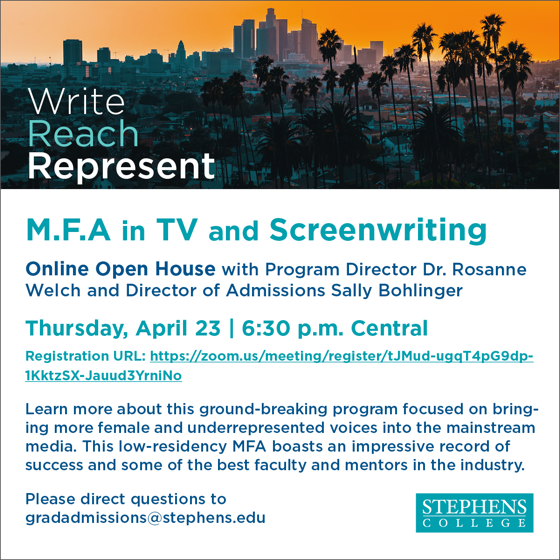
Learn more about this ground-breaking program focused on bringing more female and underrepresented voices into the mainstream media. The MFA boasts an impressive record of success and some of the best faculty and mentors in the industry.
Subscribe to Rosanne’s Channel and receive notice of each new video!
Transcript:
I apologize for the long quote but I am very appreciative when actors recognize the work of writers and so Frances McDormand said this when she won her Oscar basically she said of the writer Martin McDonagh, He did not sketch a blueprint. That’s an insult to a screenplay. He didn’t string together a few words. He wrote and meticulously crafted a tsunami of a story and then he let the actors play there. So she immediately was crediting the writer in a way that many people do not. I believe the stories are important because they transmit our culture around the world. Again, United States has had a corner on that market for far too many years and now we’re beginning to see other stories permeate our culture and that’s only been a good, beneficial thing for us.
A Note About This Presentation
A clip from my keynote speech at the 10th Screenwriters´(hi)Stories Seminar for the interdisciplinary Graduation Program in “Education, Art, and History of Culture”, in Mackenzie Presbyterian University, at São Paulo, SP, Brazil, focused on the topic “Why Researching Screenwriters (has Always) Mattered.” I was especially pleased with the passion these young scholars have toward screenwriting and it’s importance in transmitting culture across the man-made borders of our world.
To understand the world we have to understand its stories and to understand the world’s stories we must understand the world’s storytellers. A century ago and longer those people would have been the novelists of any particular country but since the invention of film, the storytellers who reach the most people with their ideas and their lessons have been the screenwriters. My teaching philosophy is that: Words matter, Writers matter, and Women writers matte, r so women writers are my focus because they have been the far less researched and yet they are over half the population. We cannot tell the stories of the people until we know what stories the mothers have passed down to their children. Those are the stories that last. Now is the time to research screenwriters of all cultures and the stories they tell because people are finally recognizing the work of writers and appreciating how their favorite stories took shape on the page long before they were cast, or filmed, or edited. But also because streaming services make the stories of many cultures now available to a much wider world than ever before.
Many thanks to Glaucia Davino for the invitation.
* A portion of each sale from Amazon.com directly supports our blogs ** Many of these books may be available from your local library. Check it out! † Available from the LA Public Library


 †
†![09 Susan Y. Mason from Why Researching Screenwriters (has Always) Mattered [Video] (47 seconds)](https://rosannewelch.com/wp-content/uploads/2020/05/rmw-sao-paolo-09.jpeg)

![08 Jeannie Macpherson from Why Researching Screenwriters (has Always) Mattered [Video] (1 minute 3 seconds)](https://rosannewelch.com/wp-content/uploads/2020/05/rmw-sao-paolo-08.jpeg)

![Stephens College MFA in TV and Screenwriting [Video]](https://rosannewelch.com/wp-content/uploads/2020/05/Stephens-College-MFA-in-TV-and-Screenwriting-Official-AD.jpeg)
![07 Storytelling And Unreliable Narrators from Why Researching Screenwriters (has Always) Mattered [Video] (1 minute 30 seconds)](https://rosannewelch.com/wp-content/uploads/2020/04/rmw-sao-paolo-07.jpeg)

![06 Stories Are Important! from Why Researching Screenwriters (has Always) Mattered [Video] (51 seconds)](https://rosannewelch.com/wp-content/uploads/2020/04/rmw-sao-paolo-06.jpeg)