
Writers are often told to “write what you know.”
Instead, we should write the emotions we know.
These are universal.
On Screenwriting and Media with Dr. Rosanne Welch
Writing, Film, Television and More!
Writers are often told to “write what you know.”
Instead, we should write the emotions we know.
These are universal.

I promised to clean my desk before a full semester of online learning began… and I did. See? There’s room for my cat Spotted Leaf (named after a character in the Erin Hunter series of books about cats who live in the woods – Warriors). Spot (as we call her for short) enjoys hearing me talk to students about everything from films to fiction. Maybe in one of her past 9 lives she was a humanities professor, too!
Another Day, Another Video Conference

As a member of the Executive Council of the Screenwriting Research Network (SRN) I have the great pleasure of meeting with colleagues from several continents (Australia, South America, Europe, etc) on a monthly basis to discuss the business of the organization. it continues to amaze me how technology allows us to do this – as it continues to amaze me how lucky I am to have had the chance to meet all of these lovely folks in person at our various conferences. Can’t wait for the next one – in Oxford in 2021!
Highlighting the articles in the past editions of the Journal of Screenwriting, of which I am the Book Reviews Editor. Hopefully these abstracts will entice you to did a little deeper into the history and future of screenwriting. — Rosanne
Everybody’s a Writer Theorizing screenwriting as creative labour by Bridget Conor
This paper offers a theoretical agenda for a labourist analysis of screenwriting, and critically evaluates the marginal status of screenwriting within film production systems. On the one hand, screenwriting offers an exemplary case study of creative work in post-modernized film production industries, work characterized by freelancing and multivalent working patterns, insecurity and hierarchization. Investigating screenwriting as creative labour also offers unique insights into an intensely industrial vocation; this requires a highly particular theorization of the contexts and conditions of writers’ working lives.This paper draws on sociological analyses of creative production and utilizes a Foucauldian understanding of technologies of the self as this concept has been applied in the analysis of creative labour. This approach enables a critical examination of particular aspects of screenwriting labour, including the rigidity of the industrial screenplay form and its pedagogical frameworks, the standardized mechanisms of control over screenwriting labour (such as inequitable collaboration and practices of multiple authorship), and the heady mix of both creative fulfilment and punishment which characterizes this form of work.
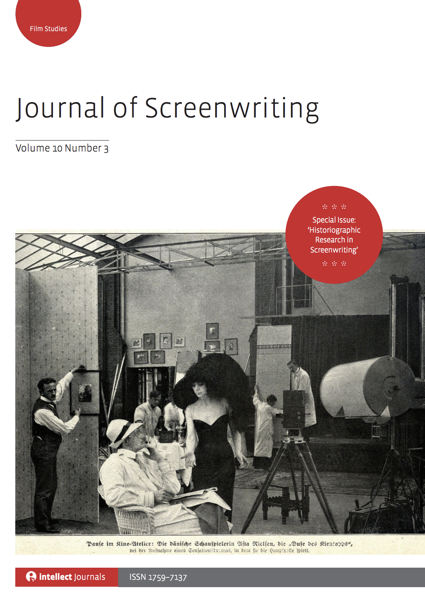
The Journal of Screenwriting is an international double-blind peer-reviewed journal that is published three times a year. The journal highlights current academic and professional thinking about the screenplay and intends to promote, stimulate and bring together current research and contemporary debates around the screenplay whilst encouraging groundbreaking research in an international arena. The journal is discursive, critical, rigorous and engages with issues in a dynamic and developing field, linking academic theory to screenwriting practice.
Get your copy and subscription to the Journal of Screenwriting Today!
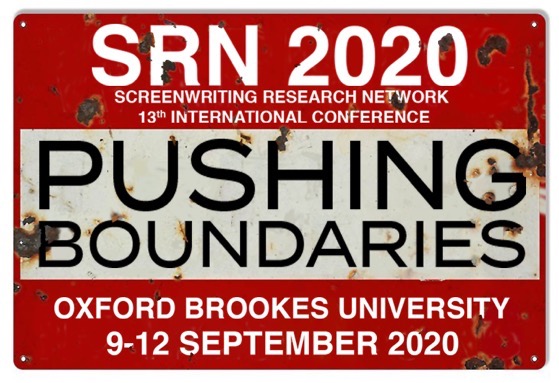
Join me at the Screenwriting Research Network’s Annual Conference in Oxford, UK
* A portion of each sale from Amazon.com directly supports our blogs
** Many of these books may be available from your local library. Check it out!
Between the Sheets: Writing About Sex on Television

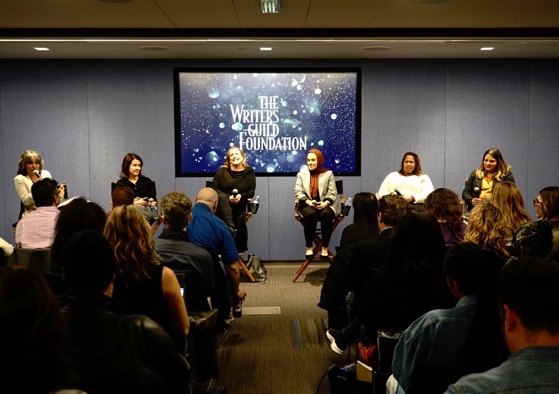
The Stephens College MFA in TV and Screenwriting program teamed up with the Writers Guild Foundation to pull the covers back on a topic that still makes viewers blush: sex. On this special evening, our panel of TV writers and producers share how they approach writing about sex, from intimate scenes to revealing dialogue, and the nuances they consider when crafting stories about sex and sexuality.
Panelists:
Writers Guild Foundation – @wgfoundation
Follow and Like the Stephens College MFA in TV and Screenwriting
Between the Sheets: Writing About Sex on Television
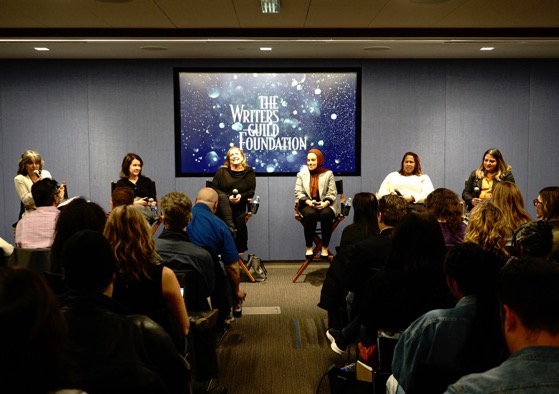
The Stephens College MFA in TV and Screenwriting program teamed up with the Writers Guild Foundation to pull the covers back on a topic that still makes viewers blush: sex. On this special evening, our panel of TV writers and producers share how they approach writing about sex, from intimate scenes to revealing dialogue, and the nuances they consider when crafting stories about sex and sexuality.
Panelists:
Writers Guild Foundation – @wgfoundation
Follow and Like the Stephens College MFA in TV and Screenwriting
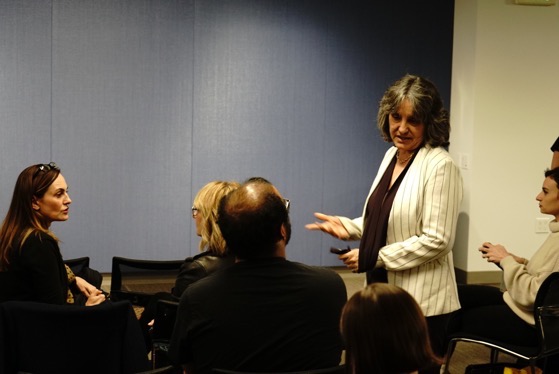

Hosting the WGA events for Stephens allows me to reconnect with students I’ve had and other schools. Here I am chatting with a student from last spring’s one-hour drama class from Columbia College’s Semester in LA program.
Writers Guild Foundation – @wgfoundation
Follow and Like the Stephens College MFA in TV and Screenwriting

After our WGA panel on Writing sex scenes for television, Dr. Rosanne Welch speaks to panelist (and Stephens College MFA alum) Sahar Jahani (Ramy, 13 Reasons Why) speak with Intimacy coordinator Mia Schachter.
Writers Guild Foundation – @wgfoundation
Follow and Like the Stephens College MFA in TV and Screenwriting
It’s not a tree until there’s a kitty sitting under it!

* A portion of each sale from Amazon.com directly supports our blogs
** Many of these books may be available from your local library. Check it out!
† Available from the LA Public Library
