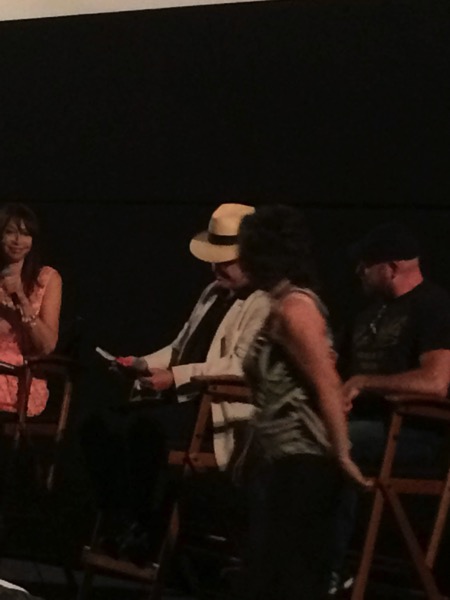
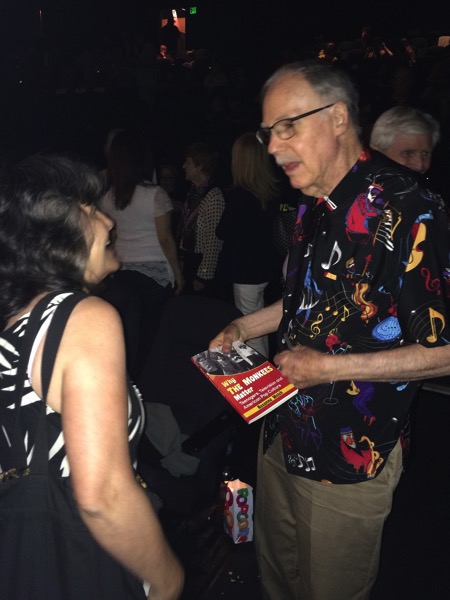
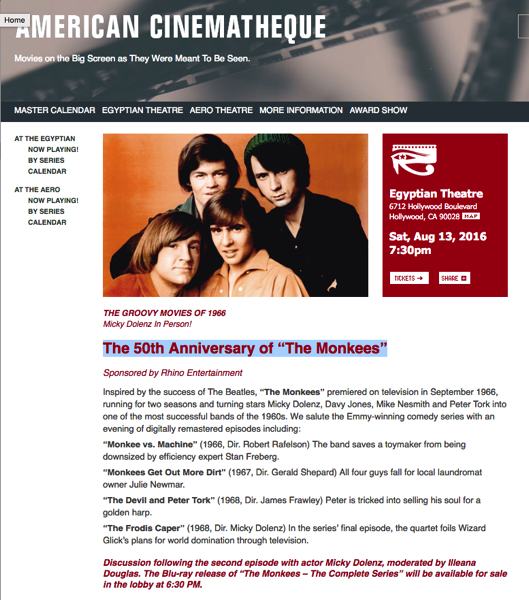
Last night I attended American Cinematheque’s “50th Anniversary of the Monkees” event at the Egyptian Theater in Hollywood and had the opportunity to present copies of “Why The Monkees Matter” to writer, Dave Evans and Micky Dolenz. This is the culmination of a long path in writing the book and I was very happy that I could put a copy directly into the hands of 2 people who played such a fundamental role in the creation of “The Monkees” television show — and therefore, my book.
Presenting “Why The Monkees Matter” to Micky Dolenz
Presenting “Why The Monkees Matter” to writer, Dave Evans
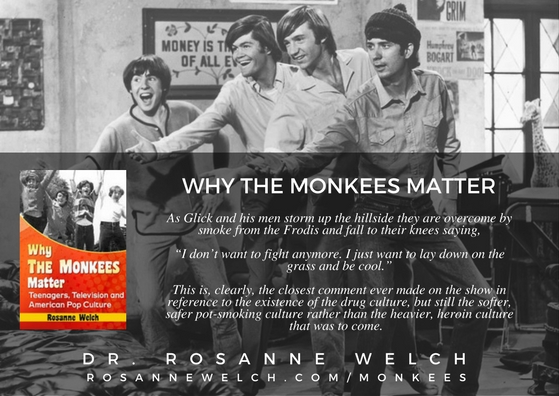
“As Glick and his men storm up the hillside they are overcome by smoke from the Frodis and fall to their knees saying, “I don’t want to fight anymore. I just want to lay down on the grass and be cool.” This is, clearly, the closest comment ever made on the show in reference to the existence of the drug culture, but still the softer, safer pot-smoking culture rather than the heavier, heroin culture that was to come.
“1960s TV Censorship and The Monkees” gives a brief overview of where censorship standards were in the era – and how The Monkees pushed the envelope with its mentions of the Vietnam War – and Sunset Strip riots – and even with the outrageous storytelling behind “Frodis Caper”, the episode that celebrated the saving of an alien plant that very closely resembled a marijuana plant…
Writer Treva Silverman said the staff got away with such jokes because the network executives were just old enough not to understand any of the references. Presented at Stephens College MFA in Screenwriting classes on Friday, August 5, 2016
Dr. Rosanne Welch is a professor in the Low Residency MFA in Screenwriting Program from Stephens College, California State University, Fullerton, Mount San Antonio Community College and Cal Poly Pomona. In 2007, she graduated with her Ph.D. in 20th Century U.S./Film History from Claremont Graduate University. She graduated with her M.A. in 20th Century United States History from California State University, Northridge in 2004.
Welch is also a television writer/producer with credits for Beverly Hills 90210 , CBS’s Emmy winning Picket Fences and Touched By An Angel . She also writes and hosts her own podcasts on 3rdPass.media, her first one titled “Mindful(I) Media with Dr. Rosanne Welch.”
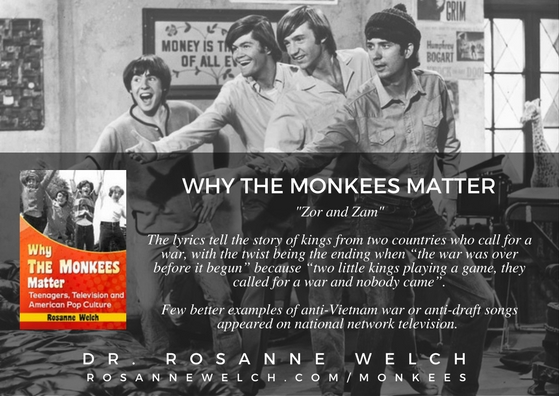
The lyrics tell the story of kings from two countries who call for a war, with the twist being the ending when “the war was over before it begun” because “two little kings playing a game, they called for a war and nobody came”.
Few better examples of anti-Vietnam war or anti-draft songs appeared on national network television.
“The power of that love was inside of Peter. It was inside of him from the first. And it was that kind of power that made Peter able to play the harp… Don’t you understand what that is, when you have that inside of you. If you love music, man. You can play music… All it takes is just love, ‘cause baby in the final analysis, love is power. That’s where the power is at.”
“Director James Frawley framed the opening shot of Davy on the phone to include an embroidered sampler on the wall just above his right shoulder that reads, Money is the Root of all Evil. The sampler stayed in place – and in frequent shots – for the entire run of the series. Young audience members were being both visually and verbally carefully taught that their parents’ materialism would not bring them happiness.”

![1960’s TV Censorship and The Monkees with Dr. Rosanne Welch [Video] (21:34)](https://rosannewelch.com/wp-content/uploads/2016/08/monkees-censorship-2016.jpeg)
![Why move into Academe? from An Interview with Dr. Rosanne Welch, Author of “Why The Monkees Matter” on the Zilch Podcast [Audio]](https://rosannewelch.com/wp-content/uploads/2016/02/Zilch48-940x198.jpg)