It was great to be able to attend this year’s SD WhoCon in San Diego and present this lecture on “The Difficulties and Delicacies of Writing the First Female Doctor in 50+ years” in which I discuss how successful I think showrunner Christopher Chibnall was in making that transition.
It gave me a chance to talk about the creative work of a showrunner/screenwriter while also reconnecting to some friends we had met at this same convention some 3 years ago – and to talk about one of my favorite subjects – Doctor Who!
Transcript:
I tend to teach Broadchurch. I think it’s one of the best mini-series that I’ve ever seen. I always think something’s really good if I can’t guess the ending because yeah then you’re like okay you got me because I’m really looking at every single moment and if I don’t know then you have done some very good writing and I really love that. I think of course looking at the fact that Olivia Coleman before she won her Oscar and now her Emmy for The Crown recognizing a powerful actress a little bit earlier than other people did and bringing her forth and of course because of Broadchurch, we get to Jody right and I just — she — in the midst of this terrible tragedy was as strong a person as she could be. She wasn’t just in a corner weeping and crying and all that. So I think he’s always treated women intelligently and respectfully.
I was at SCMS too, doing a paper and it was on Unreliable Narrators and a great example of that — this happens to many female writers — but also Nunnally Johnson wrote the adaptation of The Grapes Of Wrath which was filmed by John Ford and my example of — one of my examples is that obituaries are unreliable narrators because eventuallyNunnally Johnson married the actress Doris Bowden who played Rosa Sharon in the film. When she died just about five or six years ago you know in her 90s, her obituary said that she had starred in John Ford’s The Grapes Of Wrath and afterward married that film’s screenwriter. So her husband’s name didn’t appear in her obituary but the director of the film she made 50 years ago — his name appeared in her obituary. So i have to laugh at that because even John Ford — then I found some lovely quotes where he talked about how Nunnally Johnson directed on the page. He said you know this is the camera angle and this is what we need close up and this is all going to track and all those things and Ford said you know people are going to credit me with that and Nunnally Johnson said I don’t care who they credit. I know who did it. So it’s kind of a pity that people don’t recognize these names of the movies they love.
One of the benefits of attending conferences is that you can meet the editors from the companies that have published some of your books face to face. That happened at the recent SCMS conference where I met Intellect editor James Campbell and he invited me to be a guest on his InstagramLive show.
We even had time to nerd out on our own favorite classic films across the eras which brought up fun memories of Angels with Dirty Faces, Back to the Future, Bonnie and Clyde, and of course, all things Star Wars from the original 3 to The Mandalorian. It’s always so fun to talk to fellow cinephiles.
Speaking with Dr. Rosanne Welch, Author, teacher, and television screenwriter. Today we cover everything from women in screenwriting to our favorite Jimmy Cagney movies and Friends.
It was great to be able to attend this year’s SD WhoCon in San Diego and present this lecture on “The Difficulties and Delicacies of Writing the First Female Doctor in 50+ years” in which I discuss how successful I think showrunner Christopher Chibnall was in making that transition.
It gave me a chance to talk about the creative work of a showrunner/screenwriter while also reconnecting to some friends we had met at this same convention some 3 years ago – and to talk about one of my favorite subjects – Doctor Who!
Transcript:
I think we have to look at his early work to see that he was capable of doing this right? When I think about the early episodes that he wrote obviously before he became the Executive Producer almost every episode had an important leader who was a female and that just sort of glosses over you when you’re looking at it but when you put it all together like every single time he was trying to find a way to show us a woman in charge. So he was really building up to be the guy, the showrunner, who would be able to do a full female character but if you think about this right Hungry Earth we’ve got Dr. Chaudry. That’s a really cool thing. Could have been a boy doctor. Was a girl doctor right? Writers make those choices all the time. Captain Kath in 42 right has to go through that terrible experience. She could have been a male captain of the ship right. It wouldn’t have hurt and then I just adore Kate Lethbridge Stewart. I think she’s marvelous. There’s actually another tv show in the UK called Grantchester. It’s about a vicar. Now his mother is played by the actress who played Kate. So it’s kind of fun to see her in different roles but so he did this — so Chibnalll did this in his early work and now both outside of Doctor Who, I’m really impressed with some of the stuff he’s done again involving strong female characters.
So I mostly am interested in that and screenwriting because in Hollywood the issue has always been — we have that “Auteur Theory” which has been fought about and we’ve argued about. We’re getting there but you still read in the newspapers the review of a film and they’ll say it belongs to the director. They’ll name you know so and so such and such film and maybe four paragraphs in you’ll find oh that person also wrote it. So they’re a writer-director. Why didn’t you say that right or five paragraphs in they’ll now mention who wrote the thing and you’re like well that’s what I want to know. That’s where the idea came from. I get it. Directors do cool things and they run the set and whatever but the theme and the characters and the dialogue — which is what we quote all the time — came from the writer and that’s the person that I feel like we should be — I don’t say they have to be higher than the director. Let’s get equal again, right, which again we were in the Silent Era. So that stuff interests me a lot.
One of the benefits of attending conferences is that you can meet the editors from the companies that have published some of your books face to face. That happened at the recent SCMS conference where I met Intellect editor James Campbell and he invited me to be a guest on his InstagramLive show.
We even had time to nerd out on our own favorite classic films across the eras which brought up fun memories of Angels with Dirty Faces, Back to the Future, Bonnie and Clyde, and of course, all things Star Wars from the original 3 to The Mandalorian. It’s always so fun to talk to fellow cinephiles.
Speaking with Dr. Rosanne Welch, Author, teacher, and television screenwriter. Today we cover everything from women in screenwriting to our favorite Jimmy Cagney movies and Friends.
It was great to be able to attend this year’s SD WhoCon in San Diego and present this lecture on “The Difficulties and Delicacies of Writing the First Female Doctor in 50+ years” in which I discuss how successful I think showrunner Christopher Chibnall was in making that transition.
It gave me a chance to talk about the creative work of a showrunner/screenwriter while also reconnecting to some friends we had met at this same convention some 3 years ago – and to talk about one of my favorite subjects – Doctor Who!
Transcript:
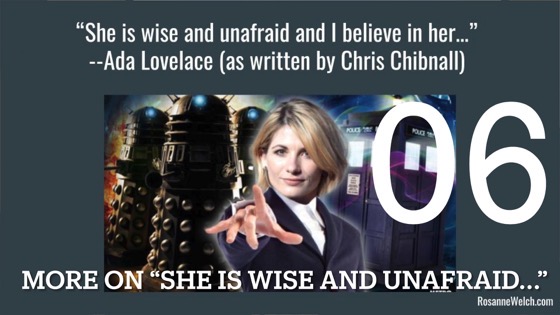
…but this line I really like. I also think it’s an example of how he promised to sort of give the show a bit of a female gaze right and I love all the dudes who’ve ever been on Doctor Who — well maybe not Colin Baker so much — but you know in general do love them all but he made a promise and I think he kept it. I think he didn’t just sort of gloss over and pretend and I think we’ll see that in the choice of guest characters, the choice of people we get to meet, right down to the fact that we met Ada Lovelace, who we’ve kind of heard about but I’ll still mention her in some classes and people don’t know who she is. So the fact that he’s giving a moment here for people to go oh oh that’s an interesting woman I need to know some more about and I think he scattered the show with those types of characters — those types of historical people we would not have met had he not kept in mind, I’ve promised to give this a kind of a different spin right? So that really impresses me.
James: I just want to say welcome to everyone who’s joining us today. This is In Conversation. We’ll be chatting for another 45 minutes or so. I’m very pleased to have Dr. Rosanne Welch with me today who is a practicing screenwriter with some serious writing credits to her CV, which we’ll get into as well, but also she runs an MFA program and works as a major researcher involved in Intellect’s Journal of Screenwriting which we can also definitely discuss. So why don’t you tell us a little bit about your research interest? Is it just screenwriting you focus on or is there other aspects of film and history?
Rosanne: Well it’s largely yes film history as well but it kind of always focuses on women in film history because they’ve sort of been left behind on the cutting room floor. We’re getting there we’re seeing more involvement in that. I actually had a great conversation with the documentarian from the BBC who found me because I put a lot of my lectures online and in one of them I discuss research that we’re trying to do into a woman named Jennie Louise Toussaint. She was an African-American screenwriter in the Silent Era but the problem is her work was not preserved right? The films we know disintegrated. There are no paper scripts around. We know she existed because of advertisements in newspapers advertising her films that were playing. So they noticed that I had mentioned her and just said here’s someone we need to find more research on and they’re doing a BBC documentary on famous sisters of famous brothers — on accomplished women who were sisters of famous brothers and her brother was a Harlem Renaissance photographer. So they were like do you know anything more about her so we can do more on her. This is what I have. We’re all building on the knowledge. I mean that’s what a journal is for. We build on the knowledge that other people have found and eventually we get a bigger picture that didn’t exist.
One of the benefits of attending conferences is that you can meet the editors from the companies that have published some of your books face to face. That happened at the recent SCMS conference where I met Intellect editor James Campbell and he invited me to be a guest on his InstagramLive show.
We even had time to nerd out on our own favorite classic films across the eras which brought up fun memories of Angels with Dirty Faces, Back to the Future, Bonnie and Clyde, and of course, all things Star Wars from the original 3 to The Mandalorian. It’s always so fun to talk to fellow cinephiles.
Speaking with Dr. Rosanne Welch, Author, teacher, and television screenwriter. Today we cover everything from women in screenwriting to our favorite Jimmy Cagney movies and Friends.
It was great to be able to attend this year’s SD WhoCon in San Diego and present this lecture on “The Difficulties and Delicacies of Writing the First Female Doctor in 50+ years” in which I discuss how successful I think showrunner Christopher Chibnall was in making that transition.
It gave me a chance to talk about the creative work of a showrunner/screenwriter while also reconnecting to some friends we had met at this same convention some 3 years ago – and to talk about one of my favorite subjects – Doctor Who!
Transcript:
Because I do know — I have two very favorite — yeah my very favorite fandoms are Doctor Who and The Monkees and somebody did this lovely piece of fan art which I just fell in love with so I love how fandom blends together and you know the whole community that you create with other people who love what you love but today we’re going to talk about the writing of this new female Doctor right? I used to actually have a Matt outfit I like to wear and I had a Peter outfit that I like to wear but now I’m going to have to kind of have to go with the fact that hello I bought this two years ago here at WhoCon, so it’s really fun. Anyway, this was actually the title and this is a line right from the first episode. What I loved is this business right? “She’s wise and unafraid and I believe in her.” One of the things I noticed about what Chibnall had to do right away and I know that we all have some gripes about some of the stuff he’s done but I think that he made some very good choices in the beginning and a lot of that has to do with writing and hiring some other very good writers who brought in some aspects of the show we hadn’t had before.
It was great to be able to attend this year’s SD WhoCon in San Diego and present this lecture on “The Difficulties and Delicacies of Writing the First Female Doctor in 50+ years” in which I discuss how successful I think showrunner Christopher Chibnall was in making that transition.
It gave me a chance to talk about the creative work of a showrunner/screenwriter while also reconnecting to some friends we had met at this same convention some 3 years ago – and to talk about one of my favorite subjects – Doctor Who!
Transcript:
So Written By Magazine. Journal of Screenwriting again obviously coming from that standpoint and California History. I do some pop culture for them so I’m trying to figure out how to get some Doctor Who in there right? A little — I’m a little behind on Matt having actually been in the West but maybe I’ll get something on there. This is the piece that I did for Written By and as I said it’s a sample over there. It was really fun to sort of sit in the room with him. I do think he’s one of my favorite writers and that made me very happy and then these are a bunch of other books and things that I’ve written so you kind of know where I’m coming from and where these opinions come from.
It was great to be able to attend this year’s SD WhoCon in San Diego and present this lecture on “The Difficulties and Delicacies of Writing the First Female Doctor in 50+ years” in which I discuss how successful I think showrunner Christopher Chibnall was in making that transition.
It gave me a chance to talk about the creative work of a showrunner/screenwriter while also reconnecting to some friends we had met at this same convention some 3 years ago – and to talk about one of my favorite subjects – Doctor Who!
Transcript:
I also am on the editorial board for different things. Written By Magazine is the magazine of the Writers Guild. I have a sample of it over there. I got lucky one time when Russell was in town doing Miracle Day the editor was like I know you’re a Doctor Who fan. Would you like to interview him and I was like yes I would love to sit in a room and chat with him and it turned out few journalists are as Whovian of a fan as I. So we ended up chatting longer than I was meant to be there and the publicist would walk by and go “Are you all done yet?” and I thought. oh, they’re going to kick me out, and then Russell was like in a minute and he’d send the publicist away. So I laughed.
It was great to be able to attend this year’s SD WhoCon in San Diego and present this lecture on “The Difficulties and Delicacies of Writing the First Female Doctor in 50+ years” in which I discuss how successful I think showrunner Christopher Chibnall was in making that transition.
It gave me a chance to talk about the creative work of a showrunner/screenwriter while also reconnecting to some friends we had met at this same convention some 3 years ago – and to talk about one of my favorite subjects – Doctor Who!
Transcript:
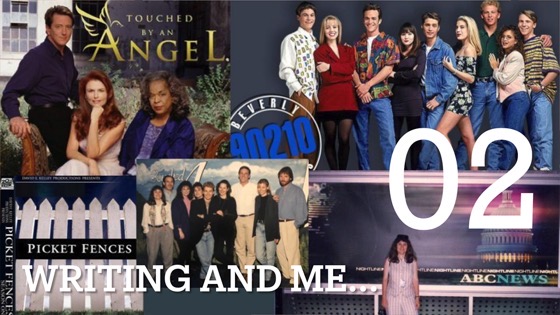
I came out of television into academia. So I worked on these shows earlier in my career and learned a lot from the people who ran them right? 90210. Very popular still. Always shocked about that because there’s been lots of teen shows but I think we learned that they took these teenagers seriously and when you take your character seriously, they become friends to the people who watch and I obviously believe that’s true in Doctor Who. We all have our favorite doctors. Mine actually goes back to classic Who. I’m a Peter Davidson person but our companions. I mean they are about bringing friends into our home. That’s how TV is different than film because you have to pay to go see the people in the films but these people come into our homes where we’re having coffee or you know having pizza or whatever. So I really think it’s interesting to look at why we fall in love with these characters and for me, of course, it comes from the writing.
![08 More On Chibnall's Earlier Writing...from The Difficulties and Delicacies of Writing the First Female Doctor in 50+ years [Video] [Doctor Who]](https://rosannewelch.com/wp-content/uploads/2022/03/rmw-whocon-2021-chibnall-08.jpg)
![03 Unreliable Narrators from In Conversation with Dr. Rosanne Welch and Intellect Books [Video]](https://rosannewelch.com/wp-content/uploads/2022/03/rmw-intellect-03.jpg)

![07 Chibnall's Earlier Writing...from The Difficulties and Delicacies of Writing the First Female Doctor in 50+ years [Video] [Doctor Who]](https://rosannewelch.com/wp-content/uploads/2022/03/rmw-whocon-2021-chibnall-07.jpg)
![02 On The Imporatnce of Screenwriters from In Conversation with Dr. Rosanne Welch and Intellect Books [Video]](https://rosannewelch.com/wp-content/uploads/2022/03/rmw-intellect-02.jpg)
![01 Introduction and Stephens College MFA In TV and Screenwriting from In Conversation with Dr. Rosanne Welch and Intellect Books [Video]](https://rosannewelch.com/wp-content/uploads/2022/03/rmw-intellect-01-1-1200x675.jpg)
![01 Introduction and Stephens College MFA In TV and Screenwriting from In Conversation with Dr. Rosanne Welch and Intellect Books [Video]](https://rosannewelch.com/wp-content/uploads/2022/03/rmw-intellect-01.jpg)

![04 My Writing from The Difficulties and Delicacies of Writing the First Female Doctor in 50+ years [Video] [Doctor Who]](https://rosannewelch.com/wp-content/uploads/2022/02/rmw-whocon-2021-chibnall-04.jpg)
![03 Russell T Davies from The Difficulties and Delicacies of Writing the First Female Doctor in 50+ years [Video] [Doctor Who]](https://rosannewelch.com/wp-content/uploads/2022/02/rmw-whocon-2021-chibnall-03.jpg)