25 Selling Services, not products from Why Researching Screenwriters (has Always) Mattered [Video] (1 minute)

Watch this entire presentation

25 Selling Services, not products from Why Researching Screenwriters (has Always) Mattered

Subscribe to Rosanne’s Channel and receive notice of each new video!


Transcript:

In their mind, playwrights were to be respected because they sold a product — they sold their play — screenwriters sold a service like a maid or a car wash person. That isn’t something they should own and that legal difference made the difference in how writers could have control of their work for years and years and years. At a certain point Dorothy Parker, again a very famous writer from New York, the Academy of Motion Picture Arts and Sciences, which we think of as the group that gives away the Oscars and has the big party once a year, in fact, started a union for writers but the producers were in charge of the rules of the union for the writers and Dorothy parker said “Looking to the academy for representation was like trying to get laid in your mother’s house. Someone was always watching in the parlor.” How could you trust the producers to give the writers a good deal if it meant less money for them but they were trying to appease the writers.

A Note About This Presentation

A clip from my keynote speech at the 10th Screenwriters´(hi)Stories Seminar for the interdisciplinary Graduation Program in “Education, Art, and History of Culture”, in Mackenzie Presbyterian University, at São Paulo, SP, Brazil, focused on the topic “Why Researching Screenwriters (has Always) Mattered.” I was especially pleased with the passion these young scholars have toward screenwriting and it’s importance in transmitting culture across the man-made borders of our world.

To understand the world we have to understand its stories and to understand the world’s stories we must understand the world’s storytellers. A century ago and longer those people would have been the novelists of any particular country but since the invention of film, the storytellers who reach the most people with their ideas and their lessons have been the screenwriters. My teaching philosophy is that: Words matter, Writers matter, and Women writers matte, r so women writers are my focus because they have been the far less researched and yet they are over half the population. We cannot tell the stories of the people until we know what stories the mothers have passed down to their children. Those are the stories that last. Now is the time to research screenwriters of all cultures and the stories they tell because people are finally recognizing the work of writers and appreciating how their favorite stories took shape on the page long before they were cast, or filmed, or edited. But also because streaming services make the stories of many cultures now available to a much wider world than ever before.

Many thanks to Glaucia Davino for the invitation.


* A portion of each sale from Amazon.com directly supports our blogs
** Many of these books may be available from your local library. Check it out!
† Available from the LA Public Library

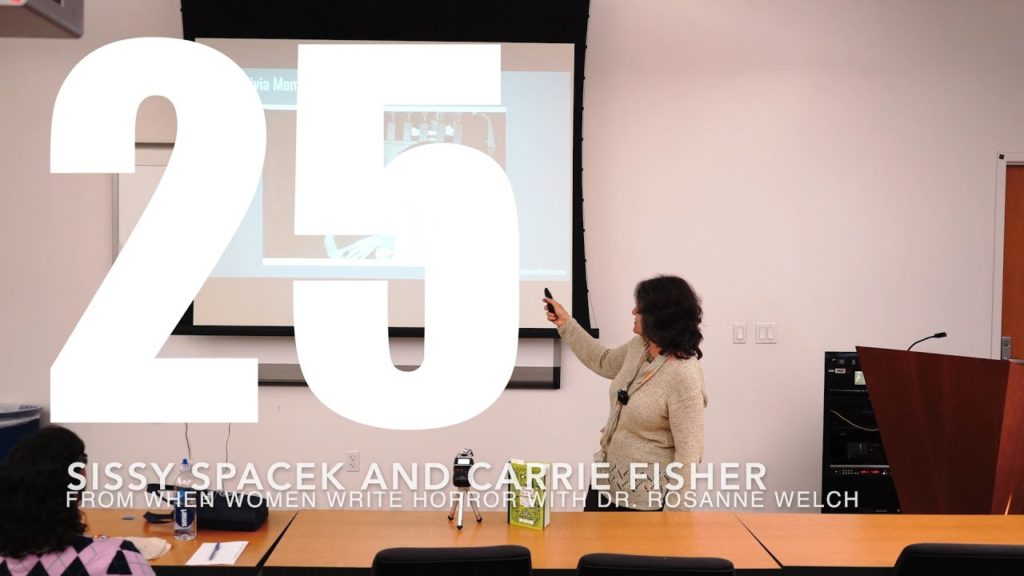
25 Sissy Spacek and Carrie Fisher from When Women Write Horror with Dr. Rosanne Welch [Video] (48 seconds)

Watch this entire presentation

Subscribe to Rosanne’s Channel and receive notice of each new video!

In honor of Halloween – and in service to my teaching philosophy —

“Words Matter. Writers Matter. Women Writers Matter.”

I presented this holiday lecture “When Women Write Horror” on Tuesday, October 29th, 2019. Researching the many, many women who have written horror stories – in novels, films and television – brought new names to my attention who I am excited to start reading. I hope you will be, too!

Transcript:

Sissy Spacek was quite wonderful. Do a little pop culture moment here. That’s Sissy Spacek and she’s with Carrie Fisher. Why would i put those two together in a picture? I’s because long ago and far away onthe day that they each auditioned for their separate movie, the two directors swapped the women. So Sissy Spacek could have been Princess Leia and Carrie Fisher could have been Carrie. Think about how different both of their careers would have gone had that happened and how much that each of them affect the further work they did. Carrie Fisher would always argue and I believe with her Princess Leia was powerful. She wasn’t as powerful as she could be but she was a character that took a weapon and helped with saving herself right? So each of them affected the work they did in the future.

24 Studios and “Work For Hire” from Why Researching Screenwriters (has Always) Mattered [Video] (1 minute 10 seconds)

Watch this entire presentation

Studios and

Subscribe to Rosanne’s Channel and receive notice of each new video!


Transcript:

So why didn’t everyone do that? A couple of reasons. These guys are famous studio heads back in the day, Jack Warner, Louis B. Mayer, and Carl Lemley. Carl Lemley was of Universal Studios. They, when they created the studio system, went to the United States government and they said that writing a movie was more like working in a factory — that a bunch of people came together in an assembly line and assembled a piece and therefore one person didn’t need credit for everything and that was important to them because it meant that the author legally of any movie is not even the director nor the writer it’s the studio that made the film. So Paramount Studios is the author of every Paramount film. Writers give away their ownership forever. If you write a movie and it has a character in it that they want to make a sequel to they don’t have to hire you to write the sequel. They own that character and they gave it away this early in the history of the business because they didn’t take the business seriously. They thought it would disappear so quickly and then a hundred years later we’re still talking about it. So right away this was an issue.

A Note About This Presentation

A clip from my keynote speech at the 10th Screenwriters´(hi)Stories Seminar for the interdisciplinary Graduation Program in “Education, Art, and History of Culture”, in Mackenzie Presbyterian University, at São Paulo, SP, Brazil, focused on the topic “Why Researching Screenwriters (has Always) Mattered.” I was especially pleased with the passion these young scholars have toward screenwriting and it’s importance in transmitting culture across the man-made borders of our world.

To understand the world we have to understand its stories and to understand the world’s stories we must understand the world’s storytellers. A century ago and longer those people would have been the novelists of any particular country but since the invention of film, the storytellers who reach the most people with their ideas and their lessons have been the screenwriters. My teaching philosophy is that: Words matter, Writers matter, and Women writers matte, r so women writers are my focus because they have been the far less researched and yet they are over half the population. We cannot tell the stories of the people until we know what stories the mothers have passed down to their children. Those are the stories that last. Now is the time to research screenwriters of all cultures and the stories they tell because people are finally recognizing the work of writers and appreciating how their favorite stories took shape on the page long before they were cast, or filmed, or edited. But also because streaming services make the stories of many cultures now available to a much wider world than ever before.

Many thanks to Glaucia Davino for the invitation.


* A portion of each sale from Amazon.com directly supports our blogs
** Many of these books may be available from your local library. Check it out!
† Available from the LA Public Library

24 Carrie from When Women Write Horror with Dr. Rosanne Welch [Video] (48 seconds)

Watch this entire presentation

24 Carrie from When Women Write Horror with Dr. Rosanne Welch

Subscribe to Rosanne’s Channel and receive notice of each new video!


In honor of Halloween – and in service to my teaching philosophy —

“Words Matter. Writers Matter. Women Writers Matter.”

I presented this holiday lecture “When Women Write Horror” on Tuesday, October 29th, 2019. Researching the many, many women who have written horror stories – in novels, films and television – brought new names to my attention who I am excited to start reading. I hope you will be, too!

Transcript:

So now I want to focus for a second here also now on what happens when women are in horror films and what kind of women kind of female role models are we seeing in that world right? So, in movies, we didn’t have for a long time women doing a lot of writing so the women were represented as the characters in this piece so right? Popular, most famous, of course, being Carrie so now we’re back to Stephen King who wrote that right? So not written by a girl and the movie was actually adapted by Lawrence Cohen, but Carrie’s an interesting study in a girl revenge movie right? This is a chance for “You misused me and I’m going to get you back,” and that wasn’t something frequently that girls had a chance to get. They just got bullied and hurt and then gee who saves the day? She’s going to save her own day when she rises from the dead.

23 Edna Ferber and New York Writers from Why Researching Screenwriters (has Always) Mattered [Video] (1 minute 8 seconds)

Watch this entire presentation

23 Edna Ferber and New York Writers from Why Researching Screenwriters (has Always) Mattered

Subscribe to Rosanne’s Channel and receive notice of each new video!


Transcript:

In the early days of Hollywood there were some issues because many of the people who came to write came from New York and they were very “fancy.” They thought they were better writers than that silly screenplay stuff. So when they came to Hollywood they didn’t really take their work seriously. They didn’t ask for too much credit. Edna Ferber I want to talk about for a minute. She was a novelist from New York. The quote I just think is cute. She said “A woman can look both moral and exciting if she also looks as if it was quite a struggle.” So she wrote a lot about early attitudes toward females and sex. She also wrote Showboat which is a classic film in the United States and she wrote Giant which is one of James Dean’s last films and she wrote this film Saratoga Trunk. All based on novels she had written first. She was smart enough when she came to Hollywood to require the studio to lease her novels not to buy the rights. So that they had to credit her and after a few years they couldn’t show the film anymore because it always remained in her possession and that was a brilliant idea but too many other of the New York writers didn’t take their work as seriously and didn’t bother with that idea. So it went away and we lost that chance to own our work.

A Note About This Presentation

A clip from my keynote speech at the 10th Screenwriters´(hi)Stories Seminar for the interdisciplinary Graduation Program in “Education, Art, and History of Culture”, in Mackenzie Presbyterian University, at São Paulo, SP, Brazil, focused on the topic “Why Researching Screenwriters (has Always) Mattered.” I was especially pleased with the passion these young scholars have toward screenwriting and it’s importance in transmitting culture across the man-made borders of our world.

To understand the world we have to understand its stories and to understand the world’s stories we must understand the world’s storytellers. A century ago and longer those people would have been the novelists of any particular country but since the invention of film, the storytellers who reach the most people with their ideas and their lessons have been the screenwriters. My teaching philosophy is that: Words matter, Writers matter, and Women writers matte, r so women writers are my focus because they have been the far less researched and yet they are over half the population. We cannot tell the stories of the people until we know what stories the mothers have passed down to their children. Those are the stories that last. Now is the time to research screenwriters of all cultures and the stories they tell because people are finally recognizing the work of writers and appreciating how their favorite stories took shape on the page long before they were cast, or filmed, or edited. But also because streaming services make the stories of many cultures now available to a much wider world than ever before.

Many thanks to Glaucia Davino for the invitation.


* A portion of each sale from Amazon.com directly supports our blogs
** Many of these books may be available from your local library. Check it out!
† Available from the LA Public Library

23 Taking Horror Seriously from When Women Write Horror with Dr. Rosanne Welch [Video] (43 seconds)

Watch this entire presentation

23 Taking Horror Seriously from When Women Write Horror with Dr. Rosanne Welch

Subscribe to Rosanne’s Channel and receive notice of each new video!


In honor of Halloween – and in service to my teaching philosophy —

“Words Matter. Writers Matter. Women Writers Matter.”

I presented this holiday lecture “When Women Write Horror” on Tuesday, October 29th, 2019. Researching the many, many women who have written horror stories – in novels, films and television – brought new names to my attention who I am excited to start reading. I hope you will be, too!

Transcript:

It’s one of those questions you find yourself — you know people think, “Oh you’re doing a class on horror. That can’t be anything you take seriously.” Well, we have to because it’s information people are taking in. What is it making you think right? If you’re with a dude who’s scary, do you think oh yeah it was good for her. It all worked out in the end for he.r Maybe not right? Let’s reconsider how we’re taking these fictional stories into our life. So I think that’s really interesting. Twilight of course was put together by Melissa Rosenberg who had come off the tv show, Dexter. So what an interesting background before you’re gonna write about Twilight and vampire romance, she’d written about a serial killer who you know kills once a week. I don’t know but uh she made a good ton of money off that and obviously was pretty successful.

22 More On The Auteur Theory from Why Researching Screenwriters (has Always) Mattered [Video] (1 minute)

Watch this entire presentation

22 More On The Auteur Theory from Why Researching Screenwriters (has Always) Mattered

Subscribe to Rosanne’s Channel and receive notice of each new video!


Transcript:

Some critics at the time even said they only did it because often a movie would have two or three writers and only one director and it was easier to use the director’s name. It didn’t really mean they thought he was the only one who’d done any work but it became the way we thought but also this leads to the great man version of filmmaking because mostly directors were men. So we could begin to say these geniuses who had created films for us — the Alfred Hitchcocks of the world — and we forget to mention Joan Harrison who is the female who wrote half of his movies including um one of them that won an Oscar whose name just escaped me, so this great man theory is no good. Also in America Peter Bogdanovich is a director and he wrote this book in 1997, which is about legendary directors. Even though Peter Bogdanovich was a writer/director. He privileged the directors in the history that he wrote about Hollywood. So this is crazy.

A Note About This Presentation

A clip from my keynote speech at the 10th Screenwriters´(hi)Stories Seminar for the interdisciplinary Graduation Program in “Education, Art, and History of Culture”, in Mackenzie Presbyterian University, at São Paulo, SP, Brazil, focused on the topic “Why Researching Screenwriters (has Always) Mattered.” I was especially pleased with the passion these young scholars have toward screenwriting and it’s importance in transmitting culture across the man-made borders of our world.

To understand the world we have to understand its stories and to understand the world’s stories we must understand the world’s storytellers. A century ago and longer those people would have been the novelists of any particular country but since the invention of film, the storytellers who reach the most people with their ideas and their lessons have been the screenwriters. My teaching philosophy is that: Words matter, Writers matter, and Women writers matte, r so women writers are my focus because they have been the far less researched and yet they are over half the population. We cannot tell the stories of the people until we know what stories the mothers have passed down to their children. Those are the stories that last. Now is the time to research screenwriters of all cultures and the stories they tell because people are finally recognizing the work of writers and appreciating how their favorite stories took shape on the page long before they were cast, or filmed, or edited. But also because streaming services make the stories of many cultures now available to a much wider world than ever before.

Many thanks to Glaucia Davino for the invitation.


* A portion of each sale from Amazon.com directly supports our blogs
** Many of these books may be available from your local library. Check it out!
† Available from the LA Public Library

22 Modern-Day Vampires from When Women Write Horror with Dr. Rosanne Welch [Video] (1 minute)

Watch this entire presentation

22 Modern-Day Vampires from When Women Write Horror with Dr. Rosanne Welch

Subscribe to Rosanne’s Channel and receive notice of each new video!


In honor of Halloween – and in service to my teaching philosophy —

“Words Matter. Writers Matter. Women Writers Matter.”

I presented this holiday lecture “When Women Write Horror” on Tuesday, October 29th, 2019. Researching the many, many women who have written horror stories – in novels, films and television – brought new names to my attention who I am excited to start reading. I hope you will be, too!

Transcript:

We also then, of course, know about The Vampire Diaries. Julie Pleck put that out, but now she has Legacies which is a sequel to that and Origins which is another one. Interesting because here she’s also turning them more into the sexy dudes and we’re starting to talk about that concept. The problem behind it is at what point does the super-sexy guy really become a way to hide the toxic romance that’s going on when we think about vampires, because vampires are, in fact, capable of killing you. This is a boyfriend who can kill you and you are agreeing to be with him knowing how dangerous that is. That’s a definition of domestic violence in its own way and yet we’re turning it into pop culture hot oh boy which one do I pick? Which team are you on? Right? so is that, again, defanging them, or is that accidentally empowering those kinds of relationships?

21 Truffaut and The Auteur Theory from Why Researching Screenwriters (has Always) Mattered [Video] (56 seconds)

Watch this entire presentation

21 Truffaut and The Auteur Theory from Why Researching Screenwriters (has Always) Mattered

Subscribe to Rosanne’s Channel and receive notice of each new video!


Transcript:

So how did this happen in a town called Hollywood where we thought we were all about filmmaking and caring about writers and all of that. Few directors are as fair as JOhn Carpenter, who basically said “It is a collaborative effort. All I take credit for is the directing.” That’s the kind of guy we need more of, right? We don’t have enough of that. The problem was, I blame France, not to insult anyone who might be here from France, but it was, in fact, Francois Truffaut, early in his career as a film reviewer her came up with what we call “The Auteur Theory,” which told us that directors were the “auteur”, the author, the writer of the film and that was the end of that. From that point on that’s how people referenced films and this is a deep problem. He was writing for this — Cahiers du Cinema — and this is where the auteur theory was born. To me the biggest mistake ever made.

A Note About This Presentation

A clip from my keynote speech at the 10th Screenwriters´(hi)Stories Seminar for the interdisciplinary Graduation Program in “Education, Art, and History of Culture”, in Mackenzie Presbyterian University, at São Paulo, SP, Brazil, focused on the topic “Why Researching Screenwriters (has Always) Mattered.” I was especially pleased with the passion these young scholars have toward screenwriting and it’s importance in transmitting culture across the man-made borders of our world.

To understand the world we have to understand its stories and to understand the world’s stories we must understand the world’s storytellers. A century ago and longer those people would have been the novelists of any particular country but since the invention of film, the storytellers who reach the most people with their ideas and their lessons have been the screenwriters. My teaching philosophy is that: Words matter, Writers matter, and Women writers matte, r so women writers are my focus because they have been the far less researched and yet they are over half the population. We cannot tell the stories of the people until we know what stories the mothers have passed down to their children. Those are the stories that last. Now is the time to research screenwriters of all cultures and the stories they tell because people are finally recognizing the work of writers and appreciating how their favorite stories took shape on the page long before they were cast, or filmed, or edited. But also because streaming services make the stories of many cultures now available to a much wider world than ever before.

Many thanks to Glaucia Davino for the invitation.


* A portion of each sale from Amazon.com directly supports our blogs
** Many of these books may be available from your local library. Check it out!
† Available from the LA Public Library

21 Buffy and Masculinity from When Women Write Horror with Dr. Rosanne Welch [Video] (1 minute 9 seconds)

Watch this entire presentation

21 Buffy and Masculinity from When Women Write Horror with Dr. Rosanne Welch

Subscribe to Rosanne’s Channel and receive notice of each new video!


In honor of Halloween – and in service to my teaching philosophy —

“Words Matter. Writers Matter. Women Writers Matter.”

I presented this holiday lecture “When Women Write Horror” on Tuesday, October 29th, 2019. Researching the many, many women who have written horror stories – in novels, films and television – brought new names to my attention who I am excited to start reading. I hope you will be, too!

Transcript:

The other thing that was going on with Buffy and a couple of other shows we’ll talk about, is that we’re taking vampires who were the other and the scary and the bad and we’re making them sexy and hot, which is a female perspective but then we have to ask ourselves is that good or is that bad? Is that good because in a way when you make the men the objectified sexual object are you taking power away from them and therefore giving that power to the women? That’s a question because you can’t deny David Boreanaz was hot. This is all there is to it. He’s still hot. I know through Buffy through Bones and through Seal Team that man just… but I think it’s a great credit to this actor. We have to recognize he could manage to be deeply, deeply masculine while not being the most important person in the story. He could be the supportive man beside her and that made him all the more man and that’s a different way to define what manhood is and that’s I think a really important thing we’re seeing in some newer literature. So that I think is fascinating.