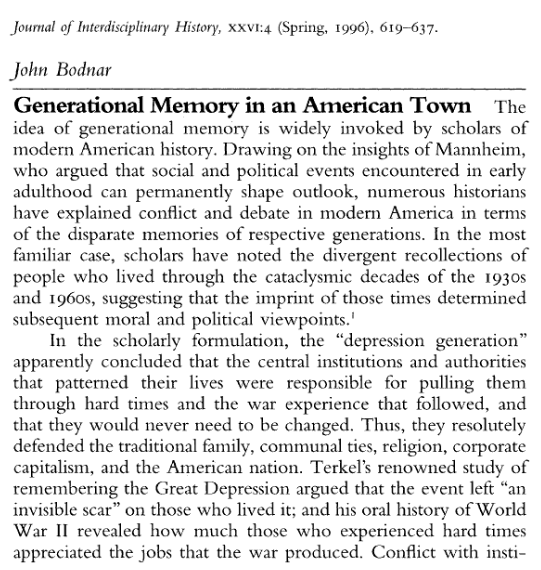
As the show was winding down this second season, the occasions for recognizing themselves as actors in a television program, often referenced as being trapped inside the program, become more pronounced, giving evidence of the growing conflict between the artists and the front offices of the studio and network.
This book signing at Book Soup was wonderful – good people, good conversation (before and after the signing). Just another example of the kind of quality positive people who have been drawn to The Monkees across generations – I even met a former head of publicity for ScreenGems who had some fun stories to tell. — Rosanne
I started by writing an article for Written By Magazine which is the magazine of the Writers Guild and I’m on their board and I wanted a chance to meet some people so I recommended this idea and from that article, I then used that as the proposal for the book company and that’s what they chose to let me continue it. So that was what was fun. Here’s the beginning part. I was a fan from the beginning. At the age of 6 when the show debuted on NBC and caused what I often teased was the first great choice of a childhood lived without the benefit of DVR. Should I watch The Monkees or Gilligan’s Island? Both aired at the same non-Bat Time on the same non-Bat Channel. I used that question as the thesis to an essay when many years later I applied to film school and I’m amazed how it still resonates with others of my generation. For my students, that choice harkens back to an unimagined time before VCRs, DVRs or iPads. When one had to choose between two favorite programs and wait for summer reruns to see if the one they hadn’t chosen was going to re-run and you could finally see that story.
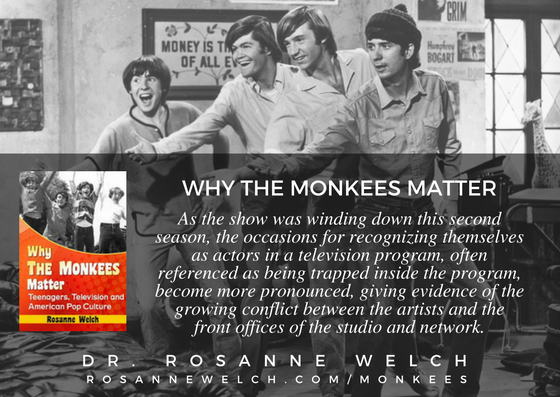
In the pilot, the mere act of beginning with the unrehearsed auditions of Jones and Nesmith ushered in the underlying metatextuality almost by accident. It was actually a desperate attempt to raise the ratings of the test audience who complained they could not tell the difference between the four long-haired band members.
This book signing at Book Soup was wonderful – good people, good conversation (before and after the signing). Just another example of the kind of quality positive people who have been drawn to The Monkees across generations – I even met a former head of publicity for ScreenGems who had some fun stories to tell. — Rosanne
Transcript:
Thank you. Thank you. Thank everybody for coming out tonight. It’s really coo to talk about The Monkees whenever you get a chance so I appreciate the chance. What I was just going to do was I was going to read a little bit from the Preface and the Introduction — kind of a setup for the purpose of the book and what it’s all about and then just talk about The Monkees for a little bit and see if anybody’s interested in telling stories and what they first remember about the show. So, if that’s good with everybody….I’ll start. The Preface of the book is called “I’m (Still) A Believer” and one of the things I did in writing it was I made all the chapters were the titles of songs — famous Monkee songs and it was really interesting to sit there and try to think of, what was the right song to put on this particular (chapter) and I ended up finding song titles I didn’t even remember because they put out so much music and everyone has their favorites and you just didn’t realize that there were these other titles. So, part of the them, they might have been perfect for that chapter, but they didn’t hit your brain immediately as obvious Monkee songs so then I would pick something else. The first one is obviously “I’m (Still) A Believer” because that’s what brought me to writing about them.
Dr. Rosanne Welch is a professor in the Low Residency MFA in Screenwriting Program from Stephens College, California State University, Fullerton, Mount San Antonio Community College and Cal Poly Pomona. In 2007, she graduated with her Ph.D. in 20th Century U.S./Film History from Claremont Graduate University. She graduated with her M.A. in 20th Century United States History from California State University, Northridge in 2004.
Welch is also a television writer/producer with credits for Beverly Hills 90210 , CBS’s Emmy winning Picket Fences and Touched By An Angel . She also writes and hosts her own podcasts on 3rdPass.media, her first one titled “Mindful(I) Media with Dr. Rosanne Welch.”
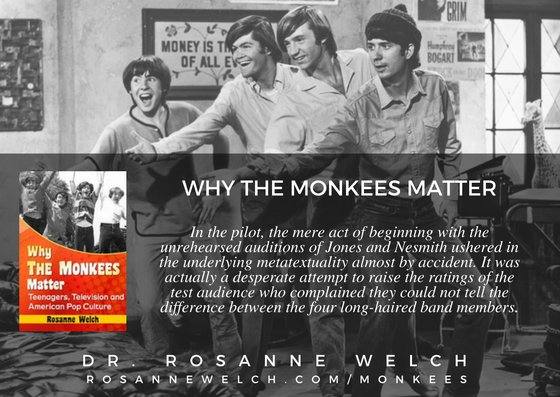
This all added up to a new, exciting aesthetic that caught the eye of a newer viewer and was planned from the start by the producers. In an interview with TV Week, Rafelson claimed he was creating “something rare in television–creativity, freedom and non-phoniness… We’re doing something new, avoiding the status quo. We’re probably the only show with the technical crew built around the content.”
“1960s TV Censorship and The Monkees” gives a brief overview of where censorship standards were in the era – and how The Monkees pushed the envelope with its mentions of the Vietnam War – and Sunset Strip riots – and even with the outrageous storytelling behind “Frodis Caper”, the episode that celebrated the saving of an alien plant that very closely resembled a marijuana plant…
Writer Treva Silverman said the staff got away with such jokes because the network executives were just old enough not to understand any of the references. Presented at Stephens College MFA in Screenwriting classes on Friday, August 5, 2016
Transcript:
They had a couple of other big names come in. And then this was Treva’s explanation to me about why they got away with it. Network guys thought they were hip and cool, but they had no idea what was going on. And these guys knew it. She defined herself as a hippy as did Peter Meyerson like I said and she said she started smoking pot during the course of working on the show and when she went home to New York to visit her relatives they were like, ahhh…scandalized. She said, “Well, that’s just what everyone is doing.” So, I wanted to mention that we’re not done with censorship on television briefly. If you know Amy Schumer recently had this sketch canceled from her show. It was censored. She wasn’t to air it and it was anti-gun thing based on all the mass shootings. We still obviously knew about the “wardrobe malfunction” and what can and can’t be shown of a woman on television and of course, George Carlin went to court over The 7 Dirty Words You Can’t Say on Television. Dexter, of course, think how violent that is. We worry so much about what sex we show on TV but look how much violence we show and I think Gilda Radner, who I love dearly, is pretty brilliant because she talked about the violence on television back in the day. So we’re still not done with that. If you’re interested in censorship on TV, these are some books that are fun to look at that talk about this period of time. And so, if you want to look into that, that’s what they are. And that’s the flat out presentation.
Dr. Rosanne Welch is a professor in the Low Residency MFA in Screenwriting Program from Stephens College, California State University, Fullerton, Mount San Antonio Community College and Cal Poly Pomona. In 2007, she graduated with her Ph.D. in 20th Century U.S./Film History from Claremont Graduate University. She graduated with her M.A. in 20th Century United States History from California State University, Northridge in 2004.
Welch is also a television writer/producer with credits for Beverly Hills 90210 , CBS’s Emmy winning Picket Fences and Touched By An Angel . She also writes and hosts her own podcasts on 3rdPass.media, her first one titled “Mindful(I) Media with Dr. Rosanne Welch.”
Among the many technical terms students confront when studying the aesthetics of television, the one they seem to remember most is metatextuality, which in laymen’s terms happens when a character breaks the fourth wall with an aside to the audience, thereby acknowledging that someone, the audience, is watching and admitting they know they are playing a character in a fictional world.

![How It All Began from Why The Monkees Matter Book Signing, Book Soup, Hollywood [Video] (1:07)](https://rosannewelch.com/wp-content/uploads/2017/03/wtmm-reading-02-beginnings.jpeg)

![Introduction from Why The Monkees Matter Book Signing, Book Soup. Hollywood [Video] (1:03)](https://rosannewelch.com/wp-content/uploads/2017/03/wtmm-reading-01.jpeg)

![Wrapping Up The Monkees from 1960’s TV Censorship and The Monkees [Video] (1:26)](https://rosannewelch.com/wp-content/uploads/2017/02/monkees-censorship-22-conclusion.jpeg)