Subscribe to Rosanne’s Channel and receive notice of each new video!
In honor of Halloween – and in service to my teaching philosophy —
“Words Matter. Writers Matter. Women Writers Matter.”
I presented this holiday lecture “When Women Write Horror” on Tuesday, October 29th, 2019. Researching the many, many women who have written horror stories – in novels, films and television – brought new names to my attention who I am excited to start reading. I hope you will be, too!
* A portion of each sale from Amazon.com directly supports our blogs ** Many of these books may be available from your local library. Check it out!
Subscribe to Rosanne’s Channel and receive notice of each new video!
This one allowed me to riff on some of my favorite female science fiction writers across time, whether they be novelists or television writers. It also opened up a good conversation on what art we support and include in our lives – and what that art says to us and about us. — Rosanne
Transcript:
The other thing that’s cool about her — well she’s written many books — but Kindred is my favorite. A little chat about that from last week. She wanted to talk about race and she wanted to figure out a way to do that. So she chose the time-travel story and she took a modern-day African-American woman who without explanation — sort of like Narnia where they stumble into a wardrobe and bam they’re in a kingdom — we don’t need to know the machinations of how the time travel works. We don’t need to put dials in a car and drive the DeLorean down the street. We just walk into a room and oh my god now we’re in pre Civil War south and she’s a woman of African descent and she’s got to deal with now I’m in a place where they’re slaves and now she ends up being on the plantation where her ancestors were held in slavery and she comes up with you know drama. You want the big choice, the big question. She discovers that the way she could get back to her own future is she has to save the life of the plantation owner who owns her family on time for him to rape her great-great grandmother or she won’t exist yeah. There’s there’s a moral decision you gotta make in your lives right? But that’s a really fascinating and of course it allows her to have a discussion about what we don’t talk about in classrooms about the reality of slavery right? So this is a really fascinating book. It’s a one-off book. That’s good. She’s got a lot of you know series books so you can get involved in her writing and be busy for a while. That’s a great book to start with though. So I think Octavia Butler is of good attention for us.
* A portion of each sale from Amazon.com directly supports our blogs ** Many of these books may be available from your local library. Check it out!
Subscribe to Rosanne’s Channel and receive notice of each new video!
Transcript:
Dorothy and her husband Alan Campbell wrote A Star Is Born which if you know obviously the story is about a marriage where the woman is far more famous than the man. His career is going while hers is rising. That’s Dorothy Parker and her husband’s story. That’s exactly the emotion she was experiencing. She just put it on an actor and actress. It became such a classic it was remade in the 50s with Julia my brain just went dead. Thank you. Judy Garland. I was saying Julianne and that was wrong. Judy Garland. Thank you and it was written this was adapted by Moss Hart who’s a famous name from Broadway. He wrote it himself however he credited several scenes from the original movie he’d just cut and pasted them out of the first script and put them in his and admitted that when he was doing it. So whenever he got notes from the studio that they wanted to change something he would say “No no no. That’s how Parker had it the first time. It’s good enough. We’re not fixing it.” So essentially it’s Moss Hart and Dorothy Parker together right?
Dr. Rosanne Welch discusses the women in her new book “When Women Wrote Hollywood” which covers female screenwriters from the Silents through the early 1940s when women wrote over 50% of films and Frances Marion was the highest paid screenwriter (male or female) and the first to win 2 Oscars. Yet, she fails to appear in film history books, which continue to regurgitate the myth that male directors did it all – even though it’s been proven that the only profitable movies Cecil B. de Mille ever directed were all written by Jeannie Macpherson film ever won for Best Picture was written by Robert E. Sherwood (who people have heard of, mostly due to his connection to Dorothy Parker) and Joan Harrison.
* A portion of each sale from Amazon.com directly supports our blogs ** Many of these books may be available from your local library. Check it out! † Available from the LA Public Library
Wherever you go, you find Monkees fans and the Denver Popular Culture Con was no different. Amid rooms full of caped crusaders and cosplay creations, I was initially not sure how many folks would attend a talk on a TV show from the 1960s – but happily I was met by a nice, engaged audience for my talk on Why the Monkees Matter – and afterward they bought books! What more could an author ask for?
Subscribe to Rosanne’s Channel and receive notice of each new video!
Transcript
The thing about TV is it comes into everybody’s house for free. Granted now we pay for cable but back then it was free. To see a movie with a new idea you had to pay money and not everybody could do that certainly not younger children. So these ideas are coming into homes where they can affect more people and I think Peter was very right about that. I love this. This is a shot of the entire cast and crew. So you can see the guys sitting in several places in front and then the gentleman to the left of the camera by two, holding the coffee cup, that’s James Frawley. He’s gonna win an Emmy for Best Directing in this first season. So this is an Emmy winning show not just Emmy nominated. It won as best comedy of the year and it won for Best Directing. James Frawley will grow up to direct The Muppet Movie and many many of the things. So he’s been involved in the business for a long time and this was his first directing job. So again quality people putting together a quality show. I think if the show had stayed on longer and we’d gotten more understanding of it, we’d be looking at — essentially this is The Big Bang Theory except they’re not for nerds they’re for rock and roll kids right but that’s what it’s all about.
A hit television show about a fictitious rock band, The Monkees (1966-1968) earned two Emmys–Outstanding Comedy Series and Outstanding Directorial Acheivement in Comedy.
Capitalizing on the show’s success, the actual band formed by the actors, at their peak, sold more albums than The Beatles and The Rolling Stones combined, and set the stage for other musical TV characters from The Partridge Family to Hannah Montana. In the late 1980s, the Monkees began a series of reunion tours that continued into their 50th anniversary.
This book tells the story of The Monkees and how the show changed television, introducing a new generation to the fourth-wall-breaking slapstick created by Laurel and Hardy and the Marx Brothers.
Its creators contributed to the innovative film and television of 1970s with projects like Bob & Carol & Ted & Alice, The Mary Tyler Moore Show, Laugh-In and Welcome Back, Kotter. Immense profits from the show, its music and its merchandising funded the producers’ move into films such as Head, Easy Riderand Five Easy Pieces.
Subscribe to Rosanne’s Channel and receive notice of each new video!
This one allowed me to riff on some of my favorite female science fiction writers across time, whether they be novelists or television writers. It also opened up a good conversation on what art we support and include in our lives – and what that art says to us and about us. — Rosanne
Transcript:
I think particularly this quote is an important one to think about — “what science fiction can do for us…”, right, “What we don’t see , we assume we can’t be.” So it’s very important to her to put African Americans into the future to see that they exist in the future. That meant something to her. Just like the other female writers were putting women in powerful positions in the future because they wanted girls to see role models like that. So that’s the quote I think that should stick with us because it’s an important thought and a lot of the media that we consume — what are we giving our money – what are we supporting what do we want to see more of right?
* A portion of each sale from Amazon.com directly supports our blogs ** Many of these books may be available from your local library. Check it out!
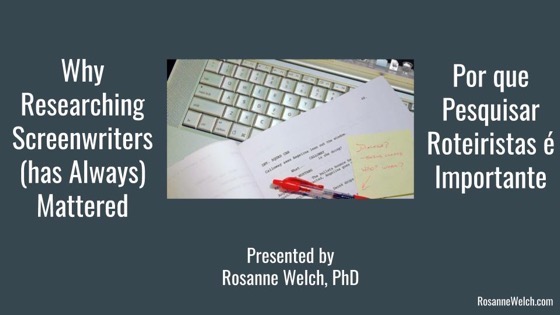
To understand the world we have to understand its stories and to understand the world’s stories we must understand the world’s storytellers. A century ago and longer those people would have been the novelists of any particular country but since the invention of film, the storytellers who reach the most people with their ideas and their lessons have been the screenwriters. My teaching philosophy is that: Words matter, Writers matter and Women writers matter s– o women writers are my focus because they have been the far less researched and yet they are over half the population. We cannot tell the stories of the people until we know what stories the mothers have passed down to their children. Those are the stories that last. Now is the time to research screenwriters of all cultures and the stories they tell because people are finally recognizing the work of writers and appreciating how their favorite stories took shape on the page long before they were cast, or filmed, or edited. But also because streaming services make the stories of many cultures now available to a much wider world than ever before.
* A portion of each sale from Amazon.com directly supports our blogs ** Many of these books may be available from your local library. Check it out! † Available from the LA Public Library
Subscribe to Rosanne’s Channel and receive notice of each new video!
Transcript:
This lady I wish people knew more. They know her in literature and poetry classes but they don’t know her as a screenwriter. Guesses? Dorothy Parker. Dorothy Parker right who happily said , “You can lead a whore of culture but you can’t make her think.” Yeah Exactly. Dorothy was nominated for two Oscars. She was from New York. She was of that world the Algonquin Round Table. She came out here because there was lots of money to be made. She was married to an actor who was about 12 years her junior and everyone thought that was a crazy marriage. There were a few women doing that back in the day. He wanted to write in Hollywood because there was more money out here. So they came out here. They wrote several movies. These movies she did — they ended up divorcing — so she got the Oscars when she wasn’t working with him. She had the nominations. What she did with him is “A Star Is Born”, the original “A Star Is Born” which I must tell you, in my class one day I was having people name their favorite movies and of course some would name “A Star is Born” and I said “Which version?” and she said “There’s more than one?” Yeah that was really sad.
Dr. Rosanne Welch discusses the women in her new book “When Women Wrote Hollywood” which covers female screenwriters from the Silents through the early 1940s when women wrote over 50% of films and Frances Marion was the highest paid screenwriter (male or female) and the first to win 2 Oscars. Yet, she fails to appear in film history books, which continue to regurgitate the myth that male directors did it all – even though it’s been proven that the only profitable movies Cecil B. de Mille ever directed were all written by Jeannie Macpherson film ever won for Best Picture was written by Robert E. Sherwood (who people have heard of, mostly due to his connection to Dorothy Parker) and Joan Harrison.
* A portion of each sale from Amazon.com directly supports our blogs ** Many of these books may be available from your local library. Check it out! † Available from the LA Public Library
Wherever you go, you find Monkees fans and the Denver Popular Culture Con was no different. Amid rooms full of caped crusaders and cosplay creations, I was initially not sure how many folks would attend a talk on a TV show from the 1960s – but happily I was met by a nice, engaged audience for my talk on Why the Monkees Matter – and afterward they bought books! What more could an author ask for?
Subscribe to Rosanne’s Channel and receive notice of each new video!
Transcript
This is a quote by Peter obviously. Who knows who’s sitting behind him? Janis Joplin. These guys were friends. So there’s also this ridiculous myth that nobody in music like The Monkees back then. That’s all not true. They lived in Laurel Canyon which is an area right above Hollywood. They had houses next to Mama Cass Elliot, Eric Clapton lived in the neighborhood and Frank Zappa buy a house there eventually. John Lennon would visit Mickey Dolenz’ home all the time because Mickey had married a woman from England and Lennon and Ringo, of The Beatles obviously, made the joke that that was the house they could go to where somebody knew how to serve tea at four o’clock. So you know they were just English guys hanging out in America. So but Peter, very much against the character he was asked to play which of course was the dummy, he was a very intellectual very smart gentleman and saw right from start that their message would actually have more power than The Beatles.
A hit television show about a fictitious rock band, The Monkees (1966-1968) earned two Emmys–Outstanding Comedy Series and Outstanding Directorial Acheivement in Comedy.
Capitalizing on the show’s success, the actual band formed by the actors, at their peak, sold more albums than The Beatles and The Rolling Stones combined, and set the stage for other musical TV characters from The Partridge Family to Hannah Montana. In the late 1980s, the Monkees began a series of reunion tours that continued into their 50th anniversary.
This book tells the story of The Monkees and how the show changed television, introducing a new generation to the fourth-wall-breaking slapstick created by Laurel and Hardy and the Marx Brothers.
Its creators contributed to the innovative film and television of 1970s with projects like Bob & Carol & Ted & Alice, The Mary Tyler Moore Show, Laugh-In and Welcome Back, Kotter. Immense profits from the show, its music and its merchandising funded the producers’ move into films such as Head, Easy Riderand Five Easy Pieces.
Subscribe to Rosanne’s Channel and receive notice of each new video!
This one allowed me to riff on some of my favorite female science fiction writers across time, whether they be novelists or television writers. It also opened up a good conversation on what art we support and include in our lives – and what that art says to us and about us. — Rosanne
Transcript:
…and we had a marvelous presentation about two weeks ago on Octavia Butler right? So moving now moving further and further into the 90s. Octavia Butler the first African-American female to be successful writing science fiction. We had a presentation here from the curator of her papers at the Huntington Library because she lived in Pasadena. So she’s a local to California and a lot of her stuff was infused with sort of the attitudes and the progressive ideas that we tend to be surrounded by here. She won a MacArthur Fellowship again the first science fiction writer — not a person of color and not even a woman — the very first science fiction writer ever to get a MacArthur grant which is a huge piece of support to creative people and artistic people so I think that’s really cool.
* A portion of each sale from Amazon.com directly supports our blogs ** Many of these books may be available from your local library. Check it out!
Subscribe to Rosanne’s Channel and receive notice of each new video!
Transcript:
Of course, most people know her. Mae West. Again, she made herself a brand, long before Madonna and long before Lady Gaga this lady knew that sex sells and I’m going to make myself as sexy as I can and I’m going to tell innuendos and I am going to do all of that so that she actually got arrested a few times. People remember Mae West as an actress and forget that she wrote almost everything she performed in. Broadway plays. Movies. Stage shows. She was her own writer. She would talk about how easy it was to write but people who did her autobiography discovered that she had journals and journals and journals of every joke she could ever write — that she could ever find. She wrote all day long waiting to get that one or two really good pieces to use in her next production. She was consummately a writer before she was a performer. All she had to do to perform was throw on the fancy clothes and smile, right, but the writing was the hard work that she engaged in. She was pretty cool. These are all her movies. She did sex before Madonna released a book called “Sex.” This is way back in the day when it was actually against the law. So she’s pretty amazing.
Dr. Rosanne Welch discusses the women in her new book “When Women Wrote Hollywood” which covers female screenwriters from the Silents through the early 1940s when women wrote over 50% of films and Frances Marion was the highest paid screenwriter (male or female) and the first to win 2 Oscars. Yet, she fails to appear in film history books, which continue to regurgitate the myth that male directors did it all – even though it’s been proven that the only profitable movies Cecil B. de Mille ever directed were all written by Jeannie Macpherson film ever won for Best Picture was written by Robert E. Sherwood (who people have heard of, mostly due to his connection to Dorothy Parker) and Joan Harrison.
* A portion of each sale from Amazon.com directly supports our blogs ** Many of these books may be available from your local library. Check it out! † Available from the LA Public Library
![When Women Write Horror with Dr. Rosanne Welch (Complete) - Cal Poly Pomona University Library [Video] (36 minutes)](https://rosannewelch.com/wp-content/uploads/2019/11/rmw-cpp-horror.jpeg)
![24 Octavia Butler’s Kindred from The Sisterhood of Science Fiction – Dr. Rosanne Welch [Video] (1 minute 25 seconds)](https://rosannewelch.com/wp-content/uploads/2019/11/scifi-rmw-cpp-24.jpeg)
![26 Dorothy Parker and A Star Is Born from “When Women Wrote Hollywood” with Dr. Rosanne Welch [Video] (55 seconds)](https://rosannewelch.com/wp-content/uploads/2019/11/csuf-rmw-w3h-26.jpeg)
![11 Who Made The Monkees from “Why The Monkees Matter: Even 50 Years Later [Video] (1 minute 4 seconds)](https://rosannewelch.com/wp-content/uploads/2019/11/monkees-popcon-2019-11.jpeg)

![23 More On Octavia Butler from The Sisterhood of Science Fiction – Dr. Rosanne Welch [Video] (33 seconds)](https://rosannewelch.com/wp-content/uploads/2019/10/scifi-rmw-cpp-23.jpeg)
![25 Dorothy Parker from “When Women Wrote Hollywood” with Dr. Rosanne Welch [Video] (1 minute 6 seconds)](https://rosannewelch.com/wp-content/uploads/2019/10/csuf-rmw-w3h-25.jpeg)
![10 More On TV As Platform And Podium from “Why The Monkees Matter: Even 50 Years Later [Video] (52 seconds)](https://rosannewelch.com/wp-content/uploads/2019/10/monkees-popcon-2019-10.jpeg)
![22 Octavia Butler from The Sisterhood of Science Fiction – Dr. Rosanne Welch [Video] (46 seconds)](https://rosannewelch.com/wp-content/uploads/2019/10/scifi-rmw-cpp-22.jpeg)
![24 Mae West from “When Women Wrote Hollywood” with Dr. Rosanne Welch [Video] (1 minute 5 seconds)](https://rosannewelch.com/wp-content/uploads/2019/10/csuf-rmw-w3h-24.jpeg)