35 Harriet Frank, Jr. from “When Women Wrote Hollywood” with Dr. Rosanne Welch [Video] (1 minute 9 seconds)

Part of the California State University, Fullerton Faculty Noon Time Talks at the Pollak Library.

Watch this entire presentation


35 Harriet Frank, Jr. from

Subscribe to Rosanne’s Channel and receive notice of each new video!


Transcript:

Moving through into the 50s, we come up with Harriet Frank Jr. — a woman going by Jr. because her mother was Harriet Frank and her mother was a reader at one of the studios which is how she got into the business of writing. She married Irving Ravetch and together they made several important films. To me, most important is Norma Rae. Again a very female based film which really falls into Harriet’s world and also Stanley and Iris and Murphy’s Romance are very female-focused stories. Harriet was a really strong woman — very involved in the Union which makes sense when you think about Norma Rae right? So again names people don’t really know because these are considered Martin Ritt films because he directed all four of them, because he was best friends with Frank and Ravetch. So they liked to hire directors they knew who wouldn’t muck up their work and I believe in those collaborations. I don’t — like I’m dissing directors. I don’t mean to. I like directors but there it’s an even collaboration and I think that’s what academia has to start referencing more than we do because that’s how writers get lost and if male writers are getting lost you know female writers getting even more lost right? So we need to keep thinking about it’s a — it’s a collaboration.

Dr. Rosanne Welch discusses the women in her new book “When Women Wrote Hollywood” which covers female screenwriters from the Silents through the early 1940s when women wrote over 50% of films and Frances Marion was the highest paid screenwriter (male or female) and the first to win 2 Oscars.  Yet, she fails to appear in film history books, which continue to regurgitate the myth that male directors did it all – even though it’s been proven that the only profitable movies Cecil B. de Mille ever directed were all written by Jeannie Macpherson film ever won for Best Picture was written by Robert E. Sherwood (who people have heard of, mostly due to his connection to Dorothy Parker) and Joan Harrison.


Buy a signed copy of when Women Wrote Hollywood

…or via Amazon…

Paperback Edition | Kindle Edition | Google Play Edition

* A portion of each sale from Amazon.com directly supports our blogs
** Many of these books may be available from your local library. Check it out!
† Available from the LA Public Library

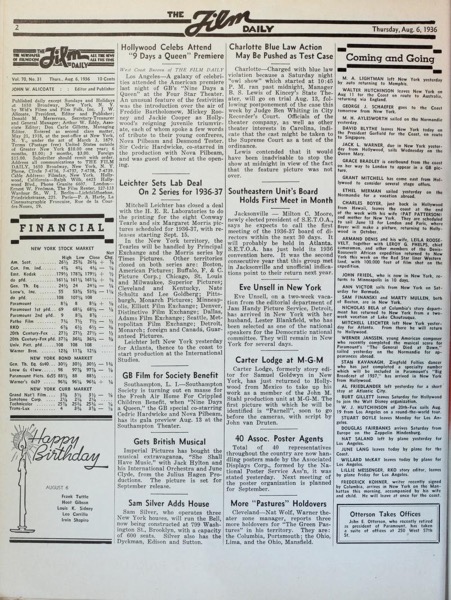
From The “When Women Wrote Hollywood” Archives 08: Marion Fairfax: “Algerian Village Erected for Desert Healer.” Motion Picture News. Motion Picture News, 15 March 1926

Months of research went into the creation of the essays in “When Women Wrote Hollywood.” Here are some of the resources used to enlighten today’s film lovers to the female pioneers who helped create it.

From The “When Women Wrote Hollywood Archives 08: Marion Fairfax:  “Algerian Village Erected for Desert Healer.” Motion Picture News. Motion Picture News, 15 March 1926

From The

Algerian Village Erected for
“Desert Healer”

Marion Fairfax Productions in collabora-
tion with Sam E. Rork have had erected a
complete Algerian village for the company
producing “The Desert Healer” under the di-
rection of Maurice Tourneur. The principals
in the cast include Lewis Stone, Barbara
Bedford, Tully Marshall, Katherine MacDon-
ald, Walter Pidgeon, Ann Rork, Arthur
Rankin and Albert Conti.

Read “Algerian Village Erected for Desert Healer.” Motion Picture News. Motion Picture News, 15 March 1926


Buy “When Women Wrote Hollywood” Today!

Paperback Edition | Kindle Edition | Google Play Edition

* A portion of each sale from Amazon.com directly supports our blogs
** Many of these books may be available from your local library. Check it out!
† Available from the LA Public Library

Save The Date! – Rosanne at SCMS (Society for Cinema and Media Studies) Conference, April 1-5, 2020, Denver Colorado

Save The Date! - SCMS (Society for Cinema and Media Studies), April 1-5, 2020, Denver Colorado

I’m excited to fly to Denver again this year (twice actually – once for the SCMS conference in April and once for SeriesFest in June – more about that in another post!). 

For SCMS (Society for Cinema and Media Studies) I was invited to be part of a panel with 3 other fascinating female academics discussing How Unreliable Narrators harm giving women enough credit in historical research

A great deal of women’s work has gone uncredited. Its documentation or evidence may not exist in predictable places. Conceiving of how this work was conducted, or had impact, or might be theorized often pose more questions than answers. Our panel is interesteded in meeting these challenges through new and alternative forms of storytelling. How might we identify creative or productive approaches to historical writing that address absences, gaps, rumors, contradictions, or suspect information?

This may involve examining how biography has informed the construction of a star image. Vicki Callahan confronts the inability to reconstruct Normand’s filmmaking career and piece together missing parts of her star biography due to a lack of documentation (in addition to the scandals that arise at pivotal moments). In contrast, Eartha Kitt made a concerted effort to represent herself through “self-narrativization,” according to Philana Payton (who will present “Eartha Kitt vs. Eartha Mae”). Kitt wrote multiple autobiographies, scrupulously examining her private identity versus her public self on stage and screen.

The notion of narrator–whether unreliable narrator, storyteller, cryptic voice–proves useful here. For example, Normand serves as an unreliable narrator, leading Callahan to place historical weight on her scripts and performances (and performativity). Kitt, on the other hand, asserted her authority (and made a bid for black feminist resistance) by claiming her narrator role.

Taking a long-range historical view, my presentation will consider how certain male filmmakers have been unreliable narrators in reference to their collaborations with women in the industry. They often fail to credit their female collaborators or mentors, especially in public. A similar dynamic occurred with Joan Harrison; many of her film and TV contributions have been obscured because of the bright spotlight on Hitchcock. For Christina Lane, this (along with major gaps in documentation) fed into the challenges of historicizing her life and career. Sources came from unexpected places—Harrison’s housekeepers and caretakers—which created an opportunity for alternative feminist writing strategies.

Scms logo

About SCMS

The Society for Cinema and Media Studies is the leading scholarly organization in the United States dedicated to promoting a broad understanding of film, television, and related media through research and teaching grounded in the contemporary humanities tradition.

SCMS encourages excellence in scholarship and pedagogy and fosters critical inquiry into the global, national, and local circulation of cinema, television, and other related media. SCMS scholars situate these media in various contexts, including historical, theoretical, cultural, industrial, social, artistic, and psychological.

SCMS seeks to further media study within higher education and the wider cultural sphere, and to serve as a resource for scholars, teachers, administrators, and the public. SCMS works to maintain productive relationships with organizations in other nations, disciplines, and areas of media study; to foster dialogue between media industries and scholars; and to promote the preservation of our film, television, and media heritage. We encourage membership and participation of scholars and those in related positions not only in the US but around the world.
32 Characters: Uhura, Guinan, Star Trek from The Sisterhood of Science Fiction – Dr. Rosanne Welch [Video] (1 minute 16 seconds)

Watch this entire presentation

The Sisterhood of Science Fiction: A Walk Through Some Writers and Characters You (Should) Know And Love

32 Characters: Uhura, Guinan, Star Trek from The Sisterhood of Science Fiction - Dr. Rosanne Welch

Subscribe to Rosanne’s Channel and receive notice of each new video!


This one allowed me to riff on some of my favorite female science fiction writers across time, whether they be novelists or television writers. It also opened up a good conversation on what art we support and include in our lives – and what that art says to us and about us. — Rosanne

Transcript:

Because of him talking to her at that event, she stayed on the show and as we know, she went through the movies– as an older woman, which is also a big deal an — older woman doing empowering things very cool. She influenced Whoopi Goldberg who at that point was an Academy award-winning actress. She did the TV show, The Next Generation, for the very same reason. She said I grew up watching Nichelle Nichols. I want to give that same message to children in the next generation. So she would guest frequently on Next Generation and while we’re busy thinking about people who got very very influenced, you may not know this lady? Anybody? She’s the first African American female astronaut. Her name is Mae Jemison, all right, so she’s an American woman who saw Star Trek as a kid and said I’m gonna get that job and she did which is pretty amazing. So much so that she guest-starred on the show to say thanks for what influence you gave me in my childhood and I want other young girls to see me in the future. That’s an amazing piece of powerful message coming from one character, right, one character being invented in a show. So it’s fascinating to me what we can learn from that.


* A portion of each sale from Amazon.com directly supports our blogs
** Many of these books may be available from your local library. Check it out! 

34 More On Frances Goodrich & Albert Hackett – “When Women Wrote Hollywood” with Dr. Rosanne Welch [Video] (1 minute 10 seconds)

Part of the California State University, Fullerton Faculty Noon Time Talks at the Pollak Library.

Watch this entire presentation

34 More On Frances Goodrich & Albert Hackett -

Subscribe to Rosanne’s Channel and receive notice of each new video!


Transcript:

Directors are lovely people but when you talk about a movie to your friends rarely do you discuss camera angles. You discuss dialogue and that’s what the writer wrote.It should be the writer’s movie or nobodies. I have a big fight with publishers now. I refuse to do things like Spielberg’s Lincoln. No. Tony Kushner wrote Lincoln and he’s got a Pulitzer Prize. it’s either his movie or it’s just Lincoln. Let’s leave it at that all right? It does not belong to Steven Spielberg cuz he didn’t write any of it but these guys are wonderful. Their work was great. They were invited — they did Thin Man. They did It’s A Wonderful LIfe — they were invited to work on the play the Diary of Anne Frank. A couple other people were offered at first. This was at a time when everything was crazy after the war. There were some thoughts that maybe it was a fake diary right but these guys believed in i.t They met Otto Frank — Anne’s father — and worked with him and created the play which won them a Pulitzer Prize and then they adapted their own play into a film. So Francis and Albert Hackett — they were considered the most beloved couple in Hollywood. They were friends with Dorothy and Alan and all these other couples that work together and they were apparently the nicest people you could ever meet, right?

Dr. Rosanne Welch discusses the women in her new book “When Women Wrote Hollywood” which covers female screenwriters from the Silents through the early 1940s when women wrote over 50% of films and Frances Marion was the highest paid screenwriter (male or female) and the first to win 2 Oscars.  Yet, she fails to appear in film history books, which continue to regurgitate the myth that male directors did it all – even though it’s been proven that the only profitable movies Cecil B. de Mille ever directed were all written by Jeannie Macpherson film ever won for Best Picture was written by Robert E. Sherwood (who people have heard of, mostly due to his connection to Dorothy Parker) and Joan Harrison.


Buy a signed copy of when Women Wrote Hollywood

…or via Amazon…

Paperback Edition | Kindle Edition | Google Play Edition

* A portion of each sale from Amazon.com directly supports our blogs
** Many of these books may be available from your local library. Check it out!
† Available from the LA Public Library

31 Characters: Nyota Uhura, Star Trek from The Sisterhood of Science Fiction – Dr. Rosanne Welch [Video] (1 minute 20 seconds)

Watch this entire presentation

The Sisterhood of Science Fiction: A Walk Through Some Writers and Characters You (Should) Know And Love

31 Characters: Nyota Uhura, Star Trek from The Sisterhood of Science Fiction - Dr. Rosanne Welch [Video] (1 minute 20 seconds)

Subscribe to Rosanne’s Channel and receive notice of each new video!


This one allowed me to riff on some of my favorite female science fiction writers across time, whether they be novelists or television writers. It also opened up a good conversation on what art we support and include in our lives – and what that art says to us and about us. — Rosanne

Transcript:

In terms of characters that we need to pay some attention to, if you don’t know the original Star Trek you should but you’ve seen some of these characters and memes all over the internet right? Nyota Uhura. It was a big deal. They’re putting an African-American woman in the future. Now there was some chit chat about the sexism going on because she was just answering the phone. She’s running the radio on the ship but she’s still on the ship on the main place and she often was involved in stories, but what’s really important about her character and why these two are connected in these pictures is that after the first season on the show, she was kind of like “I’m just answering the damn phone like I don’t really feel like I’m empowered very much I don’t really want to do this show anymore” and she was a big band singer, she could go back out on the road , sing, tour America, make money. I don’t need to do this cheesy science fiction show and then she met him at some event– I forget — some fundraising event and she said she kind of apologized for kind of how stupid her role was in the show and told him she was quitting so she’s proud of I want you to know I’m not gonna do this anymore and he was like “Oh no no no no. You have to stay. You are the only African-American who is seen in the future. You do not understand the power of little children looking up and saying okay we survive. She made it. I’ll make it. This is a big, big deal.


* A portion of each sale from Amazon.com directly supports our blogs
** Many of these books may be available from your local library. Check it out! 

33 Frances Goodrich & Albert Hackett from “When Women Wrote Hollywood” with Dr. Rosanne Welch [Video] (58 seconds)

Part of the California State University, Fullerton Faculty Noon Time Talks at the Pollak Library.

Watch this entire presentation

33 Frances Goodrich & Albert Hackett from

Subscribe to Rosanne’s Channel and receive notice of each new video!


Transcript:

These guys are somebody that everybody should know and, of course, each of these people that I’m talking about now, they have a chapter in this book which is what the books all about. Francis and Albert Hackett. They were married for 54 years and wrote films together for about 50 of those. They started in New York as playwrights they came out here and again you’ve probably never heard their names but you have seen these movies, have you not? Every year how many times do we watch It’s a Wonderful Life and what does everybody tell you whose movie is that? Frank Capra’s movie because Frank Capra forced himself on the writing credits. He wrote some scenes and had his name added to the writing credits and when they edited the movie they cut out all the scenes he wrote. The movie is Francis and Albert Hackett’s script. He kept adding more to prove he was a writer and none of it was any good. So it kills me that we call that Frank Capra’s It’s a Wonderful Life.

Dr. Rosanne Welch discusses the women in her new book “When Women Wrote Hollywood” which covers female screenwriters from the Silents through the early 1940s when women wrote over 50% of films and Frances Marion was the highest paid screenwriter (male or female) and the first to win 2 Oscars.  Yet, she fails to appear in film history books, which continue to regurgitate the myth that male directors did it all – even though it’s been proven that the only profitable movies Cecil B. de Mille ever directed were all written by Jeannie Macpherson film ever won for Best Picture was written by Robert E. Sherwood (who people have heard of, mostly due to his connection to Dorothy Parker) and Joan Harrison.


Buy a signed copy of when Women Wrote Hollywood

…or via Amazon…

Paperback Edition | Kindle Edition | Google Play Edition

* A portion of each sale from Amazon.com directly supports our blogs
** Many of these books may be available from your local library. Check it out!
† Available from the LA Public Library

Krista Dyson, Stephens College MFA in TV and Screenwriting Alumni, wins Buffy for Best Documentary at the 2019 Tampa Bay Underground Film Festival

Congratulations Krista Dyson (Stephens College MFA in TV and Screenwriting Class of 2018), co-producer on “When All That’s Left Is Love” which won the Buffy for Best Documentary at the 2019 Tampa Bay Underground Film Festival.

This feature-length documentary goes behind closed doors with Alzheimer’s caregivers. Dyson worked on the film while she was completing the MFA program.

“I feel like I earned two MFAs, between the writing program and the work I did on this project… Our goal was to allow the audience to truly understand what a complex and difficult situation exists for caregivers.”

Stephens College MFA Alums are Active Achievers!

Krista Dyson, Stephens College MFA in TV and Screenwriting Alunmi, wins Buffy for Best Documentary at the 2019 Tampa Bay Underground Film FestivalKrista Dyson, Stephens College MFA in TV and Screenwriting Alunmi, wins Buffy for Best Documentary at the 2019 Tampa Bay Underground Film Festival


Follow and Like the Stephens College MFA in TV and Screenwriting

#MentorMonday 8 - Dawn Comer Jefferson - Stephens College MFA in TV and Screenwriting

New Essay Published: The Twenty-First-Century Western: New Riders of the Cinematic Stage

Once again I’m happy to have co-written a chapter with editor Doug Brode. — Westward Ho! The Women!: Frontier Females in Postfeminist Films

Our first was collaboration came in The American Civil War on Film and TV: Blue and Gray in Black and White and Color – this one gave me a chance to analyze female characters in westerns produced after 2000.

Sadly, you’d think their new-ness would have made for more interesting, nuanced female characters but, as I say in the chapter, the most well-rounded, honest and real representations of females in westerns in the (supposedly) 21st century came from one of the youngest characters (Mattie Ross in True Grit) and from one of the animated characters, who is not even a female human, but a female lizard (Beans in Rango). And once again, as I am finding more and more, whether the screenwriter was female or male often made a difference.

New Essay Published: The Twenty-First-Century Western

Focusing on twenty-first century Western films, including all major releases since the turn of the century, the essays in this volume cover a broad range of aesthetic and thematic aspects explored in these films, including gender and race. As diverse contributors focus on the individual subgenres of the traditional Western (the gunfighter, the Cavalry vs. Native American conflict, the role of women in Westerns, etc.), they share an understanding of the twenty-first century Western may be understood as a genre in itself. They argue that the films discussed here reimagine certain aspects of the more conventional Western and often reverse the ideology contained within them while employing certain forms and clichés that have become synonymous internationally with Westerns. The result is a contemporary sensibility that might be referred to as the postmodern Western.

From The “When Women Wrote Hollywood Archives 07: “Frederica Sagor Maas, Hollywood’s ‘Shocking Miss Pilgrim'” The Forward.

Months of research went into the creation of the essays in “When Women Wrote Hollywood.” Here are some of the resources used to enlighten today’s film lovers to the female pioneers who helped create it.

From The “When Women Wrote Hollywood Archives 07: “Frederica Sagor Maas, Hollywood’s ‘Shocking Miss Pilgrim'” The Forward.

From The

Read From The “When Women Wrote Hollywood Archives 07: “Frederica Sagor Maas, Hollywood’s ‘Shocking Miss Pilgrim'” The Forward. 


Buy “When Women Wrote Hollywood” Today!

Paperback Edition | Kindle Edition | Google Play Edition

* A portion of each sale from Amazon.com directly supports our blogs
** Many of these books may be available from your local library. Check it out!
† Available from the LA Public Library