When Women Wrote Hollywood – 33 in a series – The Little Foxes (1941) – Wr: Lillian Hellman

To highlight the wonderful yet largely forgotten work of a collection of female screenwriters from the early years of Hollywood (and as a companion to the book, When Women Wrote Hollywood) we will be posting quick bits about the many films they wrote along with links to further information and clips from their works which are still accessible online. Take a few moments once or twice a week to become familiar with their names and their stories. I think you’ll be surprised at how much bold material these writers tackled at the birth of this new medium. — Rosanne Welch

When Women Wrote Hollywood – 33 in a series – The Little Foxes (1941) – Wr: Lillian Hellman

When Women Wrote Hollywood - 33 in a series -  The Little Foxes (1941) - Wr: Lillian Hellman

The Little Foxes (1941) is an American drama film directed by William Wyler. The screenplay by Lillian Hellman is based on her 1939 play The Little Foxes. Hellman’s ex-husband Arthur Kober, Dorothy Parker and her husband Alan Campbell contributed additional scenes and dialogue.[2]

The title comes from Chapter 2, Verse 15 in the Song of Solomon in the King James version of the Bible, which reads, “Take us the foxes, the little foxes, that spoil the vines: for our vines have tender grapes.”[3] The same passage also inspired the title of an unrelated film, Our Vines Have Tender Grapes.

Southern aristocrat Regina Hubbard Giddens (Bette Davis) struggles for wealth and freedom within the confines of an early 20th-century society where a father considered only sons as legal heirs. As a result, her avaricious brothers, Benjamin (Charles Dingle) and Oscar (Carl Benton Reid), are independently wealthy, while she must rely for financial support upon her sickly husband Horace (Herbert Marshall), who has been away undergoing treatment for a severe heart condition. — Wikipedia 

More about The Little Foxes (1941)

More about Lillian Hellman

More books by and about Lillian Hellman


Buy a signed copy of when Women Wrote Hollywood


Paperback Edition | Kindle Edition | Google Play Edition

* A portion of each sale from Amazon.com directly supports our blogs
** Many of these books may be available from your local library. Check it out!
† Available from the LA Public Library
When Women Wrote Hollywood – 32 in a series – Lillian Hellman

To highlight the wonderful yet largely forgotten work of a collection of female screenwriters from the early years of Hollywood (and as a companion to the book, When Women Wrote Hollywood) we will be posting quick bits about the many films they wrote along with links to further information and clips from their works which are still accessible online. Take a few moments once or twice a week to become familiar with their names and their stories. I think you’ll be surprised at how much bold material these writers tackled at the birth of this new medium. — Rosanne Welch

When Women Wrote Hollywood – 32 in a series – Lillian Hellman

When Women Wrote Hollywood - 32 in a series - Lillian Hellman

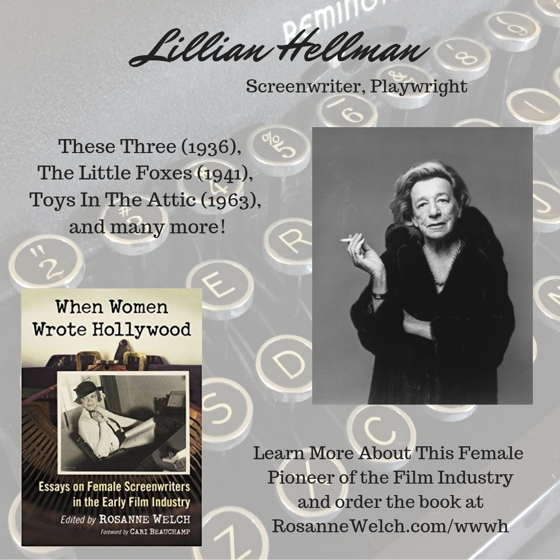
Lillian Florence Hellman (June 20, 1905 – June 30, 1984) was an American dramatist and screenwriter known for her success as a playwright on Broadway, as well as her left-wing sympathies and political activism. She was blacklisted after her appearance before the House Committee on Un-American Activities (HUAC) at the height of the anti-communist campaigns of 1947–52. Although she continued to work on Broadway in the 1950s, her blacklisting by the American film industry caused a drop in her income. Many praised Hellman for refusing to answer questions by HUAC, but others believed, despite her denial, that she had belonged to the Communist Party.

As a playwright, Hellman had many successes on Broadway, including Watch on the Rhine, The Autumn Garden, Toys in the Attic, Another Part of the Forest, The Children’s Hour and The Little Foxes. She adapted her semi-autobiographical play The Little Foxes into a screenplay, which starred Bette Davis and received an Academy Award nomination in 1942.

Hellman was romantically involved with fellow writer and political activist Dashiell Hammett, author of the classic detective novels The Maltese Falcon and The Thin Man, who also was blacklisted for 10 years until his death in 1961. The couple never married — Wikipedia 

More about Lillian Hellman

More books by and about Lillian Hellman


Buy a signed copy of when Women Wrote Hollywood


Paperback Edition | Kindle Edition | Google Play Edition

* A portion of each sale from Amazon.com directly supports our blogs
** Many of these books may be available from your local library. Check it out!
† Available from the LA Public Library

31 Adric from Gender Diversity in the Who-niverse [Video] (0:38)

Watch this entire presentation: Gender Diversity in the Who-niverse: Paving the Way for a Lady Doctor with Dr. Rosanne Welch [Video] (36:58)

31 Adric from Gender Diversity in the Who-niverse [Video] (0:38)

For her 5th Doctor Who lecture to the CPP community, Dr. Rosanne Welch discusses how society – and the show’s writing staff – prepared the audience for a major change in this 50-year franchise – the creation of the first Lady Doctor!

Transcript:

We also had this young gentleman who was in both the Baker and the Davison Era who was Adric, who was a math genius and he was a young kid so he had more access to his emotions. We don’t let young boys have their emotions. We tell them not to cry. That’s stupid. Humans cry. There’s no such thing as not cryng, right, but we do that. So, it was nice to have Adric as an example back in the day. And until I was putting this together I never had read that fun fact. That’s where they got his name from — an actual Nobel-winning guy. I thought it was pretty cool. I love that — again — writers playing and giving us more information. I just learned something a guy I had never heard of, right? A little research.

Follow Dr. Welch on Twitter and Instagram
https://twitter.com/rosannewelchhttp://instagram.com/drrosannewelch


Rosanne Welch, PhD

Rosanne Welch PhD teaches the History of Screenwriting and One-Hour Drama for the Stephens College MFA in Screenwriting.

Writing/producing credits include Beverly Hills 90210, Picket Fences, ABCNEWS: Nightline and Touched by an Angel. In 2016 she published the book Why The Monkees Matter: Teenagers, Television and American Pop; co-edited Women in American History: A Social, Political, and Cultural Encyclopedia; and placed “Transmitting Culture Transnationally Via the Characterization of Parents in Police Procedurals” in the New Review of Film and Television Studies. Essays appear in Torchwood Declassified: Investigating Mainstream Cult Television and Doctor Who and Race: An Anthology. Welch serves as Book Reviews editor for Journal of Screenwriting and on the Editorial Advisory Board for Written By magazine, the magazine of the Writers Guild.

Watch Dr. Welch’s talk “The Importance of Having a Female Voice in the Room” at the 2016 TEDxCPP.

Quotes from When Women Wrote Hollywood – 7 in a series – “From acting to screenwriting”

Quotes from When Women Wrote Hollywood - 7 in a series -

“In 1911, Meredyth began working as an extra at the Biograph Company, and eventually wound up as a stock player for D.W. Griffith. In addition to acting at Biograph, she also began to write and direct one- and two-reeler films. It had occurred to Meredyth that she could make more money if she both wrote and acted, so she began doing so for several different studios.”

You’d Better Learn to Hold Your Liquor: Bess Meredyth and A Career in Early Hollywood
Sydney Haven


Buy a signed copy of when Women Write Hollywood

or Buy the Book on Amazon


Paperback Edition | Kindle Edition | Google Play Edition

* A portion of each sale from Amazon.com directly supports our blogs
** Many of these books may be available from your local library. Check it out!
† Available from the LA Public Library

When Women Wrote Hollywood – 31 in a series – “The Diary of Anne Frank”, Wr: Frances Goodrich and Albert Hackett

To highlight the wonderful yet largely forgotten work of a collection of female screenwriters from the early years of Hollywood (and as a companion to the book, When Women Wrote Hollywood) we will be posting quick bits about the many films they wrote along with links to further information and clips from their works which are still accessible online. Take a few moments once or twice a week to become familiar with their names and their stories. I think you’ll be surprised at how much bold material these writers tackled at the birth of this new medium. — Rosanne Welch

When Women Wrote Hollywood – 31 in a series – “The Diary of Anne Frank”, Wr: Frances Goodrich and Albert Hackett

When Women Wrote Hollywood - 30 in a series -

The Diary of Anne Frank is a 1959 film based on the Pulitzer Prize winning play of the same name, which was based on the diary of Anne Frank. It was directedby George Stevens, with a screenplay by Frances Goodrich and Albert Hackett. It is the first film version of both the play and the original story, and features three members of the original Broadway cast.

The film was based on the personal diary of Anne Frank, a Jewish girl who lived in hiding with her family during World War II. All her writings to her diary were addressed as “Dear Kitty”. It was published after the end of the war by her father, Otto Frank (played in the film by Joseph Schildkraut, also Jewish). All of his family members had been killed by the Nazis. The film was shot on a sound stage duplicate of the factory in Los Angeles, while exteriors were filmed at the actual building in Amsterdam.[3]

The film won three Academy Awards in 1960, including Best Supporting Actress for Shelley Winters. In 2006, it was honored as the eighteenth most inspiring American film on the list AFI’s 100 Years…100 Cheers. — Wikipedia 

More about The Diary of Anne Frank (1959)

More about Frances Goodrich and Albert Hackett

Biography of Frances Goodrich and Albert Hackett


Buy a signed copy of when Women Wrote Hollywood


Paperback Edition | Kindle Edition | Google Play Edition

* A portion of each sale from Amazon.com directly supports our blogs
** Many of these books may be available from your local library. Check it out!
† Available from the LA Public Library

Want to go backstage at the Stephens MFA? Apply Now! [Video]

Want to go backstage at the Stephens MFA?

Check out this video to see what our program is like and apply now with no application fees until the end of October!

Stephens behind scenes

More information about the Stephens College MFA in TV and Screenwriting

Master of Fine Arts in TV and Screenwriting 

You have stories to tell. We’re here to make it happen. Come to Hollywood to learn from some of the best working writers in the industry. Stephens is an institution on a mission: To increase the voices and impact of women in television and film.

WHY STEPHENS?

Our program — with its bold, daring mission — has drawn the attention and the support of some of the most successful and well-known writers in Hollywood. Our faculty includes some of the best working writers in the profession, and our curriculum includes an in-depth look at the business side of TV and screenwriting.  Explore more: program highlights, student achievements and stories. 

HOW DOES IT WORK?

Stephens is proud to be the first college in the nation to offer a low-residency MFA program specifically for TV and screenwriting. Our students come to Los Angeles twice a year for 10-day workshops at the beautiful Jim Henson Studio. Between workshops, students work one-on-one online with at least four different mentors over two years. Two years + four workshops in Hollywood = your M.F.A.

Learn More

Citizen Jane Film Festival Information and a Mention of “When Women Wrote Hollywood” Book Signing During the Festival

The “When Women Wrote Hollywood” Book Signing gets a quick mention this video from the Columbia Missouri Office of Cultural Affairs. They speak with Citizen Film Festival Director Barbie Banks about the festival and what is expected this year.

As in past years, my Stephens College MFA in TV and Screenwriting students will presenting on important women screenwriters during the festival, too. — Rosanne

Get more Book Signing Event info and RSVP

When Women Wrote Hollywood – 30 in a series – Frances Goodrich and Albert Hackett

To highlight the wonderful yet largely forgotten work of a collection of female screenwriters from the early years of Hollywood (and as a companion to the book, When Women Wrote Hollywood) we will be posting quick bits about the many films they wrote along with links to further information and clips from their works which are still accessible online. Take a few moments once or twice a week to become familiar with their names and their stories. I think you’ll be surprised at how much bold material these writers tackled at the birth of this new medium. — Rosanne Welch


When Women Wrote Hollywood – 30 in a series – Frances Goodrich and Albert Hackett

When Women Wrote Hollywood - 30 in a series - Frances Goodrich and Albert Hackett

Frances Goodrich (December 21, 1890 – January 29, 1984) was an American dramatist and screenwriter, best known for her collaborations with her partner and husband Albert Hackett.

Not long after marrying Hackett, the couple went to Hollywood in the late 1920s to write the screenplay for their stage success Up Pops the Devil for Paramount Pictures. In 1933 they signed a contract with MGM and remained with them until 1939. Among their earliest assignments was writing the screenplay for The Thin Man (1934). They were encouraged by the director W. S. Van Dyke to use the writing of Dashiell Hammett as a basis only, and to concentrate on providing witty exchanges for the principal characters, Nick and Nora Charles (played by William Powell and Myrna Loy). The resulting film was one of the major hits of the year, and the script, considered to show a modern relationship in a realistic manner for the first time, is considered groundbreaking. — Wikipedia 

More about Frances Goodrich and Albert Hackett

Biography of Frances Goodrich and Albert Hackett


Buy a signed copy of when Women Wrote Hollywood


Paperback Edition | Kindle Edition | Google Play Edition

* A portion of each sale from Amazon.com directly supports our blogs
** Many of these books may be available from your local library. Check it out!
† Available from the LA Public Library

30 Sensitive Men on Doctor Who from Gender Diversity in the Who-niverse [Video] (1:08)

Watch this entire presentation: Gender Diversity in the Who-niverse: Paving the Way for a Lady Doctor with Dr. Rosanne Welch [Video] (36:58)

30 Sensitive Menu on Doctor Who from Gender Diversity in the Who-niverse [Video] (1:08)

For her 5th Doctor Who lecture to the CPP community, Dr. Rosanne Welch discusses how society – and the show’s writing staff – prepared the audience for a major change in this 50-year franchise – the creation of the first Lady Doctor!

Transcript:

In the old era, but also largely in the new era, all the men have been given the chance to be depicted as sensitive human beings, which gives them a 3-dimensional complete humanity. Which I think is very important. Now in the very early days, as I said, Lethbridge-Stewart is the father of Kate, so that is how we invented her character in the future. So he started out in the early days with Jon, came through guest starred as an older actor of course on The Sarah Jane Adventures and he came into modern Who in one episode where everybody was turned into a Cyberman who had died. All the people buried in cemeteries had their bodies converted into Cybermen and yet he’s in a cemetery when his daughter gets kicked out of an airplane and she’s going to die except he catches her and saves her life which is a super-cool thing and because he loves his daughter. He’s a super-Dad which is a super-sensitive cool thing to be and so that’s why when the actor actually died they had The Doctor honor him with that portrait which I thought was pretty cool. So even back in the day, we had a relatively sensitive man.

Follow Dr. Welch on Twitter and Instagram
https://twitter.com/rosannewelchhttp://instagram.com/drrosannewelch


Rosanne Welch, PhD

Rosanne Welch PhD teaches the History of Screenwriting and One-Hour Drama for the Stephens College MFA in Screenwriting.

Writing/producing credits include Beverly Hills 90210, Picket Fences, ABCNEWS: Nightline and Touched by an Angel. In 2016 she published the book Why The Monkees Matter: Teenagers, Television and American Pop; co-edited Women in American History: A Social, Political, and Cultural Encyclopedia; and placed “Transmitting Culture Transnationally Via the Characterization of Parents in Police Procedurals” in the New Review of Film and Television Studies. Essays appear in Torchwood Declassified: Investigating Mainstream Cult Television and Doctor Who and Race: An Anthology. Welch serves as Book Reviews editor for Journal of Screenwriting and on the Editorial Advisory Board for Written By magazine, the magazine of the Writers Guild.

Watch Dr. Welch’s talk “The Importance of Having a Female Voice in the Room” at the 2016 TEDxCPP.

From Stephens College…

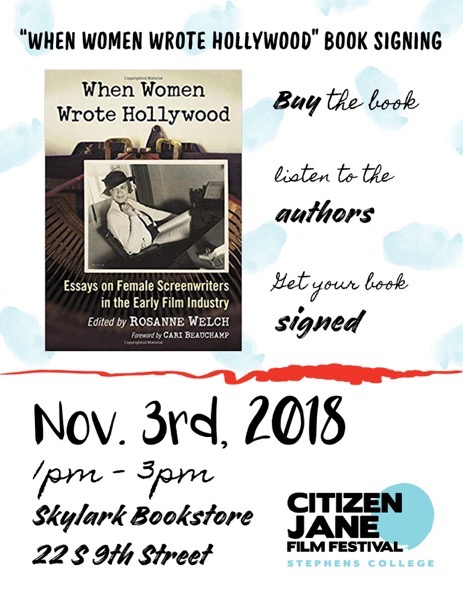
Today’s Stephens College newsletter has a great piece about the Los Angeles launch party for When Women Wrote Hollywood with details about our upcoming launch at the Skylar Bookstore in Columbia, Missouri during the Citizen Jane Film Festival. — Rosanne

Book launch party on Aug. 11 in L.A. Pictured (L-to-R): Sarah Phillips ’17 M.F.A., Khanisha Foster ’17 M.F.A. (with her daughter), Lauren Smith ’17 M.F.A., Laura Kirk ’17 M.F.A., Amelia Phillips ’17 M.F.A., Julie Berkobien ’17 M.F.A., Toni Anita Hull ’04 B.F.A., ’17 M.F.A. and Dr. Rosanne Welch, book editor/Stephens professor.

M.F.A. class publishes book of essays

Stephens College’s M.F.A. program now proudly boasts “When Women Wrote Hollywood,” a book of essays that focuses on the lives of female screenwriters of Golden Age Hollywood. The book, which published in July, is written by members of the inaugural graduating class of the Stephens M.F.A. in TV and Screenwriting. In the collection of 23 essays, Stephens Class of 2017 alumni write about female writers like Anita Loos, Adela Rogers St. Johns, and Gene Gauntier, whose work helped create unforgettable stories and characters beloved by audiences — but whose names are excluded from most film histories.“The mission of our M.F.A. program matched the mission of this book brilliantly — to increase the number of female screenwriters and female-centric stories told in Hollywood,” said Dr. Rosanne Welch, the book’s editor, and a Stephens assistant professor. She said her students used the essays as a way of thanking the earlier pioneering female writers who came before them.“When I introduce our Screenwriting History course, I remind students that we stand on the shoulders of those who came before us,” said Welch, a veteran television writer and scholar of screenwriting history. “Students are shocked at how many of these women were left out of most history books and are passionate about researching them for their final projects. When I read this first batch of essays, I knew they were worthy of publication.”The book is available on Amazon. It can also be purchased during Stephens’ Alumnae Leaders Weekend (Nov. 2-3) at the coinciding Citizen Jane Film Festival. In addition, a book launch event with local contributors will be held from 1-3 p.m. on Nov. 3 at Skylark Bookstore in downtown Columbia. Books can be purchased and signed by the authors.