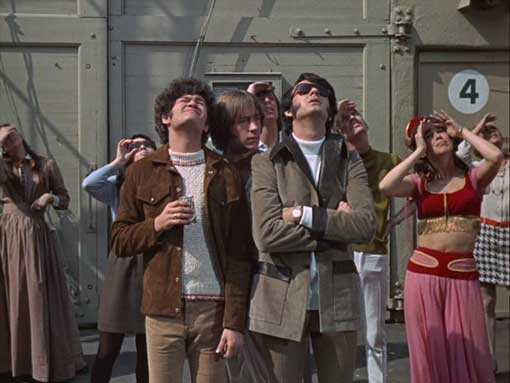
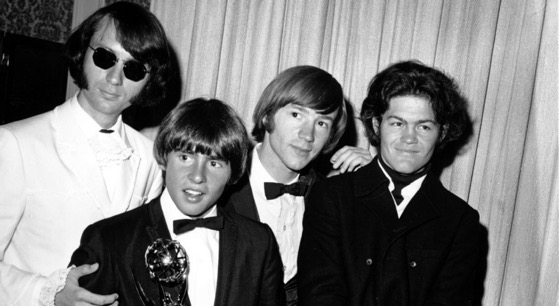
Okay, I’ll admit it. They’re not the “Fab Four.” In fact, they are best known for being the “Prefab Four.” Still, that amusing — if somewhat misleading — moniker should in no way deter The Monkees from gaining enshrinement in the Rock and Roll Hall of Fame in Cleveland, Ohio. For the 1960s pop music quartet of Michael Nesmith, Peter Tork, Micky Dolenz and the late Davy Jones, who created such chart-topping hits as “I’m a Believer,” “Daydream Believer” and “Last Train to Clarksville,” deserve to be on the scenic shores of Lake Erie as much as any of this year’s inductees.
* A portion of each sale from Amazon.com directly supports our blogs ** Many of these books may be available from your local library. Check it out! † Available from the LA Public Library
“When interviewing Hollywood stars, St. Johns saw beyond the glamour. She knew the extravagant woman on the red carpet was not that different from the average woman. Both fight to make a living and that battle is worthy of recognition.”
Adela Rogers St. Johns: Survival of the Feisty by Sarah Whorton
* A portion of each sale from Amazon.com directly supports our blogs ** Many of these books may be available from your local library. Check it out! † Available from the LA Public Library
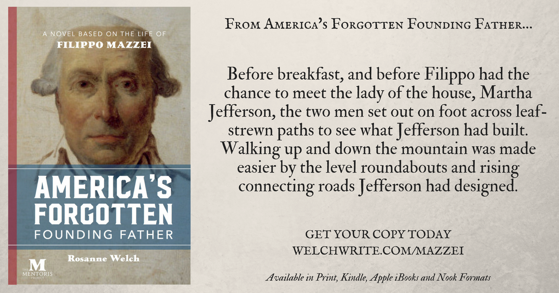
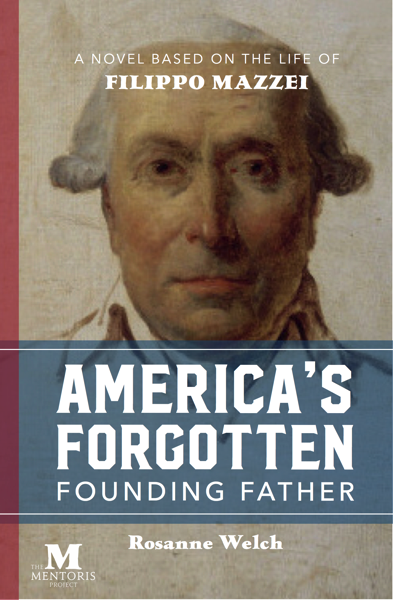
Before breakfast, and before Filippo had the chance to meet the lady of the house, Martha Jefferson, the two men set out on foot across leaf-strewn paths to see what Jefferson had built. Walking up and down the mountain was made easier by the level roundabouts and rising connecting roads Jefferson had designed.
For her 5th Doctor Who lecture to the CPP community, Dr. Rosanne Welch discusses how society – and the show’s writing staff – prepared the audience for a major change in this 50-year franchise – the creation of the first Lady Doctor!
Transcript:
Then we have Rose who came into the new Doctor Who with Christopher Eccleston and stayed threw David and Rose is a interesting character because she looks like she’s not that smart — she’s a shop girl, she really can’t keep a job etc — but she always steps up to the plate when necessary. She’s always able to take care of The Doctor when he can’t and that’s a pretty powerful job if you want. And then we come to Martha — who some people think The Doctor didn’t treat very nicely because she was the girl after the girl he loved because he fell in love with Rose and then the new girlfriend shows up. But she’s not meant to be a girlfriend. Right? She’s meant to be a companion. Except that then she fell for him, which is always a bad thing. Don’t fall for a guy after the last relationship, but I think you can find that that shows us strength too. First of all, one of the best storylines was for a whole year she walked the Earth to tell people about The Doctor in order to save his life. It is a pretty cool episode, right? So that’s one thing, She essentially saves his life. That’s a strength.
Rosanne Welch PhD teaches the History of Screenwriting and One-Hour Drama for the Stephens College MFA in Screenwriting.
Writing/producing credits include Beverly Hills 90210, Picket Fences, ABCNEWS: Nightline and Touched by an Angel. In 2016 she published the book Why The Monkees Matter: Teenagers, Television and American Pop; co-edited Women in American History: A Social, Political, and Cultural Encyclopedia; and placed “Transmitting Culture Transnationally Via the Characterization of Parents in Police Procedurals” in the New Review of Film and Television Studies. Essays appear in Torchwood Declassified: Investigating Mainstream Cult Television and Doctor Who and Race: An Anthology. Welch serves as Book Reviews editor for Journal of Screenwriting and on the Editorial Advisory Board for Written By magazine, the magazine of the Writers Guild.
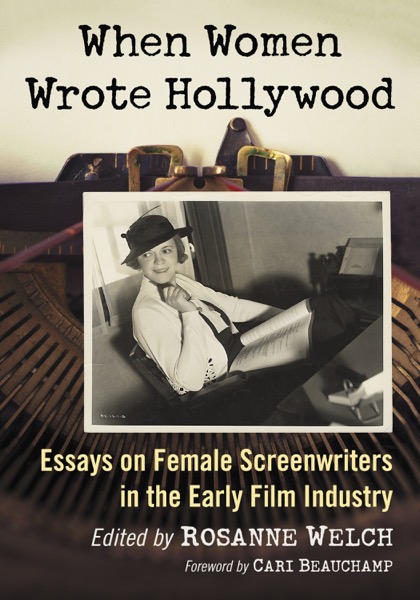
These 23 essays cover a range of female screenwriters from the early years of film through the 1940s, women whose work helped create the unforgettable stories and characters beloved generations of audiences but whose names have been left out of most film histories. Not this one. This collection is dedicated to those women and written by a group of women grateful to stand on the shoulders of those who came before – as a beacon to those who will come after.
Many thanks to the essay contributors who joined us and spoke so eloquently about the women writers they had researched: Toni Anita Hull, Laura Kirk, Amelia Phillips, Sarah Phillips, Julie Berkobien, Khanisha Foster, Lauren Smith, and to Cari Beauchamp, who wrote the Forward to the collection.
* A portion of each sale from Amazon.com directly supports our blogs ** Many of these books may be available from your local library. Check it out! † Available from the LA Public Library
It’s not quite the loss of a Beatle. But it’s obviously up there in pop culture significance, considering how TV and other media played up Wednesday’s news of the death of Davy Jones, star of TV touchstone The Monkees and the top-selling rock band of the same name.
Some will scoff — The Monkees were a manufactured group, their ’60s show looks silly, et al. But Davy Jones’ death seemed to strike a chord in baby boomers — and even in younger culture vultures, who still hear Monkees tunes like “Daydream Believer” on oldies radio, on movie soundtracks, or as background sound in public places.
Maybe it’s because The Monkees stand for a particular pop culture moment, at a confluence of events, trends and fault lines. The show’s 1966-68 TV run essentially defines the morph of what we’ll call the Mad Men ’60s — on-the-surface simple, sunny, neat — into the Vietnam-era, with all of its messy, moody, culture-shift conflicts.
* A portion of each sale from Amazon.com directly supports our blogs ** Many of these books may be available from your local library. Check it out! † Available from the LA Public Library
“From copyright records, we know that almost half of all films made before 1925 were written by women yet too often their names are found only in the footnotes of Hollywood histories.”
* A portion of each sale from Amazon.com directly supports our blogs ** Many of these books may be available from your local library. Check it out! † Available from the LA Public Library
This collection of 23 new essays focuses on the lives of female screenwriters of Golden Age Hollywood, whose work helped create those unforgettable stories and characters beloved by audiences–but whose names have been left out of most film histories. The contributors trace the careers of such writers as Anita Loos, Adela Rogers St. Johns, Lillian Hellman, Gene Gauntier, Eve Unsell and Ida May Park, and explore themes of their writing in classics like Gentlemen Prefer Blondes, Ben Hur, and It’s a Wonderful Life.




![25 Rose and Martha Jones from Gender Diversity in the Who-niverse [Video] (0:57)](https://rosannewelch.com/wp-content/uploads/2018/08/gender-dw-25-rose-martha.jpeg)
![“When Women Wrote Hollywood” Book Launch Event [Video] (31:40)](https://rosannewelch.com/wp-content/uploads/2018/08/wwwh-cover-large-1.jpg)