
DTLA Film Festival panel discussion, Privileged Characters: How to recognize and avoid implicit bias in your screenwriting. via Instagram

Quotes from When Women Wrote Hollywood – 50 and End in a series – “…her female-centric work failed to find acclaim with critics.”
Do you know about these women screenwriters? Many don’t. Learn more about them today!
Buy “When Women Wrote Hollywood” Today!

Zoë Akins is described as “a perplexing figure in the history of American theatre” by historian Yvonne Shafer (58). Akins was a poet, novelist, playwright, and screenwriter. Despite many successful publications, productions, films, and a Pulitzer Prize, she is not considered an obvious success. In creative fields dominated by the male perspective, her female-centric work failed to find acclaim with critics.
Zoë Akins: A Quiet Rebellion
by Sarah Whorton
Buy a signed copy of when Women Write Hollywood or Buy the Book on Amazon
†
Paperback Edition | Kindle Edition | Google Play Edition
* A portion of each sale from Amazon.com directly supports our blogs
** Many of these books may be available from your local library. Check it out!
† Available from the LA Public Library
Teachers! Get A FREE Mentoris Adventure Lesson Plan on Filippo Mazzei, America’s Forgotten Founding Father

We love teachers at The Mentoris Project! You inspire your students, us and the world–just like the unsung heroes in our Mentoris books.
We want to say thanks with this FREE Mentoris Adventure Lesson Plan.
Breathe like back into your classroom with this creative lesson plan. It isn’t for the classroom— it’s an adventure!
On America’s Forgotten Founding Father: A Novel Based on the Life of Filippo Mazzei by Rosanne Welch
His loyalty lasted a lifetime… Surgeon, merchant, vintner, and writer Filippo Mazzei influenced American business, politics, and philosophy. Befriending Benjamin Franklin and Thomas Jefferson, Mazzei was a strong liaison for others in Europe. Mazzei was Jefferson’s inspiration for the most famous line in the Declaration of Independence: “All men are created equal.” Clearly, Mazzei had a gift of language and often used his words to share his ideas about religious freedom. Mazzei encouraged other Italians still living overseas to join him in a country rich with opportunity and promise. Often, when returning from Italy, he booked passages on ships for people who desired to travel to America and employed them on his estate—just to ensure a better, more fruitful life for everyone. During those travels, Mazzei found himself at the center of many fights for freedom. He was truly a friend to freedom around the world.
Presenting “When Women Wrote Horror” at the Cal Poly Pomona University Library as a Halloween event
Presenting “When Women Wrote Horror” at the Cal Poly Pomona University Library as a Halloween event

Video of this talk is coming soon!
* A portion of each sale from Amazon.com directly supports our blogs
** Many of these books may be available from your local library. Check it out!
DTLA Film Festival panel discussion, Privileged Characters: How to recognize and avoid implicit bias in your screenwriting via Instagram

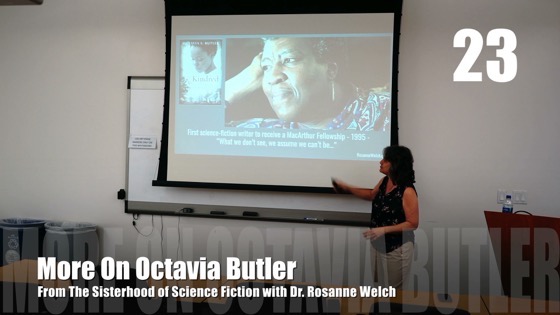
23 More On Octavia Butler from The Sisterhood of Science Fiction – Dr. Rosanne Welch [Video] (33 seconds)
Watch this entire presentation
Subscribe to Rosanne’s Channel and receive notice of each new video!
This one allowed me to riff on some of my favorite female science fiction writers across time, whether they be novelists or television writers. It also opened up a good conversation on what art we support and include in our lives – and what that art says to us and about us. — Rosanne
Transcript:
I think particularly this quote is an important one to think about — “what science fiction can do for us…”, right, “What we don’t see , we assume we can’t be.” So it’s very important to her to put African Americans into the future to see that they exist in the future. That meant something to her. Just like the other female writers were putting women in powerful positions in the future because they wanted girls to see role models like that. So that’s the quote I think that should stick with us because it’s an important thought and a lot of the media that we consume — what are we giving our money – what are we supporting what do we want to see more of right?
* A portion of each sale from Amazon.com directly supports our blogs
** Many of these books may be available from your local library. Check it out!
Podcast: Play in new window | Download
Subscribe: RSS
DTLA Film Festival panel discussion via Instagram

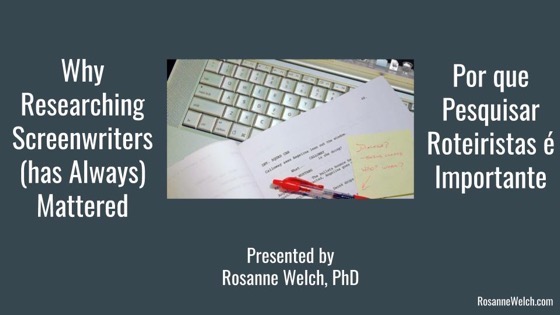
Why Researching Screenwriters (has Always) Mattered – 10th Screenwriters´ (hi)Stories Seminar – Dr. Rosanne Welch
*** Note: Introduction is in Portuguese, but the presentation is entirely in English
Subscribe to Rosanne’s Channel and receive notice of each new video!
My keynote speech at the 10th Screenwriters´(hi)Stories Seminar for the interdisciplinary Graduation Program in “Education, Art, and History of Culture”, in Mackenzie Presbyterian University, at São Paulo, SP, Brazil, focused on the topic “Why Researching Screenwriters (has Always) Mattered.” I was especially pleased with the passion these young scholars have toward screenwriting and it’s importance in transmitting culture across the man-made borders of our world.
To understand the world we have to understand its stories and to understand the world’s stories we must understand the world’s storytellers. A century ago and longer those people would have been the novelists of any particular country but since the invention of film, the storytellers who reach the most people with their ideas and their lessons have been the screenwriters. My teaching philosophy is that: Words matter, Writers matter and Women writers matter s– o women writers are my focus because they have been the far less researched and yet they are over half the population. We cannot tell the stories of the people until we know what stories the mothers have passed down to their children. Those are the stories that last. Now is the time to research screenwriters of all cultures and the stories they tell because people are finally recognizing the work of writers and appreciating how their favorite stories took shape on the page long before they were cast, or filmed, or edited. But also because streaming services make the stories of many cultures now available to a much wider world than ever before.
Many thanks to Glaucia Davino for the invitation.
Paperback Edition | Kindle Edition | Google Play Edition
* A portion of each sale from Amazon.com directly supports our blogs
** Many of these books may be available from your local library. Check it out!
† Available from the LA Public Library
Podcast: Play in new window | Download
Subscribe: RSS
From The Journal Of Screenwriting 5 : Crafting an ‘authentic’ monster: Dialogue, genre and ethical questions in Mindhunter (2017)
Highlighting the articles in the latest edition of the Journal of Screenwriting, of which I am the Book Reviews Editor. Hopefully these abstracts will entice you to did a little deeper into the history and future of screenwriting. — Rosanne
Crafting an ‘authentic’ monster: Dialogue, genre and ethical questions in Mindhunter (2017)
Erica Moulton
Extended scenes of idiosyncratic dialogue between a serial killer and profiler are emblematic of the first season of Joe Penhall and David Fincher’s Netflix series Mindhunter. In examining this aspect of the series, my article engages with several burgeoning areas of study in screenwriting and adaptation, notably the intersection of ethics, genre and dialogue. Mindhunter falls squarely into the serial killer subset of the crime procedural genre, following two FBI agents as they interview incarcerated killers under the purview of the newly formed Behavioral Science Unit. In exploring the origin and deployment of highly psychologized speech, I argue that conventions within the serial killer subgenre and the invocation of non-fictional source material led the show’s writers to rely on codes of ‘authenticity’ in crafting the dialogue. Building on studies of screenwriting and genre by Jule Selbo, I also argue that the interview scenes depicted on Mindhunter between the FBI agents and the serial killers can be broken down into various dialogue typologies. The dialogue in these scenes presents the killer as a fount of wisdom, the investigator as an eager receptacle and the psychological boundaries between the two characters as disturbingly permeable. I conclude by probing the ethical underpinnings of this typology considering how screenwriters navigate the tensions between on-screen representation and the framing of ‘authentic’ content.
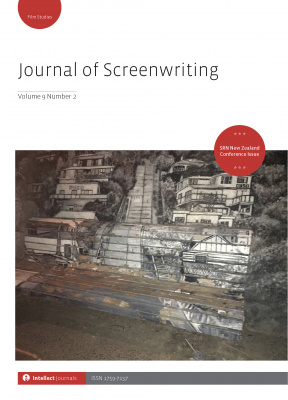
The Journal of Screenwriting is an international double-blind peer-reviewed journal that is published three times a year. The journal highlights current academic and professional thinking about the screenplay and intends to promote, stimulate and bring together current research and contemporary debates around the screenplay whilst encouraging groundbreaking research in an international arena. The journal is discursive, critical, rigorous and engages with issues in a dynamic and developing field, linking academic theory to screenwriting practice.
Get your copy and subscription to the Journal of Screenwriting Today!
* A portion of each sale from Amazon.com directly supports our blogs
** Many of these books may be available from your local library. Check it out!