Grace Notes: A Novel Based on the Life of Henry Mancini By Stacia Raymond – Italian-American Heritage Month – 13 in a series

Grace Notes: A Novel Based on the Life of Henry Mancini By Stacia Raymond - Italian-American Heritage Month - 13 in a series

Buy Your Copy Today!

Celebrating a giant of American popular music… 

With a legacy that resonates today in the work of contemporary film composers, the magnanimous Henry Mancini left an indelible mark on the culture. Over the course of a life cut short, Mancini helped liberate a concentration camp at the end of WWII, created some of the most iconic film and television themes ever written, and unseated the Beatles from the number one spot at the apex of rock and roll. 

Resurrected through dialogue portraying pivotal scenes from his life, readers will get to know Mancini like never before—and come to appreciate this national treasure who fought for equality while bringing out the beauty of the world through his artistry.


Join the Rosanne Welch Mailing List for future book and event announcements!
 

Also from the Mentoris Project

Want to use these books in your classroom? Contact the Mentoris Project!`

A.P. Giannini, The People’s Banker By Francesca Valente – Italian-American Heritage Month – 12 in a series

A.P. Giannini, The People's Banker By Francesca Valente - Italian-American Heritage Month - 12 in a series

Buy Your Copy Today!

The story of a dreamer…

Envisioning a socio-economic utopia, A. P. Giannini was not a typical banking tycoon. With a socially enlightened heart, he made the American dream a reality, not just for himself, but for society as a whole.

In spite of devastating personal obstacles, such as the death of his father, Giannini became the world’s leading banker of the twentieth century. Raised by hardworking peasant immigrants in what was considered a backwater area of California, Giannini received his economic education in an unconventional way, paving the way for his rise to prosperity.  

Founding the Bank of Italy for poor immigrant families, he wanted to overcome the barriers put in place by the conservative current banking elite to fulfill the dreams of “little guys.”  

Soon, the Bank of Italy became the Bank of America and the poor Italian was now in a position to help dreamers such as Walt Disney achieve their own dreams. Giannini also shaped the San Francisco skyline by financing the bold Golden Gate Bridge. His influences and hard work can be seen all over the country, simply because he believed in “a more general distribution of wealth and happiness.” 


Join the Rosanne Welch Mailing List for future book and event announcements!
 

Also from the Mentoris Project

Want to use these books in your classroom? Contact the Mentoris Project!`

Quotes from When Women Wrote Hollywood – 8 in a series – Strong Willed Woman

Quotes from When Women Wrote Hollywood - 8 in a series - Strong Willed Woman

Get your copy today!

“Frederica Sagor Maas moved to Hollywood in 1924 and as was true for many young women, those who were considered good looking were pushed towards being seen on screen. Being the strong willed woman that she was, Mass decided she still wanted to be a writer.”

The Best Revenge Is Outliving Them All: The life and heartbreak of Frederica Sagor Maas
Mikayla Daniels


Buy a signed copy of when Women Write Hollywood

or Buy the Book on Amazon


Paperback Edition | Kindle Edition | Google Play Edition

* A portion of each sale from Amazon.com directly supports our blogs
** Many of these books may be available from your local library. Check it out!
† Available from the LA Public Library

Women Rock! First Female Doctor Who premiere hist 10 year ratings high!

Women Rock! First Female Doctor Who premiere hist 10 year ratings high!

Folks (mostly male critics) predicted 5 million in the overnights – she it 8 million+

Harvesting the American Dream: A Novel Based on the Life of Ernest Gallo By Karen Richardson – Italian-American Heritage Month – 11 in a series

Harvesting the American Dream: A Novel Based on the Life of Ernest Gallo By Karen Richardson - Italian-American Heritage Month - 11 in a series

Buy Your Copy Today!

A toast to the man who changed how America drinks …

Enduring an unspeakable nightmare and a family secret that he guarded at all costs, Ernest Gallo overcame unimaginable odds to achieve the American dream.

Ernest Gallo (the “E” of E & J Gallo) may have been haunted by tragedy, but that didn’t deter him from his mission:  putting a bottle of wine on every American table.  

Gallo grew his legacy from the musty Modesto, California dirt. From fallow acres he practically willed the wine industry into being out of faith and tenacity as he overcame physical and emotional abuse, illness, and the near destruction of the family he was determined to save. 


Join the Rosanne Welch Mailing List for future book and event announcements!
 

Also from the Mentoris Project

Want to use these books in your classroom? Contact the Mentoris Project!`

When Women Wrote Hollywood – 33 in a series – The Little Foxes (1941) – Wr: Lillian Hellman

To highlight the wonderful yet largely forgotten work of a collection of female screenwriters from the early years of Hollywood (and as a companion to the book, When Women Wrote Hollywood) we will be posting quick bits about the many films they wrote along with links to further information and clips from their works which are still accessible online. Take a few moments once or twice a week to become familiar with their names and their stories. I think you’ll be surprised at how much bold material these writers tackled at the birth of this new medium. — Rosanne Welch

When Women Wrote Hollywood – 33 in a series – The Little Foxes (1941) – Wr: Lillian Hellman

When Women Wrote Hollywood - 33 in a series -  The Little Foxes (1941) - Wr: Lillian Hellman

The Little Foxes (1941) is an American drama film directed by William Wyler. The screenplay by Lillian Hellman is based on her 1939 play The Little Foxes. Hellman’s ex-husband Arthur Kober, Dorothy Parker and her husband Alan Campbell contributed additional scenes and dialogue.[2]

The title comes from Chapter 2, Verse 15 in the Song of Solomon in the King James version of the Bible, which reads, “Take us the foxes, the little foxes, that spoil the vines: for our vines have tender grapes.”[3] The same passage also inspired the title of an unrelated film, Our Vines Have Tender Grapes.

Southern aristocrat Regina Hubbard Giddens (Bette Davis) struggles for wealth and freedom within the confines of an early 20th-century society where a father considered only sons as legal heirs. As a result, her avaricious brothers, Benjamin (Charles Dingle) and Oscar (Carl Benton Reid), are independently wealthy, while she must rely for financial support upon her sickly husband Horace (Herbert Marshall), who has been away undergoing treatment for a severe heart condition. — Wikipedia 

More about The Little Foxes (1941)

More about Lillian Hellman

More books by and about Lillian Hellman


Buy a signed copy of when Women Wrote Hollywood


Paperback Edition | Kindle Edition | Google Play Edition

* A portion of each sale from Amazon.com directly supports our blogs
** Many of these books may be available from your local library. Check it out!
† Available from the LA Public Library

Are those #unicorns I see entering Noah’s Ark!? via Instagram

Are those #unicorns I see entering Noah’s Ark!? via Instagram

Are those #unicorns I see entering Noah’s Ark!?

Painting Detail, Noah’s Ark Series, Chiesa di San Maurizio al Monastero Maggiore 

Instagram and Follow


Learn more about Milan

* A portion of each sale from Amazon.com directly supports our blogs
** Many of these books may be available from your local library. Check it out!
† Books available at the LA Public Library

A Milano Street Scene in Black and White via Instagram

A Milano Street Scene in Black and White via Instagram

A Milano Street Scene in Black and White

Strolling along the tree-lined boulevards of Milano on the way to the Brera District. 

Buy this photo as Poster, Canvas Print, Art Board, Framed Print, Art Print, Metal Print, Cards and Notebooks

Buy this photo as Poster, Canvas Print, Art Board, Framed Print, Art Print, Metal Print, Cards and Journal

Instagram and Follow


Learn more about black and white photography

Learn more about Milan

* A portion of each sale from Amazon.com directly supports our blogs
** Many of these books may be available from your local library. Check it out!
† Books available at the LA Public Library

Saving the Republic: A Novel Based on the Life of Marcus Cicero By Eric D. Martin – Italian-American Heritage Month – 10 in a series

Saving the Republic: A Novel Based on the Life of Marcus Cicero By Eric D. Martin - Italian-American Heritage Month - 10 in a series

Buy Your Copy

A boy, weak of body, became a pillar of strength.

As the first century approached, a sickly boy was born while the Roman Republic was nearing its ultimate demise. The boy’s life and the country both hung in the balance.  

But the strong and determined young man grew to be the Republic’s fiercest defender. With his dogged determination and towering intellect, Marcus Tullius Cicero became a famed statesman, celebrated orator, and an esteemed philosopher.  

Surviving civil wars, political intrigues, and assassination attempts, Cicero pushed against the grain, standing steadfastly in support of the Republic, even when it threatened his career—or his life.


Join the Rosanne Welch Mailing List for future book and event announcements!
 

Also from the Mentoris Project

Want to use these books in your classroom? Contact the Mentoris Project!`

20 Metatextuality and The Monkees from How The Monkees Changed Television [Video] (0:58)

What this entire presentation — How The Monkees Changed Television with Rosanne Welch, PhD (Complete Presentation and Q&A) [Video] (45:06)

20 Metatextuality and The Monkees from How The Monkees Changed Television [Video] (0:58)

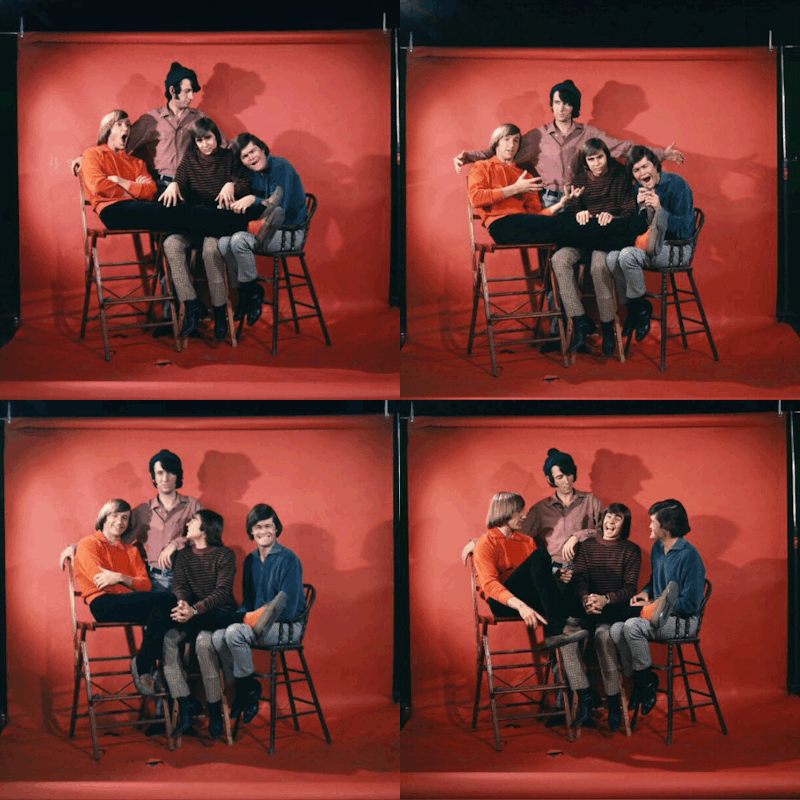
Rosanne Welch, PhD, Author of Why The Monkees Matter, presents “How The Monkees Changed Television” at a Cal State Fullerton Lunch Lecture on May 8, 2018.

In this talk, she shows how The Monkees, and specifically their presence on television, set the stage for large changes to come in the late 1960s.


Transcript

In this metatextuality world, they weren’t — The Monkees weren’t the first ones to do it. We can go back to George Burns and Jack Benny and they talked directly to the screen. George would be having a problem with Gracie then he would walk into his study and look right at you and say “Well, what’s Gracie gotten us into now?” So talking to the audience — breaking the fourth wall — it’s been done before, but no one was doing it right there in the 60’s so I think it’s interesting that our guys jumped in and did that. And you see that in a lot of ways. They would write on the screen, so in the Pilot, you have dancing and then ‘Typical Teenager? No, friends of the producer.” So there were often those kinds of inside jokes so they’re talking to the audience. They’re letting you in on the joke which made a younger audience, a hipper audience think “Wow. We’re part of this things. That’s really exciting.” Now we also have the fact that they were on NBC and in one of the episodes they were running through town and they were at NBC. It’s a little knock knock cute.


 Buy Why The Monkees Matter: Teenagers, Television and American Pop Culture


A hit television show about a fictitious rock band, The Monkees (1966-1968) earned two Emmys–Outstanding Comedy Series and Outstanding Directorial Acheivement in Comedy.

Capitalizing on the show’s success, the actual band formed by the actors, at their peak, sold more albums than The Beatles and The Rolling Stones combined, and set the stage for other musical TV characters from The Partridge Family to Hannah Montana. In the late 1980s, the Monkees began a series of reunion tours that continued into their 50th anniversary.

This book tells the story of The Monkees and how the show changed television, introducing a new generation to the fourth-wall-breaking slapstick created by Laurel and Hardy and the Marx Brothers.

Its creators contributed to the innovative film and television of 1970s with projects like Bob & Carol & Ted & Alice, The Mary Tyler Moore Show, Laugh-In and Welcome Back, Kotter. Immense profits from the show, its music and its merchandising funded the producers’ move into films such as Head, Easy Riderand Five Easy Pieces.

McFarland (Direct from Publisher) | Amazon | Kindle Edition | Nook Edition

Want to use “Why The Monkees Matter” in your classroom?

Order Examination Copies, Library and Campus Bookstore orders directly from McFarland

McFarland Company logo