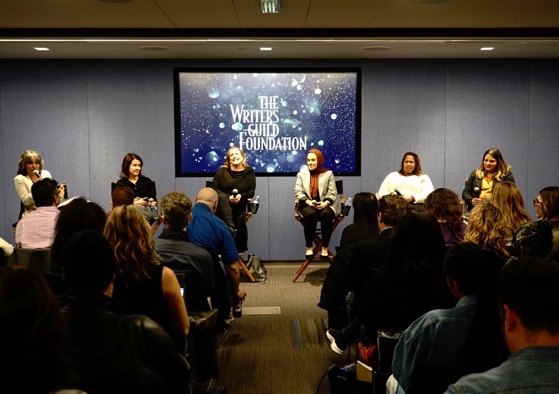
The Stephens College MFA in TV and Screenwriting program teamed up with the Writers Guild Foundation to pull the covers back on a topic that still makes viewers blush: sex. On this special evening, our panel of TV writers and producers share how they approach writing about sex, from intimate scenes to revealing dialogue, and the nuances they consider when crafting stories about sex and sexuality.
Panelists:
Michelle Ashford – Masters of Sex, The Pacific
Cindy Chupack – I’m Dying Up Here, Divorce, Sex and the City
Sahar Jahani – 13 Reasons Why, Ramy
Dayna Lynne North – Insecure, Single Ladies, Lincoln Heights
Months of research went into the creation of the essays in “When Women Wrote Hollywood.” Here are some of the resources used to enlighten today’s film lovers to the female pioneers who helped create it.
The first full-length study of the authorial and cross-media practices of the English novelist Elinor Glyn (1864-1943), Elinor Glyn as Novelist, Moviemaker, Glamour Icon and Businesswoman examines Glyn’s work as a novelist in the United Kingdom followed by her success in Hollywood where she adapted her popular romantic novels into films. Making extensive use of newly available archival materials, Vincent L. Barnett and Alexis Weedon explore Glyn’s experiences from multiple perspectives, including the artistic, legal and financial aspects of the adaptation process. At the same time, they document Glyn’s personal and professional relationships with a number of prominent individuals in the Hollywood studio system, including Louis B. Mayer and Irving Thalberg. The authors contextualize Glyn’s involvement in scenario-writing in relationship to other novelists in Hollywood, such as Edgar Wallace and Arnold Bennett, and also show how Glyn worked across Europe and America to transform her stories into other forms of media such as plays and movies. Providing a new perspective from which to understand the historical development of both British and American media industries in the first half of the twentieth century, this book will appeal to historians working in the fields of cultural and film studies, publishing and business history.
* A portion of each sale from Amazon.com directly supports our blogs
** Many of these books may be available from your local library. Check it out!
† Available from the LA Public Library
The Stephens College MFA in TV and Screenwriting program teamed up with the Writers Guild Foundation to pull the covers back on a topic that still makes viewers blush: sex. On this special evening, our panel of TV writers and producers share how they approach writing about sex, from intimate scenes to revealing dialogue, and the nuances they consider when crafting stories about sex and sexuality.
Panelists:
Michelle Ashford – Masters of Sex, The Pacific
Cindy Chupack – I’m Dying Up Here, Divorce, Sex and the City
Sahar Jahani – 13 Reasons Why, Ramy
Dayna Lynne North – Insecure, Single Ladies, Lincoln Heights
Subscribe to Rosanne’s Channel and receive notice of each new video!
This one allowed me to riff on some of my favorite female science fiction writers across time, whether they be novelists or television writers. It also opened up a good conversation on what art we support and include in our lives – and what that art says to us and about us. — Rosanne
Transcript:
My favorite picture of her is always this moment, where she breaks him down with no weapon just her mind and her courage. She’s like screw you dude. I could smell you when I walked in the room. Too bad right? That diplomat. That person who could do it with their voice and their inner strength. That’s the character that I like to remember better but you’re mostly gonna see these pictures and you know I didn’t put up the picture of her in the bikini and Jabba the Hutt because that’s just overdone — overdone and sad to say — much as I like George Lucas — pretty cool in many things he’s done, she does throw out reference in the book when she showed up as a 19-year-old all alone in England to film this movie with a bunch of dudes who are older than her. She’s not wearing a bra under that thing and when she asked George Lucas why he said there are no bras in the 25th century and it wasn’t till later in life she was like these guys just wanted to see me bouncing around without a bra. All the men on the crew just wanted to watch me without a bra. What do you mean there are no bras in the 25th century?! Who are you? You’re not the guy who invented that! So you know that’s kind of sad and kind of bums me out, but this is the Princess Leia that I like to remember. I think she’s powerful.
* A portion of each sale from Amazon.com directly supports our blogs ** Many of these books may be available from your local library. Check it out!
Subscribe to Rosanne’s Channel and receive notice of each new video!
Transcript:
Then we have this lady who I think is fascinating if you’re a Star Wars fan. Leigh Brackett. She’s mostly did all these kinds of space operas they called them right but she got hired to write the first draft of The Empire Strikes Back because George Lucas wanted her sci-fi brain on his property. The problem is she wrote the script — which there you are — and she died of cancer. So Lawrence Kasdan who I adore was hired to do the next draft in the next draft and Lawrence Kasdan becomes the writer we know from Star Wars but when you think about the Han Solo character, Leigh Brackett made him the cowboy that he is because she did cowboy movies and space operas. That’s the perfect blending of Han Solo. So she gave us that character in the incarnation that we know him in — which i think is cool.
Dr. Rosanne Welch discusses the women in her new book “When Women Wrote Hollywood” which covers female screenwriters from the Silents through the early 1940s when women wrote over 50% of films and Frances Marion was the highest paid screenwriter (male or female) and the first to win 2 Oscars. Yet, she fails to appear in film history books, which continue to regurgitate the myth that male directors did it all – even though it’s been proven that the only profitable movies Cecil B. de Mille ever directed were all written by Jeannie Macpherson film ever won for Best Picture was written by Robert E. Sherwood (who people have heard of, mostly due to his connection to Dorothy Parker) and Joan Harrison.
* A portion of each sale from Amazon.com directly supports our blogs ** Many of these books may be available from your local library. Check it out! † Available from the LA Public Library
Months of research went into the creation of the essays in “When Women Wrote Hollywood.” Here are some of the resources used to enlighten today’s film lovers to the female pioneers who helped create it.
* A portion of each sale from Amazon.com directly supports our blogs
** Many of these books may be available from your local library. Check it out!
† Available from the LA Public Library
Subscribe to Rosanne’s Channel and receive notice of each new video!
This one allowed me to riff on some of my favorite female science fiction writers across time, whether they be novelists or television writers. It also opened up a good conversation on what art we support and include in our lives – and what that art says to us and about us. — Rosanne
Transcript:
Now of course, post Star Trek, the next big star science fiction thing that’s going to happen is Star Wars. We all know that and so it’s interesting because now sometimes people go oh Princess Leia sort of sat there and waited to be rescued. Ehhh… it was a big deal back in the day that she fought her way out right? She grabbed the blaster and they jumped in the garbage chute and all those things. She was considered a much more active princess. She’s not as active as we want people to be today but she’s like a bridge between where they didn’t do anything and where they do everything but I think it’s an important thing to pay attention to. She writes a lot about that in her last book before Carrie Fisher died, The Princess Diarist. She writes about the experience of filming that. What I don’t like is that we sort of when you look up pictures of Princess Leia and you think power it’s because she’s always got that blaster in her hand. So we’re still equating power with the male concept of a weapon as opposed to the interior power that you bring.
* A portion of each sale from Amazon.com directly supports our blogs ** Many of these books may be available from your local library. Check it out!
Subscribe to Rosanne’s Channel and receive notice of each new video!
Transcript:
Moving through into the 50s, we come up with Harriet Frank Jr. — a woman going by Jr. because her mother was Harriet Frank and her mother was a reader at one of the studios which is how she got into the business of writing. She married Irving Ravetch and together they made several important films. To me, most important is Norma Rae. Again a very female based film which really falls into Harriet’s world and also Stanley and Iris and Murphy’s Romance are very female-focused stories. Harriet was a really strong woman — very involved in the Union which makes sense when you think about Norma Rae right? So again names people don’t really know because these are considered Martin Ritt films because he directed all four of them, because he was best friends with Frank and Ravetch. So they liked to hire directors they knew who wouldn’t muck up their work and I believe in those collaborations. I don’t — like I’m dissing directors. I don’t mean to. I like directors but there it’s an even collaboration and I think that’s what academia has to start referencing more than we do because that’s how writers get lost and if male writers are getting lost you know female writers getting even more lost right? So we need to keep thinking about it’s a — it’s a collaboration.
Dr. Rosanne Welch discusses the women in her new book “When Women Wrote Hollywood” which covers female screenwriters from the Silents through the early 1940s when women wrote over 50% of films and Frances Marion was the highest paid screenwriter (male or female) and the first to win 2 Oscars. Yet, she fails to appear in film history books, which continue to regurgitate the myth that male directors did it all – even though it’s been proven that the only profitable movies Cecil B. de Mille ever directed were all written by Jeannie Macpherson film ever won for Best Picture was written by Robert E. Sherwood (who people have heard of, mostly due to his connection to Dorothy Parker) and Joan Harrison.
* A portion of each sale from Amazon.com directly supports our blogs ** Many of these books may be available from your local library. Check it out! † Available from the LA Public Library
Months of research went into the creation of the essays in “When Women Wrote Hollywood.” Here are some of the resources used to enlighten today’s film lovers to the female pioneers who helped create it.
Marion Fairfax Productions in collabora- tion with Sam E. Rork have had erected a complete Algerian village for the company producing “The Desert Healer” under the di- rection of Maurice Tourneur. The principals in the cast include Lewis Stone, Barbara Bedford, Tully Marshall, Katherine MacDon- ald, Walter Pidgeon, Ann Rork, Arthur Rankin and Albert Conti.
* A portion of each sale from Amazon.com directly supports our blogs
** Many of these books may be available from your local library. Check it out!
† Available from the LA Public Library