When Women Wrote Hollywood – 21 in a series – Where Are My Children? (1916), Wr: Lois Weber, Dir: Phillips Smalley

To highlight the wonderful yet largely forgotten work of a collection of female screenwriters from the early years of Hollywood (and as a companion to the book, When Women Wrote Hollywood) we will be posting quick bits about the many films they wrote along with links to further information and clips from their works which are still accessible online. Take a few moments once or twice a week to become familiar with their names and their stories. I think you’ll be surprised at how much bold material these writers tackled at the birth of this new medium. — Rosanne Welch


When Women Wrote Hollywood – 21 in a series – Where Are My Children? (1916), Wr: Lois Weber, Dir: Phillips Smalley

When Women Wrote Hollywood - 21 in a series - Where Are My Children? (1916), Wr: Lois Weber, Dir: Phillips Smalley

Where Are My Children? is a 1916 American silent drama film directed by Phillips Smalley and Lois Weber and stars Tyrone Power, Sr., Juan de la Cruz, Helen Riaume, Marie Walcamp, Cora Drew, A.D. Blake, Rene Rogers, William Haben and C. Norman Hammond

The film tells the story of a district attorney (Power, Sr.) who, while prosecuting a doctor for illegal abortions, finds out that society people, including his wife, used the doctor’s services.

Richard Walton, a district attorney, is presented with an obscenity case: A medical practitioner, Dr. Homer, has been arrested for distributing ‘indecent’ birth control literature. On the stand, Dr. Homer makes a strong case for legalizing contraception. He recounts three incidents from his medical practice, each shown in a brief flashback: children are exposed to violent abuse in a family riddled with alcoholism; an impoverished family is unable to provide adequate medical care for their sick children; and a single mother, abandoned by her male lover, commits suicide with her young infant.

Meanwhile, Richard’s wife, Edith, has been keeping a secret from him for many years: she has been seeing a doctor, one Herman Malfit, who performs abortions so that her busy social life will not be interrupted by the inconvenience of pregnancy. She suggests it as an option for her friend Mrs. William Carlo, who is with child. Mrs. Carlo has the abortion.

The Waltons receive two new guests in their house almost simultaneously: Edith Walton’s ne’er-do-well younger brother, and their maid’s young daughter, Lillian. Smitten by the brother’s advances, the maid’s daughter is seduced and soon finds herself pregnant. She is taken to Dr. Malfit and then abandoned by the boy after the operation goes wrong. Making her way back to the Walton mansion, she collapses and dies from the botched abortion.

Following Malfit’s arrest and trial, Richard Walton examines the doctor’s ledgers and realized that his wife and many of her friends are listed as having received ‘personal services.’ He returns home, furious, to find them lunching at his home. He banishes his wife’s friends, saying ‘I should bring you to trial for manslaughter!’ and confronts Edith with the cry, ‘where are my children?’ She is overcome with remorse. As the years pass, the couple must contend with a lonely, childless life, full of longing for the family they might have had. Wikipedia 

Watch Where are my children?

More about “Where are my children?”

More about Lois Weber


Buy a signed copy of when Women Write Hollywood


Paperback Edition | Kindle Edition | Google Play Edition

* A portion of each sale from Amazon.com directly supports our blogs
** Many of these books may be available from your local library. Check it out!
† Available from the LA Public Library

Class of 2020 – Stephens College MFA in Screenwriting in Television via Instagram

Class of 2020 - Stephens College MFA in Screenwriting in Television via Instagram

Class of 2020 – Stephens College MFA in Screenwriting in Television 

Our latest class is in Los Angeles for their first workshop session so we took the opportunity to grab our first group photo. 

They’ll be back in August for another 10-day session and two more workshops in their second year. 

Always great to welcome a new set of MFA students each year!

Follow me on Instagram!

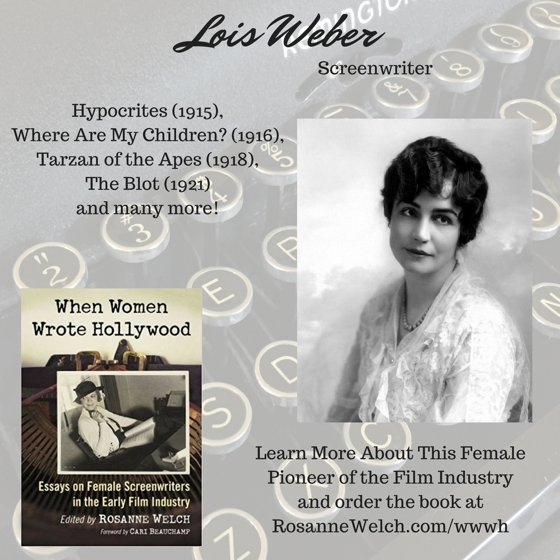
When Women Wrote Hollywood – 20 in a series – Lois Weber

To highlight the wonderful yet largely forgotten work of a collection of female screenwriters from the early years of Hollywood (and as a companion to the book, When Women Wrote Hollywood) we will be posting quick bits about the many films they wrote along with links to further information and clips from their works which are still accessible online. Take a few moments once or twice a week to become familiar with their names and their stories. I think you’ll be surprised at how much bold material these writers tackled at the birth of this new medium. — Rosanne Welch


When Women Wrote Hollywood – 20 in a series – Lois Weber

When Women Wrote Hollywood - 20 in a series - Lois Weber

Lois Weber (June 13, 1879 – November 13, 1939) was an American silent film actress, screenwriter, producer, and director, who is considered “the most important female director the American film industry has known”,[1] and “one of the most important and prolific film directors in the era of silent films”.[2][3] Film historian Anthony Slide asserts that: “Along with D.W. Griffith, Weber was the American cinema’s first genuine auteur, a filmmaker involved in all aspects of production and one who utilized the motion picture to put across her own ideas and philosophies.”[4]

Weber produced an oeuvre which Jennifer Parchesky argues is comparable to Griffith’s in both quantity and quality,[5] and brought to the screen her concerns for humanity and social justice in an estimated 200 to 400 films,[2][6] of which as few as twenty have been preserved,[7][8] and has been credited by IMDb with directing 135 films, writing 114, and acting in 100.[9] Weber was “one of the first directors to come to the attention of the censors in Hollywood’s early years”.[10] Wikipedia 

Watch a movie by Lois Weber

A clip from The Blot

More about Lois Weber


Buy a signed copy of when Women Write Hollywood


Paperback Edition | Kindle Edition | Google Play Edition

* A portion of each sale from Amazon.com directly supports our blogs
** Many of these books may be available from your local library. Check it out!
† Available from the LA Public Library

Books for Sale! – When Women Wrote Hollywood Book Launch Event via Instagram

Books for Sale! - When Women Wrote Hollywood Book Launch Event via Instagram

Books for Sale! – When Women Wrote Hollywood Book Launch Event

Many thanks to the essay contributors who joined us and spoke so eloquently about the women writers they had researched: Toni Anita Hull, Laura Kirk, Amelia Phillips, Sarah Phillips, Julie Berkobien, Khanisha Foster, Lauren Smith, and to Cari Beauchamp, who wrote the Forward to the collection.

Follow Rosanne Welch on Instagram


Buy a signed copy of when Women Write Hollywood

or Buy the Book on Amazon


* A portion of each sale from Amazon.com directly supports our blogs
** Many of these books may be available from your local library. Check it out!
† Available from the LA Public Library

When Women Wrote Hollywood Book Launch Event – August 11, 2018 [Photos]

When Women Wrote Hollywood Book Launch Event - August 11, 2018 [Photos]

See the entire collection of photos

In honor of the launch of our book of essays – When Women Wrote Hollywood – Jake Flynn, Communications Director for Councilmember Bob Blumenfield presented us this Certificate of Recognition from the Los Angeles City Council for “bringing students from throughout the country to Los Angeles and pairing them with mentors in the heart of the entertainment business…

The flexibility of the program allows for a diverse student body which in turn promotes the telling of stories that have not been heard before.” One certificate will return home to Stephens College with Dean Gail Humphries Mardirosian, who flew out to attend the launch, and the other two will stay with Ken and I here in Los Angeles.

Many thanks to the essay contributors who joined us and spoke so eloquently about the women writers they had researched: Toni Anita Hull, Laura Kirk, Amelia Phillips, Sarah Phillips, Julie Berkobien, Khanisha Foster, Lauren Smith, and to Cari Beauchamp, who wrote the Forward to the collection.


Buy a signed copy of when Women Write Hollywood

or Buy the Book on Amazon


* A portion of each sale from Amazon.com directly supports our blogs
** Many of these books may be available from your local library. Check it out!
† Available from the LA Public Library

24 Nyssa from Gender Diversity in the Who-niverse [Video] (0:42)

Watch this entire presentation: Gender Diversity in the Who-niverse: Paving the Way for a Lady Doctor with Dr. Rosanne Welch [Video] (36:58)

24 Nyssa from Gender Diversity in the Who-nivers [Video] (0:42)

For her 5th Doctor Who lecture to the CPP community, Dr. Rosanne Welch discusses how society – and the show’s writing staff – prepared the audience for a major change in this 50-year franchise – the creation of the first Lady Doctor!

Transcript:

Then we had Nyssa who I really enjoyed. Nyssa came in with the Peter Davison era with Teegan — who’s alright. Teegan has her moments. But Nyssa is an alien, super intelligent from her alien race and at the end of her time with The Doctor — thy end up on a planet where there’s a leper colony and nobody is taking care of these people and rather than — again — continuing to travel with The Doctor she chooses to stay and be a caregiver to these people. She’s a doctor so she can take care of them and imagines that she will find a cure for this if she stays behind and he’s like “well maybe this will never be cured” and she’s like “it won’t ever be cured if no one tries.” So she’s willing to give it that time which I think is a beautiful strength being evidenced by a female character. Not that hard.

Follow Dr. Welch on Twitter and Instagram
https://twitter.com/rosannewelchhttp://instagram.com/drrosannewelch


Rosanne Welch, PhD

Rosanne Welch PhD teaches the History of Screenwriting and One-Hour Drama for the Stephens College MFA in Screenwriting.

Writing/producing credits include Beverly Hills 90210, Picket Fences, ABCNEWS: Nightline and Touched by an Angel. In 2016 she published the book Why The Monkees Matter: Teenagers, Television and American Pop; co-edited Women in American History: A Social, Political, and Cultural Encyclopedia; and placed “Transmitting Culture Transnationally Via the Characterization of Parents in Police Procedurals” in the New Review of Film and Television Studies. Essays appear in Torchwood Declassified: Investigating Mainstream Cult Television and Doctor Who and Race: An Anthology. Welch serves as Book Reviews editor for Journal of Screenwriting and on the Editorial Advisory Board for Written By magazine, the magazine of the Writers Guild.

Watch Dr. Welch’s talk “The Importance of Having a Female Voice in the Room” at the 2016 TEDxCPP.

Rosanne Moderates the Women Comedy Writers Panel for the Writers Guild Foundation and Stephens College

Rosanne Moderates the Women Comedy Writers Panel for the Writers Guild Foundation and Stephens College
Pictured:  Gail Parent, Njeri Brown, Rosanne Welch, Natasha Leggero, Riki Lindhome, Christine Zander and Ken Lazebnik pose before the Women Comedy Writers Panel

I had a great time moderating another panel for the WGA Foundation and enjoyed meeting all these female comedy writers. We talked about the power of comedy to force us to face the issues of our day and the pure fun of finding your place in a writers room.

I took the opportunity to ask Gail Parent (of The Carol Burnett Show, and The Golden Girls) to sign my used copy of her novel Sheila Levine is Dead and Living in New York so now I have another book to add to my autographed shelf! 

It was wonderful to feel the reverence in the room whenever she spoke – coming from the audience as well as the panel. That kind of reverence for those who came before us is usually reserved for men, which made experiencing it so much more powerful.

Rosanne Moderates the Women Comedy Writers Panel for the Writers Guild Foundation and Stephens College

See all the pictures in this set on the Stephens College MFA in Screenwriting and Television Facebook Page

From The Research Vault: Hey, Hey, They Wrote The Monkees: How a few writers changed the hair-length (and face) of television, Written By, November/December 2012

From The Research Vault: Hey, Hey, They Wrote The Monkees: How a few writers changed the hair-length (and face) of television, Written By, November/December 2012

Early 1960s television characters came in a one-size-fits-all,  squeaky-clean-cut style, from Dr. Kildare in his white lab coat,  to Hoss Cartwright in his white Stetson, to Sr. Bertrille in her  white habit. That lasted until 7:30 p.m. Monday, September  12, 1966 when four long-haired teenagers began dancing a Monkeewalk while singing, “Hey, Hey, We’re the Monkees.”

Though it looked simple enough, the comedy was about  more than four struggling musicians living in a beach house  they couldn’t afford, without adult supervision, and hoping for  success while engaging in Marx(Bros)ian humor. According to  star Micky Dolenz, the only actor with previous television series experience: “It brought long hair into the living room and  changed the way teenagers were portrayed on television.”

Dolenz’s opinion is backed up by psychologist and author  Timothy Leary in The Politics of Ecstasy: “While it lasted, it  was a classic Sufi[ism] put-on. An early-Christian electronic  satire. A mystic magic show. A jolly Buddha laugh at hypocrisy. And woven into the fast-moving psychedelic stream of action  were the prophetic, holy, challenging words. Micky was rapping  quickly, dropping literary names, making scholarly references.”

Why The Monkees Matter: Teenagers, Television and American Pop Culture

Buy Your Copy Now!

* A portion of each sale from Amazon.com directly supports our blogs
** Many of these books may be available from your local library. Check it out!
† Available from the LA Public Library

It’s Time For History of Screenwriting 101! via Instagram

It’s Time For History of Screenwriting 101! via Instagram

It’s Time For History of Screenwriting 101!

My Stephens College MFA in Screenwriting students are in town for the next 20 days and we are diving into our work.

This is a low-residency program where most of the work is done online but each cohort (1st year and 2nd year) comes to LA twice each year and meets for 10 days of intense workshops and research at the Jim Henson Studio (originally the Chaplin Studio) in the heart of Hollywood.

This week is the first workshop for our new class of 2020. 

Follow Me On Instagram

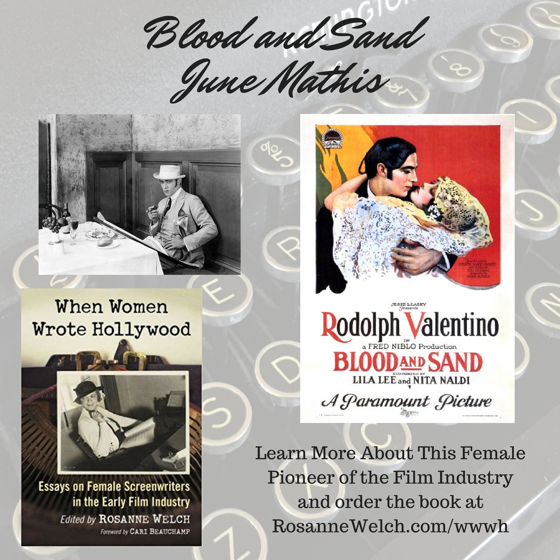
When Women Wrote Hollywood – 19 in a series – Blood and Sand starring Rudolph Valentino, Written for the screen by June Mathis

To highlight the wonderful yet largely forgotten work of a collection of female screenwriters from the early years of Hollywood (and as a companion to the book, When Women Wrote Hollywood) we will be posting quick bits about the many films they wrote along with links to further information and clips from their works which are still accessible online. Take a few moments once or twice a week to become familiar with their names and their stories. I think you’ll be surprised at how much bold material these writers tackled at the birth of this new medium. — Rosanne Welch


When Women Wrote Hollywood – 19 in a series – Blood and Sand starring Rudolph Valentino, Written for the screen by June Mathis

When Women Wrote Hollywood - 19 in a series - Blood and Sand starring Rudolph Valentino, Written for the screen by June Mathis

Blood and Sand is a 1922 American silent drama film produced by Paramount Pictures, directed by Fred Niblo and starring Rudolph Valentino, Lila Lee and Nita Naldi. It was based on the 1909 Spanish novel Sangre y arena (Blood and Sand) by Vicente Blasco Ibáñez and the play version of the book by Thomas Cushing.

Juan Gallardo (Valentino), a village boy born into poverty, grows up to become one of the greatest matadors in Spain. He marries a friend from his childhood, the beautiful and virtuous Carmen (Lee), but after he achieves fame and fortune he finds himself drawn to Doña Sol (Naldi), a wealthy, seductive widow.

They embark on a torrid affair with rather sadomasochistic overtones, but Juan, feeling guilty over his betrayal of Carmen, tries to free himself of Doña Sol. Furious at being rejected, she exposes their affair to Carmen and Juan’s mother, seemingly destroying his marriage. Growing more and more miserable and dissipated, Juan becomes reckless in the arena. He is eventually killed in a bullfight but does manage to reconcile with Carmen moments before he dies.

There is also a subplot involving a local outlaw whose career is paralleled to Juan’s throughout the film by the village philosopher: Juan’s fatal injury in the bullring comes moments after the outlaw is shot by the police.  Wikipedia  

Watch Blood and Sand

More on Blood and Sand

* A portion of each sale from Amazon.com directly supports our blogs
** Many of these books may be available from your local library. Check it out!
† Available from the LA Public Library

More about June Mathis


Buy a signed copy of when Women Write Hollywood


* A portion of each sale from Amazon.com directly supports our blogs
** Many of these books may be available from your local library. Check it out!
† Available from the LA Public Library