Another Fun Day at the Stephens MFA In Screenwriting Program

Stephens 2

Another Fun Day at the Stephens MFA In Screenwriting Program

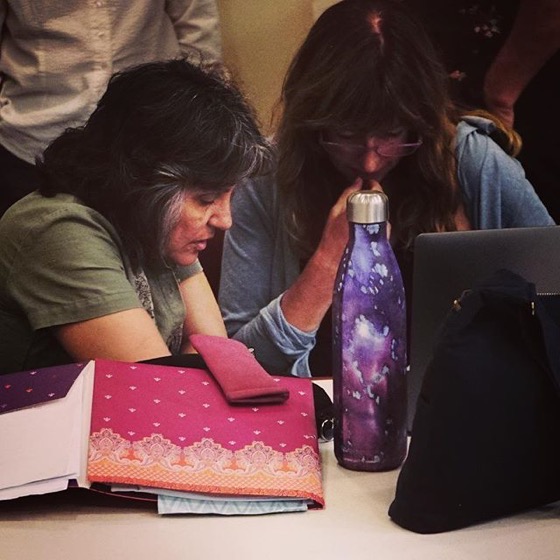
My Stephens College MFA in Screenwriting students are in town for the next 20 days and we are diving into our work.

This is a low-residency program where most of the work is done online but each cohort (1st year and 2nd year) comes to LA twice each year and meets for 10 days of intense workshops and research at the Jim Henson Studio (originally the Chaplin Studio) in the heart of Hollywood.

This week is the first workshop for our new class of 2020. 


Follow Me On Instagram

Working with MFA Students via Instagram

Working with MFA Students via Instagram

Working with MFA Students

My Stephens College MFA in Screenwriting students are in town for the next 20 days and we are diving into our work.

This is a low-residency program where most of the work is done online but each cohort (1st year and 2nd year) comes to LA twice each year and meets for 10 days of intense workshops and research at the Jim Henson Studio (originally the Chaplin Studio) in the heart of Hollywood.

This week is the first workshop for our new class of 2020. 

Follow Me On Instagram

When Women Wrote Hollywood – 18 in a series – June Mathis

To highlight the wonderful yet largely forgotten work of a collection of female screenwriters from the early years of Hollywood (and as a companion to the book, When Women Wrote Hollywood) we will be posting quick bits about the many films they wrote along with links to further information and clips from their works which are still accessible online. Take a few moments once or twice a week to become familiar with their names and their stories. I think you’ll be surprised at how much bold material these writers tackled at the birth of this new medium. — Rosanne Welch


When Women Wrote Hollywood – 18 in a series – June Mathis

When Women Wrote Hollywood - 18 in a series - June Mathis

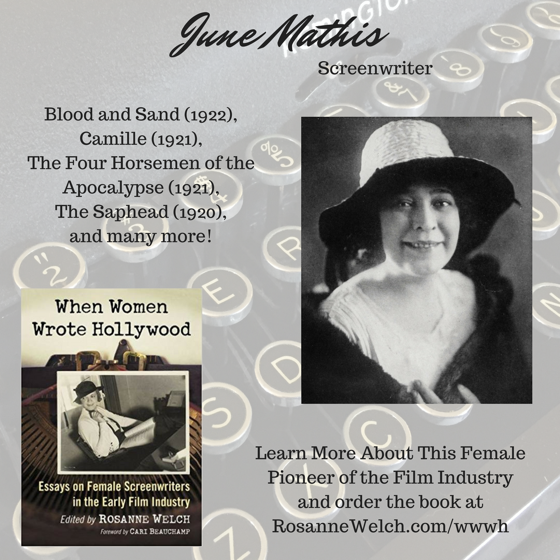
June Mathis (January 30, 1887 – July 26, 1927) was an American screenwriter. Mathis was the first female executive for Metro/MGM and at only 35, she was the highest paid executive in Hollywood.[1] In 1926 she was voted the third most influential woman in Hollywood, behind Mary Pickford and Norma Talmadge.[2] Mathis is best remembered for discovering Rudolph Valentino and writing such films as The Four Horsemen of the Apocalypse (1921) and Blood and Sand (1922).

Mathis was determined to become a screenwriter and, accompanied with her mother, she moved to New York City, where she studied writing and went to the movies in the evenings.[6] She entered a screenwriting competition; but despite not winning, her entry was so impressive it did bring job offers. Her first script, House of Tears, would be directed by Edwin Carewe in 1915 and led to a contract in 1918 with Metro studios, later to be merged into MGM. As one of the first screenwriters to include details such as stage directions and physical settings in her work, Mathis saw scenarios as a way to make movies into more of an art form. Much of the standard screenwriting styles can be attributed to her. Mathis later credited her success to a strong concentration on plot and theme: “No story that did not possess a theme has ever really lived…. Occasionally one may make money and perhaps be popular for a time. But in the end it dies.”[6]

By 1919 Mathis and her mother had moved to Hollywood. After only a year of screenwriting, she had advanced to the head of Metro’s scenario department.[7] She was one of the first heads of any film department and the only female executive at Metro.[8]

During her early years, she had a close association with silent star Alla Nazimova. Their films together can be said to be marked by over-sentimentality; what little praise these films received was due to Nazimova’s acting rather the conventional romantic stories.[6] Wikipedia 

Watch a movie by June Mathis

More about June Mathis


Buy a signed copy of when Women Write Hollywood


* A portion of each sale from Amazon.com directly supports our blogs
** Many of these books may be available from your local library. Check it out!
† Available from the LA Public Library

23 Sarah Jane Smith from Gender Diversity in the Who-niverse [Video] (0:54)

Watch this entire presentation: Gender Diversity in the Who-niverse: Paving the Way for a Lady Doctor with Dr. Rosanne Welch [Video] (36:58)

Sarah Jane Smith from Gender Diversity in the Who-niverse

For her 5th Doctor Who lecture to the CPP community, Dr. Rosanne Welch discusses how society – and the show’s writing staff – prepared the audience for a major change in this 50-year franchise – the creation of the first Lady Doctor!

Transcript:

Sarah Jane is one of my favorite companions. She’s come from the old Who to new Who and then she even had her own program The Sarah Jane Adventures. So what happened was she came into the Third Doctor’s life. She was an investigative reporter so she wasn’t some girl who did nothing and she wasn’t just reporting on fashion and/or celebrities. She was an investigative reporter. She looked for things that were wrong in her society and she highlighted that with being her newspaper writer. So that’s how she came to meet The Doctor. She traveled with him through Tom Baker obviously. Then she left and returned in an episode called School Reunion with David Tennant. So in the new Who era and at that time, of course, time had passed and she was invited to continue traveling and she had the strength and the intelligence to say No. I need to move on with my life. I’ve been thinking of you for too long. I need to have my own life.

Follow Dr. Welch on Twitter and Instagram
https://twitter.com/rosannewelchhttp://instagram.com/drrosannewelch


Rosanne Welch, PhD

Rosanne Welch PhD teaches the History of Screenwriting and One-Hour Drama for the Stephens College MFA in Screenwriting.

Writing/producing credits include Beverly Hills 90210, Picket Fences, ABCNEWS: Nightline and Touched by an Angel. In 2016 she published the book Why The Monkees Matter: Teenagers, Television and American Pop; co-edited Women in American History: A Social, Political, and Cultural Encyclopedia; and placed “Transmitting Culture Transnationally Via the Characterization of Parents in Police Procedurals” in the New Review of Film and Television Studies. Essays appear in Torchwood Declassified: Investigating Mainstream Cult Television and Doctor Who and Race: An Anthology. Welch serves as Book Reviews editor for Journal of Screenwriting and on the Editorial Advisory Board for Written By magazine, the magazine of the Writers Guild.

Watch Dr. Welch’s talk “The Importance of Having a Female Voice in the Room” at the 2016 TEDxCPP.

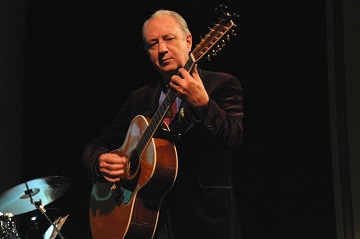
From The Research Vault: Michael Nesmith of the Monkees delights fans at Phoenixville’s Colonial Theatre, Joe Vallee, (2013, November 10).

From The Research Vault: Michael Nesmith of the Monkees delights fans at Phoenixville’s Colonial Theatre, Joe Vallee, (2013, November 10).

From The Research Vault: Michael Nesmith of the Monkees delights fans at Phoenixville's Colonial Theatre, Joe Vallee,  (2013, November 10).

Michael Nesmith of The Monkees isn’t exactly known for being a road warrior. With the exception of a few tours with his past and present Monkee bandmates (Davy Jones died in 2012), the last two years have brought Nesmith back to the road for his first official solo dates since 1992.

But don’t mistake this for indifference or laziness. Nesmith is more than just a musician. He’s an innovator (after all, he IS partially responsible for the beginning stages of MTV), thespian, Liquid Paper heir, novelist, entrepreneur and producer. Yes, Michael Nesmith never seems to have a problem staying occupied.

Over the last year Nesmith has cited several reasons for his long awaited return to the stage, but don’t expect a greatest hits package if he decides to stop by a venue near you.

Read Michael Nesmith of the Monkees delights fans at Phoenixville’s Colonial Theatre


Why The Monkees Matter: Teenagers, Television and American Pop Culture

Buy Your Copy Now!

* A portion of each sale from Amazon.com directly supports our blogs
** Many of these books may be available from your local library. Check it out!
† Available from the LA Public Library

When Women Wrote Hollywood – 17 in a series – “It” (1927) Starring Clara Bow, Wr: Elinor Glyn , Hope Loring , and, Louis D. Lighton , George Marion Jr.

To highlight the wonderful yet largely forgotten work of a collection of female screenwriters from the early years of Hollywood (and as a companion to the book, When Women Wrote Hollywood) we will be posting quick bits about the many films they wrote along with links to further information and clips from their works which are still accessible online. Take a few moments once or twice a week to become familiar with their names and their stories. I think you’ll be surprised at how much bold material these writers tackled at the birth of this new medium. — Rosanne Welch


When Women Wrote Hollywood – 17 in a series – “It” (1927) Starring Clara Bow, Wr: Elinor Glyn , Hope Loring , and, Louis D. Lighton , George Marion Jr.

When Women Wrote Hollywood - 17 in a series -

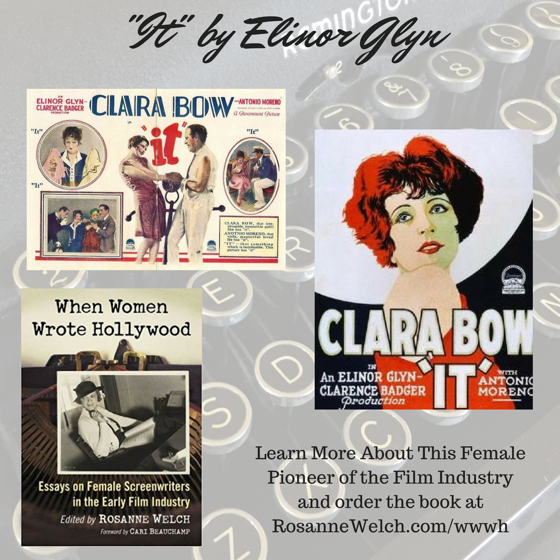
“It” is a 1927 silent romantic comedy film that tells the story of a shop girl who sets her sights on the handsome, wealthy boss of the department store where she works. It is based on a novella by Elinor Glyn that was originally serialized in Cosmopolitan magazine.

This film turned actress Clara Bow into a major star, and led people to label her the It girl.

The film had its world premiere in Los Angeles on January 14, 1927, followed by a New York showing on February 5, 1927. “It” was released to the general public on February 19, 1927.

The picture was considered lost for many years, but a Nitrate-copy was found in Prague in the 1960s.[1] In 2001, “It” was selected for preservation in the United States National Film Registry by the Library of Congress as being “culturally, historically, or aesthetically significant”. Wikipedia 

Watch the Movie

More information on It

More about Elinor Glyn


Buy a signed copy of when Women Write Hollywood


* A portion of each sale from Amazon.com directly supports our blogs
** Many of these books may be available from your local library. Check it out!
† Available from the LA Public Library

When Women Wrote Hollywood – 16 in a series – Elinor Glyn

To highlight the wonderful yet largely forgotten work of a collection of female screenwriters from the early years of Hollywood (and as a companion to the book, When Women Wrote Hollywood) we will be posting quick bits about the many films they wrote along with links to further information and clips from their works which are still accessible online. Take a few moments once or twice a week to become familiar with their names and their stories. I think you’ll be surprised at how much bold material these writers tackled at the birth of this new medium. — Rosanne Welch


When Women Wrote Hollywood – 16 in a series – Elinor Glyn

When Women Wrote Hollywood - 15 in a series - Elinor Glyn


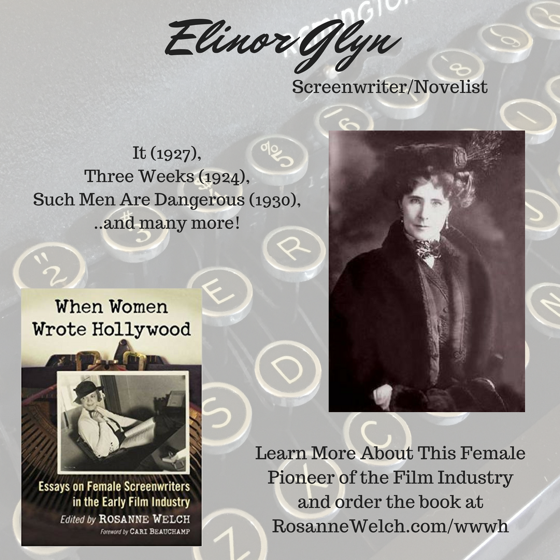
Elinor Glyn (née Sutherland; 17 October 1864 – 23 September 1943) was a British novelist and scriptwriter who specialised in romantic fiction that was considered scandalous for its time. She popularized the concept of It. Although her works are relatively tame by modern standards, she had tremendous influence on early 20th-century popular culture and perhaps on the careers of notable Hollywood stars such as Rudolph Valentino, Gloria Swanson and Clara Bow in particular.

Glyn pioneered risqué, and sometimes erotic, romantic fiction aimed at a female readership, a radical idea for its time—though her writing is not scandalous by modern standards. She coined the use of the word it to mean a human characteristic that “…draws all others with magnetic force. With ‘IT’ you win all men if you are a woman–and all women if you are a man. ‘IT’ can be a quality of the mind as well as a physical attraction.” [13] Her use of the word is often erroneously[citation needed]taken to be a euphemism for sexuality or sex appeal. Wikipedia 

When Women Wrote Hollywood - 15 in a series - Elinor Glyn

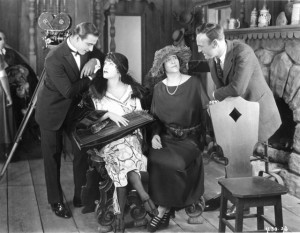
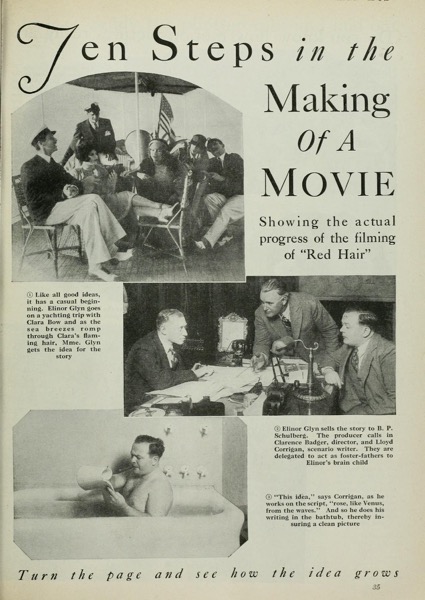
Elinor Glyn (a/w/d/p/o), Beyond the Rocks (1922). PC

Photoplay3334movi 0319

More about Elinor Glyn


Buy a signed copy of when Women Write Hollywood


* A portion of each sale from Amazon.com directly supports our blogs
** Many of these books may be available from your local library. Check it out!
† Available from the LA Public Library

22 More Strong Female Companions In The Past from Gender Diversity in the Who-niverse [Video] (0:51)

Watch this entire presentation: Gender Diversity in the Who-niverse: Paving the Way for a Lady Doctor with Dr. Rosanne Welch [Video] (36:58)

22 More Strong Female Companions In The Past from Gender Diversity in the Who-niverse [Video] (0:51)

For her 5th Doctor Who lecture to the CPP community, Dr. Rosanne Welch discusses how society – and the show’s writing staff – prepared the audience for a major change in this 50-year franchise – the creation of the first Lady Doctor!

Transcript:

…and I also just jokingly have to say, from a strength standpoint Jean Marsh, the actress who played that character (Sara Kingdom) ended up writing the miniseries “Upstairs, Downstairs” which was the “Downton Abbey” of your parent’s generation. Huge PBS show about the maids and the rich people living in a house. So literally it was a copy — or the predecessor I should say — of “Downton Abbey.” So she moved her career, using this acting career into a writing career where she could write the kind of representations she felt that the world needed. So that is pretty cool. Liz Shaw came up in the John Pertwee era, The third Doctor Who and she was a scientist so she was the equal to any of the men she worked with and sometimes she was smarter than they were, because she had a Ph.D. and she could do science and these guys sometimes weren’t — sometimes just military dudes. So Liz Shaw is a pretty good example of a strong woman we’ve met along the way.

Follow Dr. Welch on Twitter and Instagram
https://twitter.com/rosannewelchhttp://instagram.com/drrosannewelch


Rosanne Welch, PhD

Rosanne Welch PhD teaches the History of Screenwriting and One-Hour Drama for the Stephens College MFA in Screenwriting.

Writing/producing credits include Beverly Hills 90210, Picket Fences, ABCNEWS: Nightline and Touched by an Angel. In 2016 she published the book Why The Monkees Matter: Teenagers, Television and American Pop; co-edited Women in American History: A Social, Political, and Cultural Encyclopedia; and placed “Transmitting Culture Transnationally Via the Characterization of Parents in Police Procedurals” in the New Review of Film and Television Studies. Essays appear in Torchwood Declassified: Investigating Mainstream Cult Television and Doctor Who and Race: An Anthology. Welch serves as Book Reviews editor for Journal of Screenwriting and on the Editorial Advisory Board for Written By magazine, the magazine of the Writers Guild.

Watch Dr. Welch’s talk “The Importance of Having a Female Voice in the Room” at the 2016 TEDxCPP.

Of Writing, Research, Verdi and Garibaldi – New Discoveries!

Here’s the fun of research – and poetic license.

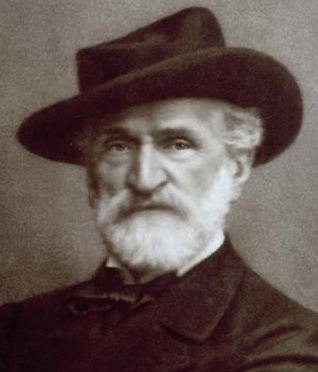
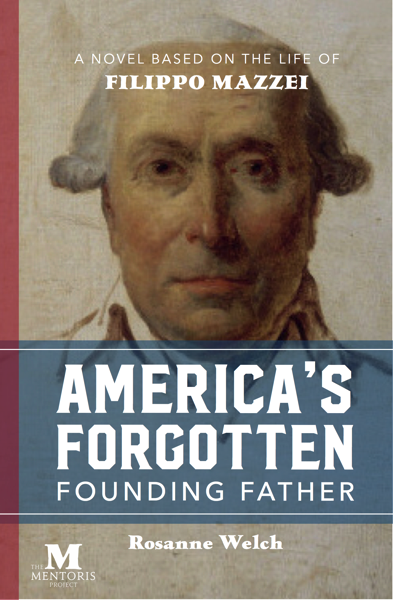
I’m working on my novel on the life of Giuseppe Garibaldi (the General who united Italy in 1860) for The Mentoris Project and I discovered that Giuseppe Verdi was a supporter of the Risorgimento (Resurgence), the movement to unite Italy.  Moreover, in his 1842 opera, Nabucco (which follows the plight of the Jews as they are conquered and exiled by the Babylonian King Nebuchadnezzar II (Nabucco in Italian) he wrote a song — Va Pensiero (to think/to recall) — which was popular among the men of the movement in the 1840s through 1860.  

Giuseppe Garibaldi (1866).jpg
Public Domain, Link

Verdi-photo-Brogi.jpg
By Giacomo BrogiFile:Brogi,_Giacomo_(1822-1881)_-_Giuseppe_Verdi.jpg Scan by G.dallorto, Public Domain, Link

Poetic license comes in when I see it wasn’t performed in South America (where Garibaldi could have access to it) until a year after he’d left that country.  So, I created a scene where he hears it from a newly arrived Italian sailor on the local docks and then Garibaldi goes home to sing it as a lullaby with his wife, Anita, and their son.

Of course, I had to hear the song myself (being more a Dean Martin fan than an opera fan I had not seen Nabucco) so, naturally, I turned to YouTube where I found this beautiful rendition of it with Pavorotti singing in Italian and Italian singer Zucchero Fornaciari, known mostly as Zucchero (but brand new to me!).

All in all a delightful discovery.

Zucchero

Click to view the video on YouTube

Va, pensiero, sull’ali dorate;
va, ti posa sui clivi, sui colli,
ove olezzano tepide e molli
l’aure dolci del suolo natal!

Del Giordano le rive saluta,
di Sionne le torri atterrate…
O, mia patria, sì bella e perduta!
O, membranza, sì cara e fatal!

Arpa d’or dei fatidici vati,
perché muta dal salice pendi?
Le memorie nel petto raccendi,
ci favella del tempo che fu!

O simile di Sòlima ai fati
traggi un suono di crudo lamento,
t’ispiri il Signore un concento
che ne infonda al patire virtù.[11]

Go, thought, on wings of gold;
go settle upon the slopes and the hills,
where, soft and mild, the sweet airs
of our native land smell fragrant!

Greet the banks of the Jordan
and Zion’s toppled towers…
Oh, my country, so beautiful and lost!
Oh, remembrance, so dear and so fatal!

Golden harp of the prophetic seers,
why dost thou hang mute upon the willow?
Rekindle our bosom’s memories,
and speak to us of times gone by!

Either, akin to the fate of Jerusalem,
give forth a sound of crude lamentation,
or let the Lord inspire you a harmony of voices
which may instill virtue to suffering.

Buy the album

* A portion of each sale from Amazon.com directly supports our blogs 


Join the Rosanne Welch Mailing List for future book and event announcements!
 

My First Mentoris Project Book

Order an autographed copy of America’s Forgotten Founding Father

Print Edition | Kindle Edition | Apple iBooks Edition | Nook Edition

Also from the Mentoris Project

Want to use these books in your classroom? Contact the Mentoris Project!`
From The Research Vault: Feminist Thought: A More Comprehensive Introduction by Rosemarie Tong & Tina Fernandes Botts

From The Research Vault: Feminist Thought: A More Comprehensive Introduction by Rosemarie Tong & Tina Fernandes Botts

A classic resource on feminist theory, Feminist Thought offers a clear, comprehensive, and incisive introduction to the major traditions of feminist theory, from liberal feminism, radical feminism, and Marxist and socialist feminism to care-focused feminism, psychoanalytic feminism, and ecofeminism. The fifth edition has been thoroughly revised, and now includes a new chapter on Third Wave and Third Space Feminism. Also added to this edition are significantly expanded discussions on women of color feminisms, psychoanalytic and care feminisms, as well as new examinations of queer theory, LGBTQ and trans feminism.Learning tools like end-of-chapter discussion questions and the bibliography make Feminist Thought an essential resource for students and thinkers who want to understand the theoretical origins and complexities of contemporary feminist debates.Amazon


Why The Monkees Matter: Teenagers, Television and American Pop Culture

Buy Your Copy Now!

* A portion of each sale from Amazon.com directly supports our blogs
** Many of these books may be available from your local library. Check it out!
† Available from the LA Public Library