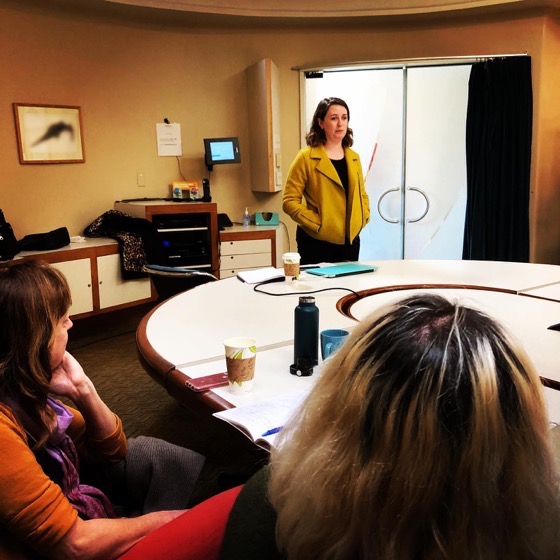

Lilliana Winkworth, of The Second City’s National Touring Company, gave a workshop on writing sketch comedy during this January’s MFA workshop at the Jim Henson Studios.
Follow and Like the Stephens College MFA in TV and Screenwriting
On Screenwriting and Media with Dr. Rosanne Welch
Writing, Film, Television and More!
Lilliana Winkworth, of The Second City’s National Touring Company, gave a workshop on writing sketch comedy during this January’s MFA workshop at the Jim Henson Studios.
Follow and Like the Stephens College MFA in TV and Screenwriting

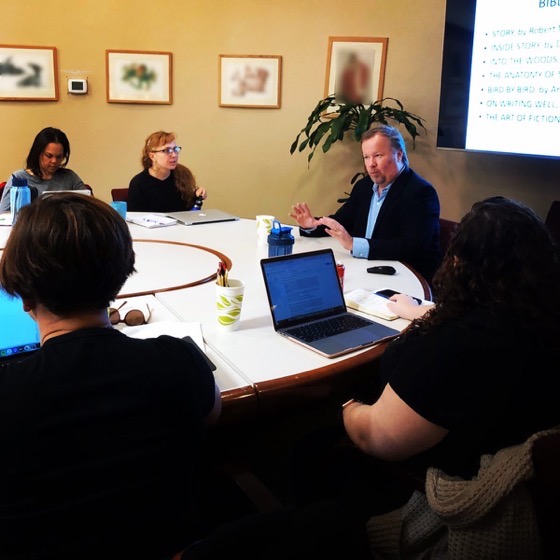
Screenwriter Thomas Dean Donnelly (Conan the Barbarian, Jax of Heart) lectured on How to Increase your Writing Productivity at the January workshop for the Stephens College MFA in TV and Screenwriting.
Follow and Like the Stephens College MFA in TV and Screenwriting
Serendipitous Learning at the Stephens College MFA in TV and Screenwriting Winter Workshop

Some of the best things about hosting the Stephens College MFA in TV and Screenwriting at the historic Jim Henson Studios (after the quality of our guest speakers, of course) is the accidental opportunity to meet writers working on the lot. After our graduate assistant met a writer in the studio kitchen, the current first -year class was invited to the set of a sizzle reel – a 3-minute trailer for a television show the writer-producers will use to shop around town for the funding the make the full show.
Follow and Like the Stephens College MFA in TV and Screenwriting
Every Monday we will be profiling a member of the Stephens College MFA in TV and Screenwriting 2020 graduating class. This exciting, fresh crop of writers are the future of the industry and are going on to do BIG things, so get to know them now! First up is Yousif Nash! #MeetTheGraduatesMonday

Yousif Nash is a true nerd who prides himself for having an encyclopedic knowledge on games, comics, anime, film, and television. An American born Iraqi, his parents regaled him with stories of their homeland, how it felt like a mystical land with history, culture, and wonder. It influenced him to become a storyteller, but he delayed that pursuit as he answered the call of duty and became an officer of the United States Air Force. When he left, he pursued writing seriously. He was accepted to the Writers Guild Foundation Veterans Workshop, worked on short and feature length films in his hometown, and is finishing his Masters of Fine Arts in TV Writing and Screenwriting from Stephens College. He just finished an internship at Hivemind (The Witcher, The Expanse) and is currently in another internship at Berlanti Productions (Arrow, The Flash, Riverdale) and Avi Arad’s Production Company (Spider-Man, Venom). He likes to write about nerds that suffer the normalcies of life, sci-fi, fantasy, and about Arab characters being normal people in America.
Follow and Like the Stephens College MFA in TV and Screenwriting
Highlighting the articles in the past editions of the Journal of Screenwriting, of which I am the Book Reviews Editor. Hopefully these abstracts will entice you to did a little deeper into the history and future of screenwriting. — Rosanne
Walter Reisch: The musical writer by Claus Tieber
Academy Award-winning Austrian screenwriter Walter Reisch’s (1903–83) career started in Austrian silent cinema and ended in Hollywood. Reisch wrote the screenplays for silent films, many of them based on musical topics (operetta films, biopics of musicians, etc.). He created the so-called Viennese film, a musical subgenre, set in an almost mythological Vienna. In my article I am analysing the characteristics of his writing in which music plays a crucial part. The article details the use of musical devices in his screenplays (his use of music, the influence of musical melodrama, instructions and use of songs and leitmotifs). The article closes with a reading of the final number in the last film he was able to make in Austria: Silhouetten (1936).
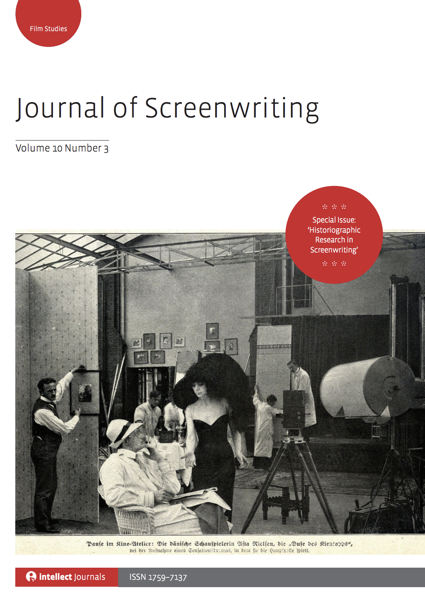
The Journal of Screenwriting is an international double-blind peer-reviewed journal that is published three times a year. The journal highlights current academic and professional thinking about the screenplay and intends to promote, stimulate and bring together current research and contemporary debates around the screenplay whilst encouraging groundbreaking research in an international arena. The journal is discursive, critical, rigorous and engages with issues in a dynamic and developing field, linking academic theory to screenwriting practice.
Get your copy and subscription to the Journal of Screenwriting Today!
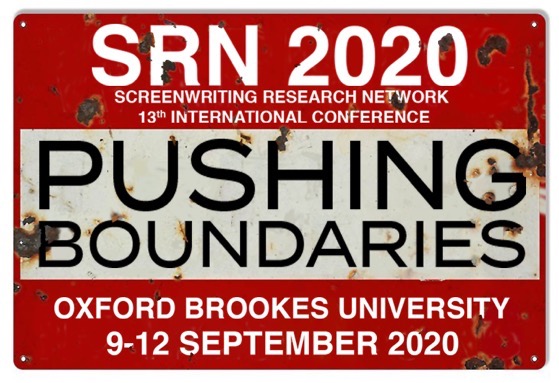
Join me at the Screenwriting Research Network’s Annual Conference in Oxford, UK
* A portion of each sale from Amazon.com directly supports our blogs
** Many of these books may be available from your local library. Check it out!

Students in the second year of the Stephens College MFA in TV and Screenwriting work on writing prompts with creativity coach JoAnn Braheny during their January workshop meetings at the Henson Studios in Hollywood. Applications are open now for the fall class!
Follow and Like the Stephens College MFA in TV and Screenwriting
Author, Tom Stempel Speaks at Stephens College MFA in TV and Screenwriting Winter Workshop

Tom Stempel, (historian and author of one of the textbooks used in our MFA – Framework: a History of Screenwriting) has a blog – Understanding Screenwriting — where he analyzes the work of recent screenplays, many of which you may have just seen.
Follow and Like the Stephens College MFA in TV and Screenwriting
Highlighting the articles in the past editions of the Journal of Screenwriting, of which I am the Book Reviews Editor. Hopefully these abstracts will entice you to did a little deeper into the history and future of screenwriting. — Rosanne
This article examines the screenwriting practice in Czech silent cinema in the late 1910s and 1920s. It focuses on Jan Stanislav Kolár’s narrative poetics as a case study of specific storytelling choices within the transitional era from one- or two-reelers to the feature-length format in the context of local technological restrictions in exhibition – inevitable breaks of changing film reels in single-projector cinemas. Poetological analysis of Kolár’s Řina (1926) with his other surviving scenarios and pictures shows that meant not only the necessity of adapting to these limitations, but also became a productive way of achieving particular effects on the audience. Semi-independent narrative acts, thrilling moments occurring at the end of the reel, or significant shifts in space and time between two reels were integral parts of his own original stories as well as adaptations of various novels. Nevertheless, the article outlines more general perspective in relation to film reels as structural narrative units and screenwriting practice among Czech filmmakers as well.
The Journal of Screenwriting is an international double-blind peer-reviewed journal that is published three times a year. The journal highlights current academic and professional thinking about the screenplay and intends to promote, stimulate and bring together current research and contemporary debates around the screenplay whilst encouraging groundbreaking research in an international arena. The journal is discursive, critical, rigorous and engages with issues in a dynamic and developing field, linking academic theory to screenwriting practice.
Get your copy and subscription to the Journal of Screenwriting Today!
Join me at the Screenwriting Research Network’s Annual Conference in Oxford, UK
* A portion of each sale from Amazon.com directly supports our blogs
** Many of these books may be available from your local library. Check it out!
Between the Sheets: Writing About Sex on Television
![Listen: Between the Sheets: Writing About Sex on TV [Audio]](https://rosannewelch.com/wp-content/uploads/2020/01/WGAF-Sheets-131.jpg)
Podcast: Play in new window | Download
Subscribe: RSS
The Stephens College MFA in TV and Screenwriting program teamed up with the Writers Guild Foundation to pull the covers back on a topic that still makes viewers blush: sex. On this special evening, our panel of TV writers and producers share how they approach writing about sex, from intimate scenes to revealing dialogue, and the nuances they consider when crafting stories about sex and sexuality.
Panelists:
Writers Guild Foundation – @wgfoundation
Between the Sheets: Writing About Sex on Television

The Stephens College MFA in TV and Screenwriting program teamed up with the Writers Guild Foundation to pull the covers back on a topic that still makes viewers blush: sex. On this special evening, our panel of TV writers and producers share how they approach writing about sex, from intimate scenes to revealing dialogue, and the nuances they consider when crafting stories about sex and sexuality.
Panelists:
Writers Guild Foundation – @wgfoundation
Follow and Like the Stephens College MFA in TV and Screenwriting