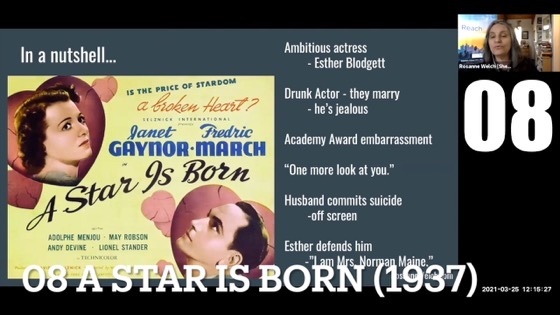
07 More On Dorothy Parker from “Female Creatives & A Star Is Born” [Video]

07 More On Dorothy Parker from

Transcript:

Also has been said about her, her stories feature female characters trying to square exhilarating new choices with the enduring bold constraints of social expectation. The social expectation in A Star Is Born is that a man should be more successful than his wife. That is something that happened in any particular level of the society at the time. Also, her heroines are lovelorn and there are always suicidal alcoholics in so many of her pieces and this appears in other films she wrote without Alan. They did effect eventually split up and get divorced. So she wrote for Hitchcock. He specifically sought her out. He wanted a writer as famous as she and she got an Oscar nomination both for A Star Is Born and for Smash-Up, the story of a woman which was about a female alcoholic. So clearly these are all pieces of her little ingredient book that she threw together into A Star Is Born.

Watch this entire presentation

Connections at conferences matter! Through the most recent SCMS, I met Vicki Callahan, whose film history focus right now is on Mabel Normand. When she learned I could put together a lecture on the importance of the female voice in the A Star is Born franchise she asked me to give that lecture to her master students.

It made for a great opportunity for me to hone the ideas I’m working on for a chapter on that franchise that I’m writing for a new book from Bloomsbury: The Bloomsbury Handbook Of International Screenplay Theory. It’s always nice when one piece of research can be purposed in other ways – and it’s always fun revisiting such a female-centric film franchise – one that drew the talents of such powerful performers as Janet Gaynor, Judy Garland, Barbara Streisand, and Lady Gaga.

Find out why in this lecture!

RMW Rosanne Signature for Web


06 Dorothy Parker from “Female Creatives & A Star Is Born” [Video]

06 Dorothy Parker from

Transcript:

So that’s the writing credits but I will say that it was her voice that did it and this in fact is one of the quotes that makes me — gives me evidence for that. Somerset Maugham, a very, very famous writer in his own time. A novelist so much better than a movie writer. Much more literate and important and he recognized right away she had this gift for finding something to laugh at in the bitterest tragedies of the human animal and that is exactly what this story is — the bitterest tragedy of life that someone you love cannot deal with the fact that you are having more success or luck in life than they are and that is the saddest thing or one of the saddest experiences that they could imagine. So I think that’s important for us to keep in mind when we think about her voice and how it appears in this particular piece. I love her. As we said, her wittiness is there. She was talking about a time when the Motion Picture Academy was trying to create a union for writers and this is what she had to say about having them watch “…was like trying to get laid in your mother’s house. Somebody was always in the parlor watching.” They couldn’t trust them obviously. So this wit and this sadness I think very interestingly connects inside this story..

Watch this entire presentation

Connections at conferences matter! Through the most recent SCMS, I met Vicki Callahan, whose film history focus right now is on Mabel Normand. When she learned I could put together a lecture on the importance of the female voice in the A Star is Born franchise she asked me to give that lecture to her master students.

It made for a great opportunity for me to hone the ideas I’m working on for a chapter on that franchise that I’m writing for a new book from Bloomsbury: The Bloomsbury Handbook Of International Screenplay Theory. It’s always nice when one piece of research can be purposed in other ways – and it’s always fun revisiting such a female-centric film franchise – one that drew the talents of such powerful performers as Janet Gaynor, Judy Garland, Barbara Streisand, and Lady Gaga.

Find out why in this lecture!

RMW Rosanne Signature for Web


05 More Credits for A Star Is Born (1937) from “Female Creatives & A Star Is Born” [Video]

05 More Credits for A Star Is Born (1937) from

Transcript:

I like this. It’s hard for you to read but it’s literally in an archive — the front cover of the first script and I do love to remember that it all started on the page. It is something that was written first and so amazing these folks touched this and we can go look at it at the Herrick Library. These are the credits on this 1937 A Star Is Born that you just watched. So you notice that the major screenplay credits are up here. Then we have from a story by so Wellman and Carson wrote the basic story. These guys translated it into a screenplay right and then because IMDb tries to resurrect people who worked on things but weren’t credited at the time, you see all these names in here. It is in Ben Hecht’s autobiography. He claims to have written the final line — ” I am Mrs. Norman Maine.” Did he? Did he not? There’s no paper trail for that right and he was known to be kind of an arrogant guy and he like to take credit for a lot of things but he’s on the list. We should pay attention.

Watch this entire presentation

Connections at conferences matter! Through the most recent SCMS, I met Vicki Callahan, whose film history focus right now is on Mabel Normand. When she learned I could put together a lecture on the importance of the female voice in the A Star is Born franchise she asked me to give that lecture to her master students.

It made for a great opportunity for me to hone the ideas I’m working on for a chapter on that franchise that I’m writing for a new book from Bloomsbury: The Bloomsbury Handbook Of International Screenplay Theory. It’s always nice when one piece of research can be purposed in other ways – and it’s always fun revisiting such a female-centric film franchise – one that drew the talents of such powerful performers as Janet Gaynor, Judy Garland, Barbara Streisand, and Lady Gaga.

Find out why in this lecture!

RMW Rosanne Signature for Web


04 The Writers of A Star Is Born (1937) from “Female Creatives & A Star Is Born” [Video]

04 The Writers of A Star Is Born (1937) from

Transcript:

So when we come along and redo it, it’s going to be this team that is assigned — can you do this differently? Can you do this better? Dorothy Parker, who I adore. Her husband, Alan Campbell who no one has probably ever heard of and that’s maybe fair. Maybe not. he was an actor on Broadway when he met her and they got married. He was her second husband. He wanted to come to Hollywood and be a writer. She did not. She was, as we mentioned earlier, a member of the Algonquin Round Table. She wrote witty things for the New Yorker, She did not want to live in Hollywood, but she did what her husband wanted because she wanted him to be happy, These other gentlemen — Carson and William — came along. They’d done some polishes, some pieces, but I’m going to maintain that the voice of A Star is Born — and that carries across almost all four of the iterations — is Dorothy Parker’s voice and to me, that’s what’s interesting — a screenwriter’s voice.

Watch this entire presentation

Connections at conferences matter! Through the most recent SCMS, I met Vicki Callahan, whose film history focus right now is on Mabel Normand. When she learned I could put together a lecture on the importance of the female voice in the A Star is Born franchise she asked me to give that lecture to her master students.

It made for a great opportunity for me to hone the ideas I’m working on for a chapter on that franchise that I’m writing for a new book from Bloomsbury: The Bloomsbury Handbook Of International Screenplay Theory. It’s always nice when one piece of research can be purposed in other ways – and it’s always fun revisiting such a female-centric film franchise – one that drew the talents of such powerful performers as Janet Gaynor, Judy Garland, Barbara Streisand, and Lady Gaga.

Find out why in this lecture!

RMW Rosanne Signature for Web


03 What Price Hollywood from “Female Creatives & A Star Is Born” with Dr. Rosanne Welch [Video]

03 What Price Hollywood from

Transcript:

Jane Murphin also wrote on this original “What Price Hollywood. Jane Murphin had a long screenwriting career. You don’t hear a lot about her. This is — I love this picture — Strongheart was her own personal dog. She also was the woman who invented the dog movie before Rin Tin Tin and Lassie there was Strongheart. Believe it or not, the franchise of Strongheart created dog food which was available up to about 10 years ago. Even though obviously the dog and she are long gone. So two women wrote on that piece. In a nutshell, what is “What Price Hollywood?” It’s an ambitious actress, a drunken director, who she doesn’t marry. She marries a polo player. A very famous man who’s jealous of her fame. Her friend the director commits suicide and she travels to Paris and reconnects with the husband who left her because he was jealous. Kind of the bones of “A Star is Born” but not exactly.

Watch this entire presentation

Connections at conferences matter! Through the most recent SCMS, I met Vicki Callahan, whose film history focus right now is on Mabel Normand. When she learned I could put together a lecture on the importance of the female voice in the A Star is Born franchise she asked me to give that lecture to her master students.

It made for a great opportunity for me to hone the ideas I’m working on for a chapter on that franchise that I’m writing for a new book from Bloomsbury: The Bloomsbury Handbook Of International Screenplay Theory. It’s always nice when one piece of research can be purposed in other ways – and it’s always fun revisiting such a female-centric film franchise – one that drew the talents of such powerful performers as Janet Gaynor, Judy Garland, Barbara Streisand, and Lady Gaga.

Find out why in this lecture!

RMW Rosanne Signature for Web


02 Women Writers Matter from “Female Creatives & A Star Is Born” with Dr. Rosanne Welch [Video]

02 Women Writers Matter from

Transcript:

Teaching philosophy. Words Matter. Writers Matter. Women Writers Matter and they’ve been far too often forgotten in history. So I love this movie to talk about because we’re going to talk about a very important female writer in Hollywood and yes this is coming out of practice for a chapter that I’m creating on this book on this movie and how it really relies on the female input to make it work in each of the iterations and we will see all of those women in all of those iterations and as Jacob mentioned we’ll notice the last movie is the only one without a female creative in the writing team which is interesting. Anyway, it all begins with Adela Rogers St Johns. She was a journalist out of San Francisco. She moved to Hollywood and she began to write short stories and sometimes scripts. She wrote mostly prose stories that were transformed into films. One of which is a thing called What Price Hollywood and it starred Constance Bennett who was a very very high-end female performer at the time and it’s a really interesting piece but it is not the first Star Is Born. There are parts of it that are similar and we will see the parts that change. She’s quite a fascinating person. If you ever want to read about her, she wrote a couple of memoirs and she used to appear in television shows. You can find her interviews on YouTube. She’s quite cool. She lived for a long time and she was the mother confessor to the stars of Hollywood because she wrote for the Hearst syndicate and so people in scandals would call her and say “you’ve got to come to my house and tell me how to deal with the press because they’re going to kill me because someone just died in my house” right? So she’s a pretty cool lady.

Watch this entire presentation

Connections at conferences matter! Through the most recent SCMS, I met Vicki Callahan, whose film history focus right now is on Mabel Normand. When she learned I could put together a lecture on the importance of the female voice in the A Star is Born franchise she asked me to give that lecture to her master students.

It made for a great opportunity for me to hone the ideas I’m working on for a chapter on that franchise that I’m writing for a new book from Bloomsbury: The Bloomsbury Handbook Of International Screenplay Theory. It’s always nice when one piece of research can be purposed in other ways – and it’s always fun revisiting such a female-centric film franchise – one that drew the talents of such powerful performers as Janet Gaynor, Judy Garland, Barbara Streisand, and Lady Gaga.

Find out why in this lecture!

RMW Rosanne Signature for Web


10 Things Hollywood Writers Must Know with Dr. Rosanne Welch – Best in Fest Podcast Ep #23 – La Femme Film Festival

10 Things Hollywood Writers Must Know with Dr. Rosanne Welch - Best in Fest Podcast Ep #23 - La Femme Film Festival

The Stephens College MFA in TV and Screenwriting is one of many sponsors of the LaFemme Film Festival which supports and nurtures the artistic entertainment productions of women. Their President and Director, Leslie LaPage, hosts the Best in Fest podcast and recently invited me on to talk about the 10 Things Hollywood Writers Must Know.

RMW Rosanne Signature for Web

Dr. Rosanne Welch is a writer and university professor of Humanities in the (IGE) Department at California State Polytechnic University, Pomona; and screenwriting for two MFA in Screenwriting programs (Cal State, Fullerton and Stephens College). Her current books include Why The Monkees Matter: Teenagers, Television and American Pop Culture (McFarland Publishing, 2017) and Women in American History: A Social, Political, and Cultural Encyclopedia and Document Collection (ABC-CLIO, 2017), which she co-edited with her CalPoly Pomona colleague and officemate, Dr. Peg Lamphier. 

In her previous life, Welch was a television writer/producer with credits that include Beverly Hills 90210, Picket Fences and Touched by an Angel and ABC NEWS/Nightline. Welch serves as Book Reviews editor for Journal of Screenwriting and on the Editorial Advisory Board for Written By magazine, the magazine of the Writers Guild.

In this episode, Leslie and Rosanne discuss 10 things Hollywood writers must know. For example, how to write what you emotionally know, how to work in a writer’s room, the do’s and don’ts of pitching, when to use a pitch deck and when it’s a horrible idea and much more.

01 Introduction from “Female Creatives & A Star Is Born” with Dr. Rosanne Welch [Video] [CC]

01 Introduction from

Transcript:

Here we are. We’re talking about the importance of female creatives in A Star Is Born. For me, that’s really what it’s all about. I like to my begin my lectures about the fact that I would like to acknowledge that this event is happening on the traditional lands of the Tongva people. That’s what Los Angeles is and we should recognize that there were people here before us and we need to respect their history and they’re the people who still exist on this land. So I like to start with that. I learned that when I went to a conference in New Zealand and they start all their lectures that way and I thought that was quite beautiful. As you just said so I don’t need this. These are the shows that I’ve worked on. These are the books that I have written. The lecture we’re speaking on today is going to come up next year in the book. I also am on the editorial board for Written By magazine, which I happen to have a copy of right next to me. It’s free online. So the magazine of the Writers Guild. I recommend people read it and it always has interviews with movie writers or television writers and that’s really good. I also do book reviews for the Journal of Screenwriting. It’s a great place for new academics to get published. If there are books you feel like reviewing or you’d like a free copy of you can write a review for me. So Vicki will get you in touch with me if that’s interesting to you.

Watch this entire presentation

Connections at conferences matter! Through the most recent SCMS, I met Vicki Callahan, whose film history focus right now is on Mabel Normand. When she learned I could put together a lecture on the importance of the female voice in the A Star is Born franchise she asked me to give that lecture to her master students.

It made for a great opportunity for me to hone the ideas I’m working on for a chapter on that franchise that I’m writing for a new book from Bloomsbury: The Bloomsbury Handbook Of International Screenplay Theory. It’s always nice when one piece of research can be purposed in other ways – and it’s always fun revisiting such a female-centric film franchise – one that drew the talents of such powerful performers as Janet Gaynor, Judy Garland, Barbara Streisand, and Lady Gaga.

Find out why in this lecture!

RMW Rosanne Signature for Web


Stephens College and Writers Guild Foundation Present The Panel Discussion — “It’s All Relative: Writing Matriarchs” [Video]

During every Residency Workshop the Stephens College MFA in TV and Screenwriting Executive Director, Dr. Rosanne Welch, joins with the Writers Guild Foundation to moderate a panel on a topic of interest to female writers.  This year we planned one on Writing Diverse Families – but in the last day before our panel 2 panelists had to drop out due to… family duties.  So we pivoted, realizing the panelists who were able to appear all had shows that involved 3 generational families lead by matriarchs.  

Hence the title:   It’s All Relative: Writing Matriarchs.

This gave us a chance to explore how these female TV writers have expanded depictions of the relationships between grandmothers, mothers and daughter over the years and how they’ve developed storylines that reflect the complexity and universality of these inescapable bonds. Panelists include Sheryl J. Anderson – Creator and Executive Producer, Sweet Magnolias;  Lang Fisher – Co-creator and Executive Producer, Never Have I Ever; and Valerie Woods – Co-executive Producer, Queen Sugar. Everyone shared memories of their own family matriarchs and the inspiration they continue to provide each woman’s writing.

 Stephens College and Writers Guild Foundation Present The Panel Discussion --

Due to Covid we recorded this panel live at the Jim Henson Studios where we host our Workshop in front of the live audience of MFA candidates.

Online Panel Discussion: It's All Relative: Writing Diverse Television Families, Friday, August 6, 2021, 5:30 PM  7:00 PM - Stephens College MFA in TV and Screenwriting

The Importance of Endings

The Importance of Endings

I had typed out one of those quotes I tend to use all the time –

“So much time and so little to do. Wait a minute. Strike that. Reverse it.”

— and in my habit I wanted to credit the writer of the quote, which we all know comes from the movie, Willy Wonka and the Chocolate Factory, adapted by David Seltzer from the book by Roald Dahl. 

My question became “Did that line come from the book OR the film OR both?”  I couldn’t find any clarification on that right away – but I did find this great NPR interview with Seltzer about how he changed the ending of the film because the director felt “It ends with the word, yippee? He said that’s not a screen play. That’s not a movie. You can’t do that” so Seltzer rewrote the ending to be this:

Mr. SELTZER: It ends with the word, yippee? He said that’s not a screen play. That’s not a movie. You can’t do that.

COHEN: So, what did you do?

Mr. SELTZER: I said, well, let me think about it. You know, how long do I have? He said, how long? We’re standing here. It’s $30,000 an hour. You tell me. And, I said, well, give me a second. And I think it was about 6 in the morning. And I walked down, literally, looked over the lake in Maine. I thought, what the hell am I going to do? My head space was totally out of this movie. I could barely remember what had led up to this but I thought, OK, it’s a fairy tale. It’s a children’s story, and how do children’s stories end? I don’t know. How could – how do they end? They end with, they all lived happily ever after. But that’s not good. That’s not what a screenwriter writes. And so I took a deep swallow and I went to the phone. I said, Mel, OK, listen carefully. They’re going up in the spaceship and looking at the ground disappear. And Willy Wonka announces to Charlie that the chocolate factory is his. Then, Willy Wonka looks at him and he says, but Charlie – in a very cautious voice – you do know what happened to the little boy who suddenly got everything he ever wanted, don’t you? And fear comes across Charlie’s face and he says, no, what? And Willy says, he lived happily ever after. And it was a long pause, and I thought my career as a screenwriter is over.