From The Journal Of Screenwriting V10 Issue 1: An insider perspective on the script in practice by Vincenzo Giarrusso

Highlighting the articles in the past editions of the Journal of Screenwriting, of which I am the Book Reviews Editor. Hopefully these abstracts will entice you to did a little deeper into the history and future of screenwriting. — Rosanne


An insider perspective on the script in practice by Vincenzo Giarrusso

The machinations of industry, the exigencies of film funding and the producer’s prominent role in setting fiscal and marketing objectives for film production seem incongruous with scriptwriting as a generative creative practice in the filmmaking process. This article presents a case study that investigates the agency of creative practice from the insider perspective of a scriptwriter. In mobilizing the concept of the boundary object, the case links the problematic and transitional status of the script – as it passes out of the hands of the writer – to other roles under the control of filmmaking practitioners. In combining a practice-based reflexive narrative with theoretical observations, the article explores the processes and imperatives that mediate the script and scriptwriting as an embodied experience for the scriptwriter.
Journal of Screenwriting Cover

The Journal of Screenwriting is an international double-blind peer-reviewed journal that is published three times a year. The journal highlights current academic and professional thinking about the screenplay and intends to promote, stimulate and bring together current research and contemporary debates around the screenplay whilst encouraging groundbreaking research in an international arena. The journal is discursive, critical, rigorous and engages with issues in a dynamic and developing field, linking academic theory to screenwriting practice. 

Get your copy and subscription to the Journal of Screenwriting Today!
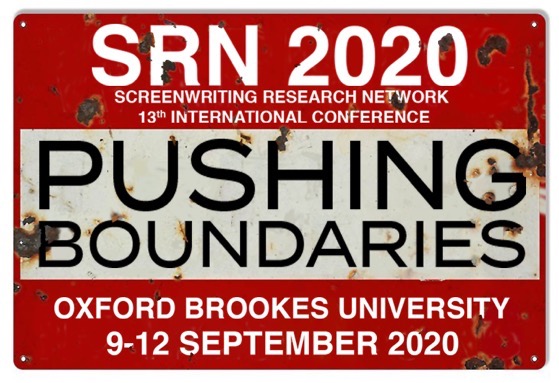

Screenwriting Research Network Conference 2020

Join me at the Screenwriting Research Network’s Annual Conference in Oxford, UK


* A portion of each sale from Amazon.com directly supports our blogs
** Many of these books may be available from your local library. Check it out!

#MentorMonday 7 – Jon Vandergriff – Stephens College MFA in TV and Screenwriting

Today’s the Stephens College MFA in TV and Screenwriting #mentormonday goes out to Jon Vandergriff! (IMDB)

VandergriffJon Vandergriff received his MFA in screenwriting at the University of Southern California and immediately segued into professional sitcom writing with his debut freelance script for the ABC hit show, Coach.

That was followed by a six-year stint on the even bigger ABC hit, Home Improvement, where he rose from staff writer to supervising producer. He attained the title of co-executive producer on the popular WB show Sabrina, the Teenage Witch. Along the way, Vandergriff wrote sitcom pilots for NBC and The WB and also has had two screenplays optioned by Hollywood-based production companies.

A lifelong lover of board games, Vandergriff also is a board game inventor who has had three games published, including Anger Management and A Way with Words, which also is an app and was recently picked up by Electronic Arts to publish on their website, pogo.com.


Follow and Like the Stephens College MFA in TV and Screenwriting

30 Lillian Hellman from “When Women Wrote Hollywood” with Dr. Rosanne Welch [Video] (55 seconds)

Part of the California State University, Fullerton Faculty Noon Time Talks at the Pollak Library.

Watch this entire presentation

30 Lillian Hellman from

Subscribe to Rosanne’s Channel and receive notice of each new video!


Transcript:

Another woman — we’re moving kind of through — now we’re moving to the 40s and 50s — Lillian Hellman. More people know of her because she was a playwright. They know about her winning some Tony’s and then her stuff was transferred to film. The Children’s Hour was almost a Pulitzer Prize winner but it’s the story of two lesbian women who run a girl’s school and one is accused of lesbianism and the Pulitzer Prize committee actually came out and said “we’re not giving an award to a movie that discusses that” — Oh to a play, excuse me. So it was won that year by Zoe Akins for a play that has been falling out of — nobody cares about anymore — et people are still performing The Little Foxes and you can still of course watch the Bette Davis version, which is quite brilliant. So Lillian Hellman is a pretty amazing woman. She’s also famous to us because during the Blacklist there was a threat of blacklisting her and when she was asked to give names to the committee in Washington that’s what she said — which could have destroyed her career.

Dr. Rosanne Welch discusses the women in her new book “When Women Wrote Hollywood” which covers female screenwriters from the Silents through the early 1940s when women wrote over 50% of films and Frances Marion was the highest paid screenwriter (male or female) and the first to win 2 Oscars.  Yet, she fails to appear in film history books, which continue to regurgitate the myth that male directors did it all – even though it’s been proven that the only profitable movies Cecil B. de Mille ever directed were all written by Jeannie Macpherson film ever won for Best Picture was written by Robert E. Sherwood (who people have heard of, mostly due to his connection to Dorothy Parker) and Joan Harrison.


Buy a signed copy of when Women Wrote Hollywood

…or via Amazon…

Paperback Edition | Kindle Edition | Google Play Edition

* A portion of each sale from Amazon.com directly supports our blogs
** Many of these books may be available from your local library. Check it out!
† Available from the LA Public Library

From The “When Women Wrote Hollywood Archives 03: Anita Loos Papers 1917-1981., Billy Rose Theatre Division, The New York Public Library

Months of research went into the creation of the essays in “When Women Wrote Hollywood.” Here are some of the resources used to enlighten today’s film lovers to the female pioneers who helped create it.


Anita Loos, screenwriter and novelist, was born on April 26, 1893, in Sisson, CA, the daughter of R. Beers and Minnie Ellen Loos. Miss Loos wrote the subtitles for D. W. Griffith’s film, Intolerance, in 1916. Her best known work is Gentlemen Prefer Blondes. She died on August 18, 1981, at the age of 93. The Anita Loos Papers consist of scripts, essays and articles from her career as a screenwriter and novelist. The bulk of the collection dates from 1917-1969. There are also adaptations of her works, unfinished scripts and research notes.


Buy “When Women Wrote Hollywood” Today!

Paperback Edition | Kindle Edition | Google Play Edition

* A portion of each sale from Amazon.com directly supports our blogs
** Many of these books may be available from your local library. Check it out!
† Available from the LA Public Library

From The Journal Of Screenwriting V10 Issue 1: Intellectual spaces in screenwriting studies: The practitioner-academic and fidelity discourse by Terry Bailey

Highlighting the articles in the past editions of the Journal of Screenwriting, of which I am the Book Reviews Editor. Hopefully these abstracts will entice you to did a little deeper into the history and future of screenwriting. — Rosanne


Intellectual spaces in screenwriting studies: The practitioner-academic and fidelity discourse
AuthorTerry Bailey

As Craig Batty argues, traditional screenwriting research predominantly concerns itself not with the practice of writing, but its end product. This can lead to the actual process of writing being overlooked. The advent of the practitioner-academic within screenwriting studies has led to the foregrounding of the interests of practice over those of more traditional academic research. According to Batty, the intent of the practitioner-academic’s research is to generate knowledge that can influence the work of screenwriters directly. This article argues that additionally, practitioner-academics can make a valuable contribution towards more ‘traditional’ research, simply by occupying the same unique intellectual space from which they might influence practice. The article uses debates surrounding fidelity within adaptation studies to examine the ways in which the practitioner-academic’s unique approach can enhance ‘traditional’ research, and draws on examples from practice to do so, namely the book to film adaptation Starship Troopers (1997).

Journal of Screenwriting Cover

The Journal of Screenwriting is an international double-blind peer-reviewed journal that is published three times a year. The journal highlights current academic and professional thinking about the screenplay and intends to promote, stimulate and bring together current research and contemporary debates around the screenplay whilst encouraging groundbreaking research in an international arena. The journal is discursive, critical, rigorous and engages with issues in a dynamic and developing field, linking academic theory to screenwriting practice. 

Get your copy and subscription to the Journal of Screenwriting Today!


* A portion of each sale from Amazon.com directly supports our blogs
** Many of these books may be available from your local library. Check it out!

Listen To The Podcast: Location as Character: The Craft of Writing Place Panel Panel at The Writers Guild Foundation [Audio]

Follow Rosanne on Instagram!

Listen To The Podcast: Location as Character: The Craft of Writing Place Panel Panel at The Writers Guild Foundation [Audio]

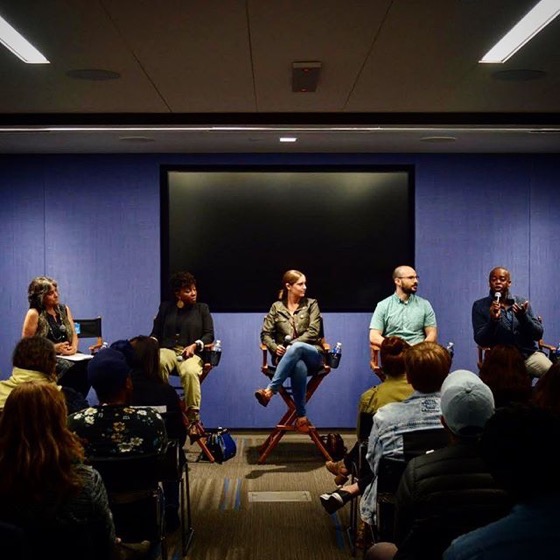
I really enjoyed being invited to moderate this Writers Guild Foundation panel co-hosted by Columbia Collge of Chicago’s Semester in LA program.

In honor of the co-host we chose to have a conversation about “Location as Character” – and for a kid from Cleveland, believe me, I know how much the place you come from infuses who you are – and how important it is for writers to properly portray the effect of location on the many characters who populate their programs. 

I was joined by a great collection of panelists from shows ranging from Queen Sugar to On Becoming a God in Central Florida to The Chi and Young Sheldon. Listen in when you have some time!

Listen to this podcast

Location as Character: The Craft of Writing Place Panel via Instagram

From @writersguildf – Writers Guild Foundation

We team up with @ColumbiaChi to talk about how locations inform and impact characters on TV with @qu33nofdrama, @SparksAnthony, Matt Lutsky, @RosanneWelch and Connor Kilpatrick.


* A portion of each sale from Amazon.com directly supports our blogs
** Many of these books may be available from your local library. Check it out!

From The “When Women Wrote Hollywood Archives: Cecil B. DeMille’s Hollywood by Robert S. Birchard

Months of research went into the creation of the essays in “When Women Wrote Hollywood.” Here are some of the resources used to enlighten today’s film lovers to the female pioneers who helped create it.


Cecil B. DeMille was the most successful filmmaker in early Hollywood history. Cecil B. DeMille’s Hollywood is a detailed and definitive chronicle of the screen work that changed the course of film history and a fascinating look at how movies were actually made in Hollywood’s Golden Age. Drawing extensively on DeMille’s personal archives and other primary sources, Robert S. Birchard offers a revealing portrait of DeMille the filmmaker that goes behind studio gates and beyond DeMille’s legendary persona. In his forty-five-year career DeMille’s box-office record was unsurpassed, and his swaggering style established the public image for movie directors. DeMille had a profound impact on the way movies tell stories and brought greater attention to the elements of decor, lighting, and cinematography. Best remembered today for screen spectacles such as The Ten Commandments and Samson and Delilah , DeMille also created Westerns, realistic “chamber dramas,” and a series of daring and highly influential social comedies. He set the standard for Hollywood filmmakers and demanded absolute devotion to his creative vision from his writers, artists, actors, and technicians.


Buy “When Women Wrote Hollywood” Today!

Paperback Edition | Kindle Edition | Google Play Edition

* A portion of each sale from Amazon.com directly supports our blogs
** Many of these books may be available from your local library. Check it out!
† Available from the LA Public Library

#MentorMonday 6 – Jennifer Maisel – Stephens College MFA in TV and Screenwriting

Jennifer Maisel (IMDB) is our featured mentor at the Stephens College MFA in TV and Screenwriting for #mentormonday this week!

#MentorMonday 6 - Jennifer Maisel - Stephens College MFA in TV and ScreenwritingJennifer Maisel most recently developed an original pilot called “The 626” with Super Deluxe and adapted two Jane Green novels—Tempting Fate and To Have and to Hold, which aired in June. She currently is working on a two-hour about campus rape and institutional betrayal with Just Singer Entertainment. Her screenplay “Lost Boy” was filmed starring Virginia Madsen. She wrote The Assault and The March Sisters for Mar Vista Entertainment and Double Wedding for Jaffe Braunstein. She has written movies for NBC, ABC, MTV and Lifetime, was a staff writer on the television series Related, wrote a pilot for ABC Family and an animated feature for Disney. Maisel has developed original pilots with Bunim-Murray, Ineffable, Stun Media and MomentumTV and co-created the critically acclaimed web series Faux Baby with Laura Brennan and Rachel Leventhal. The screenplay adaptation of her play The Last Seder won Showtime’s Tony Cox Screenwriting Award, meriting her a month’s stay in a haunted farmhouse at the Nantucket Screenwriter’s Colony. A graduate of Cornell University and NYU’s Dramatic Writing program, Maisel is also an award-winning playwright whose Eight Nights will premiere at Antaeus Theatre in October 2019; the play is currently part of a nationwide event called 8 Nights of Eight Nights, raising funds and awareness for HIAS.


Follow and Like the Stephens College MFA in TV and Screenwriting

From The Journal Of Screenwriting V10 Issue 1: Screenwriting for new film mediums: Conceptualizing visual models for interactive storytelling

Highlighting the articles in the past editions of the Journal of Screenwriting, of which I am the Book Reviews Editor. Hopefully these abstracts will entice you to did a little deeper into the history and future of screenwriting. — Rosanne


Screenwriting for new film mediums: Conceptualizing visual models for interactive storytelling
Gwendolyn Ogle

Journal of Screenwriting, Volume 10, Issue 1

This article considers challenges specific to screenwriting for interactive storytelling in new film mediums, and proposes fifteen visual, conceptual models for interactive storytelling. The models are placed on a continuum with increasing degrees of interactivity. Three arguments are posed for the necessity of visual, conceptual models and a review of literature is presented that lends credence to these arguments. Though technology’s ability to provide interaction is an important factor, technology is not the focus of this article. Instead, the focus is on the need for authors to have a voice and a process in this new, interdisciplinary domain of interactive storytelling in new film mediums. The models proposed in this article help establish a common vernacular from which authors, programmers and others can communicate and direct interactive storytelling efforts towards the design of interactive storytelling systems.

Journal of Screenwriting Cover

The Journal of Screenwriting is an international double-blind peer-reviewed journal that is published three times a year. The journal highlights current academic and professional thinking about the screenplay and intends to promote, stimulate and bring together current research and contemporary debates around the screenplay whilst encouraging groundbreaking research in an international arena. The journal is discursive, critical, rigorous and engages with issues in a dynamic and developing field, linking academic theory to screenwriting practice. 

Get your copy and subscription to the Journal of Screenwriting Today!


* A portion of each sale from Amazon.com directly supports our blogs
** Many of these books may be available from your local library. Check it out!

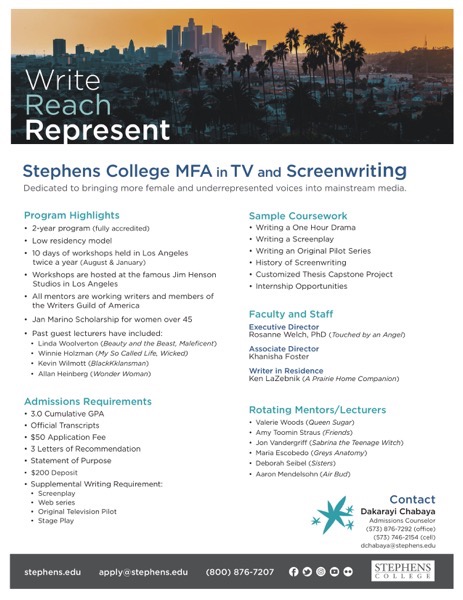
New Stephens College MFA in TV and Screenwriting One Sheet – Please Post and Share!

Here is our latest one sheet for the Stephens College MFA in TV and Screenwriting Program.

Applications are now open, so please share this flyer with our interested friends, family and students!

New Stephens College MFA in TV and Screenwriting One Sheet - Please Pos and Share!

Download a PDF Version – New Stephens College MFA in TV and Screenwriting One Sheet

Like Stephens College MFA in TV and Screenwriting on Facebook