09 Parker, Grandmothers, and Husbands from “Female Creatives & A Star Is Born” [Video]

09 Parker, Grandmothers, and Husbands from

Transcript:

Okay. Here’s where I find Dorothy Parker’s female focus coming to us. It begins with this grandmother. A female character has the money to give her granddaughter what she needs to follow her dream. That’s a big deal. Thinking that a woman in that period — who is now some 50 years older than the woman starring in the film — could have agency and could choose to give the money and trust her granddaughter when her own parents are not trusting her. I think that relationship is so key. That maternal relationship is a very big deal. Dorothy Parker’s mother died when she was quite young. I think she was 9 or 10. She didn’t like her stepmother but she liked her grandmother. So clearly that’s represented in this piece. Also even though Esther seems a little weak and fluffy at some points, she certainly stands up for herself when she needs to right? In this, we see Norman is a very desperate and envious guy. Some of what we read about Alan Campbell, he was desperate to succeed. He was desperate to be famous. After they divorced and he couldn’t get a job screenwriting, a producer literally said to him “Look, get back together with the old lady. She’s the one we want. Together we’ll hire you.” Imagine how humiliating that would be for someone and not man or woman but I want to be talented. I want to be recognized as someone of quality but I can’t be without attaching myself to this other person.

Watch this entire presentation

Connections at conferences matter! Through the most recent SCMS, I met Vicki Callahan, whose film history focus right now is on Mabel Normand. When she learned I could put together a lecture on the importance of the female voice in the A Star is Born franchise she asked me to give that lecture to her master students.

It made for a great opportunity for me to hone the ideas I’m working on for a chapter on that franchise that I’m writing for a new book from Bloomsbury: The Bloomsbury Handbook Of International Screenplay Theory. It’s always nice when one piece of research can be purposed in other ways – and it’s always fun revisiting such a female-centric film franchise – one that drew the talents of such powerful performers as Janet Gaynor, Judy Garland, Barbara Streisand, and Lady Gaga.

Find out why in this lecture!

RMW Rosanne Signature for Web


14 Fuller, Women, and War from Concord Days: Margaret Fuller in Italy [Video]

In researching and writing my book on Giuseppe and Anita Garibaldi and the unification of Italy (A Man Of Action Saving Liberty: A Novel Based On The Life Of Giuseppe Garibaldi)  I re-discovered the first American female war correspondent – Margaret Fuller — who I had first met in a college course on the Transcendentalists. I was once again fascinated by a life lived purposefully.

Then I found Tammy Rose’s podcast on the Transcendentalists – Concord Days – and was delighted when she asked me to guest for a discussion of Fuller’s work in Italy as both a journalist – and a nurse. — Rosanne

14 Fuller, Women, and War from Concord Days: Margaret Fuller in Italy [Video]

Watch this entire presentation

Concord Days sends love to Margaret Fuller on the anniversary of her death in 1850.

The conversation focuses on Margaret’s exciting days in ITALY!

Dr. Rosanne Welch takes us through her adventures and enthusiastically reminds us what she was like when she was living her best life!

Transcript:

Tammy: In America, we don’t really have titles. We don’t really understand that level of society but over there it’s a thing.

Rosanne: Even if there’s no money associated with it, there’s an honor to it. You are of the upper classes even if you don’t have the money to go with it and that’s a big deal.

Tammy: Exactly. Exactly. yeah so and and and also another important point you had you had mentioned this before, so Garibaldi’s wife had like gone into battle like really with a baby like on her. It’s like she’s literally — she’s not just a nurse she’s she’s also nursing like while she’s on the battlefront right?

Rosanne: That’s so beautifully said. That’s exactly right, right? They end up having four children and there’s a statue of her in Rome because Mussolini tried to use her reputation to support his work. Look how dedicated she was to her country. There’s a statue of her with the child at her breast while she’s riding and she was a great horsewoman and she trained the cavalry. The men trusted her because Garibaldi trusted her but of course after they had a couple of kids when they’re in Rieti and they’re doing all this stuff it was like now you can’t risk yourself dying. So please stay behind and behind meant you’re dealing with the bloody leftovers. You know we’re not even in M*A*S*H days where you’ve got legitimate drugs to help people. I mean they’re just — it’s carnage and that’s what her and Margaret were doing — working together in this hospital while they had their kids around and their men were off and maybe that report the next body that comes in could be your husband.

Professors Dr. Rosanne Welch and Dr. Peg Lamphier spotlight Gloria Steinem in women-centered book series – PolyPost

What’s normal in my world is working on books with my friend and colleague, Dr. Peg Lamphier, about brilliant women in U.S. history.  What’s not normal is having a brilliant young journalism student, Elizabeth Casillas, approach us to write an article about our work. 

This article in the PolyPost is the outcome of both of those events. 

It covers the latest book in the series Peg and I are editing:  Women Making History where we were asked to create 8 women’s biographies to include in the series – with the best part being we then chose the 8 writers for the job. That meant giving a few of them their first book project ever.  That is when this job become the most fun.  This article covers the latest book on the life of Gloria Steinem, written by William Pruden (the only male author in the whole series – why?  Because women’s history IS U.S. History so men can – and should – highlight it, too).


Professors Dr. Rosanne Welch and Dr. Peg Lamphier spotlight Gloria Steinem in women-centered book series - PolyPost

Peg Lamphier and Rosanne Welch, lecturers in the Interdisciplinary General Education Department, teamed up to co-edit “Gloria Steinem: A Life in American History,” the second installment of their book series focused on women’s contribution to American history and culture released Aug. 2.

The book, written by William Prudent and published by ABC-CLIO, covers the life of feminist journalist Gloria Steinem. After previously working with ABC-CLIO on “Women in American History,” an encyclopedia dedicated to detailing women’s contributions in American history and culture, Lamphier and Welch were sought out by the publishing firm to co-edit a larger book series.

Other subjects in the book series include Ruth Bader Ginsburg, Hillary Clinton, Helen Keller, Sally Ride, Eleanor Roosevelt, Ida B. Wells and Delores Huerta.

“If we’re going to have a series on women, what I want is books on women that don’t have 13 other books about them,” said Lamphier on the decision to incorporate Steinem into the series. “We keep trotting out the same women; it’s like we can only know 10 women at a time in America, so we got some people like Wilma Mankiller and Gloria Steinem.” A world-renowned feminist, Steinem’s life experiences were crucial to the feminist movement which compelled the lecturers to include her story in the series.

Read the entire article


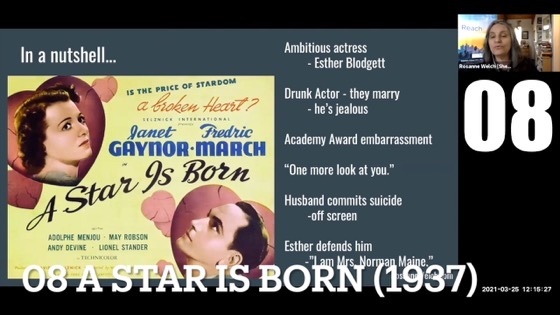
08 A Star Is Born (1937) from “Female Creatives & A Star Is Born” [Video]

08 A Star Is Born (1937) from

Transcript:

In a nutshell, what do we see in the first version of A Star Is Born?” We have this ambitious actress. We have a drunken actor, not a director. They do marry and he is jealous of her despite how bad that makes him feel. We have this classic scene where she wins an Academy Award and he shows up drunk and destroys and humiliates the evening right? We have this classic line “Can I have one more look at you”, right before I kill myself but you don’t know that’s what I’m about to do right? We have the husband committing suicide off-screen. We’re going to see him walk off into the ocean. We’re not going to see him dead on our screen and of course, we’re going to have this ending where she defends him to the society that destroyed him — to Hollywood — by saying “I am Mrs. Norman Maine” and there’s a lot — we’ll talk about this a little if we have some time — there’s some argument. My undergrad students nowadays will say they hate that line and they’re seeing it as her stepping back and losing her identity and I don’t think that’s how it was intended. I think if we think again about the time period, this was her asserting this man meant something and you people ruined him and I will not forget him right? So it’s an interesting line to see. Everything changes as we move through society and we bring our own baggage to what we watch. So we have to think about that. It was intended to be a monument to him and not a detriment to her at this point.

Watch this entire presentation

Connections at conferences matter! Through the most recent SCMS, I met Vicki Callahan, whose film history focus right now is on Mabel Normand. When she learned I could put together a lecture on the importance of the female voice in the A Star is Born franchise she asked me to give that lecture to her master students.

It made for a great opportunity for me to hone the ideas I’m working on for a chapter on that franchise that I’m writing for a new book from Bloomsbury: The Bloomsbury Handbook Of International Screenplay Theory. It’s always nice when one piece of research can be purposed in other ways – and it’s always fun revisiting such a female-centric film franchise – one that drew the talents of such powerful performers as Janet Gaynor, Judy Garland, Barbara Streisand, and Lady Gaga.

Find out why in this lecture!

RMW Rosanne Signature for Web


June Mathis: An Eye for Talent — Dr. Rosanne Welch, Script magazine, October 2021

June Mathis: An Eye for Talent -- Dr. Rosanne Welch, Script magazine, October 2021

Though she wrote over 100 films in the Silent Era and was a founding member of the Academy of Motion Picture Arts and Sciences, June Mathis appears in film history books (when she does) as a writer-producer with an eye for talent in that she gave both Buster Keaton and Rudolph Valentino their debuts on film.

She came to film from an early career as a child in vaudeville, despite suffering from undiagnosed heart issues. Born as June Hughes in 1887 in Leadville, Colorado there was no father listed and the child would later take Mathis, the last name of her stepfather, as her own.

Read June Mathis: An Eye for Talent — Dr. Rosanne Welch, Script magazine, October 2021


Read about more women from early Hollywood


13 Fuller and Her Relationships from Concord Days: Margaret Fuller in Italy [Video]

In researching and writing my book on Giuseppe and Anita Garibaldi and the unification of Italy (A Man Of Action Saving Liberty: A Novel Based On The Life Of Giuseppe Garibaldi)  I re-discovered the first American female war correspondent – Margaret Fuller — who I had first met in a college course on the Transcendentalists. I was once again fascinated by a life lived purposefully.

Then I found Tammy Rose’s podcast on the Transcendentalists – Concord Days – and was delighted when she asked me to guest for a discussion of Fuller’s work in Italy as both a journalist – and a nurse. — Rosanne

13 Fuller and Her Relationships from Concord Days: Margaret Fuller in Italy [Video]

Watch this entire presentation

Concord Days sends love to Margaret Fuller on the anniversary of her death in 1850.

The conversation focuses on Margaret’s exciting days in ITALY!

Dr. Rosanne Welch takes us through her adventures and enthusiastically reminds us what she was like when she was living her best life!

Transcript:

Rosanne:…and it fascinates me because they’re also having relationships in their lives because Anita had been married to someone else and she ran away with Garibaldi. Her husband was an abuser and a terrible guy and then he eventually died. So they were able to get married but they had a couple kids outside of wedlock.

Tammy: That sounds familiar yeah

Rosanne: Exactly and yeah hello Margaret’s going to show up right with Ossoli who’s a beautiful gorgeous man who’s also fighting for Italy and they’re not married but they do get that little secret marriage in before the baby’s born because that’s very careful.

Tammy: As long as everything’s legal right like that’s that that’s actually what matters yeah.

Rosanne: Well because you know we forget nowadays because it’s not a big deal to us but it was all about inheritance, If you were not the legal child, you would not inherit any of the father’s money or land or title in this case. So you know she definitely wanted to make — I assume she wanted to make sure her child would be given all that he was owed.

07 More On Dorothy Parker from “Female Creatives & A Star Is Born” [Video]

07 More On Dorothy Parker from

Transcript:

Also has been said about her, her stories feature female characters trying to square exhilarating new choices with the enduring bold constraints of social expectation. The social expectation in A Star Is Born is that a man should be more successful than his wife. That is something that happened in any particular level of the society at the time. Also, her heroines are lovelorn and there are always suicidal alcoholics in so many of her pieces and this appears in other films she wrote without Alan. They did effect eventually split up and get divorced. So she wrote for Hitchcock. He specifically sought her out. He wanted a writer as famous as she and she got an Oscar nomination both for A Star Is Born and for Smash-Up, the story of a woman which was about a female alcoholic. So clearly these are all pieces of her little ingredient book that she threw together into A Star Is Born.

Watch this entire presentation

Connections at conferences matter! Through the most recent SCMS, I met Vicki Callahan, whose film history focus right now is on Mabel Normand. When she learned I could put together a lecture on the importance of the female voice in the A Star is Born franchise she asked me to give that lecture to her master students.

It made for a great opportunity for me to hone the ideas I’m working on for a chapter on that franchise that I’m writing for a new book from Bloomsbury: The Bloomsbury Handbook Of International Screenplay Theory. It’s always nice when one piece of research can be purposed in other ways – and it’s always fun revisiting such a female-centric film franchise – one that drew the talents of such powerful performers as Janet Gaynor, Judy Garland, Barbara Streisand, and Lady Gaga.

Find out why in this lecture!

RMW Rosanne Signature for Web


12 Fuller and Garibaldi from Concord Days: Margaret Fuller in Italy [Video]

In researching and writing my book on Giuseppe and Anita Garibaldi and the unification of Italy (A Man Of Action Saving Liberty: A Novel Based On The Life Of Giuseppe Garibaldi)  I re-discovered the first American female war correspondent – Margaret Fuller — who I had first met in a college course on the Transcendentalists. I was once again fascinated by a life lived purposefully.

Then I found Tammy Rose’s podcast on the Transcendentalists – Concord Days – and was delighted when she asked me to guest for a discussion of Fuller’s work in Italy as both a journalist – and a nurse. — Rosanne

12 Fuller and Garibaldi from Concord Days: Margaret Fuller in Italy [Video]

Watch this entire presentation

Concord Days sends love to Margaret Fuller on the anniversary of her death in 1850.

The conversation focuses on Margaret’s exciting days in ITALY!

Dr. Rosanne Welch takes us through her adventures and enthusiastically reminds us what she was like when she was living her best life!

Transcript:

Tammy: So she gets to Italy and like what is her assignment? To like write every week or just whenever she wants or…

Rosanne: Whatever dispatches. So because of course, we don’t have as fast communication as one would love. So you’ve got to get whatever you get when you get it. you have to get to a place where you can transmit that information in the midst of there’s little battles happening everywhere you know. She’s just in Reiti, which is right outside of Rome and that’s where Giuseppe Garibaldi — who is the man who united Italy right — that’s his thing and that’s where I came more modern-day.

Tammy: Ooo look at that.

Rosanne: Yeah I was actually…

Tammy: I feel like during this conversation you should just be like and this is the book I wrote and then this is the book…

Rosanne: Well this one I was asked to do a historical novel based on Garibaldi who is this hero in Italy for organizing and what happened was he and his wife Anita — who’s a Brazilian woman — because he left Italy. He went to Brazil. Tried to get some stuff happening in Brazil. Didn’t work. He failed but he learned so much and there were a ton of Italian people living in brazil and they knew that his goal was to unite Italy, their home country, and so his wife Anita came with him to do that and she’s another fascinating woman and the fact that she and Margaret are going to become friends because they become nurses together taking care of the soldiers who fall in this battle.

Tammy: Wow

Rosanne:…and that fascinates me.

06 Dorothy Parker from “Female Creatives & A Star Is Born” [Video]

06 Dorothy Parker from

Transcript:

So that’s the writing credits but I will say that it was her voice that did it and this in fact is one of the quotes that makes me — gives me evidence for that. Somerset Maugham, a very, very famous writer in his own time. A novelist so much better than a movie writer. Much more literate and important and he recognized right away she had this gift for finding something to laugh at in the bitterest tragedies of the human animal and that is exactly what this story is — the bitterest tragedy of life that someone you love cannot deal with the fact that you are having more success or luck in life than they are and that is the saddest thing or one of the saddest experiences that they could imagine. So I think that’s important for us to keep in mind when we think about her voice and how it appears in this particular piece. I love her. As we said, her wittiness is there. She was talking about a time when the Motion Picture Academy was trying to create a union for writers and this is what she had to say about having them watch “…was like trying to get laid in your mother’s house. Somebody was always in the parlor watching.” They couldn’t trust them obviously. So this wit and this sadness I think very interestingly connects inside this story..

Watch this entire presentation

Connections at conferences matter! Through the most recent SCMS, I met Vicki Callahan, whose film history focus right now is on Mabel Normand. When she learned I could put together a lecture on the importance of the female voice in the A Star is Born franchise she asked me to give that lecture to her master students.

It made for a great opportunity for me to hone the ideas I’m working on for a chapter on that franchise that I’m writing for a new book from Bloomsbury: The Bloomsbury Handbook Of International Screenplay Theory. It’s always nice when one piece of research can be purposed in other ways – and it’s always fun revisiting such a female-centric film franchise – one that drew the talents of such powerful performers as Janet Gaynor, Judy Garland, Barbara Streisand, and Lady Gaga.

Find out why in this lecture!

RMW Rosanne Signature for Web


11 Underestimated? from Concord Days: Margaret Fuller in Italy [Video]

In researching and writing my book on Giuseppe and Anita Garibaldi and the unification of Italy (A Man Of Action Saving Liberty: A Novel Based On The Life Of Giuseppe Garibaldi)  I re-discovered the first American female war correspondent – Margaret Fuller — who I had first met in a college course on the Transcendentalists. I was once again fascinated by a life lived purposefully.

Then I found Tammy Rose’s podcast on the Transcendentalists – Concord Days – and was delighted when she asked me to guest for a discussion of Fuller’s work in Italy as both a journalist – and a nurse. — Rosanne

11 Underestimated? from Concord Days: Margaret Fuller in Italy [Video]

Watch this entire presentation

Concord Days sends love to Margaret Fuller on the anniversary of her death in 1850.

The conversation focuses on Margaret’s exciting days in ITALY!

Dr. Rosanne Welch takes us through her adventures and enthusiastically reminds us what she was like when she was living her best life!

Transcript:

Rosanne: …and here’s the person to send in terms of what Horace Greeley may be thinking. I mean she knows how many languages? So she’s going to be comfortable anywhere and maybe a woman can get more information from people — can get into different parts of society right? A general — a military guy — maybe not.

Tammy: Because she’s not intimidating in a separate country where they don’t know all of the stuff that she knows. Like her reputation does not precede her. She’s just a woman. She’s in skirts.

Rosanne: Right.

Tammy: You know why don’t I tell her all my secrets you know.

Rosanne: Exactly. Exactly and you know but of course she’s also an excellent writer and that again is what he needs. You’re going to get there. You going to get the information quick. You’re going to give it to me so I can have it in the newspaper and that will I have the scoop right? It’s all about who gets the scoop first.

Tammy: Yeah well and so she’s documented as the first female like international correspondent and war correspondent right?

Rosanne: Exactly and again now she even parallels the transcendentalists we could parallel a little bit with the Algonquin round table because Dorothy Parker and Edna Ferber are just a couple of the only women allowed in that circle.