
When Women Wrote Hollywood – Little Women (1933) – 39 in a series – Wr: Sarah Y. Mason and Victor Heerman

When Women Wrote Hollywood – 38 in a series – Sarah Y. Mason and Victor Heerman
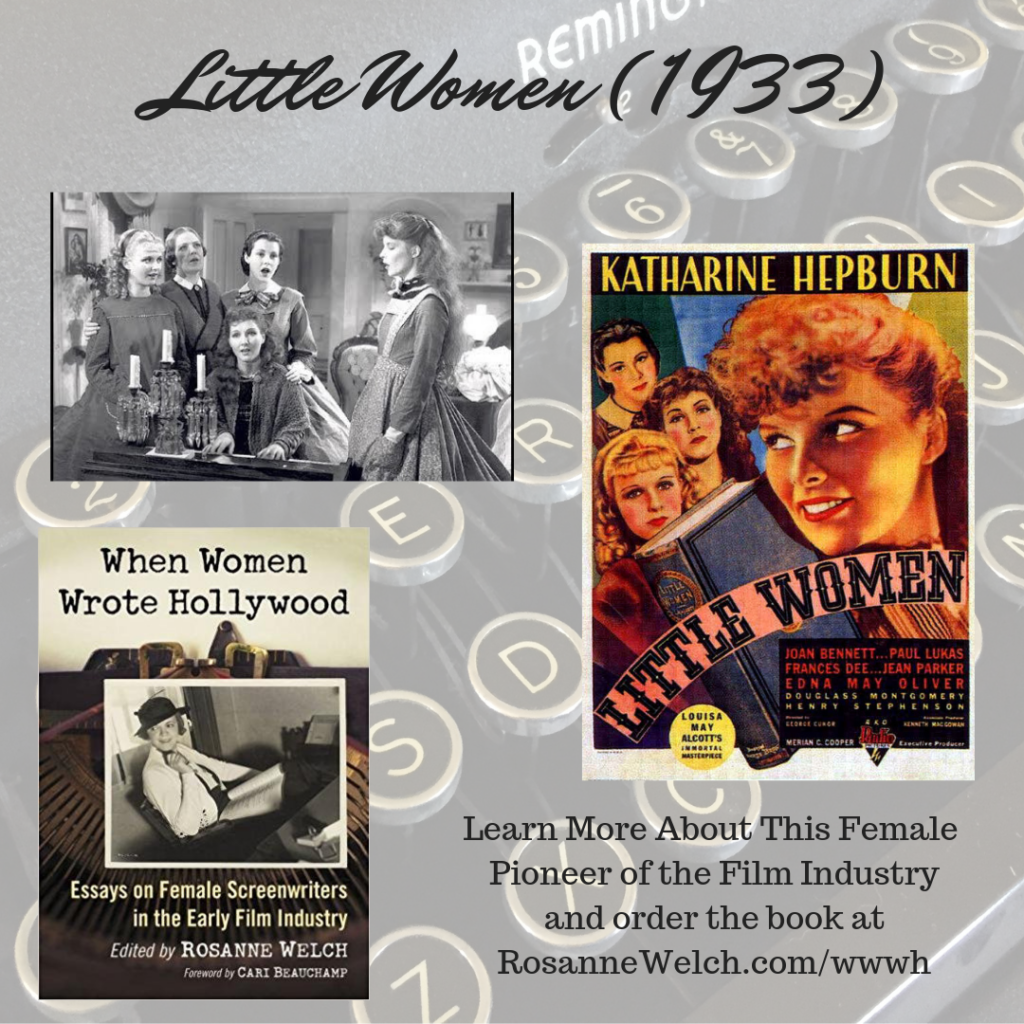
Little Women is a 1933 American pre-Code drama film, directed by George Cukor and starring Katharine Hepburn, Joan Bennett, Frances Dee and Jean Parker. The screenplay, by Sarah Y. Mason and Victor Heerman, is based on the 1868 novel of the same name, by Louisa May Alcott. — Wikipedia
More information about Little Women (1933)
More about Sarah Y. Mason and Victor Heerman
- Read more about this screenwriter in When Women Wrote Hollywood
- Like When Women Wrote Hollywood on Facebook
- Sarah Y. Mason and Victor Heerman on Wikipedia
- Sarah Y. Mason and Victor Heerman on IMDB
Buy a signed copy of when Women Wrote Hollywood
Paperback Edition | Kindle Edition | Google Play Edition
* A portion of each sale from Amazon.com directly supports our blogs
** Many of these books may be available from your local library. Check it out!
† Available from the LA Public Library
A morning at @lakotacoffee to start our @citizenjanefilmfestival day! Fun today, work tomorrow! via Instagram

A morning at @lakotacoffee to start our @citizenjanefilmfestival day!Fun today, work tomorrow!
Who Chat in the Hallway, San Diego WhoCon 2018 via Instagram
Who’s Your Favorite Doctor? Do you watch Doctor Who? What other Science Fiction do you love? Share in the comments?

Baroque by Richard Vetere – Italian-American Heritage Month – End of series

BAROQUE is the true story of the young painter Mario Minitti and several others who lived in and loved in Rome at the turn of the century in 1600. They came to Rome to find fame and fortune, Fillide Meladrone, Archbishop Pietero Aldrobondini, Ranuccio Tomassoni, Nunzio Pulzone. The story follows their lives as they intersect and fall in love with one another and share a common bond that they were painted by the great Caravaggio.
Also from the Mentoris Project


Want to use these books in your classroom? Contact the Mentoris Project!`
They are serious about security at this con! via Instagram
Do you watch Doctor Who? What’s your take on the first female Doctor? What other Science Fiction do you love? Share in the comments?

They are serious about security at this con!
At @sdwhocon 2018
 and Follow
How do I scan a nametag?
To scan a nametag using the Instagram app camera:
- Open the Instagram app and tap in the top left.
- Make sure the nametag you are trying to scan is visible in front of you.
- Hover the camera over the nametag. Hold and press on the camera screen until the nametag is captured.
To scan a nametag from your profile:
- Go to your profile and tap .
- Tap your nametag at the top of the screen.
- At the bottom of the screen, tap Scan a nametag.
- Hover the camera over the nametag until the nametag is captured.
Learn more about Doctor Who with these books and videos!
††
* A portion of each sale from Amazon.com directly supports our blogs
** Many of these books may be available from your local library. Check it out!
† Available from the LA Public Library
When Women Wrote Hollywood – 38 in a series – Sarah Y. Mason and Victor Heerman
When Women Wrote Hollywood – 38 in a series – Sarah Y. Mason and Victor Heerman

Mason was born Sarah Yeiser Mason in Pima, Arizona. She and her husband Victor Heerman won the Academy Award for best screenplay adaptation for their adaptation for the 1933 film Little Women, based on the novel by Louisa May Alcott. Mason was one of the first people in Hollywood to specialize in script supervision and film continuity when the industry switched from silent film to talkies.[2][3] — Wikipedia
More about Sarah Y. Mason and Victor Heerman
- Read more about this screenwriter in When Women Wrote Hollywood
- Like When Women Wrote Hollywood on Facebook
- Sarah Y. Mason and Victor Heerman on Wikipedia
- Sarah Y. Mason and Victor Heerman on IMDB
Buy a signed copy of when Women Wrote Hollywood
Paperback Edition | Kindle Edition | Google Play Edition
* A portion of each sale from Amazon.com directly supports our blogs
** Many of these books may be available from your local library. Check it out!
† Available from the LA Public Library
Quote from “America’s Forgotten Founding Father” by Dr. Rosanne Welch – 34 in a series – A Militia Is Formed
Learn more about the American Revolution through the eyes of an important, Italian Immigrant, Filippo Mazzei.
Read his story today!

“Before Jefferson could leave for Philadelphia, he joined Filippo, Bellini, a young Italian laborer from Colle named Vincenzo, James Monroe and the rest of the 100 man militia as they marched on Williamsburg under the command of Patrick Henry. Two incidents converged to call these men to action in April of 1775.”
From America’s Forgotten Founding Father — Get Your Copy Today!
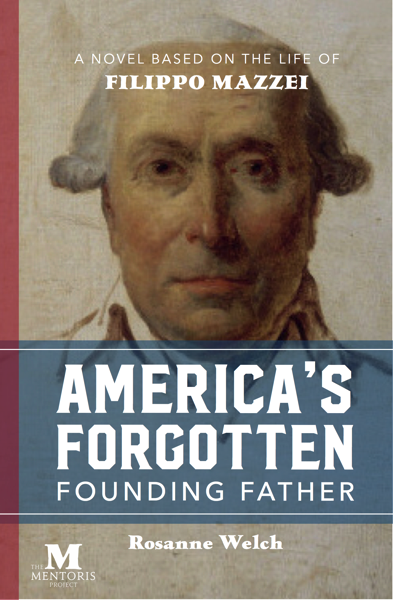
Order an autographed copy of America’s Forgotten Founding Father
Print Edition | Kindle Edition | Apple iBooks Edition | Nook Edition
Also from the Mentoris Project
Want to use these books in your classroom? Contact the Mentoris Project!`
A Thread of Grace: A Novel by Mary Doria Russell – Italian-American Heritage Month – 30 in a series
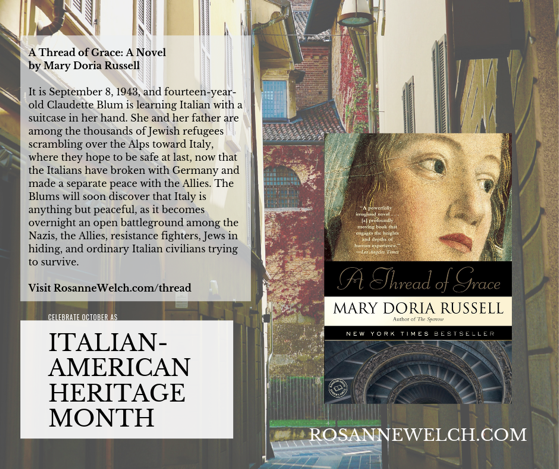
Set in Italy during the dramatic finale of World War II, this new novel is the first in seven years by the bestselling author of The Sparrow and Children of God.
It is September 8, 1943, and fourteen-year-old Claudette Blum is learning Italian with a suitcase in her hand. She and her father are among the thousands of Jewish refugees scrambling over the Alps toward Italy, where they hope to be safe at last, now that the Italians have broken with Germany and made a separate peace with the Allies. The Blums will soon discover that Italy is anything but peaceful, as it becomes overnight an open battleground among the Nazis, the Allies, resistance fighters, Jews in hiding, and ordinary Italian civilians trying to survive.
Mary Doria Russell sets her first historical novel against this dramatic background, tracing the lives of a handful of fascinating characters. Through them, she tells the little-known but true story of the network of Italian citizens who saved the lives of forty-three thousand Jews during the war’s final phase. The result of five years of meticulous research, A Thread of Grace is an ambitious, engrossing novel of ideas, history, and marvelous characters that will please Russell’s many fans and earn her even more.


Also from the Mentoris Project
Want to use these books in your classroom? Contact the Mentoris Project!`
Rosanne Co-Hosts Zilch #126 Monkees 101 – “Monkee See, Monkee Die” for Halloween
I’m having more fun than should be allowed recording this new segment on Zilch: Monkees 101. So far Dr. Sarah Clark and I have recorded 4 of our shows and the 2nd episode is a deconstruction of the 2nd episode of The Monkees to be broadcast. “Monkee See, Monkee Die” was written by Treva Silverman and involves the Monkees attending the reading of a late millionaire’s will, but in order to earn the organ he has left to them, they must stay the night in his haunted castle. — Rosanne
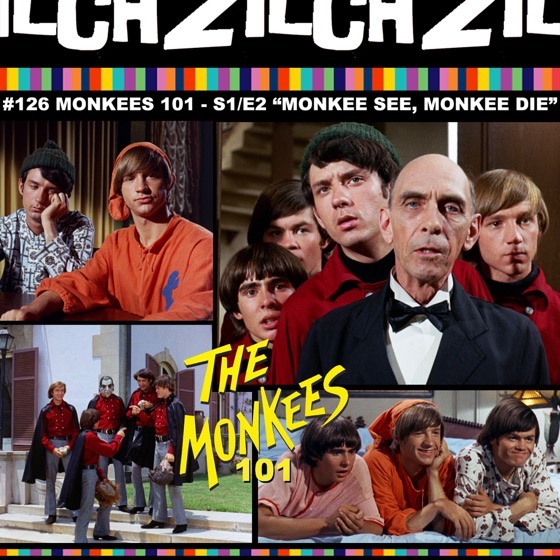
Drs. Rosanne Welch and Sarah Clark debut their new series for Zilch! entitled Monkees 101.
Join them for a fun, thoughtful romp through S1 E2 “Monkee See, Monkee Die” the second episode of The Monkees to air. Originally aired 10/29/18.
Want to learn more about The Monkees? Buy Why The Monkees Matter: Teenagers, Television and American Pop Culture

A hit television show about a fictitious rock band, The Monkees (1966-1968) earned two Emmys–Outstanding Comedy Series and Outstanding Directorial Acheivement in Comedy.
Capitalizing on the show’s success, the actual band formed by the actors, at their peak, sold more albums than The Beatles and The Rolling Stones combined, and set the stage for other musical TV characters from The Partridge Family to Hannah Montana. In the late 1980s, the Monkees began a series of reunion tours that continued into their 50th anniversary.
This book tells the story of The Monkees and how the show changed television, introducing a new generation to the fourth-wall-breaking slapstick created by Laurel and Hardy and the Marx Brothers.
Its creators contributed to the innovative film and television of 1970s with projects like Bob & Carol & Ted & Alice, The Mary Tyler Moore Show, Laugh-In and Welcome Back, Kotter. Immense profits from the show, its music and its merchandising funded the producers’ move into films such as Head, Easy Riderand Five Easy Pieces.
McFarland (Direct from Publisher) | Amazon | Kindle Edition | Nook Edition
Want to use “Why The Monkees Matter” in your classroom?
Order Examination Copies, Library and Campus Bookstore orders directly from McFarland

Podcast: Play in new window | Download
Subscribe: RSS