While I don’t have a dog myself, my friends’ dogs always seem to love me. 😀
Leonardo’s Secret by Peter David Myers – Italian-American Heritage Month – 9 in a series
More than a painter…
Renowned artist Leonardo da Vinci was the greatest genius to ever conquer the worlds of art, science, and philosophy. Writing backwards to protect his knowledge, da Vinci epitomized creativity and eccentricity.
Despite being plagued with frustrations and failures, da Vinci was spurred to create, invent, research, and write no matter the cost. By exploring his sorrows and joys, da Vinci’s world is uncovered. And with it a five-hundred-year-old secret is released: the hidden truth of Leonardo da Vinci.
Also from the Mentoris Project
Want to use these books in your classroom? Contact the Mentoris Project!`
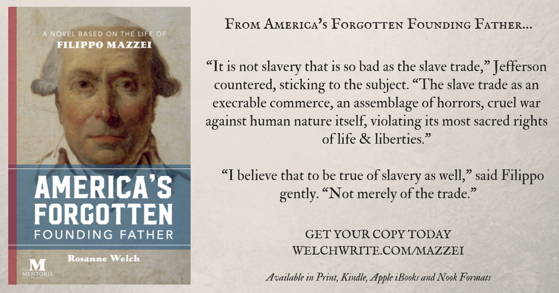
Quote from “America’s Forgotten Founding Father” by Dr. Rosanne Welch – 31 in a series – Slavery and the Slave Trade
“It is not slavery that is so bad as the slave trade,” Jefferson countered, sticking to the subject. “The slave trade as an execrable commerce, an assemblage of horrors, cruel war against human nature itself, violating its most sacred rights of life & liberties.”
“I believe that to be true of slavery as well,” said Filippo gently. “Not merely of the trade.”
From America’s Forgotten Founding Father — Get Your Copy Today!
Order an autographed copy of America’s Forgotten Founding Father
Print Edition | Kindle Edition | Apple iBooks Edition | Nook Edition
Also from the Mentoris Project
Want to use these books in your classroom? Contact the Mentoris Project!`
When Women Wrote Hollywood – 32 in a series – Lillian Hellman
To highlight the wonderful yet largely forgotten work of a collection of female screenwriters from the early years of Hollywood (and as a companion to the book, When Women Wrote Hollywood) we will be posting quick bits about the many films they wrote along with links to further information and clips from their works which are still accessible online. Take a few moments once or twice a week to become familiar with their names and their stories. I think you’ll be surprised at how much bold material these writers tackled at the birth of this new medium. — Rosanne Welch
When Women Wrote Hollywood – 32 in a series – Lillian Hellman
Lillian Florence Hellman (June 20, 1905 – June 30, 1984) was an American dramatist and screenwriter known for her success as a playwright on Broadway, as well as her left-wing sympathies and political activism. She was blacklisted after her appearance before the House Committee on Un-American Activities (HUAC) at the height of the anti-communist campaigns of 1947–52. Although she continued to work on Broadway in the 1950s, her blacklisting by the American film industry caused a drop in her income. Many praised Hellman for refusing to answer questions by HUAC, but others believed, despite her denial, that she had belonged to the Communist Party.
As a playwright, Hellman had many successes on Broadway, including Watch on the Rhine, The Autumn Garden, Toys in the Attic, Another Part of the Forest, The Children’s Hour and The Little Foxes. She adapted her semi-autobiographical play The Little Foxes into a screenplay, which starred Bette Davis and received an Academy Award nomination in 1942.
Hellman was romantically involved with fellow writer and political activist Dashiell Hammett, author of the classic detective novels The Maltese Falcon and The Thin Man, who also was blacklisted for 10 years until his death in 1961. The couple never married — Wikipedia
More about Lillian Hellman
- Read more about this screenwriter in When Women Wrote Hollywood
- Like When Women Wrote Hollywood on Facebook
- Lillian Hellman on Wikipedia
- Lillian Hellman on IMDB
More books by and about Lillian Hellman
††
Buy a signed copy of when Women Wrote Hollywood
Paperback Edition | Kindle Edition | Google Play Edition
* A portion of each sale from Amazon.com directly supports our blogs
** Many of these books may be available from your local library. Check it out!
† Available from the LA Public Library
More on Mazzei: Philip Mazzei, Virginia’s agent in Europe; the story of his mission as related in his own dispatches and other documents;
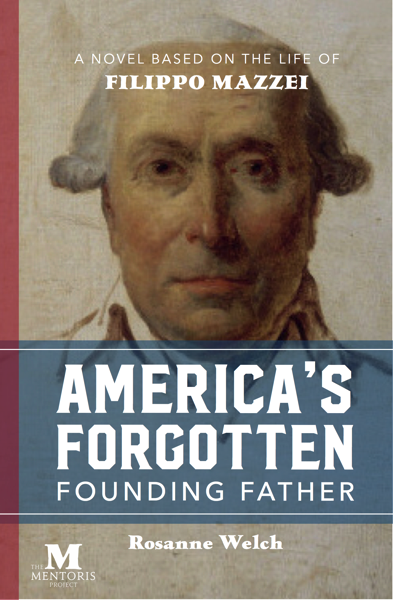
This series will focus on material I found while researching my book, America’s Forgotten Founding Father: A Novel Based on the Life of Filippo Mazzei.
These next few items come from the Bibliography I submitted when proposing the original book. — Rosanne.
PHILIP MAZZEI, VIRGINIA’S AGENT IN EUROPE
The Story of His Mission as Related in His Own Dispatches and Other Documents
INTRODUCTION
IN April, 1925, The New York Public Library acquired through purchase a collection of the papers of Philip Mazzei. Four additional pages of manu- script were purchased in 1927. The whole collection comprises twenty-seven items and includes Mazzei’s relation of his capture and detention by the British naval forces in 1779; eighteen dispatches sent by him, as Virginia’s agent in Europe (sixteen to Thomas Jefferson, Governor of Virginia, and two to Benjamin Harrison, who followed, as Governor, Thomas Nelson, Jr., Jefferson’s succes- sor) ; his “Representation,” or report of his conduct as agent; and six letters to John Page, prominent Virginian and successor to James Monroe as Governor. These manuscripts, with the exception of the letters to Page, which are largely on personal matters, are now set forth in the present publication.
Mazzei’s spelling, capitalization, and punctuation have been adhered to strictly in this printing of the manuscripts. When it seemed advisable, corrections of some of the less obvious errors have been made in the foot-notes.
Philip Mazzei was born at Poggio a Caiano, a small town near Florence, Tus- cany, on December 25, 1730. Little is known of his youth except that he studied medicine at the hospital of Santa Maria Nuova in Florence and was dismissed for some minor offence. Somewhat later, forced by the death of his father to earn his own livelihood, he went to Pisa to live with his cousins ; and began to earn money by medical practice among the people of that community. During this sojourn, Mazzei was urged by Dr. Salinas to accompany him and his wife to Smyrna, whence they had come. Accepting this invitation, he left Florence with them in August, 1752. From the time of his arrival at Constantinople in De- cember of that year, and throughout the next three years that he remained there, Mazzei devoted himself to the practice of medicine — a profession which placed him in contact with many influential men.
Download this book in PDF, Text and many other formats
Order an autographed copy of America’s Forgotten Founding Father
Print Edition | Kindle Edition | Apple iBooks Edition | Nook Edition
Also from the Mentoris Project
Want to use these books in your classroom? Contact the Mentoris Project!`
God’s Messenger, The Astounding Achievements of Mother Cabrini: A Novel Based on the Life of Mother Frances X. Cabrini – Italian-American Heritage Month – 8 in a series
Her passion became her reality.
Children were her life, and God’s messenger Mother Frances X. Cabrini dedicated her entire life to caring for poor Italian immigrants who sought refuge in the slums of New York City in the early 1890s.
A devout champion of education and proper health care for the poverty-stricken, Cabrini forged a path of survival for young children by building schools, orphanages, and hospitals—not only in the United States, but also throughout Europe and Central and South America. With an acumen for business and a desire to help, Mother Cabrini chiseled away at a problem others refused to see.
Years after her death, Mother Cabrini was named Patron Saint of Immigrants because of her unwavering work for those who needed her.
Also from the Mentoris Project
Want to use these books in your classroom? Contact the Mentoris Project!`
31 Adric from Gender Diversity in the Who-niverse [Video] (0:38)
Watch this entire presentation: Gender Diversity in the Who-niverse: Paving the Way for a Lady Doctor with Dr. Rosanne Welch [Video] (36:58)
For her 5th Doctor Who lecture to the CPP community, Dr. Rosanne Welch discusses how society – and the show’s writing staff – prepared the audience for a major change in this 50-year franchise – the creation of the first Lady Doctor!
Transcript:
We also had this young gentleman who was in both the Baker and the Davison Era who was Adric, who was a math genius and he was a young kid so he had more access to his emotions. We don’t let young boys have their emotions. We tell them not to cry. That’s stupid. Humans cry. There’s no such thing as not cryng, right, but we do that. So, it was nice to have Adric as an example back in the day. And until I was putting this together I never had read that fun fact. That’s where they got his name from — an actual Nobel-winning guy. I thought it was pretty cool. I love that — again — writers playing and giving us more information. I just learned something a guy I had never heard of, right? A little research.
Follow Dr. Welch on Twitter and Instagram
https://twitter.com/rosannewelch – http://instagram.com/drrosannewelch
Rosanne Welch, PhD
Rosanne Welch PhD teaches the History of Screenwriting and One-Hour Drama for the Stephens College MFA in Screenwriting.
Writing/producing credits include Beverly Hills 90210, Picket Fences, ABCNEWS: Nightline and Touched by an Angel. In 2016 she published the book Why The Monkees Matter: Teenagers, Television and American Pop; co-edited Women in American History: A Social, Political, and Cultural Encyclopedia; and placed “Transmitting Culture Transnationally Via the Characterization of Parents in Police Procedurals” in the New Review of Film and Television Studies. Essays appear in Torchwood Declassified: Investigating Mainstream Cult Television and Doctor Who and Race: An Anthology. Welch serves as Book Reviews editor for Journal of Screenwriting and on the Editorial Advisory Board for Written By magazine, the magazine of the Writers Guild.
Watch Dr. Welch’s talk “The Importance of Having a Female Voice in the Room” at the 2016 TEDxCPP.
Podcast: Play in new window | Download
Subscribe: RSS
Building Heaven’s Ceiling: A Novel Based on the Life of Filippo Brunelleschi By Joe Cline Italian-American Heritage Month – 7 in a series
His greatest accomplishment came after his greatest disappointment.
One of the founding fathers of the Renaissance, Filippo Brunelleschi was more than an Italian designer. Brunelleschi made his mark in architecture and construction.
In his early years, sculpting was Brunelleschi’s passion. But after being passed over for a major commission, he set his sights on architecture, and changed the landscape of Italy as it is known today.
Brunelleschi’s most prominent contribution, the dome of Cathedral of Santa Maria del Fiore, was the first of its kind, paving the way for bigger and more elaborate domes to come. His invention of machines to facilitate the construction of the dome allowed future structures to not only be imagined, but to be erected as well.
With his imagination, understanding of linear perspective, focus on geometric principles, and intellect for mathematics, Brunelleschi influenced the rise of modern science and architecture worldwide.
Also from the Mentoris Project
Want to use these books in your classroom? Contact the Mentoris Project!`
Event: How Star Wars Changed Films Forever with Dr. Rosanne Welch, Cal State Fullerton, October 25, 2018 at Noon
Date: Thursday, October 25, 2018
Time: 12:00pm – 1:00pm
Location: Special Events Room 4829, Cal State Fullerton Pollack Library, 800 N State College Blvd, Fullerton, CA 92831
Campus: Building 15
In her talk screenwriter and professor Rosanne Welch will discuss everything Star Wars from George Lucas to Leigh Brackett to Lawrence Kasdan. From Luke Skywalker to Han Solo to Lando Calrissian (both original and prequel versions) to Poe. From Leia Organa to Rey to Jyn Erso. From Jaws to the whole Star Wars franchise to Raiders of the Lost Ark in a look at how Star Wars changed films and fandom forever.
Soldier, Diplomat, Archaeologist: A Novel Based on the Bold Life of Louis Palma di Cesnola by Peg Lamphier – Italian-American Heritage Month – 6 in a series

He fought for himself.
He fought for his country.
He fought for acceptance.
As the son of an Italian count, Cavalry Colonel Louis Palma di Cesnola had more military experience than most of the leading officers in the Civil War. Objecting to his general’s orders, di Cesnola led his men into battle, earning himself a Medal of Honor.
When di Cesnola was captured and thrown into the notorious Libby Prison, he was forced to examine his life decisions. Upon release, di Cesnola was torn between his desire to return to war or to his wife and daughter—a battle of his heart and his duty.
Once the war ended, di Cesnola became America’s consul for archaeological excavators, and eventually became the first director of the New York Metropolitan Museum of Art. With every step of success, di Cesnola was forced to prove himself in a country that emphatically disapproved of immigrants. His plight forged a path of national acceptance of Italian-Americans throughout the entire country.
Also from the Mentoris Project
Want to use these books in your classroom? Contact the Mentoris Project!`
and Follow