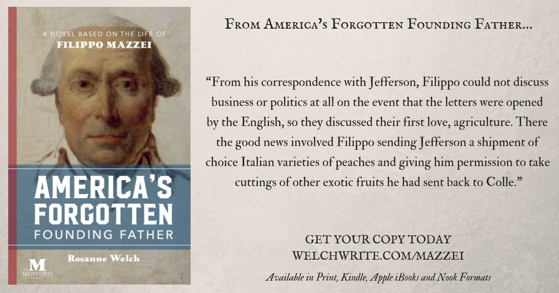
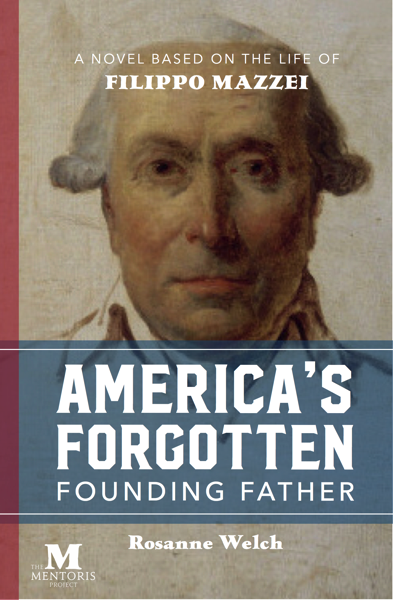
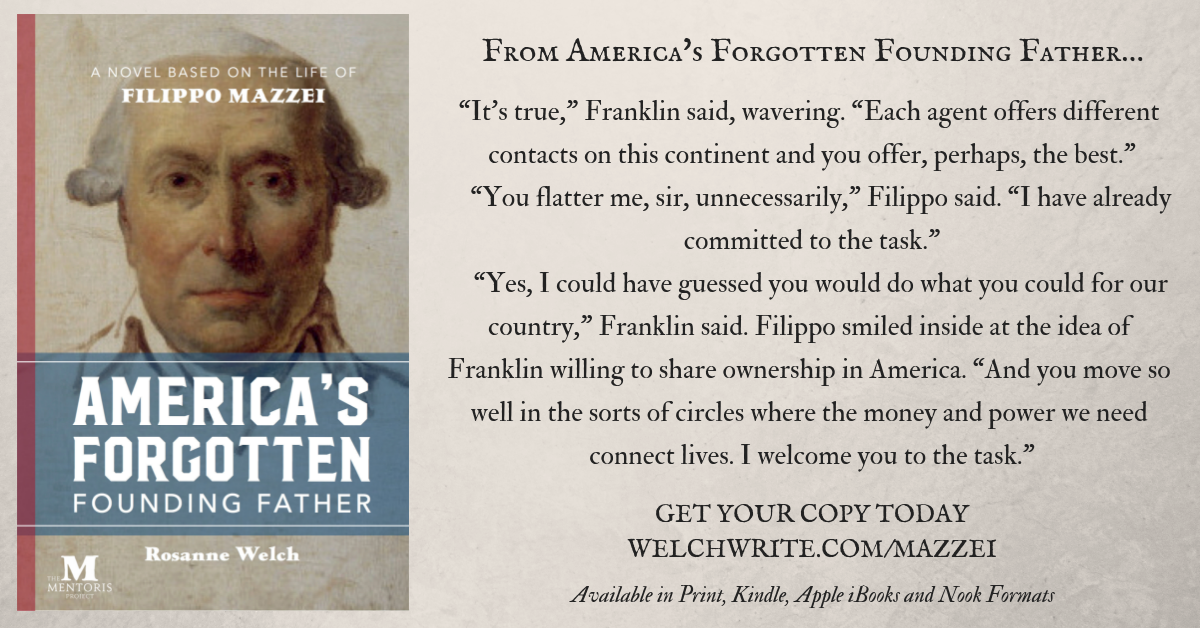
Learn more about the American Revolution through the eyes of an important, Italian Immigrant, Filippo Mazzei.
Read his story today!
“From his correspondence with Jefferson, Filippo could not discuss business or politics at all on the event that the letters were opened by the English, so they discussed their first love, agriculture. There the good news involved Filippo sending Jefferson a shipment of choice Italian varieties of peaches and giving him permission to take cuttings of other exotic fruits he had sent back to Colle.”
We also bring in guest lecturers like my friend Paolo who I met coming to an SRN. So he came to town for a week and we did some story work with our students. This is our first class. You can hear about it a little more in a minute. So this was great. He came to lecture about the Global Neorealism because we wanted an Italian expert so there you go. I’m also very fond of the idea that I’ve learned a lot from doing this with my students because I planned the whole thing focusing on women only to realize that I’ve left behind minorities. There were African American filmmakers in the silent era. Oscar Micheaux is one of them. Very famous. Much of their work has been lost so it’s difficult to teach them or to offer students the chance to study them or analyze their work but he has a lot of work out there. So I’ve had to find texts that cover the gaze the focus of African Americans in the film in America through the years. So this one– it turned out it’s mostly about actors — but it gives you a sense and then also my LGBTQ students want to see where they fit in the picture and this is an excellent book on the history of LGBTQ people in Los Angeles — screenwriters, actors, directors — the whole thing. So by them asking me what they want or where they don’t see themselves in the picture, it’s forced me to go outside of my own background and give them more.
* A portion of each sale from Amazon.com directly supports our blogs ** Many of these books may be available from your local library. Check it out! † Available from the LA Public Library
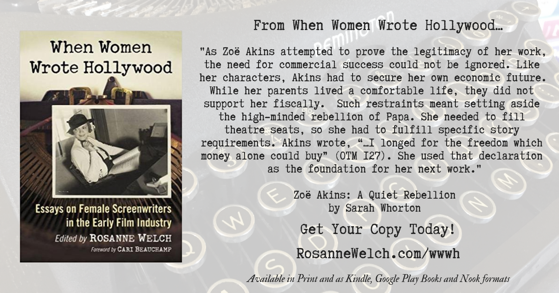
“As Zoë Akins attempted to prove the legitimacy of her work, the need for commercial success could not be ignored. Like her characters, Akins had to secure her own economic future. While her parents lived a comfortable life, they did not support her fiscally. Such restraints meant setting aside the high-minded rebellion of Papa. She needed to fill theatre seats, so she had to fulfill specific story requirements. Akins wrote, “…I longed for the freedom which money alone could buy” (OTM 127). She used that declaration as the foundation for her next work.”
* A portion of each sale from Amazon.com directly supports our blogs ** Many of these books may be available from your local library. Check it out! † Available from the LA Public Library
Learn more about the American Revolution through the eyes of an important, Italian Immigrant, Filippo Mazzei.
Read his story today!
“It’s true,” Franklin said, wavering. “Each agent offers different contacts on this continent and you offer, perhaps, the best.”
“You flatter me, sir, unnecessarily,” Filippo said. “I have already committed to the task.”
“Yes, I could have guessed you would do what you could for our country,” Franklin said. Filippo smiled inside at the idea of Franklin willing to share ownership in America. “And you move so well in the sorts of circles where the money and power we need connect lives. I welcome you to the task.”
Kevin Willmott is located at Kansas University, much farther than Los Angeles and he’s come in through Skype. Where he’s not gonna fly up to LA. So we can get guest speakers who are current working writers. We need to do more of that. in the second year, we go into looking at screenplays right — so William Goldman is the head guy there and I’m happy to use books that I found out about from my coming to these conferences and also I wanted to expand their studies so — because I’m — my grandparents were Italian so that’s how come I get to call myself Italian, so I said “Oooo let’s do some Italian films. What’s my excuse? Global neo-realism affected American film so let’s study that!” So this turned out to you great piece because there are essays by followers in many countries so it’s also pretty international which is also something made for me to bring to the Americans. We aren’t the only ones who do movies. Sometimes we pretend we are but we should not think that way and we learn a lot from international films. So I do that.
* A portion of each sale from Amazon.com directly supports our blogs ** Many of these books may be available from your local library. Check it out! † Available from the LA Public Library
But the beauty of both my books (I hope) is the fact that they bring much needed attention to writers and performers who weren’t necessarily lauded in their own time. —Rosanne
You know how you are going to lecture on topics from your new book and then something happens in the big old world that touches on your previous book?
Such is happening to Rosanne Welch, who is a writer and adjunct professor at Cal State Fullerton, Cal Poly Pomona, Mt. San Antonio College in Walnut and Stephens College in Columbia, Missouri.
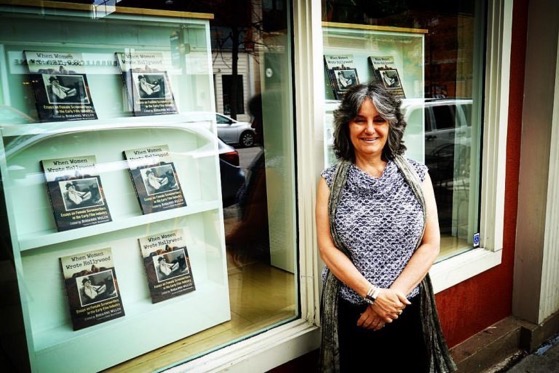
She is scheduled to give one of the Faculty Noon Time Talks in CSUF’s Pollock Library from noon to 1 p.m. Tuesday, March 5. These events are based on faculty research, which in Welch’s case is partly encapsulated in her most recent book, When Women Wrote Hollywood: Essays on Female Screenwriters in the Early Film Industry (McFarland & Co., 2018).
However, on Feb. 21, actor/composer/musician Peter Tork, who is best known as the bass player/keyboardist with the Monkees, passed away, which prompted the re-release of something Welch had said about him:
* A portion of each sale from Amazon.com directly supports our blogs ** Many of these books may be available from your local library. Check it out! † Available from the LA Public Library
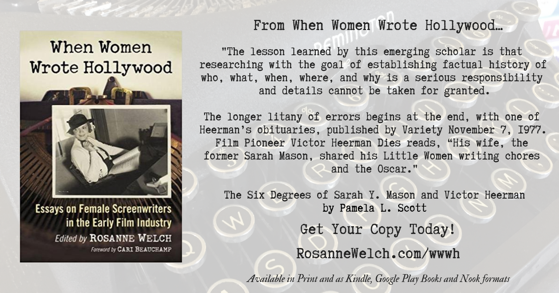
“The lesson learned by this emerging scholar is that researching with the goal of establishing factual history of who, what, when, where, and why is a serious responsibility and details cannot be taken for granted.
The longer litany of errors begins at the end, with one of Heerman’s obituaries, published by Variety November 7, 1977. Film Pioneer Victor Heerman Dies reads, “His wife, the former Sarah Mason, shared his Little Women writing chores and the Oscar.”
The Six Degrees of Sarah Y. Mason and Victor Heerman by Pamela L. Scott
* A portion of each sale from Amazon.com directly supports our blogs ** Many of these books may be available from your local library. Check it out! † Available from the LA Public Library
Rosanne Welch, PhD, Author of Why The Monkees Matter, presents “How The Monkees Changed Television” at a Cal State Fullerton Lunch Lecture on May 8, 2018.
In this talk, she shows how The Monkees, and specifically their presence on television, set the stage for large changes to come in the late 1960s.
Transcript
During their tour, I got to finally meet them. I had interviewed Micky on the phone for my newspaper article but I was invited backstage to do a photograph I was like “Om my gosh, that’s so cool!” because you know in 1980 I had another picture with Micky all right. Yeah OMG, look at us! There you go. So that’s pretty cool. They’re pretty famous. and then we’re back to who I am and what I’m working on and this is a bunch of stuff I use for research but not nearly all of it of course because I had to do a lot of work in our library. That’s what libraries are so wonderful about and so since we have a moment what I’ll do is I’ll just show you the thing that I was going to show you. This is Peter talking at Monterey very short bit quieting the crowd down. welcome now with a great big fat round of applause — my favorite group, The Buffalo Springfield.
A hit television show about a fictitious rock band, The Monkees (1966-1968) earned two Emmys–Outstanding Comedy Series and Outstanding Directorial Acheivement in Comedy.
Capitalizing on the show’s success, the actual band formed by the actors, at their peak, sold more albums than The Beatles and The Rolling Stones combined, and set the stage for other musical TV characters from The Partridge Family to Hannah Montana. In the late 1980s, the Monkees began a series of reunion tours that continued into their 50th anniversary.
This book tells the story of The Monkees and how the show changed television, introducing a new generation to the fourth-wall-breaking slapstick created by Laurel and Hardy and the Marx Brothers.
Its creators contributed to the innovative film and television of 1970s with projects like Bob & Carol & Ted & Alice, The Mary Tyler Moore Show, Laugh-In and Welcome Back, Kotter. Immense profits from the show, its music and its merchandising funded the producers’ move into films such as Head, Easy Riderand Five Easy Pieces.
Learn more about the American Revolution through the eyes of an important, Italian Immigrant, Filippo Mazzei. Read his story today!
In 1736 the Franklin’s lost their youngest son to smallpox at the age of four. Franklin had foregone inoculation as his older brother, James Franklin argued in the press that inoculation was a breach of the Sixth Commandment, “Thou shalt not kill”. But when his own son was lost, Franklin forewent protecting his brother’s stance and came out for the procedure.
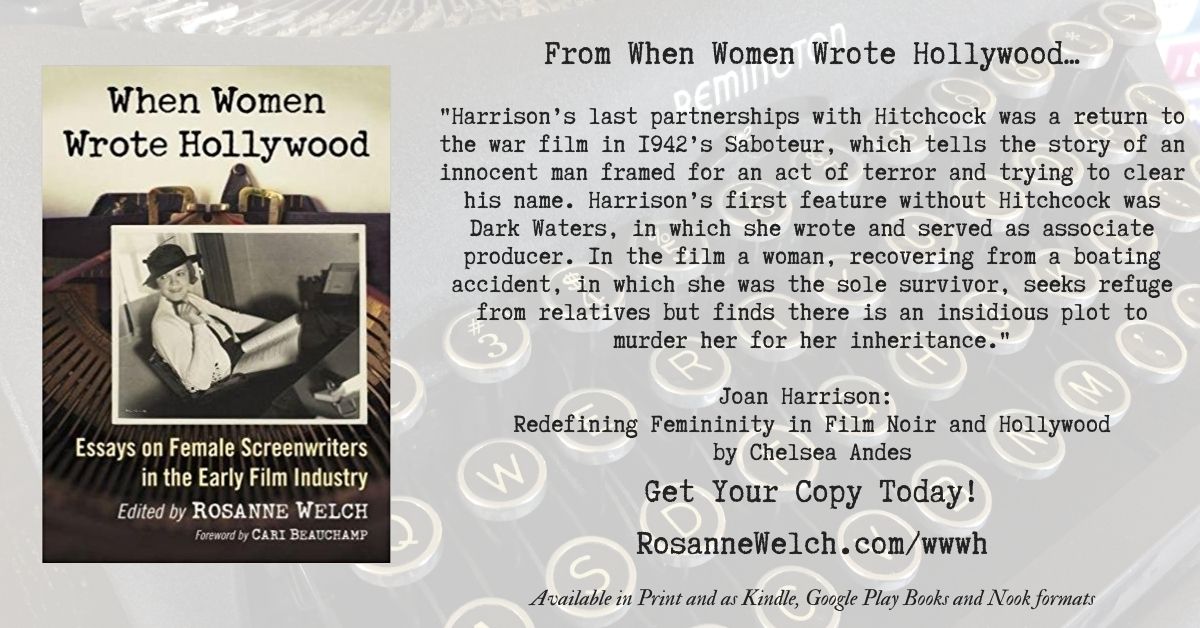
“Harrison’s last partnerships with Hitchcock was a return to the war film in 1942’s Saboteur, which tells the story of an innocent man framed for an act of terror and trying to clear his name. Harrison’s first feature without Hitchcock was Dark Waters, in which she wrote and served as associate producer. In the film a woman, recovering from a boating accident, in which she was the sole survivor, seeks refuge from relatives but finds there is an insidious plot to murder her for her inheritance.”
Joan Harrison: Redefining Femininity in Film Noir and Hollywood
by Chelsea Andes
* A portion of each sale from Amazon.com directly supports our blogs
** Many of these books may be available from your local library. Check it out!
† Available from the LA Public Library


![13 More Guest Speakers and Diversity from Why (and How) I Created a History of Screenwriting Course [Video] (1 minute 18 seconds)](https://rosannewelch.com/wp-content/uploads/2019/03/srn-rmw-2018-13.jpeg)

![12 More Guest Speakers from Why (and How) I Created a History of Screenwriting Course [Video] (58 seconds)](https://rosannewelch.com/wp-content/uploads/2019/03/srn-rmw-2018-12.jpeg)
![36 Meeting The Monkees from How the Monkees Changed Television [Video] (1 minute, 13 seconds)](https://rosannewelch.com/wp-content/uploads/2019/03/monkees-tv-36-meeting-monkees.jpeg)