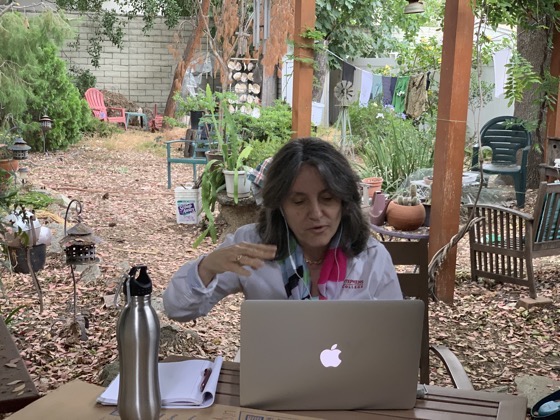
I spent a lovely and engaging morning in the company of several international screenwriting academics discussing teaching online thanks to being invited to this virtual Bucharest Symposium in Screenwriting and Literature by Tudor Voican, PhD, WallachiaIFF Jury President.
The invitation arrived in my email inbox and almost looked like a fake – until I saw the names of the other participants and knew them to be pretty stellar in their fields. So I said yes. We’ll meet online each Sunday for 3 Sundays to make 20 minute presentations to each other and share our knowledge.
Though I would have loved to actually fly to what Tudor calls “the legendary land of Principe Vlad III Drăculea aka Vlad the Impaler, Voivode of Wallachia” but for now I am outside on the patio using our built-in Zoom background.
I gave the opening lecture entitled, “Why Researching Screenwriters (has Always) Mattered” which appears here in English, though the rest of the papers (naturally) are in Portuguese. It was an honor to be asked to do the lecture and privilege to spend time with Professor Glaucia Davino and her students who made me feel very welcome in their city.
Words matter. Writers matter and women writers matter in this world. It is important to consider writers because the word writer comes before the word director when you describe a filmmaker who can do two things. They are writer-directors, they are not director-writers. That tells us something. The vision of a movie cannot exist without the screenplay. A director cannot direct nothing. There must be an idea. There must be a philosophy. There must be a theme. There must be a story. This proves that the writer is of equal importance. We must remember writers have to be equal partners and I think we realize that without realizing it. When people talk about movies to their friends they don’t say “I loved the camera angle in scene 7.” They quote dialogue from their favorite movies whether they are from a Pixar film or a Disney one, they quote the dialogue and that is the work of the writer. That’s the person who should be given credit, yet often at the start a class I ask students to list their two or three favorite films, who directed those films and who wrote that film. They very often cannot name the person who wrote the film they claim to adore. How can you study to be a writer if you don’t remember writers yourself? Hence the reason to study Screenwriting. Hence researching screenwriters has always mattered.
When actors Frances McDormand won her Oscar for Three Billboards Outside Ebbing Missouri she said of the screenwriter Martin McDonagh, “He did not sketch a blueprint. That’s an insult to a screenplay. He didn’t string together a few words. He wrote, meticulously crafted, a tsunami, and then he allowed his troupe of actors to surf it into the shore.” (https://www.hollywoodreporter.com/news/sag-awards-three-billboards-takes-top-honors-at-a-show-women-took-center-stage-1076726) She credited the writer in a way that many people do not.
Stories – and therefore screenplays and therefore screenwriters — are important because they transmit culture around the world. The United States has had a corner on that market for far too many years but now we’re beginning to see other stories permeate our culture, a good and beneficial thing for a country made of immigrants and the ancestors of immigrants. Stories have always transmitted culture far back to the cave paintings of many ancient cultures, through Gilgamesh, and the griots of Africa. Humans have used stories to move culture forward. Movies are the most current version of doing that so why do we forget to study the storytellers? Now is the time to fix this glaring omission both in casual discussions of films and in academia.
As a member of the Executive Council of the Screenwriting Research Network (SRN) I have the great pleasure of meeting with colleagues from several continents (Australia, South America, Europe, etc) on a monthly basis to discuss the business of the organization. it continues to amaze me how technology allows us to do this – as it continues to amaze me how lucky I am to have had the chance to meet all of these lovely folks in person at our various conferences. Can’t wait for the next one – in Oxford in 2021!
Every Monday we will be profiling a member of the Stephens College MFA in TV and Screenwriting 2020 graduating class. This exciting, fresh crop of writers are the future of the industry and are going on to do BIG things, so get to know them now!
Haña Lucero-Colin is a writer, musician, and artist based out of Los Angeles, CA. As a storyteller, she strives to shed light on previously unseen spaces with empathy and a sense of humor. In 2014 she was awarded the Gene Amole Scholarship for Humor and Integrity in Journalism from the Metropolitan State University of Denver. A former ArtLab intern, Haña contributed to a play titled “I.Am.Here.” about a group of mixed-income high school students giving voice to their own unique stories. She also composed original music for the piece, which was performed at the University of Denver Colorado. She is currently pursuing her Master of Fine Arts in TV and Screenwriting through Stephens College. She is best known on screen as Shawn on The Fosters and MoCap Student #1 on ConMan. You may also recognize her concentrating face from a brief stint on ABC’s How to Get Away With Murder, but otherwise she was fairly blurry. Haña is mostly just happy to be here.
Every Monday we will be profiling a member of the Stephens College MFA in TV and Screenwriting 2020 graduating class. This exciting, fresh crop of writers are the future of the industry and are going on to do BIG things, so get to know them now!
This week, Stephens College is proud to present: CJ Ehrlich #MeetTheGraduates
A Bostonian who resides in the wilds of NY, C.J. Ehrlich is an award-winning playwright, whose works have enjoyed over 200 productions around the world, and are published in numerous “Best of” anthologies (including The Best American Short Plays of 2015-16). Full-lengths include The Cupcake Conspiracy: Terrorism is Easy, Marriage is Complicated (with Philip J. Kaplan), the anti-romcom This Time We’ll Make It Work, and scifi comedy Zane to Gate 69. While in the MFA program, C.J. has written a full-length horror screenplay, Graduation, and is developing the comedy Stupid Voices from the Future, as well as pilots for a supernatural, teen-oriented thriller, and a comedy about a team of reality TV losers. She also spent a wonderful semester living amongst the female screenwriters of the silent era, and has mixed feelings about Al Jolson.
Every Monday we will be profiling a member of the Stephens College MFA in TV and Screenwriting 2020 graduating class. This exciting, fresh crop of writers are the future of the industry and are going on to do BIG things, so get to know them now!
Emma Jeszke is a dramedy writer, with a focus on coming-of-age stories that challenge and expand typical narratives about girlhood, young adulthood, and motherhood. She has a special talent for keeping you laughing till you’re crying.
Her television pilot Postpartum, about the joys and struggles of being a new mom, was a top-ten finalist in the Women Writing Competition at Series Fest. She is the author of the feature screenplays Wildflower, a forbidden love story about a soldier and an antiwar activist set in 2004, and Bobbi Malone, which follows a thirty-something as she reconnects with her estranged grandmother through a theater troupe. She’s also the author of several stage plays, and the creator of the forthcoming web series Holly & Gem, about two sisters who reconnect after one escapes a cult.
Her plays have been performed regionally in places such as the Finger Lakes Musical Theatre Festival and the Blank Theatre in Los Angeles. She is a book editor at Theatre Communications Group, the foremost publisher of theatrical literature, where she’s spent eight years working with world-renowned playwrights. She’s currently finishing her MFA in TV & Screenwriting at Stephens College.
February was a month of sharing the marvelous photos from all the guest lectures who graced the January Stephens College MFA in TV and Screenwriting workshop with their talent and inspiration… (plus a quick shot of my upcoming book on Films of the Civil War).
💪🍪 We honor the great women who have gone ahead of us and who walk beside us every day on this #InternationalWomensDay. This Peanuts strip was first published on November 11, 1976.
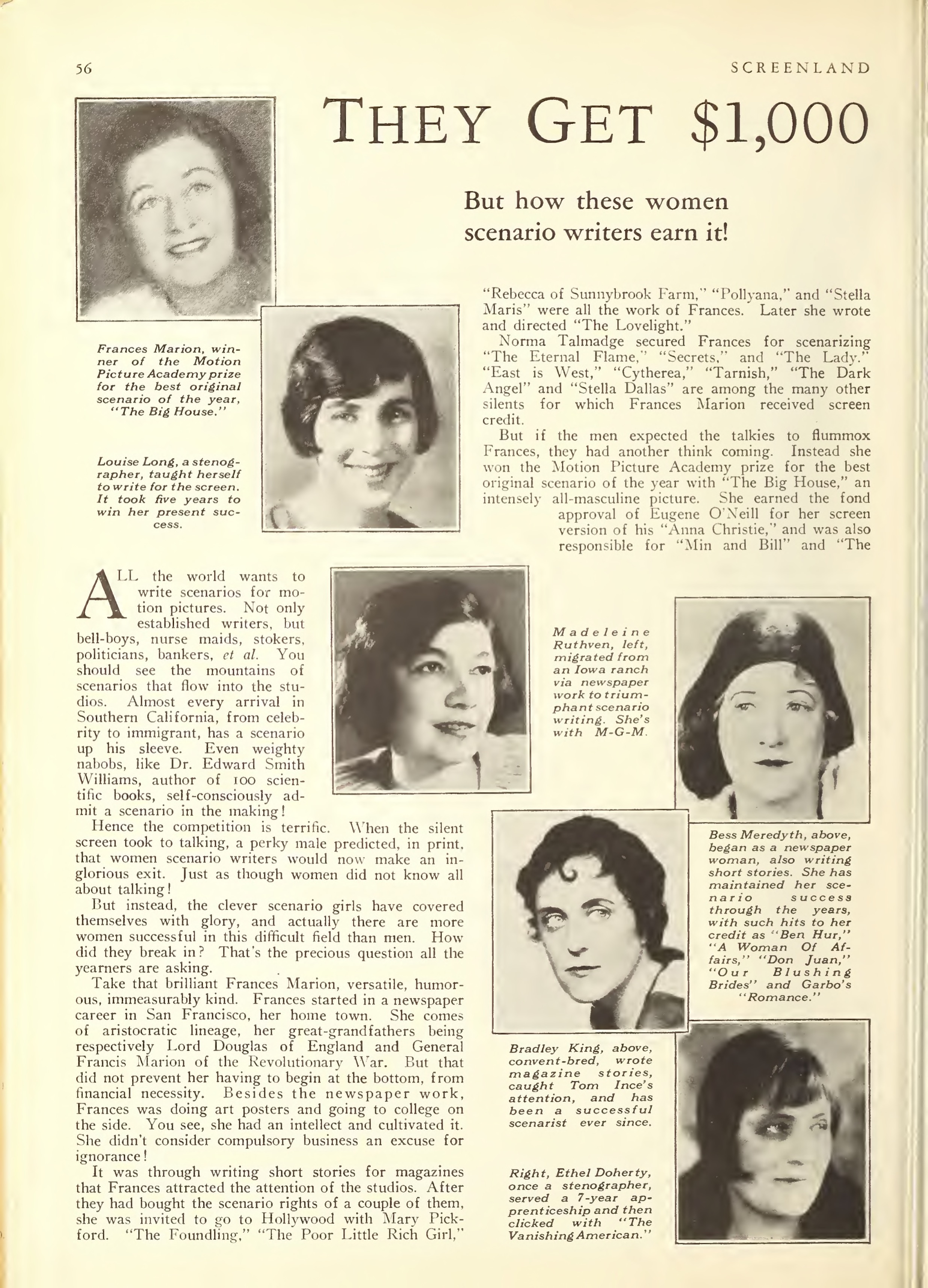
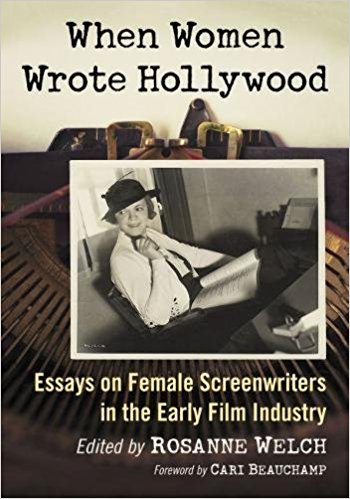
While many film historians and teachers still don’t know the name of many of these marvelous female screenwriters from Hollywood’s Golden era, research shows they existed. It’s the job of this generation of scholars to bring these names into the larger conversation.
* A portion of each sale from Amazon.com directly supports our blogs ** Many of these books may be available from your local library. Check it out! † Available from the LA Public Library
Every Monday we will be profiling a member of the Stephens College MFA in TV and Screenwriting 2020 graduating class. This exciting, fresh crop of writers are the future of the industry and are going on to do BIG things, so get to know them now!
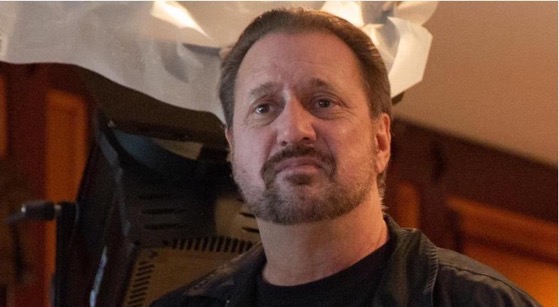
Antonio Zarro is a director and actor for film and television. He created Aria Pictures, a media production company through which he produced and directed over 300 films, commercials and training dramas. His productions have played in Hollywood, Cannes and Europe, and have shown on Showtime, HBO, Cinemax and the Family Channel.
His work has screened at the NY Film Festival, the Chicago Film Festival, the Virginia Festival of American Film, the Columbus Film Festival and Worldfest-Houston. A few of Zarro’s awards include: A Cine Golden Eagle, Telly, Addy, and Aurora Award. He is a member of the Screen Actors Guild, acting in movies, television and the theatre. Zarro received a B.A. from the University of Tulsa and an M.A. from Regent University.
At the graduate level, he wrote and directed Bird in a Cage, which won a Student Academy Award.