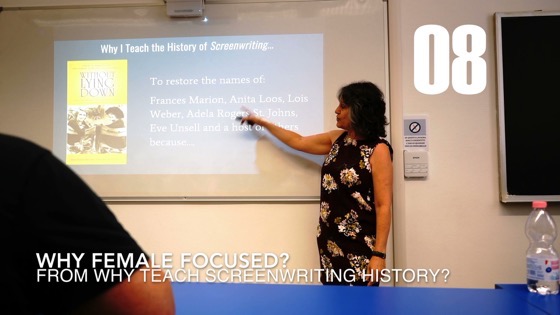
08 Why Female Focused from Why I Created a History of Screenwriting Course [Video] (1 minute, 9 seconds)

A clip from my presentation at the 11th Annual Screenwriting Research Network conference. Held on the campus of the beautiful Università Cattolica del Sacro Cuore in Milan.
Watch the entire presentation 

08 Why Female Focused from Why I Created a History of Screenwriting Course

In the presentation, I covered the reasons writers have been marginalized – and the reasons they oughtn’t to be so disrespected. Then I talked about how my course works, what books I assign, what guest speakers I invite, what research the students do – and ended on a high note by introducing ‘When Women Wrote Hollywood’ – the book of essays from our inaugural class which has now been published by McFarland.

Transcript:

So how I teach it. That’s why I teach I want respect to come back to writers. That seems simple right? How I do it. I start in the very beginning when women were the major writers of Hollywood films. There were 50 percent of the films are in by women if not more and they made more money. This is Gene Gauntier from Ireland, this is Anita Loos and Jeannie Macpherson working with Cecil B. DeMille. She wrote every one of his financially successful films and when they stopped working together, his movies stopped making money. That’s the end of Cecil B. DeMille. How I teach it. I start by asking students very quick questions. What are your first five favourite films? Who directed those films? They always know. Who wrote those films? and the look of humiliation on their faces when they sit in a screenwriting class and cannot name the people who wrote their favorite films is ridiculous to me.

Watch the entire presentation

Subscribe to Rosanne Welch, Ph.D on YouTube


Buy a signed copy of when Women Wrote Hollywood

Paperback Edition | Kindle Edition | Google Play Edition

* A portion of each sale from Amazon.com directly supports our blogs
** Many of these books may be available from your local library. Check it out!
† Available from the LA Public Library

32 The Archies and The Monkees from How the Monkees Changed Television [Video] (49 seconds)

What this entire presentation — How The Monkees Changed Television with Rosanne Welch, PhD (Complete Presentation and Q&A) [Video] (45:06)

32 The Archies and The Monkees from How the Monkees Changed Television

Rosanne Welch, PhD, Author of Why The Monkees Matter, presents “How The Monkees Changed Television” at a Cal State Fullerton Lunch Lecture on May 8, 2018.

In this talk, she shows how The Monkees, and specifically their presence on television, set the stage for large changes to come in the late 1960s.


Transcript

In the 80s they got a star on the on the Walk of Fame for the TV show not the music. That’s how important the TV show was. That’s their their star right and at this point they end up with a manager. they’d never had a manager before and he started the whole tour thing. So in their 50th year, the Archie comics had the Monkees guest star. This just came out a couple of months ago and that’s a huge “Wow the monkeys are in the Archies” right? The Archies — side tangent — were invented because Don Kirshner the music director of the show would pick their songs and Michael Nesmith didn’t like his taste and he wanted him fired and he was eventually fired over the song “Sugar, Sugar” which was supposed to be a Monkees song but Michael Nesmith refused to sing it and so Don Kirshner invented the Archies because it’s a group he could make do whatever he wanted.


 Buy Why The Monkees Matter: Teenagers, Television and American Pop Culture


A hit television show about a fictitious rock band, The Monkees (1966-1968) earned two Emmys–Outstanding Comedy Series and Outstanding Directorial Acheivement in Comedy.

Capitalizing on the show’s success, the actual band formed by the actors, at their peak, sold more albums than The Beatles and The Rolling Stones combined, and set the stage for other musical TV characters from The Partridge Family to Hannah Montana. In the late 1980s, the Monkees began a series of reunion tours that continued into their 50th anniversary.

This book tells the story of The Monkees and how the show changed television, introducing a new generation to the fourth-wall-breaking slapstick created by Laurel and Hardy and the Marx Brothers.

Its creators contributed to the innovative film and television of 1970s with projects like Bob & Carol & Ted & Alice, The Mary Tyler Moore Show, Laugh-In and Welcome Back, Kotter. Immense profits from the show, its music and its merchandising funded the producers’ move into films such as Head, Easy Riderand Five Easy Pieces.

McFarland (Direct from Publisher) | Amazon | Kindle Edition | Nook Edition

Want to use “Why The Monkees Matter” in your classroom?

Order Examination Copies, Library and Campus Bookstore orders directly from McFarland

McFarland Company logo

Adam Parker Presents On June Mathis via Instagram

Adam Parker Presents On June Mathis via Instagram

Adam Parker Presents On June Mathis via Instagram

Watching several current and alumni students of the Stephens College MFA in TV and Screenwriting who shared their research on female screenwriters with professional presentations at the Citizen Jane Film Festival in a panel titled: “Frank and Funny Female Screenwriters Who Should Be More Famous”

Instagram and Follow

07 Begin at the Beginning from Why I Created a History of Screenwriting Course [Video] (49 seconds)

A clip from my presentation at the 11th Annual Screenwriting Research Network conference. Held on the campus of the beautiful Università Cattolica del Sacro Cuore in Milan.

Watch the entire presentation 

07 Begin at the Beginning from Why I Created a History of Screenwriting Course

In the presentation, I covered the reasons writers have been marginalized – and the reasons they oughtn’t to be so disrespected. Then I talked about how my course works, what books I assign, what guest speakers I invite, what research the students do – and ended on a high note by introducing ‘When Women Wrote Hollywood’ – the book of essays from our inaugural class which has now been published by McFarland.

Transcript:

So how I teach it. That’s why I teach I want respect to come back to writers. That seems simple right? How I do it. I start in the very beginning when women were the major writers of Hollywood films. There were 50 percent of the films are in by women if not more and they made more money. This is Gene Gauntier from Ireland, this is Anita Loos and Jeannie Macpherson working with Cecil B. DeMille. She wrote every one of his financially successful films and when they stopped working together, his movies stopped making money. That’s the end of Cecil B. DeMille. How I teach it. I start by asking students very quick questions. What are your first five favourite films? Who directed those films? They always know. Who wrote those films? and the look of humiliation on their faces when they sit in a screenwriting class and cannot name the people who wrote their favorite films is ridiculous to me.

Watch the entire presentation

Subscribe to Rosanne Welch, Ph.D on YouTube


Buy a signed copy of when Women Wrote Hollywood

Paperback Edition | Kindle Edition | Google Play Edition

* A portion of each sale from Amazon.com directly supports our blogs
** Many of these books may be available from your local library. Check it out!
† Available from the LA Public Library

31 Still Popular in the 70’s from How the Monkees Changed Television [Video] (53 seconds)

What this entire presentation — How The Monkees Changed Television with Rosanne Welch, PhD (Complete Presentation and Q&A) [Video] (45:06)

31Still Popular in the 70's from How the Monkees Changed Television

Rosanne Welch, PhD, Author of Why The Monkees Matter, presents “How The Monkees Changed Television” at a Cal State Fullerton Lunch Lecture on May 8, 2018.

In this talk, she shows how The Monkees, and specifically their presence on television, set the stage for large changes to come in the late 1960s.


Transcript

In the 70s they’re still selling 16 magazine. They’re still front page worthy material right? The show’s been off the air for a few years. You can buy a Honeycomb cereal and get the record on the back and you cut the record out and put it on your turntable and it played. It was a plastic over the cardboard and you could play a record that you know that was your free gift on your cereal. Sgain in the 70s based on their reruns Saturday morning. In the 80s MTV ran a marathon and brought them back in their 20th anniversary. It was a one weekend. It was called Pleasant Valley weekend and Rachel Maddow interviewed Peter Tork after Davy Jones died and she said to him “I learned what it was like to be a kid in the 60s from watching those reruns when I was a kid in the 80s.” and he couldn’t believe that she even knew who he was. So even in the 80s now they’re coming to a new group.


 Buy Why The Monkees Matter: Teenagers, Television and American Pop Culture


A hit television show about a fictitious rock band, The Monkees (1966-1968) earned two Emmys–Outstanding Comedy Series and Outstanding Directorial Acheivement in Comedy.

Capitalizing on the show’s success, the actual band formed by the actors, at their peak, sold more albums than The Beatles and The Rolling Stones combined, and set the stage for other musical TV characters from The Partridge Family to Hannah Montana. In the late 1980s, the Monkees began a series of reunion tours that continued into their 50th anniversary.

This book tells the story of The Monkees and how the show changed television, introducing a new generation to the fourth-wall-breaking slapstick created by Laurel and Hardy and the Marx Brothers.

Its creators contributed to the innovative film and television of 1970s with projects like Bob & Carol & Ted & Alice, The Mary Tyler Moore Show, Laugh-In and Welcome Back, Kotter. Immense profits from the show, its music and its merchandising funded the producers’ move into films such as Head, Easy Riderand Five Easy Pieces.

McFarland (Direct from Publisher) | Amazon | Kindle Edition | Nook Edition

Want to use “Why The Monkees Matter” in your classroom?

Order Examination Copies, Library and Campus Bookstore orders directly from McFarland

McFarland Company logo

06 Who Tells Your Story? from Why I Created a History of Screenwriting Course [Video] (50 seconds)

A clip from my presentation at the 11th Annual Screenwriting Research Network conference. Held on the campus of the beautiful Università Cattolica del Sacro Cuore in Milan.

Watch the entire presentation 

06 Who Tells Your Story? from Why I Created a History of Screenwriting Course [Video] (50 seconds)

In the presentation, I covered the reasons writers have been marginalized – and the reasons they oughtn’t to be so disrespected. Then I talked about how my course works, what books I assign, what guest speakers I invite, what research the students do – and ended on a high note by introducing ‘When Women Wrote Hollywood’ – the book of essays from our inaugural class which has now been published by McFarland.

Transcript:

Again why teach screenwriting history.

* Music from Hamilton — Who lives? Who Dies? Who Tells Your Story?”*

“His financial system is a work of genius. I couldn’t undo if I tried and I tried.”

Also a piece very famous for the writer Lin-Manuel Miranda more so than anyone else. Historiography is something we teach in masters programs that we don’t really teach in undergrad and they have to understand who wrote these books and why do we know who why do we have that. I want to teach the history screenwriting these all artists stand on the shoulders of those who came before them be they men or women and we should know who those people were and how they created what we have.

Watch the entire presentation

Subscribe to Rosanne Welch, Ph.D on YouTube


Buy a signed copy of when Women Wrote Hollywood

Paperback Edition | Kindle Edition | Google Play Edition

* A portion of each sale from Amazon.com directly supports our blogs
** Many of these books may be available from your local library. Check it out!
† Available from the LA Public Library

Laura Kirk Presents at “When Women Wrote Hollywood” Book Signing via Instagram

Laura Kirk Presents at

Laura Kirk Presents

How Women Wrote Hollywood Book Reading and Signing, Skylark Bookshop @skylarkbookshop , Columbia, Missouri during the Citizen Jane Film Festival 


When Women Wrote Hollywood Book Reading and Signing, Skylark Bookshop, Columbia, Missouri

On Saturday, November 3rd, 2018 several of the contributors to When Women Wrote Hollywood gathered at the Skylark Bookshop in Columbia, Missouri for a signing and launch party that functioned like a mini-reunion of the Stephens College MFA in TV and Screenwriting Class of 2017.

Many thanks to all who came to hear them each speak with passion about the research subjects who became whole chapters in this book of essays on female screenwriters from the Silent Era into the 1940s.

Check it out!

Video: When Women Wrote Hollywood Book Reading and Signing, Skylark Bookshop, Columbia, Missouri


Buy a signed copy of when Women Wrote Hollywood

Paperback Edition | Kindle Edition | Google Play Edition

* A portion of each sale from Amazon.com directly supports our blogs
** Many of these books may be available from your local library.
Check it out! † Available from the LA Public Library

30 Still Popular from How the Monkees Changed Television [Video] (51 seconds)

What this entire presentation — How The Monkees Changed Television with Rosanne Welch, PhD (Complete Presentation and Q&A) [Video] (45:06)

30 Still Popular from How the Monkees Changed Television

Rosanne Welch, PhD, Author of Why The Monkees Matter, presents “How The Monkees Changed Television” at a Cal State Fullerton Lunch Lecture on May 8, 2018.

In this talk, she shows how The Monkees, and specifically their presence on television, set the stage for large changes to come in the late 1960s.


Transcript

He was voted the number one teen idol of all time about two years before he died and that’s over all the other guys you can think of David Cassidy who comes after him and the Partridge Family and anybody can think of so that’s a big deal right? After their show was cancelled they appeared on Laugh-In. Look at those great hippie clothes. So they were still considered cool enough to show up on the coolest new show. The sad part of that is the show was canceled because after two years they didn’t want to do a comedy anymore a sitcom a situation comedy. They wanted to do a variety show with rock and roll music and bring in their rock and roll friends and the network said “Oh that’ll never sell” and the next year Laugh-In came, Smothers Brothers came, the Sonny and Cher show came and rock and roll shows were all the rage but because they didn’t let them do it they all chose to quit at that one time which is too bad.


 Buy Why The Monkees Matter: Teenagers, Television and American Pop Culture


A hit television show about a fictitious rock band, The Monkees (1966-1968) earned two Emmys–Outstanding Comedy Series and Outstanding Directorial Acheivement in Comedy.

Capitalizing on the show’s success, the actual band formed by the actors, at their peak, sold more albums than The Beatles and The Rolling Stones combined, and set the stage for other musical TV characters from The Partridge Family to Hannah Montana. In the late 1980s, the Monkees began a series of reunion tours that continued into their 50th anniversary.

This book tells the story of The Monkees and how the show changed television, introducing a new generation to the fourth-wall-breaking slapstick created by Laurel and Hardy and the Marx Brothers.

Its creators contributed to the innovative film and television of 1970s with projects like Bob & Carol & Ted & Alice, The Mary Tyler Moore Show, Laugh-In and Welcome Back, Kotter. Immense profits from the show, its music and its merchandising funded the producers’ move into films such as Head, Easy Riderand Five Easy Pieces.

McFarland (Direct from Publisher) | Amazon | Kindle Edition | Nook Edition

Want to use “Why The Monkees Matter” in your classroom?

Order Examination Copies, Library and Campus Bookstore orders directly from McFarland

McFarland Company logo

05 Writing and Directing from Why I Created a History of Screenwriting Course [Video] (0:44)

A clip from my presentation at the 11th Annual Screenwriting Research Network conference. Held on the campus of the beautiful Università Cattolica del Sacro Cuore in Milan.

Watch the entire presentation 

05 Writing and Directing from Why I Created a History of Screenwriting Course [Video] (0:44)

In the presentation, I covered the reasons writers have been marginalized – and the reasons they oughtn’t to be so disrespected. Then I talked about how my course works, what books I assign, what guest speakers I invite, what research the students do – and ended on a high note by introducing ‘When Women Wrote Hollywood’ – the book of essays from our inaugural class which has now been published by McFarland.

Transcript:

Spike Lee is, of course, famous for that. Spike Lee wrote this film — his first film alone but every film after he’s had a co-writer and those co-writers names barely appear on the poster yet obviously they’re necessary to process. Same is true here for Black KKKlansman his new film. The producer Jordan Peel has a bigger credit than Kevin Willmott who co-wrote the film. No one even knows who Kevin Willmott is and he’s written two of Spike Lee’s most important films. Jordan Peele we know and look at his own poster written directed by very big so we are used crediting directors. Some directors are kind enough to tell us, it’s collaborative effort all I can take credit for is the directing. So this is the attitude that I’m trying to instill in my students.

Watch the entire presentation

Subscribe to Rosanne Welch, Ph.D on YouTube


Buy a signed copy of when Women Wrote Hollywood

Paperback Edition | Kindle Edition | Google Play Edition

* A portion of each sale from Amazon.com directly supports our blogs
** Many of these books may be available from your local library. Check it out!
† Available from the LA Public Library

29 The Beatles and The Monkees from How the Monkees Changed Television [Video] (0:52)

What this entire presentation — How The Monkees Changed Television with Rosanne Welch, PhD (Complete Presentation and Q&A) [Video] (45:06)

29 The Beatles and The Monkees from How the Monkees Changed Television

Rosanne Welch, PhD, Author of Why The Monkees Matter, presents “How The Monkees Changed Television” at a Cal State Fullerton Lunch Lecture on May 8, 2018.

In this talk, she shows how The Monkees, and specifically their presence on television, set the stage for large changes to come in the late 1960s.


Transcript

They were friends with all the Beatles so so much for the Beatles not taking them seriously and they were friends across their lives. Of course this is Mickey many years later with Ringo and Graham Nash right? This is him of course Paul McCartney and up here we got John. John Lennon would come to Mickey Dolenz’s house and they would jam and hang out because Mickey’s wife was from England and so when Lennon was in town he liked to go to the Dolenz house because she knew how to serve tea at 4 o’clock Most American girls weren’t doing that Right? So they already had a cachet. Then the show gets off the air and they go into reruns and they put them on Saturday morning because the television people think that it’s a kids show and they don’t think about all those other references and how serious to show was. So they’re in reruns on Saturday morning and in the 70s still so important that when Marcia Brady wants a prom date she writes to Davey Jones and of course he comes and he sings at her prom.


 Buy Why The Monkees Matter: Teenagers, Television and American Pop Culture


A hit television show about a fictitious rock band, The Monkees (1966-1968) earned two Emmys–Outstanding Comedy Series and Outstanding Directorial Acheivement in Comedy.

Capitalizing on the show’s success, the actual band formed by the actors, at their peak, sold more albums than The Beatles and The Rolling Stones combined, and set the stage for other musical TV characters from The Partridge Family to Hannah Montana. In the late 1980s, the Monkees began a series of reunion tours that continued into their 50th anniversary.

This book tells the story of The Monkees and how the show changed television, introducing a new generation to the fourth-wall-breaking slapstick created by Laurel and Hardy and the Marx Brothers.

Its creators contributed to the innovative film and television of 1970s with projects like Bob & Carol & Ted & Alice, The Mary Tyler Moore Show, Laugh-In and Welcome Back, Kotter. Immense profits from the show, its music and its merchandising funded the producers’ move into films such as Head, Easy Riderand Five Easy Pieces.

McFarland (Direct from Publisher) | Amazon | Kindle Edition | Nook Edition

Want to use “Why The Monkees Matter” in your classroom?

Order Examination Copies, Library and Campus Bookstore orders directly from McFarland

McFarland Company logo