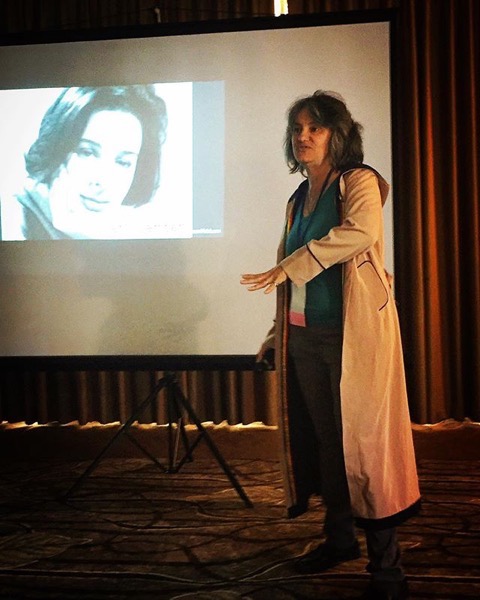
Rosanne Welch, PhD, Author of Why The Monkees Matter, presents “How The Monkees Changed Television” at a Cal State Fullerton Lunch Lecture on May 8, 2018.
In this talk, she shows how The Monkees, and specifically their presence on television, set the stage for large changes to come in the late 1960s.
Transcript
As they were putting the show together the original credits give him that name. By the time it finally gets on the air they’ve gone to Micky Dolenz. Don’t know why but now suddenly the character the goofy crazy one is Micky Dolenz and the problem with that is we don’t know who the real guys are and above and beyond the character you are and the person you are in your publicity the fan magazines were going crazy back in the day and they were inventing a persona for you. Micky Dolenz’s sister who tours with him musically now wrote a column “What it’s like to be Mickey’s sister”. Which you’re pretty sure wasn’t anything that actually happened in their family right and when Davy Jones decided to get married, it had to be kept a secret because nobody wanted the cute boy to be married or girls would feel guilty for wanting him that would be a bad thing to do
A hit television show about a fictitious rock band, The Monkees (1966-1968) earned two Emmys–Outstanding Comedy Series and Outstanding Directorial Acheivement in Comedy.
Capitalizing on the show’s success, the actual band formed by the actors, at their peak, sold more albums than The Beatles and The Rolling Stones combined, and set the stage for other musical TV characters from The Partridge Family to Hannah Montana. In the late 1980s, the Monkees began a series of reunion tours that continued into their 50th anniversary.
This book tells the story of The Monkees and how the show changed television, introducing a new generation to the fourth-wall-breaking slapstick created by Laurel and Hardy and the Marx Brothers.
Its creators contributed to the innovative film and television of 1970s with projects like Bob & Carol & Ted & Alice, The Mary Tyler Moore Show, Laugh-In and Welcome Back, Kotter. Immense profits from the show, its music and its merchandising funded the producers’ move into films such as Head, Easy Riderand Five Easy Pieces.
Make sure the nametag you are trying to scan is visible in front of you.
Hover the camera over the nametag. Hold and press on the camera screen until the nametag is captured.
To scan a nametag from your profile:
Go to your profile and tap .
Tap your nametag at the top of the screen.
At the bottom of the screen, tap Scan a nametag.
Hover the camera over the nametag until the nametag is captured.
Learn more about Doctor Who with these books and videos!
††
* A portion of each sale from Amazon.com directly supports our blogs ** Many of these books may be available from your local library. Check it out! † Available from the LA Public Library
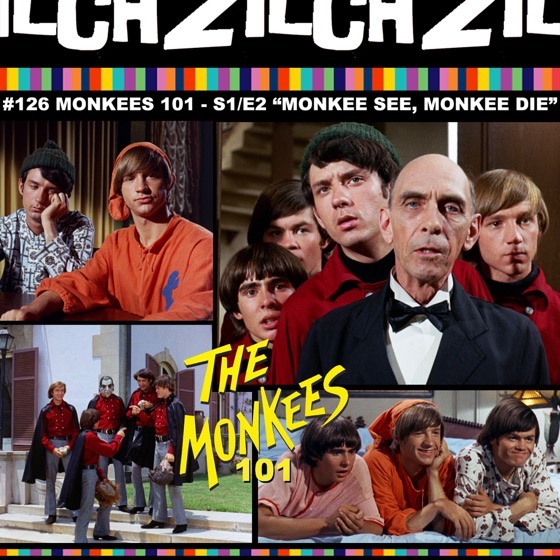
I’m having more fun than should be allowed recording this new segment on Zilch: Monkees 101. So far Dr. Sarah Clark and I have recorded 4 of our shows and the 2nd episode is a deconstruction of the 2nd episode of The Monkees to be broadcast. “Monkee See, Monkee Die” was written by Treva Silverman and involves the Monkees attending the reading of a late millionaire’s will, but in order to earn the organ he has left to them, they must stay the night in his haunted castle. — Rosanne
A hit television show about a fictitious rock band, The Monkees (1966-1968) earned two Emmys–Outstanding Comedy Series and Outstanding Directorial Acheivement in Comedy.
Capitalizing on the show’s success, the actual band formed by the actors, at their peak, sold more albums than The Beatles and The Rolling Stones combined, and set the stage for other musical TV characters from The Partridge Family to Hannah Montana. In the late 1980s, the Monkees began a series of reunion tours that continued into their 50th anniversary.
This book tells the story of The Monkees and how the show changed television, introducing a new generation to the fourth-wall-breaking slapstick created by Laurel and Hardy and the Marx Brothers.
Its creators contributed to the innovative film and television of 1970s with projects like Bob & Carol & Ted & Alice, The Mary Tyler Moore Show, Laugh-In and Welcome Back, Kotter. Immense profits from the show, its music and its merchandising funded the producers’ move into films such as Head, Easy Riderand Five Easy Pieces.
Make sure the nametag you are trying to scan is visible in front of you.
Hover the camera over the nametag. Hold and press on the camera screen until the nametag is captured.
To scan a nametag from your profile:
Go to your profile and tap .
Tap your nametag at the top of the screen.
At the bottom of the screen, tap Scan a nametag.
Hover the camera over the nametag until the nametag is captured.
Learn more about Doctor Who with these books and videos!
††
* A portion of each sale from Amazon.com directly supports our blogs ** Many of these books may be available from your local library. Check it out! † Available from the LA Public Library
Rosanne Welch, PhD, Author of Why The Monkees Matter, presents “How The Monkees Changed Television” at a Cal State Fullerton Lunch Lecture on May 8, 2018.
In this talk, she shows how The Monkees, and specifically their presence on television, set the stage for large changes to come in the late 1960s.
Transcript
This is probably the most critical studies interesting thing — their identity construction and of course by that we mean when we look at an actor many people assume they have the traits of their character, right? Tom Selleck is not, in fact, a Vietnam vet right? Magnum P.I. doesn’t exist but we assume they have these traits. This was very difficult for these guys because normally on a TV show you’d be given a character name right? The guys on the Big Bang Theory that’s not your– it’s Johnny Galecki it’s not Leonard, right? So we know that they’re acting they have a fake name on this show. For whatever reason, they chose to use their real names — not them personally but the producers chose to have them use their real names. So right away the audience is lost between who’s Michael Nesmith the man versus Michael Nesmith the actor on the show right? Versus all these other Michael’s that are going to be invented here. What’s really triply interesting is in the very first pilot they gave Micky Dolenz the name he’d used on Circus Boy. That’s his acting name because when he was a child his dad didn’t want people to think that he got the job because who his dad was, so on Circus Boy, it stars Micky Braddock.
A hit television show about a fictitious rock band, The Monkees (1966-1968) earned two Emmys–Outstanding Comedy Series and Outstanding Directorial Acheivement in Comedy.
Capitalizing on the show’s success, the actual band formed by the actors, at their peak, sold more albums than The Beatles and The Rolling Stones combined, and set the stage for other musical TV characters from The Partridge Family to Hannah Montana. In the late 1980s, the Monkees began a series of reunion tours that continued into their 50th anniversary.
This book tells the story of The Monkees and how the show changed television, introducing a new generation to the fourth-wall-breaking slapstick created by Laurel and Hardy and the Marx Brothers.
Its creators contributed to the innovative film and television of 1970s with projects like Bob & Carol & Ted & Alice, The Mary Tyler Moore Show, Laugh-In and Welcome Back, Kotter. Immense profits from the show, its music and its merchandising funded the producers’ move into films such as Head, Easy Riderand Five Easy Pieces.
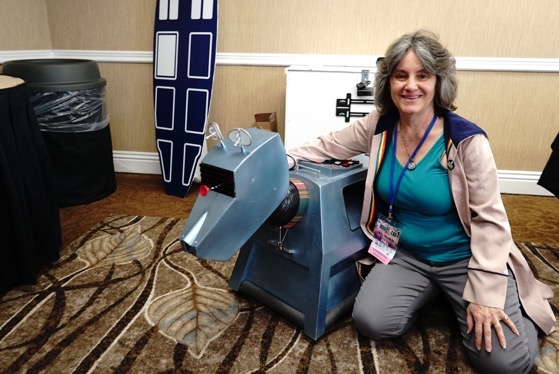
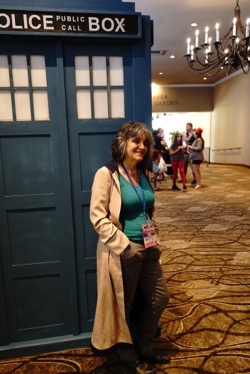
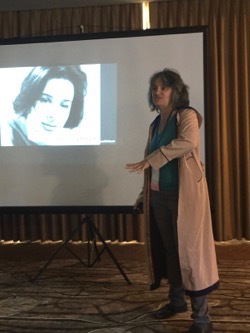
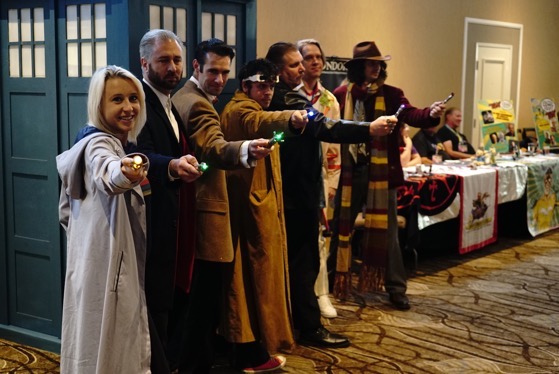
We spent the weekend down in San Diego attending WhoCon 2018. Rosanne was speaking on “Feminism in the Who-niverse in the Era of a Lady Doctor” (video coming soon).
Here are 50 photos from the presentation and the overall event.
I’ll also soon have a video interview with Dalek Builder Steve Roberts who kept us entertained all weekend with this fully functional Dalek!
Learn more about Doctor Who with these books and videos!
††
* A portion of each sale from Amazon.com directly supports our blogs ** Many of these books may be available from your local library. Check it out! † Available from the LA Public Library
Rosanne Welch, PhD, Author of Why The Monkees Matter, presents “How The Monkees Changed Television” at a Cal State Fullerton Lunch Lecture on May 8, 2018.
In this talk, she shows how The Monkees, and specifically their presence on television, set the stage for large changes to come in the late 1960s.
Transcript
In this episode, which I’m sorry the still is dark, that’s Micky and he’s confronting the werewolf and the first thing he says to the werewolf is, “You know they won’t et you into Disneyland with hair that long.” Because at the time Disneyland had a dress policy and men with long hair were not allowed in the park as guests. So they were literally putting down a major American corporation in the middle of their program and they got away with it and he did that 2 or 3 times across — I would find it in two or three other episodes there’d be a joke about “Long hair’s going to keep you out of Disneyland.” So it made me wonder if at any time any of them had attempted to go to Disneyland with their children and not been allowed in. I have not found proof of that, but I wonder why they were particularly made at Disneyland. I don’t know. Of course, often they would do things like this — Micky said, “Peter! I’ve got an idea!” and then the light bulb and Peter would say, “Wait! Let’s hear Micky’s idea.” So often they were speaking to the audience which was a particular thing that was talked about — Seinfeld gets credit for and whatnot, but these guys did it very early on.
A hit television show about a fictitious rock band, The Monkees (1966-1968) earned two Emmys–Outstanding Comedy Series and Outstanding Directorial Acheivement in Comedy.
Capitalizing on the show’s success, the actual band formed by the actors, at their peak, sold more albums than The Beatles and The Rolling Stones combined, and set the stage for other musical TV characters from The Partridge Family to Hannah Montana. In the late 1980s, the Monkees began a series of reunion tours that continued into their 50th anniversary.
This book tells the story of The Monkees and how the show changed television, introducing a new generation to the fourth-wall-breaking slapstick created by Laurel and Hardy and the Marx Brothers.
Its creators contributed to the innovative film and television of 1970s with projects like Bob & Carol & Ted & Alice, The Mary Tyler Moore Show, Laugh-In and Welcome Back, Kotter. Immense profits from the show, its music and its merchandising funded the producers’ move into films such as Head, Easy Riderand Five Easy Pieces.
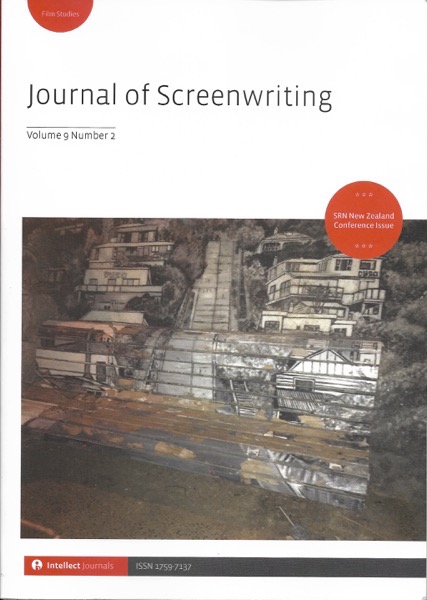
It’s always fun when a new issue of the Journal of Screenwriting arrives in my mailbox, but this one’s pleasing on several fronts.
First, in my capacity as Book Reviews Editor, I’m able to publish several of my now-graduated students, often for the first time.
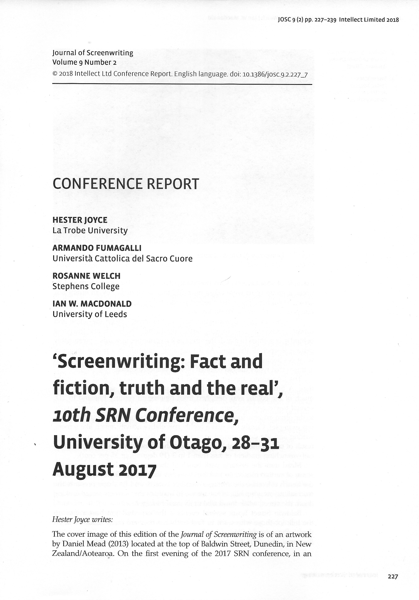
In this issue I am also the co-author of an article extolling the marvelously successful conference held at Otago University in 2017.
Also, two of the articles come from that conference – one by my friend Carmen Sofia Brenes (Chairperson, full professor of poetics and screenwriting at the School of Communication of Universidad de los Andes) is about the 2016 film Jackie, about the life of American icon Jackie Kennedy, written by an American, Noah Oppenheim, and directed by Chilean Pablo Lorrain.
The second article is (not so jokingly) “10 Ways to f#ck up Your Female Characters” by two New Zealand female producers, Fiona Samuel and Kathryn Burnett. I’ve already talked about that one with many an MFA student.

![23 Identity Construction and Confusion 2 from How The Monkees Changed Television [Video] (0:48)](https://rosannewelch.com/wp-content/uploads/2018/11/monkees-tv-23-identity-2.jpeg)




 and Follow
![22 Identity Construction and Confusion from How The Monkees Changed Television [Video] (1:07)](https://rosannewelch.com/wp-content/uploads/2018/10/monkees-tv-22-identity.jpeg)
![21 More Metatextuality and The Monkees from How The Monkees Changed Television [Video] (0:58)](https://rosannewelch.com/wp-content/uploads/2018/10/monkees-tv-21-metatextuality-2.jpeg)