This book signing at Book Soup was wonderful – good people, good conversation (before and after the signing). Just another example of the kind of quality positive people who have been drawn to The Monkees across generations – I even met a former head of publicity for ScreenGems who had some fun stories to tell. — Rosanne
Transcript:
Thank you. Thank you. Thank everybody for coming out tonight. It’s really coo to talk about The Monkees whenever you get a chance so I appreciate the chance. What I was just going to do was I was going to read a little bit from the Preface and the Introduction — kind of a setup for the purpose of the book and what it’s all about and then just talk about The Monkees for a little bit and see if anybody’s interested in telling stories and what they first remember about the show. So, if that’s good with everybody….I’ll start. The Preface of the book is called “I’m (Still) A Believer” and one of the things I did in writing it was I made all the chapters were the titles of songs — famous Monkee songs and it was really interesting to sit there and try to think of, what was the right song to put on this particular (chapter) and I ended up finding song titles I didn’t even remember because they put out so much music and everyone has their favorites and you just didn’t realize that there were these other titles. So, part of the them, they might have been perfect for that chapter, but they didn’t hit your brain immediately as obvious Monkee songs so then I would pick something else. The first one is obviously “I’m (Still) A Believer” because that’s what brought me to writing about them.
Dr. Rosanne Welch is a professor in the Low Residency MFA in Screenwriting Program from Stephens College, California State University, Fullerton, Mount San Antonio Community College and Cal Poly Pomona. In 2007, she graduated with her Ph.D. in 20th Century U.S./Film History from Claremont Graduate University. She graduated with her M.A. in 20th Century United States History from California State University, Northridge in 2004.
Welch is also a television writer/producer with credits for Beverly Hills 90210 , CBS’s Emmy winning Picket Fences and Touched By An Angel . She also writes and hosts her own podcasts on 3rdPass.media, her first one titled “Mindful(I) Media with Dr. Rosanne Welch.”
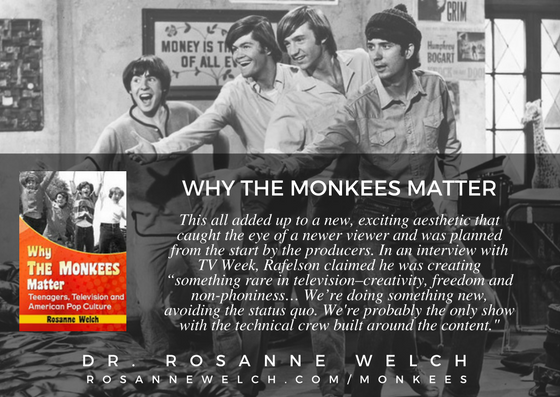
This all added up to a new, exciting aesthetic that caught the eye of a newer viewer and was planned from the start by the producers. In an interview with TV Week, Rafelson claimed he was creating “something rare in television–creativity, freedom and non-phoniness… We’re doing something new, avoiding the status quo. We’re probably the only show with the technical crew built around the content.”
“1960s TV Censorship and The Monkees” gives a brief overview of where censorship standards were in the era – and how The Monkees pushed the envelope with its mentions of the Vietnam War – and Sunset Strip riots – and even with the outrageous storytelling behind “Frodis Caper”, the episode that celebrated the saving of an alien plant that very closely resembled a marijuana plant…
Writer Treva Silverman said the staff got away with such jokes because the network executives were just old enough not to understand any of the references. Presented at Stephens College MFA in Screenwriting classes on Friday, August 5, 2016
Transcript:
They had a couple of other big names come in. And then this was Treva’s explanation to me about why they got away with it. Network guys thought they were hip and cool, but they had no idea what was going on. And these guys knew it. She defined herself as a hippy as did Peter Meyerson like I said and she said she started smoking pot during the course of working on the show and when she went home to New York to visit her relatives they were like, ahhh…scandalized. She said, “Well, that’s just what everyone is doing.” So, I wanted to mention that we’re not done with censorship on television briefly. If you know Amy Schumer recently had this sketch canceled from her show. It was censored. She wasn’t to air it and it was anti-gun thing based on all the mass shootings. We still obviously knew about the “wardrobe malfunction” and what can and can’t be shown of a woman on television and of course, George Carlin went to court over The 7 Dirty Words You Can’t Say on Television. Dexter, of course, think how violent that is. We worry so much about what sex we show on TV but look how much violence we show and I think Gilda Radner, who I love dearly, is pretty brilliant because she talked about the violence on television back in the day. So we’re still not done with that. If you’re interested in censorship on TV, these are some books that are fun to look at that talk about this period of time. And so, if you want to look into that, that’s what they are. And that’s the flat out presentation.
Dr. Rosanne Welch is a professor in the Low Residency MFA in Screenwriting Program from Stephens College, California State University, Fullerton, Mount San Antonio Community College and Cal Poly Pomona. In 2007, she graduated with her Ph.D. in 20th Century U.S./Film History from Claremont Graduate University. She graduated with her M.A. in 20th Century United States History from California State University, Northridge in 2004.
Welch is also a television writer/producer with credits for Beverly Hills 90210 , CBS’s Emmy winning Picket Fences and Touched By An Angel . She also writes and hosts her own podcasts on 3rdPass.media, her first one titled “Mindful(I) Media with Dr. Rosanne Welch.”
Among the many technical terms students confront when studying the aesthetics of television, the one they seem to remember most is metatextuality, which in laymen’s terms happens when a character breaks the fourth wall with an aside to the audience, thereby acknowledging that someone, the audience, is watching and admitting they know they are playing a character in a fictional world.
“1960s TV Censorship and The Monkees” gives a brief overview of where censorship standards were in the era – and how The Monkees pushed the envelope with its mentions of the Vietnam War – and Sunset Strip riots – and even with the outrageous storytelling behind “Frodis Caper”, the episode that celebrated the saving of an alien plant that very closely resembled a marijuana plant…
Writer Treva Silverman said the staff got away with such jokes because the network executives were just old enough not to understand any of the references. Presented at Stephens College MFA in Screenwriting classes on Friday, August 5, 2016
Transcript:
And this is the Sunset Strip Riots which had to do with Pandora’s Box which was a club down in Hollywood and the curfew was that kids under 21 had to go home by 10 o’clock and so there were marches and protests and stuff and these guys were part of that. But they had been told when they went to press events they weren’t allowed to talk about any of this stuff. And they didn’t, at the press events, but they did in the show all the time. Which I think is hilarious. Tommy Boyce and Bobby Hart wrote most of the songs for the first 2 years of the show and I love this, in the early 70’s they started this protest, Let Us Vote, the L.U.V. protest and it contributed obviously to lowering the voting age from 21 to 18. I think that’s really cool. And Peter Tork said, probably, one of the most intelligent things “the show probably garnered a larger audience for their point of view than The Beatles did” because TV comes into your house for free. You had to buy The Beatles albums. You had to pay to go to a concert. TV came into your house whether your parents allowed it or not and the parents just thought these were just a bunch of goofy guys and, by the way, who’s he sitting with at the Monterey Pop Festival? Janis Joplin. She was going to guest on the show in the 3rd season but it was cancelled.
Dr. Rosanne Welch is a professor in the Low Residency MFA in Screenwriting Program from Stephens College, California State University, Fullerton, Mount San Antonio Community College and Cal Poly Pomona. In 2007, she graduated with her Ph.D. in 20th Century U.S./Film History from Claremont Graduate University. She graduated with her M.A. in 20th Century United States History from California State University, Northridge in 2004.
Welch is also a television writer/producer with credits for Beverly Hills 90210 , CBS’s Emmy winning Picket Fences and Touched By An Angel . She also writes and hosts her own podcasts on 3rdPass.media, her first one titled “Mindful(I) Media with Dr. Rosanne Welch.”
Today Jean Powergirl takes the host reigns and welcomes her guest Rosanne Welch, PhD to the show! They’ll be discussing Roseanne’s book, “Why The Monkees Matter: Teenagers, Television and American Pop Culture.”
A hit television show about a fictitious rock band, The Monkees (1966-1968) earned two Emmys–Outstanding Comedy Series and Outstanding Directorial Achievement in Comedy. Capitalizing on the show’s success, the actual band formed by the actors, at their peak, sold more albums than The Beatles and The Rolling Stones combined and set the stage for other musical TV characters from The Partridge Family to Hannah Montana. In the late 1980s, the Monkees began a series of reunion tours that continued into their 50th anniversary.
This book tells the story of The Monkees and how the show changed television, introducing a new generation to the fourth-wall-breaking slapstick created by Laurel and Hardy and the Marx Brothers. Its creators contributed to the innovative film and television of 1970s with projects like Bob & Carol & Ted & Alice, The Mary Tyler Moore Show, Laugh-In and Welcome Back, Kotter. Immense profits from the show, its music and its merchandising funded the producers’ move into films such as Head, Easy Rider and Five Easy Pieces.
Rosanne Welch, PhD has written for television (Touched by an Angel, Picket Fences) and print (Three Ring Circus: How Real Couples Balance Marriage, Work and Kids and The Encyclopedia of Women in Aviation and Space). In the documentary world she has written and produced Bill Clinton and the Boys Nation Class of 1963 for ABC NEWS/Nightline and consulted on PBS’s A Prince Among Slaves, the story of a prince from West Africa who was enslaved in the 1780s, freed by order of President John Quincy Adams in the 1820s and returned to his homeland.
Interestingly, all the elderly episodes concern the middle-aged generation trying to take advantage of the elderly. Yet while the elderly characters are clearly a bit naïve, they also all live independently, take care of their normal daily business well, and none of them suffer from any long term illnesses, as elderly characters seem to have done more frequently in the later television seasons.


![Introduction from Why The Monkees Matter Book Signing, Book Soup. Hollywood [Video] (1:03)](https://rosannewelch.com/wp-content/uploads/2017/03/wtmm-reading-01.jpeg)

![Wrapping Up The Monkees from 1960’s TV Censorship and The Monkees [Video] (1:26)](https://rosannewelch.com/wp-content/uploads/2017/02/monkees-censorship-22-conclusion.jpeg)


![Sunset Strip Riots and The Monkees from 1960’s TV Censorship and The Monkees [Video] (1:09)](https://rosannewelch.com/wp-content/uploads/2017/02/monkees-censorship-21-sunset-strip.jpeg)
![Watch Now: Rosanne Welch talks about “Why The Monkees Matter” with Jean Hopkins Power [Video] (45 mins)](https://rosannewelch.com/wp-content/uploads/2016/07/monkees-cover-large.jpg)
