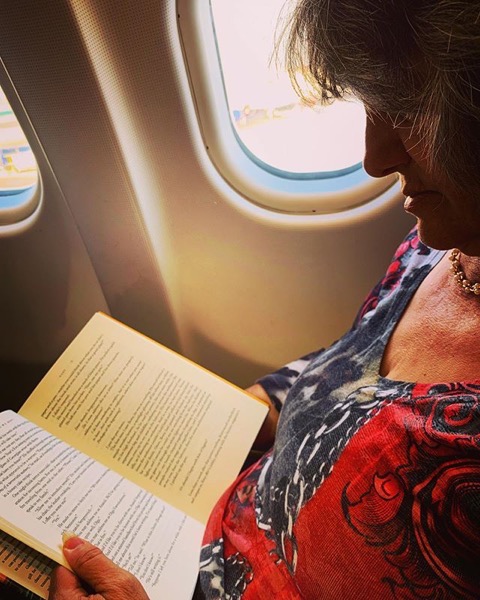
Rosanne grabbed this book “The Secrets We Kept” at The Book Soup store at the Bradley International Terminal before we took off on our trip to Porto. She finished it on the trip home.
I think Rosanne uses books as a sort of time travel. She dives into the book and wakes up wherever she needs to be. This is very useful when flying 9.5 hours East and 12 hours west.
I deeply enjoyed making my presentation on Writers Rooms in the U.S. but even more I enjoyed the presentations I attended.
This program is chock a block full of new international films to learn about (did you know there’s a Portuguese film with the name “Django” in it that has nothing to do with the one by Tarantino?) and new ways to teach writing students how to take in all the (often negative) notes they receive and decide which constructive ones to use to make their scripts stronger?
Just skimming the schedule shows the breadth of new ideas that are running around in my head right now. — Rosanne
12th SCREENWRITING RESEARCH NETWORK CONFERENCE Porto, September 11-14, 2019 · School of Arts, Universidade Católica Portuguesa
Theme: Foundation and Crisis of Europe in Screenwriting
Chair: Paolo Russo
Pablo Echart Savage continent, united continent: the writing of a feature film screenplay about the “founding fathers” of the European Union
María Noguera / Miguel Muñoz-Garnica Narrative detours in the cinematic representation of Europe in crisis: Ulysses’ Gaze, A Talking Picture and Our Music
Daniel Sierra / Marta Frago Young Winston and Darkest Hour’s films: Winston Churchill as British Hero in a Changing Europe
Theme: Modes I
Chair: Nelson Zagalo
Ruth Gutiérrez Delgado Causality is not casual in a film despite it seems to be: A Perfect Day
Paolo Braga The line between fate and chaos in Collateral
Armando Fumagalli Order and chaos in the ending of a film
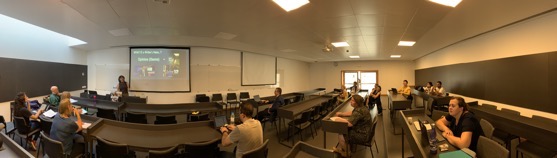
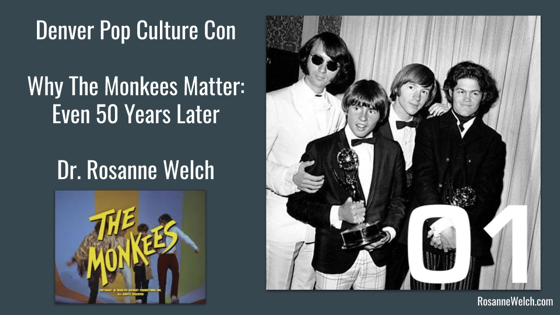
Wherever you go, you find Monkees fans and the Denver Popular Culture Con was no different. Amid rooms full of caped crusaders and cosplay creations, I was initially not sure how many folks would attend a talk on a TV show from the 1960s – but happily I was met by a nice, engaged audience for my talk on Why the Monkees Matter – and afterward they bought books! What more could an author ask for?
Transcript
First thing is a little bit of who I am. On television I wrote for Touched By An Angel, Beverly Hills 90210, and Picket Fences and ABC’s News Nightline. When I decided to get into academia and start writing first of all the Monkees book obviously but then I’ve written a lot of stuff about women in history, women in popular culture, very interested in that and you’ll be hopefully interested in finding out but there is some things to be said about feminism on The Monkees in the 60s which nobody would have expected until I studied it. I also do book reviews for the Journal of Screenwriting. I’m their book review editor and I work on Written By magazine on the editorial board. That’s a magazine for members of the Writers Guild. So my deep focus is generally — words matter — writers matter — and women writers matter and we’re gonna find out that on The Monkees, there was the first female television writer who didn’t need a male partner in order to be have job which is sounds a little crazy to us today but was true back in the day.
A hit television show about a fictitious rock band, The Monkees (1966-1968) earned two Emmys–Outstanding Comedy Series and Outstanding Directorial Acheivement in Comedy.
Capitalizing on the show’s success, the actual band formed by the actors, at their peak, sold more albums than The Beatles and The Rolling Stones combined, and set the stage for other musical TV characters from The Partridge Family to Hannah Montana. In the late 1980s, the Monkees began a series of reunion tours that continued into their 50th anniversary.
This book tells the story of The Monkees and how the show changed television, introducing a new generation to the fourth-wall-breaking slapstick created by Laurel and Hardy and the Marx Brothers.
Its creators contributed to the innovative film and television of 1970s with projects like Bob & Carol & Ted & Alice, The Mary Tyler Moore Show, Laugh-In and Welcome Back, Kotter. Immense profits from the show, its music and its merchandising funded the producers’ move into films such as Head, Easy Riderand Five Easy Pieces.
Wherever you go, you find Monkees fans and the Denver Popular Culture Con was no different. Amid rooms full of caped crusaders and cosplay creations, I was initially not sure how many folks would attend a talk on a TV show from the 1960s – but happily I was met by a nice, engaged audience for my talk on Why the Monkees Matter – and afterward they bought books! What more could an author ask for?
A hit television show about a fictitious rock band, The Monkees (1966-1968) earned two Emmys–Outstanding Comedy Series and Outstanding Directorial Acheivement in Comedy.
Capitalizing on the show’s success, the actual band formed by the actors, at their peak, sold more albums than The Beatles and The Rolling Stones combined, and set the stage for other musical TV characters from The Partridge Family to Hannah Montana. In the late 1980s, the Monkees began a series of reunion tours that continued into their 50th anniversary.
This book tells the story of The Monkees and how the show changed television, introducing a new generation to the fourth-wall-breaking slapstick created by Laurel and Hardy and the Marx Brothers.
Its creators contributed to the innovative film and television of 1970s with projects like Bob & Carol & Ted & Alice, The Mary Tyler Moore Show, Laugh-In and Welcome Back, Kotter. Immense profits from the show, its music and its merchandising funded the producers’ move into films such as Head, Easy Riderand Five Easy Pieces.
Wherever you go, you find Monkees fans and the Denver Popular Culture Con was no different. Amid rooms full of caped crusaders and cosplay creations, I was initially not sure how many folks would attend a talk on a TV show from the 1960s – but happily I was met by a nice, engaged audience for my talk on Why the Monkees Matter – and afterward they bought books! What more could an author ask for?
A hit television show about a fictitious rock band, The Monkees (1966-1968) earned two Emmys–Outstanding Comedy Series and Outstanding Directorial Acheivement in Comedy.
Capitalizing on the show’s success, the actual band formed by the actors, at their peak, sold more albums than The Beatles and The Rolling Stones combined, and set the stage for other musical TV characters from The Partridge Family to Hannah Montana. In the late 1980s, the Monkees began a series of reunion tours that continued into their 50th anniversary.
This book tells the story of The Monkees and how the show changed television, introducing a new generation to the fourth-wall-breaking slapstick created by Laurel and Hardy and the Marx Brothers.
Its creators contributed to the innovative film and television of 1970s with projects like Bob & Carol & Ted & Alice, The Mary Tyler Moore Show, Laugh-In and Welcome Back, Kotter. Immense profits from the show, its music and its merchandising funded the producers’ move into films such as Head, Easy Riderand Five Easy Pieces.
* A portion of each sale from Amazon.com directly supports our blogs ** Many of these books may be available from your local library. Check it out! † Available from the LA Public Library
A hit television show about a fictitious rock band, The Monkees (1966-1968) earned two Emmys–Outstanding Comedy Series and Outstanding Directorial Acheivement in Comedy.
Capitalizing on the show’s success, the actual band formed by the actors, at their peak, sold more albums than The Beatles and The Rolling Stones combined, and set the stage for other musical TV characters from The Partridge Family to Hannah Montana. In the late 1980s, the Monkees began a series of reunion tours that continued into their 50th anniversary.
This book tells the story of The Monkees and how the show changed television, introducing a new generation to the fourth-wall-breaking slapstick created by Laurel and Hardy and the Marx Brothers.
Its creators contributed to the innovative film and television of 1970s with projects like Bob & Carol & Ted & Alice, The Mary Tyler Moore Show, Laugh-In and Welcome Back, Kotter. Immense profits from the show, its music and its merchandising funded the producers’ move into films such as Head, Easy Riderand Five Easy Pieces.
Editor/Writer Dr. Rosanne Welch and a few of her fellow writers ((l-r) Sydney Haven, Mikayla Daniels, Kelley Zinge and Amy Banks) discusses the women in her new book “When Women Wrote Hollywood” which covers female screenwriters from the Silents through the early 1940s when women wrote over 50% of films and Frances Marion was the highest paid screenwriter (male or female) and the first to win 2 Oscars. Yet, she fails to appear in film history books, which continue to regurgitate the myth that male directors did it all – even though it’s been proven that the only profitable movies Cecil B. de Mille ever directed were all written by Jeannie Macpherson film ever won for Best Picture was written by Robert E. Sherwood (who people have heard of, mostly due to his connection to Dorothy Parker) and Joan Harrison.
* A portion of each sale from Amazon.com directly supports our blogs ** Many of these books may be available from your local library. Check it out! † Available from the LA Public Library




![02 Rosanne’s Writing History from “Why The Monkees Matter: Even 50 Years Later – Dr. Rosanne Welch [Video] (1 minute)](https://rosannewelch.com/wp-content/uploads/2019/08/monkees-popcon-2019-02.jpeg)


![Why The Monkees Matter: Even 50 Years Later with Dr. Rosanne Welch – Denver Pop Culture Con 2019 [Video] (48 Minutes)](https://rosannewelch.com/wp-content/uploads/2019/06/monkees-denverpcc-2019.png)

 and Follow
