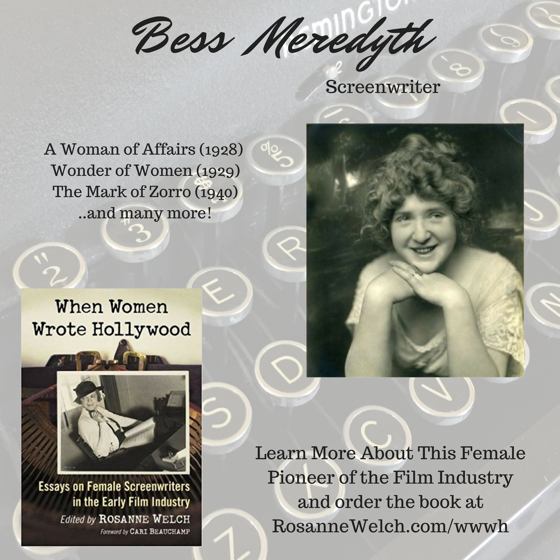
To highlight the wonderful yet largely forgotten work of a collection of female screenwriters from the early years of Hollywood (and as a companion to the book, When Women Wrote Hollywood) we will be posting quick bits about the many films they wrote along with links to further information and clips from their works which are still accessible online. Take a few moments once or twice a week to become familiar with their names and their stories. I think you’ll be surprised at how much bold material these writers tackled at the birth of this new medium. — Rosanne Welch
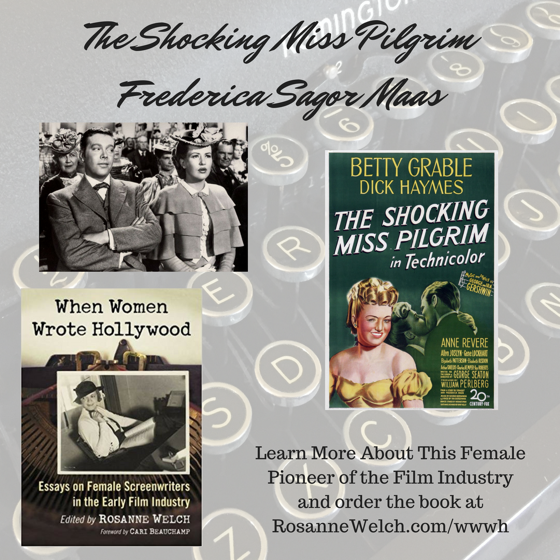
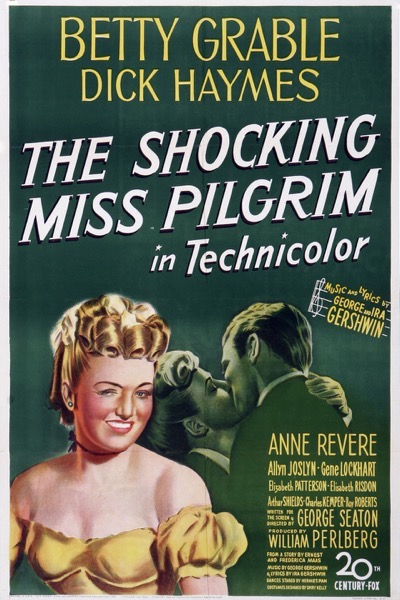
The Shocking Miss Pilgrim is a 1947 American musical comedy film in Technicolor written and directed by George Seaton, and starring Betty Grable and Dick Haymes.
The screenplay, based on a story by Frederica Sagor Maas and Ernest Maas, focuses on a young typist who becomes involved in the Women’s Suffrage movement in 1874. The songs were composed by George and Ira Gershwin. Marilyn Monroe made her film debut as an uncredited voice as a telephone operator.
In 1941, husband-and-wife screenwriting team Ernest Maas and Frederica Sagor collaborated on Miss Pilgrim’s Progress, a story about a young woman who enters the business world by demonstrating the newly invented typewriter in the window of a Wall Street establishment. When she tries to fend off the unwanted advances of one of the firm’s clerks, her employer comes to her rescue but is killed when he falls down the stairs in the ensuing altercation. Abigail Pilgrim becomes the focus of a murder trial that attracts widespread coverage by the media and the attention of Susan B. Anthony when the concept of women working in offices comes under fire.[2] — Wikipedia
* A portion of each sale from Amazon.com directly supports our blogs ** Many of these books may be available from your local library. Check it out! † Available from the LA Public Library
Rosanne Welch, PhD, Author of Why The Monkees Matter, presents “How The Monkees Changed Television” at a Cal State Fullerton Lunch Lecture on May 8, 2018.
In this talk, she shows how The Monkees, and specifically their presence on television, set the stage for large changes to come in the late 1960s.
Transcript
Back in the day — I just mentioned the war — they did have many moments where they referenced the war — the war on poverty — and President Lyndon Johnson and they mentioned particularly — there was a great episode where they were playing dominoes and they dropped all the dominoes and then Davy Jones said to Peter Tork “what do you call this game?” and Peter Tork said “Southeast Asia” and nobody cut that, right, because nobody who is a censor at the network understood what it meant which is pretty shocking if you ask me.
This is Dr. Timothy Leary who was famous back in the day for dropping LSD and whatnot and taking experiments with the psyche and he was watching the program and defining it and recognizing that it was far deeper than anyone else had given it the thought before. So already in the 60s people in the know knew that this was something different and worth paying attention to.
Rosanne Welch, PhD is a writer, producer and university professor with credits that include Beverly Hills 90210, Picket Fences, Touched by an Angel and ABC NEWS/Nightline. Other books include Why The Monkees Matter: Teenagers, Television and American Pop Culture (McFarland, 2017) and Women in American History: A Social, Political, and Cultural Encyclopedia and Document Collection (ABC-CLIO, 2017), named to the 2018 Outstanding References Sources List, by the Reference and User Services Association (RUSA), a division of the American Library Association. Welch has also published chapters in Torchwood Declassified: Investigating Mainstream Cult Television (I.B.Tauris) and The American Civil War on Film and TV: Blue and Gray in Black and White and Color (Lexington Books, 2018) and essays in Doctor Who and Race: An Anthology and Outside In Makes it So, and Outside in Boldly Goes (both edited by Robert Smith). By day she teaches courses on the history of screenwriting and on television writing for the Stephens College MFA in Screenwriting programs. Her talk “The Importance of Having a Female Voice in the Room” at the 2016 TEDxCPP is available on YouTube.
To highlight the wonderful yet largely forgotten work of a collection of female screenwriters from the early years of Hollywood (and as a companion to the book, When Women Wrote Hollywood) we will be posting quick bits about the many films they wrote along with links to further information and clips from their works which are still accessible online. Take a few moments once or twice a week to become familiar with their names and their stories. I think you’ll be surprised at how much bold material these writers tackled at the birth of this new medium. — Rosanne Welch
Frederica Alexandrina Sagor Maas (/ˌfɹɛdəˈɹikə səˈgɔɹ mæs/; July 6, 1900 – January 5, 2012) was an American dramatist and playwright, screenwriter, memoirist, and author,[1] the youngest daughter of Russian immigrants. As an essayist, Maas was best known for a detailed, tell-all memoir of her time spent in early Hollywood.[2] She was one of the oldest surviving entertainers from the silent film era.[3]
Once in Hollywood, Maas negotiated a contract with Preferred Pictures to adapt Percy Marks’s novel The Plastic Age for film. Based on this, she was signed to a three-year contract with MGM for $350 per week, though in her words: “I had the peculiar feeling that wily Louis B. [Mayer] was less interested in my writing ability than in signing someone who had worked for Ben Schulberg and Al Lichtman.”[5] It was in this period that she wrote the screenplays for silent films Dance Madnessand The Waning Sex. — Wikipedia
* A portion of each sale from Amazon.com directly supports our blogs ** Many of these books may be available from your local library. Check it out! † Available from the LA Public Library
Check out this profile of professor Laura Kirk, who contributed 2 chapters to When Women Wrote Hollywood, published by the University of Kansas where she teaches film acting for the Department of Film & Media Studies.
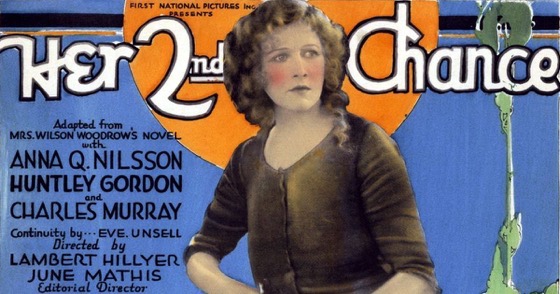
Her chapters involve Silent Era writer Eve Unsell and musical scenario writer Bella Spewack.
Read more about these – and all the great early female screenwriters in the book!
LAWRENCE — After working for many years as an actor and producer, Laura Kirk returned to her native Kansas in 2012 and joined the University of Kansas Department of Film & Media Studies as a lecturer, teaching film acting.
Now, in her first big work of academic scholarship, Kirk has contributed two chapters to “When Women Wrote Hollywood” (McFarland), a new book aimed at bringing the secret female history of Hollywood to light.
Kirk wrote about Kansan Eve Unsell, a screenwriter whose career spanned the silent and talkie era, and Bella Spewack, the journalist, author and screenwriter best known for “Kiss Me Kate.”
“When this industry started, women wrote 50 percent of the screenplays,” Kirk said. “And yet Eve Unsell was not in the index of any history book. Many of the women who have chapters in this book have not been written about in any real way.”
Unsell, for instance, got a two-line obituary in the Los Angeles Times when she died in 1937 at age 50. She was born in Chicago and grew up in Caldwell, a small Kansas town in Sumner County.
“She has 96 credits on IMDb,” the Internet Movie Database, Kirk said. “She was credited with training Alfred Hitchcock. She ran the Paramount studio in England. … I talk about how she was one of the first people to settle in Malibu when it was wild and natural and scenic.”
Order your copy of When Women Wrote Hollywood Today
* A portion of each sale from Amazon.com directly supports our blogs ** Many of these books may be available from your local library. Check it out! † Available from the LA Public Library
For her 5th Doctor Who lecture to the CPP community, Dr. Rosanne Welch discusses how society – and the show’s writing staff – prepared the audience for a major change in this 50-year franchise – the creation of the first Lady Doctor!
Transcript:
Have to give Steven for laying the groundwork finally and, as I said, if you look at his writing, when Matt changed he gave us “Not a girl. Still not ginger.” — a little ginger joke there. Which is fine. he made everyone think they were going to pick — oh my gosh I never forgot his name — Ron Weasley — yes — Rupert Grint, thank you so much. There was discussion that Rupert Grint would become a new Doctor, so a little joke there, the ginger is referencing that. So he knows what’s happening in culture. What people are saying about his program, right? So he laid that in. he also laid in in “The Doctor’s Wife” which is a marvelous episode — written by Neil Gaiman, wh you might know form American Gods and the other very cool novels. So they invited Nei Gaiman to come in and write an episode and they found old, dead, Timelords trapped in these little boxes and this is what he said about this guy, right? “He didn’t feel himself unless he had the tattoo. Or herself, a couple of times. Ooooo, she was a bad girl.” So Timelord who switched their gender It is possible. So Steven is writing or Executive Producing the writing in all these episodes. So he’s laying the groundwork for all this to happen.
Rosanne Welch PhD teaches the History of Screenwriting and One-Hour Drama for the Stephens College MFA in Screenwriting.
Writing/producing credits include Beverly Hills 90210, Picket Fences, ABCNEWS: Nightline and Touched by an Angel. In 2016 she published the book Why The Monkees Matter: Teenagers, Television and American Pop; co-edited Women in American History: A Social, Political, and Cultural Encyclopedia; and placed “Transmitting Culture Transnationally Via the Characterization of Parents in Police Procedurals” in the New Review of Film and Television Studies. Essays appear in Torchwood Declassified: Investigating Mainstream Cult Television and Doctor Who and Race: An Anthology. Welch serves as Book Reviews editor for Journal of Screenwriting and on the Editorial Advisory Board for Written By magazine, the magazine of the Writers Guild.
To highlight the wonderful yet largely forgotten work of a collection of female screenwriters from the early years of Hollywood (and as a companion to the book, When Women Wrote Hollywood) we will be posting quick bits about the many films they wrote along with links to further information and clips from their works which are still accessible online. Take a few moments once or twice a week to become familiar with their names and their stories. I think you’ll be surprised at how much bold material these writers tackled at the birth of this new medium. — Rosanne Welch
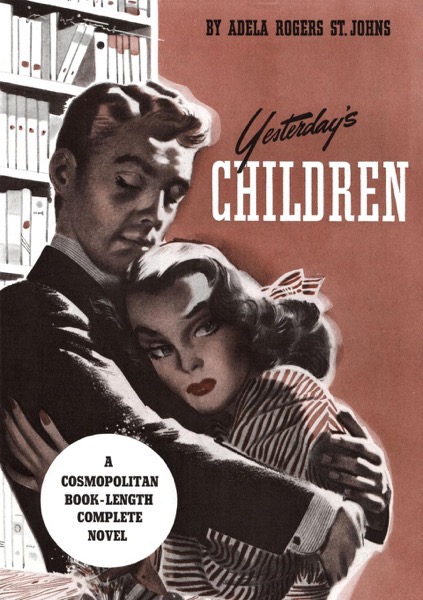
More on When Women Wrote Hollywood – Adela Rogers St. Johns – Yesterday’s Children: A Cosmopolitan Book-Length Complete Novel
Adela Rogers St. Johns was a prolific writer in many different formats besides screenwriting. This novel was published in the June 1939 issue of Cosmopolitan
* A portion of each sale from Amazon.com directly supports our blogs ** Many of these books may be available from your local library. Check it out! † Available from the LA Public Library
To highlight the wonderful yet largely forgotten work of a collection of female screenwriters from the early years of Hollywood (and as a companion to the book, When Women Wrote Hollywood) we will be posting quick bits about the many films they wrote along with links to further information and clips from their works which are still accessible online. Take a few moments once or twice a week to become familiar with their names and their stories. I think you’ll be surprised at how much bold material these writers tackled at the birth of this new medium. — Rosanne Welch
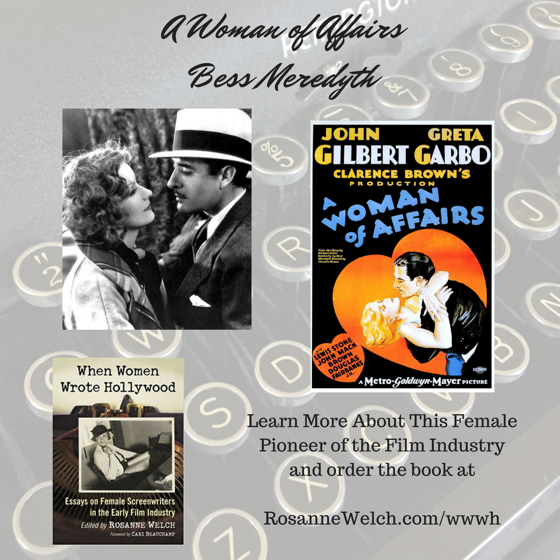
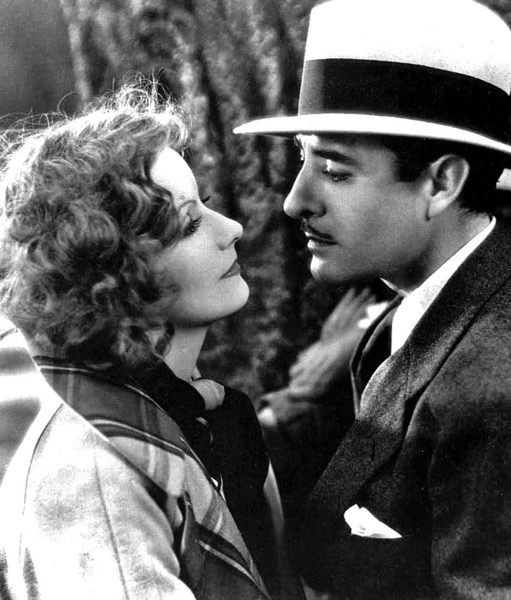
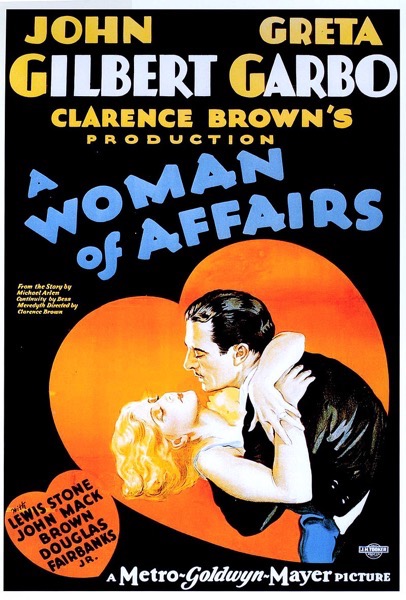
A Woman of Affairs is a 1928 Metro-Goldwyn-Mayer drama film directed by Clarence Brown and starring Greta Garbo, John Gilbert, Douglas Fairbanks Jr.and Lewis Stone. The film, released with a synchronized score and sound effects, was based on a 1924 best-selling novel by Michael Arlen, The Green Hat, which he adapted as a four-act stage play in 1925. The Green Hat was considered so daring in the United States that the movie did not allow any associations with it and was renamed A Woman of Affairs, with the characters also renamed to mollify the censors.[2] In particular the film script eliminated all references to heroin use, homosexuality and syphilis that were at the core of the tragedies involved.
The film was nominated for an Academy Award for Best Writing, for Michael Arlen and Bess Meredyth’s script. — Wikipedia
* A portion of each sale from Amazon.com directly supports our blogs ** Many of these books may be available from your local library. Check it out! † Available from the LA Public Library
Rosanne Welch, PhD, Author of Why The Monkees Matter, presents “How The Monkees Changed Television” at a Cal State Fullerton Lunch Lecture on May 8, 2018.
In this talk, she shows how The Monkees, and specifically their presence on television, set the stage for large changes to come in the late 1960s.
Transcript
Then we come to what I’m going to talk about, which is the various major chapters in the book — how this show spread some social justice messages which was shocking and other shows will be canceled for having tried that — particularly The Smothers Brothers, Laugh-In got in trouble for it. This show, I didn’t realize as a kid until I looked at all 58 episodes over and over again to write the book actually said something about feminism because every single girl that dated one of these boys had a job. None of them was a bubble-headed cheerleader. None of them was just waiting around to marry someone to take care of her. They were all women with jobs. So, they might have been record stores and whatever, but they were jobs and I think that was an interesting message in 1966. I’ll also talk briefly about metatextuality, which is the big thing in critical studies. What — How were they speaking to the audience? Breaking the 4th wall. It’s a Shakespearian thing. For this show particularly, identity construction. These guys went through a lot because with how their names were actually used in the program. Just like Jerry Seinfeld, they went by their real names and this gets very confusing when fans want to understand “Are you really that goofy guy in the TV show?” “No I’m not.I’m actually a grown man and I have kids, but I can’t tell you that because then you won’t dream or fantasize about marrying me someday.” So that was the big deal on this show and it really harmed them in their later careers and then a little bit on the Cultural Caché — how much they’ve last over the years.
Rosanne Welch, PhD is a writer, producer and university professor with credits that include Beverly Hills 90210, Picket Fences, Touched by an Angel and ABC NEWS/Nightline. Other books include Why The Monkees Matter: Teenagers, Television and American Pop Culture (McFarland, 2017) and Women in American History: A Social, Political, and Cultural Encyclopedia and Document Collection (ABC-CLIO, 2017), named to the 2018 Outstanding References Sources List, by the Reference and User Services Association (RUSA), a division of the American Library Association. Welch has also published chapters in Torchwood Declassified: Investigating Mainstream Cult Television (I.B.Tauris) and The American Civil War on Film and TV: Blue and Gray in Black and White and Color (Lexington Books, 2018) and essays in Doctor Who and Race: An Anthology and Outside In Makes it So, and Outside in Boldly Goes (both edited by Robert Smith). By day she teaches courses on the history of screenwriting and on television writing for the Stephens College MFA in Screenwriting programs. Her talk “The Importance of Having a Female Voice in the Room” at the 2016 TEDxCPP is available on YouTube.
To highlight the wonderful yet largely forgotten work of a collection of female screenwriters from the early years of Hollywood (and as a companion to the book, When Women Wrote Hollywood) we will be posting quick bits about the many films they wrote along with links to further information and clips from their works which are still accessible online. Take a few moments once or twice a week to become familiar with their names and their stories. I think you’ll be surprised at how much bold material these writers tackled at the birth of this new medium. — Rosanne Welch
Bess Meredyth (February 12, 1890 – July 13, 1969) was a screenwriter and silent film actress. The wife of film director Michael Curtiz, Meredyth wrote The Affairs of Cellini (1934) and adapted The Unsuspected (1947). She was one of the 36 founders of the Academy of Motion Picture Arts and Sciences.
Meredyth and director Michael Curtiz met soon after his arrival in the United States, while both were working at Warner Brothers Studios.[5] They were married in 1929 and unsuccessfully attempted to start a production unit at MGM studios in 1946.[1]
Though often uncredited, Meredyth contributed to several of Curtiz’s projects. Most notably, Curtiz reportedly called Meredyth for input several times a day while working on his most successful film, Casablanca (1942). [6]
Meredyth and Curtiz separated twice; once in 1941, and again in 1960. However, they remained in contact after this separation,[1] and Curtiz included Meredyth in his will upon his death in 1962.[5] — Wikipedia
* A portion of each sale from Amazon.com directly supports our blogs ** Many of these books may be available from your local library. Check it out! † Available from the LA Public Library


![08 Television After 1968 from How The Monkees Changed Television [Video] (0:55)](https://rosannewelch.com/wp-content/uploads/2018/07/monkees-tv-08-after-1968.jpeg)


 and Follow




![19 Steven Moffatt Prepares for Lady Doctor from Gender Diversity in the Who-niverse [Video] (1:13)](https://rosannewelch.com/wp-content/uploads/2018/07/gender-dw-19-moffat-prepares.jpeg)

 ††
††
![07 Overview of The Monkees’ Affect from How The Monkees Changed Television [Video] (1:28)](https://rosannewelch.com/wp-content/uploads/2018/07/monkees-tv-07-affect.jpeg)