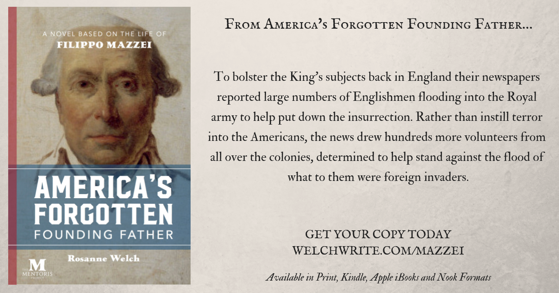
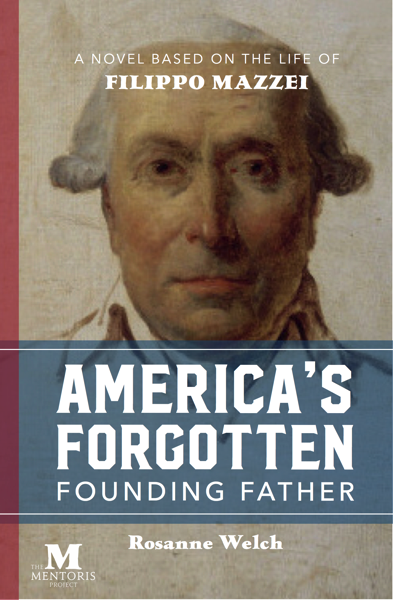
Learn more about the American Revolution through the eyes of an important, Italian Immigrant, Filippo Mazzei. Read his story today!
“To bolster the King’s subjects back in England their newspapers reported large numbers of Englishmen flooding into the Royal army to help put down the insurrection. Rather than instill terror into the Americans, the news drew hundreds more volunteers from all over the colonies, determined to help stand against the flood of what to them were foreign invaders.”
Watching several current and alumni students of the Stephens College MFA in TV and Screenwriting who shared their research on female screenwriters with professional presentations at the Citizen Jane Film Festival in a panel titled: Frank and Funny Female Screenwriters Who Should Be More Famous”. @citizenjanefilmfestival
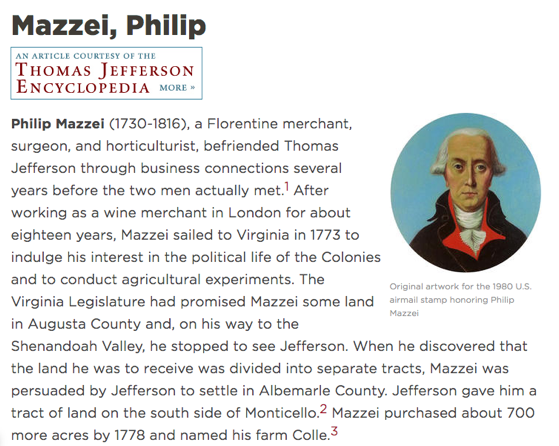
Philip Mazzei (1730-1816), a Florentine merchant, surgeon, and horticulturist, befriended Thomas Jefferson through business connections several years before the two men actually met.1 After working as a wine merchant in London for about eighteen years, Mazzei sailed to Virginia in 1773 to indulge his interest in the political life of the Colonies and to conduct agricultural experiments. The Virginia Legislature had promised Mazzei some land in Augusta County and, on his way to the Shenandoah Valley, he stopped to see Jefferson. When he discovered that the land he was to receive was divided into separate tracts, Mazzei was persuaded by Jefferson to settle in Albemarle County. Jefferson gave him a tract of land on the south side of Monticello.2 Mazzei purchased about 700 more acres by 1778 and named his farm Colle.3
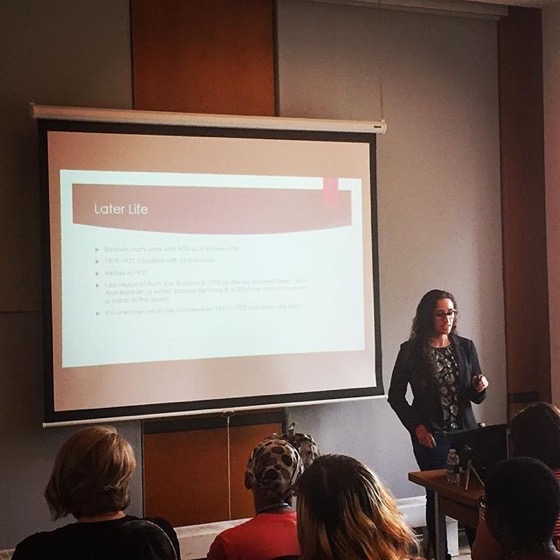
So we’re here today to talk about why I created a history of screenwriting class not a history of film class and that’s my problem. This is quickly Who I am. I’ve been a screenwriter in Los Angeles. I’ve written on Touched By An Angel Beverly Hills 90210, Picket Fences and for ABC news…oh… too fast. I’ve also just come up with a book and I’ll tell you about that came out of my class so that’s part of why I love this class. It’s another set of books that I’ve done. I’m also the book review editor for Journal of Screenwriting which I mentioned the other day. So please offer to review books and I’m on the editorial board for Written By which I always recommend as part of a screenwriting class because it’s free online digitally. You can look it up as Written By magazine and you’ll have the digital copy every month we interview either a movie writer or a television writer and it’s quite good, Of course, it’s in English. My apologies and I work for Stephens College which is located in Columbia Missouri but we do a low residency program where the students come to Los Angeles and work at the Jim Henson studios…hence Kermit … and this is Charlie Chaplin’s original studio so it’s still designed the way it was when he set it up in 1917.
* A portion of each sale from Amazon.com directly supports our blogs ** Many of these books may be available from your local library. Check it out! † Available from the LA Public Library
“At the height of her career, “Weber would receive an annual salary amounting to $5,000 per week, making her the highest-paid director in Hollywood” (Stamp 148). So how did a modest girl from Allegheny, Pennsylvania become the highest paid director, male or female, in Hollywood? Like many successful creative people, their stories begin with an eventful childhood.”
* A portion of each sale from Amazon.com directly supports our blogs
** Many of these books may be available from your local library. Check it out!
† Available from the LA Public Library
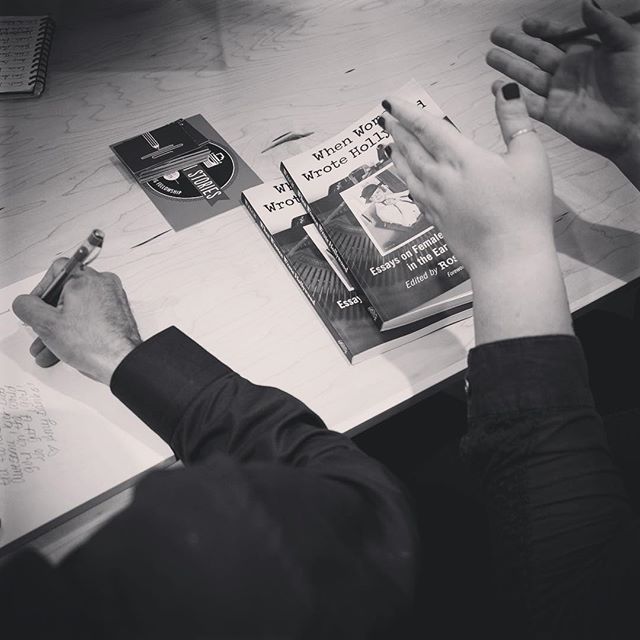
On Saturday, November 3rd, 2018 several of the contributors to When Women Wrote Hollywood gathered at the Skylark Bookshop in Columbia, Missouri for a signing and launch party that functioned like a mini-reunion of the Stephens College MFA in TV and Screenwriting Class of 2017.
Many thanks to all who came to hear them each speak with passion about the research subjects who became whole chapters in this book of essays on female screenwriters from the Silent Era into the 1940s.
* A portion of each sale from Amazon.com directly supports our blogs
** Many of these books may be available from your local library.
Check it out! † Available from the LA Public Library
Rosanne Welch, PhD, Author of Why The Monkees Matter, presents “How The Monkees Changed Television” at a Cal State Fullerton Lunch Lecture on May 8, 2018.
In this talk, she shows how The Monkees, and specifically their presence on television, set the stage for large changes to come in the late 1960s.
Transcript
Micky Dolenz is gonna leave the country and go to England and become a director for 15 years and he directs children’s television programs that are classics in England right? So he was going the Ron Howard I’m not gonna be Opie anymore thing and then he got drawn back to the states for their 20th anniversary tour and has been touring ever since but had he not given up being a director who knows where he might have gone with his directing right but he couldn’t get taken seriously as an actor here in the States even though he’d had his own TV show when he was 10 and he had his own TV show when he’s 18 and they were both hits. So but his acting career nobody believed right because he was just the goofy guy. Mike Nesmith wanted to be more of a songwriter and a country songwriter. Nobody took him seriously. He started the First National Band. It didn’t work. He ended up going off and you know running his own video company and he’s now a millionaire so he’s happy and Davy Jones probably had it the worst because being a boy teen idol — look look how hard it was for Justin Timberlake to grow up right — I mean that is the hard position for a man to grow out of. So we’re not good with Renaissance people. The fact that you can have more than one talent.
A hit television show about a fictitious rock band, The Monkees (1966-1968) earned two Emmys–Outstanding Comedy Series and Outstanding Directorial Acheivement in Comedy.
Capitalizing on the show’s success, the actual band formed by the actors, at their peak, sold more albums than The Beatles and The Rolling Stones combined, and set the stage for other musical TV characters from The Partridge Family to Hannah Montana. In the late 1980s, the Monkees began a series of reunion tours that continued into their 50th anniversary.
This book tells the story of The Monkees and how the show changed television, introducing a new generation to the fourth-wall-breaking slapstick created by Laurel and Hardy and the Marx Brothers.
Its creators contributed to the innovative film and television of 1970s with projects like Bob & Carol & Ted & Alice, The Mary Tyler Moore Show, Laugh-In and Welcome Back, Kotter. Immense profits from the show, its music and its merchandising funded the producers’ move into films such as Head, Easy Riderand Five Easy Pieces.
Learn more about the American Revolution through the eyes of an important, Italian Immigrant, Filippo Mazzei. Read his story today!
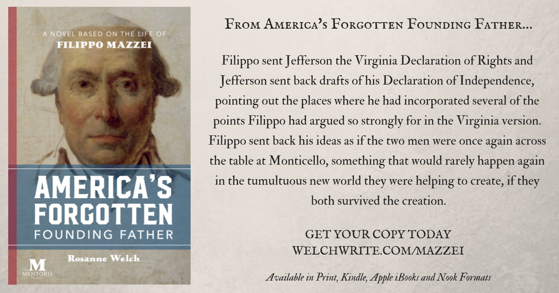
“Filippo sent Jefferson the Virginia Declaration of Rights and Jefferson sent back drafts of his Declaration of Independence, pointing out the places where he had incorporated several of the points Filippo had argued so strongly for in the Virginia version. Filippo sent back his ideas as if the two men were once again across the table at Monticello, something that would rarely happen again in the tumultuous new world they were helping to create, if they both survived the creation.”
The goal of our program and the goal of the book in general is to remind people that there was a time in Hollywood when 50% of the writers and producers were women and that was in the silent and the early Hollywood era and then they were all sort of wiped away and what happened was now we think oh can women do that? women did it in droves just a hundred years ago .It was a lot of research for all the different contributors many of who came from Columbia Missouri and it was because a lot of these women don’t have books written about them. They had to look through newspaper archives.They had to look through the Library of Congress. They — you know we could check the internet but the Internet’s not your perfect source for anything. It took a lot of time about six months for everyone to get enough research to be able to write and then the book itself took two years to go through the editing production and then produced available today. I have been a fan of very famous women from the past and Anita Loos, Adela Rodgers St. John. I’ve read their books. I’d seen them on television when I was a child doing talk shows and I thought how fascinating their lives had been and yet I never saw them in the history books that I was given about Hollywood. They always talked about the men. They never talked about the women who done that work and I wanted to create a program and a course that would allow other women to learn how many women had come before them.
On Saturday, November 3rd, 2018 several of the contributors to When Women Wrote Hollywood gathered at the Skylark Bookshop in Columbia, Missouri for a signing and launch party that functioned like a mini-reunion of the Stephens College MFA in TV and Screenwriting Class of 2017.
Many thanks to all who came to hear them each speak with passion about the research subjects who became whole chapters in this book of essays on female screenwriters from the Silent Era into the 1940s.
* A portion of each sale from Amazon.com directly supports our blogs ** Many of these books may be available from your local library. Check it out! † Available from the LA Public Library
For her 5th Doctor Who lecture to the CPP community, Dr. Rosanne Welch discusses how society – and the show’s writing staff – prepared the audience for a major change in this 50-year franchise – the creation of the first Lady Doctor!
Transcript:
I love this quote because this is pretty much my summation of what we learned from Doctor Who is that men and women should be free to be both sensitive and strong. That’s what makes us human. To deny those things or to try to claim those things only belong to one sex. It’s a waste of everybody’s time because that’s not the kind of human being you want to have in your life is it? You want someone who blends it all so yay for back to Hermione it’s all about Harry Potter and Doctor Who. Again, we come back to Jodie Whittaker. This was the quote I mentioned before and this has been chosen as the costume for this character and there’s already some controversy about that because people don’t think it’s quite right. Well that’s what the people have come up with so we’re gonna have to see how they create this character and how this is carried off. My only complaint is where little girl’s gonna find teal culottes for Halloween next year. You know the colors are fun but yeah it’s not I mean hello I could find a tweed jacket anywhere and instantly you’re Matt Smith right? So a little more difficult I think but in the long run I think we’ll be fine. But this was a posted the other day and people had some issues with it. People had issues with everything. Everyone wants to critique the writers but look what a good job they did paving the way for this new character and I think that that proves writers are sensitive and strong and cool. So basically that’s what I have to say about gender diversity. It’s always been there in Doctor Who if we’re able to interpret it and when we’re watching it when we’re seeing it and have those conversations. Art opens conversations for people to think about their world and how they like it and what they want to change about it and I think a show obviously that’s been this influential and lasted this long has had so much more power than even we can imagine. Thank you for coming. If anybody questions? chatting?
Rosanne Welch PhD teaches the History of Screenwriting and One-Hour Drama for the Stephens College MFA in Screenwriting.
Writing/producing credits include Beverly Hills 90210, Picket Fences, ABCNEWS: Nightline and Touched by an Angel. In 2016 she published the book Why The Monkees Matter: Teenagers, Television and American Pop; co-edited Women in American History: A Social, Political, and Cultural Encyclopedia; and placed “Transmitting Culture Transnationally Via the Characterization of Parents in Police Procedurals” in the New Review of Film and Television Studies. Essays appear in Torchwood Declassified: Investigating Mainstream Cult Television and Doctor Who and Race: An Anthology. Welch serves as Book Reviews editor for Journal of Screenwriting and on the Editorial Advisory Board for Written By magazine, the magazine of the Writers Guild.


 and Follow
![01 Introduction from Why (and How) I Created a History of Screenwriting Course [Video] (1:11)](https://rosannewelch.com/wp-content/uploads/2018/11/srn-rmw-2018-01-intro.png)



![25 After The Monkees from How The Monkees Changed Television [Video] (0:58)](https://rosannewelch.com/wp-content/uploads/2018/11/monkees-tv-25-after.jpeg)


![Dr. Rosanne Welch is interviewed by MUTV23, on “When Women Wrote Hollywood” [Video] (1:21)](https://rosannewelch.com/wp-content/uploads/2018/11/rmw-skylark-interview.jpeg)
![37 In Conclusion from Gender Diversity in the Who-niverse [Video] (2:02)](https://rosannewelch.com/wp-content/uploads/2018/11/gender-dw-37-conclusion.jpeg)