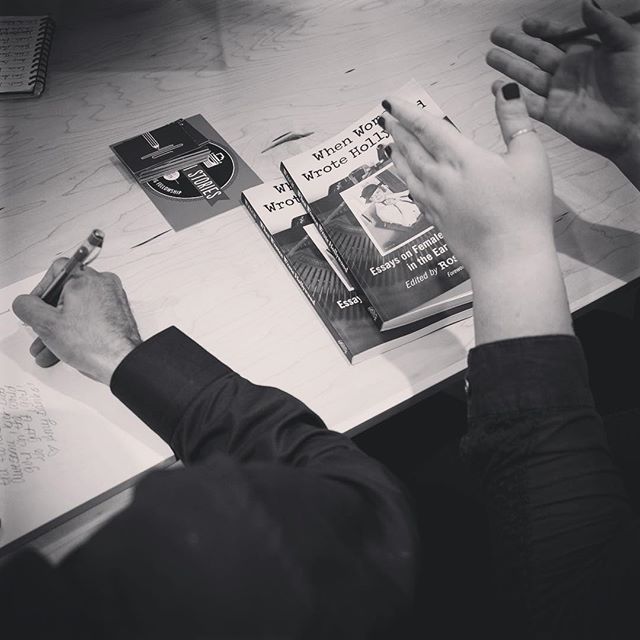
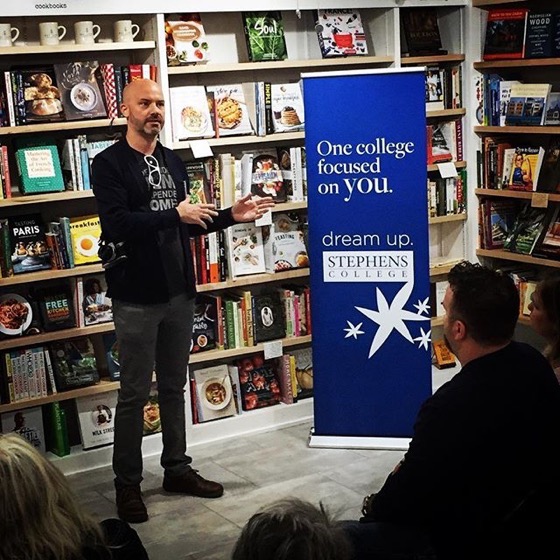
On Saturday, November 3rd, 2018 several of the contributors to When Women Wrote Hollywood gathered at the Skylark Bookshop in Columbia, Missouri for a signing and launch party that functioned like a mini-reunion of the Stephens College MFA in TV and Screenwriting Class of 2017.
Many thanks to all who came to hear them each speak with passion about the research subjects who became whole chapters in this book of essays on female screenwriters from the Silent Era into the 1940s.
* A portion of each sale from Amazon.com directly supports our blogs
** Many of these books may be available from your local library.
Check it out! † Available from the LA Public Library
Rosanne Welch, PhD, Author of Why The Monkees Matter, presents “How The Monkees Changed Television” at a Cal State Fullerton Lunch Lecture on May 8, 2018.
In this talk, she shows how The Monkees, and specifically their presence on television, set the stage for large changes to come in the late 1960s.
Transcript
Micky Dolenz is gonna leave the country and go to England and become a director for 15 years and he directs children’s television programs that are classics in England right? So he was going the Ron Howard I’m not gonna be Opie anymore thing and then he got drawn back to the states for their 20th anniversary tour and has been touring ever since but had he not given up being a director who knows where he might have gone with his directing right but he couldn’t get taken seriously as an actor here in the States even though he’d had his own TV show when he was 10 and he had his own TV show when he’s 18 and they were both hits. So but his acting career nobody believed right because he was just the goofy guy. Mike Nesmith wanted to be more of a songwriter and a country songwriter. Nobody took him seriously. He started the First National Band. It didn’t work. He ended up going off and you know running his own video company and he’s now a millionaire so he’s happy and Davy Jones probably had it the worst because being a boy teen idol — look look how hard it was for Justin Timberlake to grow up right — I mean that is the hard position for a man to grow out of. So we’re not good with Renaissance people. The fact that you can have more than one talent.
A hit television show about a fictitious rock band, The Monkees (1966-1968) earned two Emmys–Outstanding Comedy Series and Outstanding Directorial Acheivement in Comedy.
Capitalizing on the show’s success, the actual band formed by the actors, at their peak, sold more albums than The Beatles and The Rolling Stones combined, and set the stage for other musical TV characters from The Partridge Family to Hannah Montana. In the late 1980s, the Monkees began a series of reunion tours that continued into their 50th anniversary.
This book tells the story of The Monkees and how the show changed television, introducing a new generation to the fourth-wall-breaking slapstick created by Laurel and Hardy and the Marx Brothers.
Its creators contributed to the innovative film and television of 1970s with projects like Bob & Carol & Ted & Alice, The Mary Tyler Moore Show, Laugh-In and Welcome Back, Kotter. Immense profits from the show, its music and its merchandising funded the producers’ move into films such as Head, Easy Riderand Five Easy Pieces.
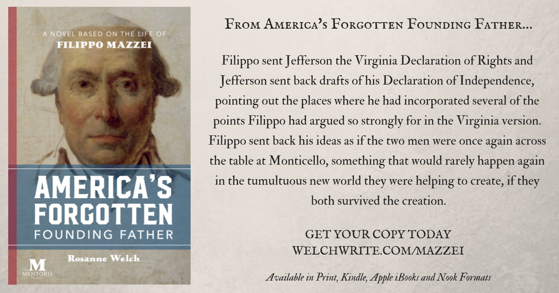
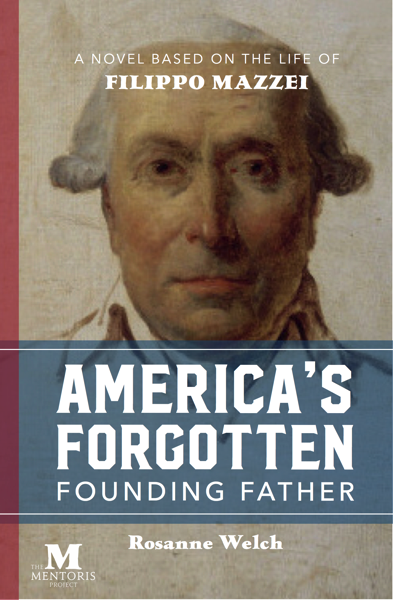
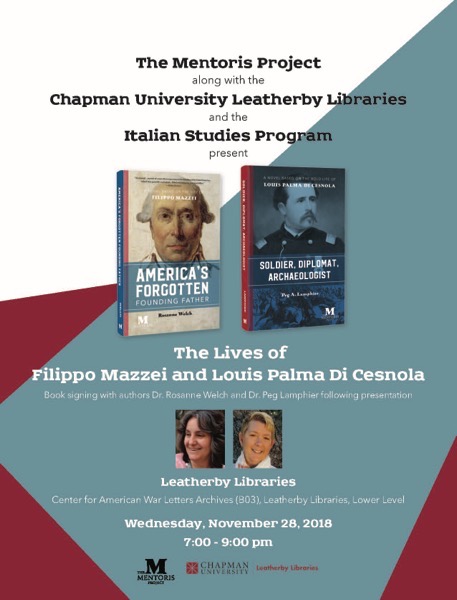
Learn more about the American Revolution through the eyes of an important, Italian Immigrant, Filippo Mazzei. Read his story today!
“Filippo sent Jefferson the Virginia Declaration of Rights and Jefferson sent back drafts of his Declaration of Independence, pointing out the places where he had incorporated several of the points Filippo had argued so strongly for in the Virginia version. Filippo sent back his ideas as if the two men were once again across the table at Monticello, something that would rarely happen again in the tumultuous new world they were helping to create, if they both survived the creation.”
The goal of our program and the goal of the book in general is to remind people that there was a time in Hollywood when 50% of the writers and producers were women and that was in the silent and the early Hollywood era and then they were all sort of wiped away and what happened was now we think oh can women do that? women did it in droves just a hundred years ago .It was a lot of research for all the different contributors many of who came from Columbia Missouri and it was because a lot of these women don’t have books written about them. They had to look through newspaper archives.They had to look through the Library of Congress. They — you know we could check the internet but the Internet’s not your perfect source for anything. It took a lot of time about six months for everyone to get enough research to be able to write and then the book itself took two years to go through the editing production and then produced available today. I have been a fan of very famous women from the past and Anita Loos, Adela Rodgers St. John. I’ve read their books. I’d seen them on television when I was a child doing talk shows and I thought how fascinating their lives had been and yet I never saw them in the history books that I was given about Hollywood. They always talked about the men. They never talked about the women who done that work and I wanted to create a program and a course that would allow other women to learn how many women had come before them.
On Saturday, November 3rd, 2018 several of the contributors to When Women Wrote Hollywood gathered at the Skylark Bookshop in Columbia, Missouri for a signing and launch party that functioned like a mini-reunion of the Stephens College MFA in TV and Screenwriting Class of 2017.
Many thanks to all who came to hear them each speak with passion about the research subjects who became whole chapters in this book of essays on female screenwriters from the Silent Era into the 1940s.
* A portion of each sale from Amazon.com directly supports our blogs ** Many of these books may be available from your local library. Check it out! † Available from the LA Public Library
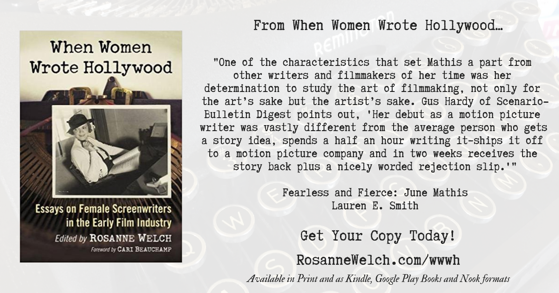
“One of the characteristics that set Mathis apart from other writers and filmmakers of her time was her determination to study the art of filmmaking, not only for the art’s sake but the artist’s sake. Gus Hardy of Scenario-Bulletin Digest points out, ‘Her debut as a motion picture writer was vastly different from the average person who gets a story idea, spends a half an hour writing it–ships it off to a motion picture company and in two weeks receives the story back plus a nicely worded rejection slip.‘”
* A portion of each sale from Amazon.com directly supports our blogs ** Many of these books may be available from your local library. Check it out! † Available from the LA Public Library
On Saturday, November 3rd, 2018 several of the contributors to When Women Wrote Hollywood gathered at the Skylark Bookshop in Columbia, Missouri for a signing and launch party that functioned like a mini-reunion of the Stephens College MFA in TV and Screenwriting Class of 2017.
Many thanks to all who came to hear them each speak with passion about the research subjects who became whole chapters in this book of essays on female screenwriters from the Silent Era into the 1940s.
* A portion of each sale from Amazon.com directly supports our blogs ** Many of these books may be available from your local library. Check it out! † Available from the LA Public Library
To highlight the wonderful yet largely forgotten work of a collection of female screenwriters from the early years of Hollywood (and as a companion to the book, When Women Wrote Hollywood) we will be posting quick bits about the many films they wrote along with links to further information and clips from their works which are still accessible online. Take a few moments once or twice a week to become familiar with their names and their stories. I think you’ll be surprised at how much bold material these writers tackled at the birth of this new medium. — Rosanne Welch
My Favorite Wife (released in the U.K. as My Favourite Wife) is a 1940 screwball comedy produced and co-written by Leo McCarey and directed by Garson Kanin. The picture stars Irene Dunne as a woman who returns to her husband and children after being shipwrecked on a tropical island for several years, and Cary Grant as her husband. The story is an adaptation of Alfred Lord Tennyson’s poem, “Enoch Arden”; in tribute, the main characters’ last name is Arden. The supporting cast features Gail Patrick as the woman Arden has just married when his first wife, now declared dead, returns, and Randolph Scott as the man with whom his wife had been marooned. My Favorite Wife was RKO’s second-biggest hit of 1940. — Wikipedia
* A portion of each sale from Amazon.com directly supports our blogs ** Many of these books may be available from your local library. Check it out! † Available from the LA Public Library
Rosanne Welch, PhD, Author of Why The Monkees Matter, presents “How The Monkees Changed Television” at a Cal State Fullerton Lunch Lecture on May 8, 2018.
In this talk, she shows how The Monkees, and specifically their presence on television, set the stage for large changes to come in the late 1960s.
Transcript
So his wife would have to travel separately when they were in country with the kid and sometimes she’d hang out with one of the other band members not one of the major guys but like you know the backup guitarist or something and they would look like they were a couple traveling behind The Monkees. Meanwhile he’s going to press events with Sally Field and the fan mags are all telling us Gidget and Davey are about to get together or Davy and Deanna Martin are about to get together right? All of that to feed the press and the newspapers. Not the real guy at all but that’s a third version of who he is right? So this messes them up and it messed the audience up because in America we’re not good with the idea of Renaissance people — that people have more than one Talent. So back when the show goes off the air it’s very hard for any of these guys to get work again because everybody thinks they’re this goofy set of guys who lives in that funny apartment on Malibu and they’re not really serious right?
A hit television show about a fictitious rock band, The Monkees (1966-1968) earned two Emmys–Outstanding Comedy Series and Outstanding Directorial Acheivement in Comedy.
Capitalizing on the show’s success, the actual band formed by the actors, at their peak, sold more albums than The Beatles and The Rolling Stones combined, and set the stage for other musical TV characters from The Partridge Family to Hannah Montana. In the late 1980s, the Monkees began a series of reunion tours that continued into their 50th anniversary.
This book tells the story of The Monkees and how the show changed television, introducing a new generation to the fourth-wall-breaking slapstick created by Laurel and Hardy and the Marx Brothers.
Its creators contributed to the innovative film and television of 1970s with projects like Bob & Carol & Ted & Alice, The Mary Tyler Moore Show, Laugh-In and Welcome Back, Kotter. Immense profits from the show, its music and its merchandising funded the producers’ move into films such as Head, Easy Riderand Five Easy Pieces.
To highlight the wonderful yet largely forgotten work of a collection of female screenwriters from the early years of Hollywood (and as a companion to the book, When Women Wrote Hollywood) we will be posting quick bits about the many films they wrote along with links to further information and clips from their works which are still accessible online. Take a few moments once or twice a week to become familiar with their names and their stories. I think you’ll be surprised at how much bold material these writers tackled at the birth of this new medium. — Rosanne Welch
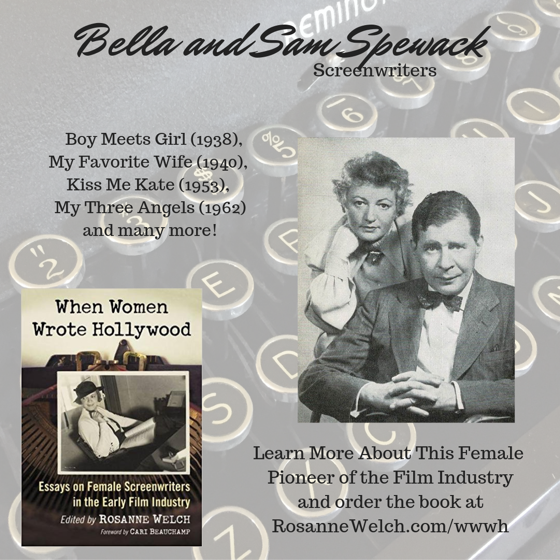
Samuel (September 16, 1899 – October 14, 1971) and Bella Spewack (March 25, 1899 – April 27, 1990) were a husband-and-wife writing team.
Samuel, who also directed many of their plays, was born in Ukraine. He attended Stuyvesant High School in New York City[1] and then received his degree from Columbia College.
They settled in New Hope, Pennsylvania. In the latter part of the decade, Samuel wrote several novels, including Mon Paul, The Skyscraper Murder, and The Murder in the Gilded Cage, on his own, while the pair collaborated on plays. The two wrote several plays and screenplays for mostly B-movies throughout the 1930s, earning an Academy Award nomination for Best Original Story for My Favorite Wife in 1940. They also penned a remake of Grand Hotel, entitled Week-End at the Waldorf (1945), which starred Ginger Rogers.
Always known as a turbulent couple, the Spewaks were in the midst of their own marital woes in 1948 when they were approached to write the book for Kiss Me, Kate, which centered on a once-married couple of thespians who use the stage on which they’re performing as a battling ground. Bella initially began working with composer Cole Porter on her own, but theatrical necessity overcame marital sparks, and the Spewacks completed the project together. It yielded each of them two Tony Awards, one for Best Musical, the other for Best Author of a Musical. Kiss Me, Kate proved to be their most successful work. — Wikipedia
* A portion of each sale from Amazon.com directly supports our blogs ** Many of these books may be available from your local library. Check it out! † Available from the LA Public Library

![25 After The Monkees from How The Monkees Changed Television [Video] (0:58)](https://rosannewelch.com/wp-content/uploads/2018/11/monkees-tv-25-after.jpeg)




![Dr. Rosanne Welch is interviewed by MUTV23, on “When Women Wrote Hollywood” [Video] (1:21)](https://rosannewelch.com/wp-content/uploads/2018/11/rmw-skylark-interview.jpeg)


![24 Monkees, Girlfriends and Wives from How The Monkees Changed Television [Video] (1:00)](https://rosannewelch.com/wp-content/uploads/2018/11/monkees-tv-24-wives.jpeg)