I have arrived and met my wonderful hosts who have already taken me to lunch and walked me around to show off their city.
I’m so excited to have been invited to be the keynote speaker at the 10th Screenwriters´(hi)Stories Seminar being held on the campus of the Universidade Presbiteriana Mackenzie in São Paulo, Brazil – NEXT WEEK!
It’s all thanks to my friend and colleague from the Screenwriting Research Network (who is actually the president of the network this year) Carmen Sofia Brenes who suggested me to the committee planning the seminar.
I’ll be speaking on “Why Researching Screenwriters (has Always) Mattered” which will be focused on the importance of storytellers in all cultures, and how screenwriters have become this last century’s most powerful storytellers thanks to the reach of technology.
* A portion of each sale from Amazon.com directly supports our blogs ** Many of these books may be available from your local library. Check it out!
Wherever you go, you find Monkees fans and the Denver Popular Culture Con was no different. Amid rooms full of caped crusaders and cosplay creations, I was initially not sure how many folks would attend a talk on a TV show from the 1960s – but happily I was met by a nice, engaged audience for my talk on Why the Monkees Matter – and afterward they bought books! What more could an author ask for?
Subscribe to Rosanne’s Channel and receive notice of each new video!
Transcript
In this case obviously you’ve read the lyrics. It’s some pretty amazing stuff to be on mainstream television in the middle of what was the beginning I should say of the Vietnam War and how it was affecting everybody. That’s very bold thing for anybody have to say which i think is amazing. Then there was actually a movement to not draft Davy Jones. So Girls wrote letters and that sort of thing which I think is adorable. He was an Englishman but he was here in the country working and so therefore could have been drafted and so that was interesting. Micky received a draft notice. Mike had been in the military. So they couldn’t draft him back and Peter, as well, also received one. Peter pretended to be crazy when he went to his interview and they believed it. So this is the line from one of the episodes that was written by Coslough Johnson about politics and the idea that you know what was going on with teenagers — “They’re the ones doing all the fighting” but we didn’t say where they would fight, right? We were sending them to fight. So there’s a lot happening about politics in this early day.
A hit television show about a fictitious rock band, The Monkees (1966-1968) earned two Emmys–Outstanding Comedy Series and Outstanding Directorial Acheivement in Comedy.
Capitalizing on the show’s success, the actual band formed by the actors, at their peak, sold more albums than The Beatles and The Rolling Stones combined, and set the stage for other musical TV characters from The Partridge Family to Hannah Montana. In the late 1980s, the Monkees began a series of reunion tours that continued into their 50th anniversary.
This book tells the story of The Monkees and how the show changed television, introducing a new generation to the fourth-wall-breaking slapstick created by Laurel and Hardy and the Marx Brothers.
Its creators contributed to the innovative film and television of 1970s with projects like Bob & Carol & Ted & Alice, The Mary Tyler Moore Show, Laugh-In and Welcome Back, Kotter. Immense profits from the show, its music and its merchandising funded the producers’ move into films such as Head, Easy Riderand Five Easy Pieces.
Oh, life is a glorious cycle of song, A medley of extemporanea; And love is a thing that can never go wrong, And I am Marie of Romania.
The charming and sarcastic little poem seen above, Comment, is the perfect introduction to Dorothy Parker for any teenage girl. Reading that poem in high school made me feel an instant affinity to Parker and her writing.
The Intimately Unknowable Dorothy Parker A Study of her Life and Art by Elizabeth Maud Dwyer Sandlin
* A portion of each sale from Amazon.com directly supports our blogs ** Many of these books may be available from your local library. Check it out! † Available from the LA Public Library
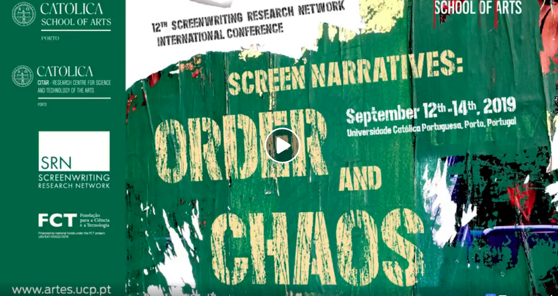
A full recording of my presentation at this year’s Screenwriting Research Network conference (at the lovely Universidade Católica Portuguesa) in Porto, Portugal.
Subscribe to Rosanne’s Channel and receive notice of each new video!
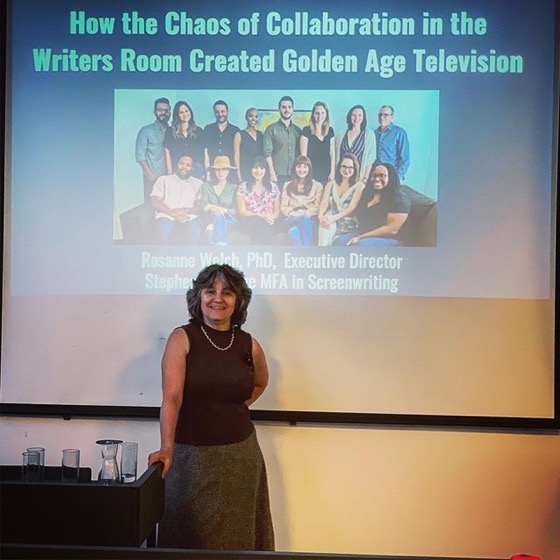
When the folks hosting the conference announced their theme as “Screen Narratives: Chaos and Order” the word ‘chaos’ immediately brought to mind writers rooms. I offered a quick history of writers rooms (the presentations are only 20 minutes long) and then quoted several current showrunners on how they compose their rooms and how they run them.
I am pleased to share with you the following announcement about an exciting change of leadership for the Stephens College MFA in TV and Screenwriting program. Congratulations to the team and thank you for all of your hard work building an amazing program. – Dr. Leslie Willey, Stephens College Vice President for Academic Affairs
The Stephens College MFA in TV and Screenwriting established in 2014, has named Dr. Rosanne Welch as the new executive director. Program founder and former director Ken LaZebnik will serve as Writer-in-Residence, while Khanisha Foster ’17, a graduate of the M.F.A. program, will serve as associate director. The program also features 15 faculty mentors and a rotating group of guest lecturers, all working writers, members of the Writers Guild and successful industry professionals.
Welch has served as a faculty member in the M.F.A. program since its start, creating a set of courses around the history of screenwriting, and teaching courses in one-hour drama. Her television writing credits include “Beverly Hills 90210,” “Picket Fences,” “ABC News: Nightline” and “Touched by an Angel.”
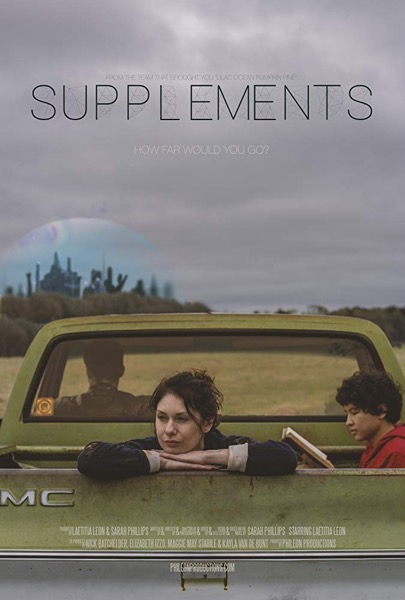
The year is 2289, and all that’s left on Planet Earth is the domed city Old Centauri, roaming sun flares that scorch the land, and the nomadic tribes that mitigate the two. Kiirke comes from one such tribe, and she must travel to Old Centauri, along with her stowaway younger brother, to seek a small fortune to save her family – But the only way to make money as a newcomer to the city is to enroll in Supplements Labs as what the locals call a “lab rat”.
Subscribe to Rosanne’s Channel and receive notice of each new video!
This one allowed me to riff on some of my favorite female science fiction writers across time, whether they be novelists or television writers. It also opened up a good conversation on what art we support and include in our lives – and what that art says to us and about us. — Rosanne
Transcript:
George Lucas writes Star Wars himself and directs it and decides he doesn’t like writing so much. He’s not sure of it. That doesn’t work for him, right? He likes the directing part and the casting, all that fun stuff. So he gets somebody else to write the sequel to his big hit movie that nobody expected to be hit and he hires Leigh Brackett because he wants what she can bring to the table, both in science fiction and in strong male characters oddly enough. She is contribute she is credited for contributing a lot to the creation of who Han Solo became because the first movie he’s kind of just swagger really cool. It’s just Harrison Ford wearing a cute uniform right? He gets much more developed in the second film and she wrote a lot of cowboys and if you think about the Han Solo we know in the second and continuing films he’s pretty much a space cowboy, but you know cool.
* A portion of each sale from Amazon.com directly supports our blogs ** Many of these books may be available from your local library. Check it out!
I’m so excited to have been invited to be the keynote speaker at the 10th Screenwriters´(hi)Stories Seminar being held on the campus of the Universidade Presbiteriana Mackenzie in São Paulo, Brazil – NEXT WEEK!
It’s all thanks to my friend and colleague from the Screenwriting Research Network (who is actually the president of the network this year) Carmen Sofia Brenes who suggested me to the committee planning the seminar.
I’ll be speaking on “Why Researching Screenwriters (has Always) Mattered” which will be focused on the importance of storytellers in all cultures, and how screenwriters have become this last century’s most powerful storytellers thanks to the reach of technology.
It’s a daunting thing to be asked to be a keynote speaker and I’ve been writing my speech for a few weeks now, still in a bit of a fog that such a fun thing should happen – but the tickets came today so now it’s a reality. I have to finish this speech (and the Google Slides that goes with it) – and PACK!
Here is a summary of my talk. I hope to have it recorded, too. Watch this space for information on a possible live stream of this event.
SUMMARY
To understand the world we have to understand its stories and to understand the world’s stories we must understand the world’s storytellers.
A century ago and longer those people would have been the novelists of any particular country but since the invention of film, the storytellers who reach the most people with their ideas and their lessons have been the screenwriters. My teaching philosophy is that: Words matter, Writers matter and Women writers matter. Therefore women writers shall be my focus. Why? Because they have been the far less researched and yet they are over half the population. We cannot tell the stories of the people until we know what stories the mothers have passed down to their children. Those are the stories that last. Now is the time to research screenwriters of all cultures and the stories they tell because people are finally recognizing the work of writers and appreciating how their favorite stories took shape on the page long before they were cast, or filmed, or edited. But also because streaming services make the stories of many cultures now available to a much wider world than ever before.
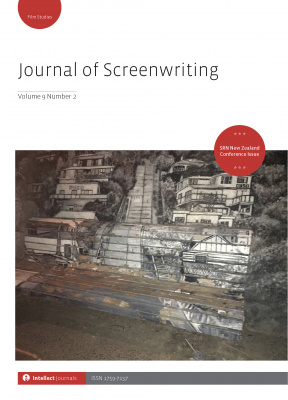
Highlighting the articles in the latest edition of the Journal of Screenwriting, of which I am the Book Reviews Editor. Hopefully these abstracts will entice you to did a little deeper into the history and future of screenwriting. — Rosanne
Re-writing theatrical documentaries: The broadcast version Phoebe Hart
In the funding matrix for major theatrical documentaries, television networks are often sought out as commissioners, particularly in territories such as Australia, where a plan in the form of distribution agreement and/or broadcaster pre-sale is required to access screen agency funds. As part of the deals with the broadcaster, there are mandated deliverables in the form of a ‘broadcast version’ of the documentary film, typically one hour in length or as a series. For producers, this arrangement raises much-needed production finance and capitalizes on the property’s reach and earning potential by exploiting the various distribution windows available. However, these deals lead to vexatious practical concerns in re-versioning for broadcast as documentary screenwriters are challenged to make changes while attempting to maintain the tone of their work. This research delves into the creative and cognitive processes as experienced by screenwriters who must ‘cut down’ a theatrical version of a documentary for broadcast. The research presents three case studies drawn from in-depth interviews, which are examined via a thematic analysis methodology to understand the processes of re-writing, including changes to narration, tone, style, character and narrative arcs, and thematic treatment. The research examines what is sacrificed due to time restrictions and viewer sensibilities, and whether or not the key intentions of documentary screenwriters can be preserved.
The Journal of Screenwriting is an international double-blind peer-reviewed journal that is published three times a year. The journal highlights current academic and professional thinking about the screenplay and intends to promote, stimulate and bring together current research and contemporary debates around the screenplay whilst encouraging groundbreaking research in an international arena. The journal is discursive, critical, rigorous and engages with issues in a dynamic and developing field, linking academic theory to screenwriting practice.


![08 Politics, War, And The Monkees from “Why The Monkees Matter: Even 50 Years Later [Video] (1 minute 3 seconds)](https://rosannewelch.com/wp-content/uploads/2019/10/monkees-popcon-2019-08.jpeg)



![How The Chaos Of Collaboration in the Writers Room Created Golden Age Television, Dr. Rosanne Welch [Video] (22 Minutes)](https://rosannewelch.com/wp-content/uploads/2019/10/SRN-2019-Portugal-1.png)

 The
The 

![20 More On Leigh Brackett from The Sisterhood of Science Fiction – Dr. Rosanne Welch [Video] (46 seconds)](https://rosannewelch.com/wp-content/uploads/2019/10/scifi-rmw-cpp-20.jpeg)