Thanks to the gracious invitation from my Screenwriting Research Network colleague Paolo Russo – and a grant he was able to procure (and in the before-Covid time) I was able to spend a week at Oxford Brookes University working with the screenwriting masters students in Paolo’s course. At the culmination of the week, I gave this lecture on how writers rooms worked in the States.
Transcript:
I do teach at Stephens College which is located in Missouri but we teach low-residency so they do everything online but they come to Hollywood — which is where I live — for 10 days twice a year and that’s a lovely thing. It’s at the Jim Henson Studios so there’s Kermit saying hi to you when you come in. Very lovely and very welcoming to see Kermit every morning. I have a teaching philosophy which is pretty simple. Words matter. Writers matter. Women writers matter. Thank you very much. Yes Indeed. We haven’t thought about women a lot over the years and I do. One of the things I think we need to think about — this is a Facebook post that I saw the other day and – how words can be misused. So I don’t want to get too political on you. I’m coming from a place where there’s a lot of politics going on, as you can imagine, but think about how these words were misused right? Take a little second. Your brain will wrap around the mistake in these words. Think about it you could have written that a different way but they had an opinion they wanted to put out, right, so words are important.
Watch this entire presentation
Subscribe to Rosanne’s Channel and receive notice of each new video!
* A portion of each sale from Amazon.com directly supports our blogs ** Many of these books may be available from your local library. Check it out! † Available from the LA Public Library
Subscribe to Rosanne’s Channel and receive notice of each new video!
Transcript:
This is actually a program from New Zealand. Who knew New Zealand made television, but I have my students write spec scripts — speculative scripts — which are their own versions of a show that already exists to teach the art of copying, because if you’re going to write television you have to copy what exists and then you make your own story, but you have to know how the characters sound. So, I have them pitch ideas from programs they are watching, but they have to write a United States show because that’s what the people are going to read in the United States. This young man pitched an episode of this show because he saw it on Netflix and he didn’t even realize it wasn’t from the United States. he didn’t even notice that they were using city names from New — he didn’t know what New Zealand was really, but the TV showed him and I stay that we learn the mythology of other cultures. This is a show about Norse mythology. the young boys on the program discover that they are the re-born versions of Norse gods and their goal is to get together with the other Norse gods and eventually go back to heaven together and rule the world. It’s adorable and I wouldn’t have heard about it except for Netflix.
Watch this entire presentation
A Note About This Presentation
A clip from my keynote speech at the 10th Screenwriters´(hi)Stories Seminar for the interdisciplinary Graduation Program in “Education, Art, and History of Culture”, in Mackenzie Presbyterian University, at São Paulo, SP, Brazil, focused on the topic “Why Researching Screenwriters (has Always) Mattered.” I was especially pleased with the passion these young scholars have toward screenwriting and it’s importance in transmitting culture across the man-made borders of our world.
To understand the world we have to understand its stories and to understand the world’s stories we must understand the world’s storytellers. A century ago and longer those people would have been the novelists of any particular country but since the invention of film, the storytellers who reach the most people with their ideas and their lessons have been the screenwriters. My teaching philosophy is that: Words matter, Writers matter, and Women writers matte, r so women writers are my focus because they have been the far less researched and yet they are over half the population. We cannot tell the stories of the people until we know what stories the mothers have passed down to their children. Those are the stories that last. Now is the time to research screenwriters of all cultures and the stories they tell because people are finally recognizing the work of writers and appreciating how their favorite stories took shape on the page long before they were cast, or filmed, or edited. But also because streaming services make the stories of many cultures now available to a much wider world than ever before.
Many thanks to Glaucia Davino for the invitation.
* A portion of each sale from Amazon.com directly supports our blogs ** Many of these books may be available from your local library. Check it out! † Available from the LA Public Library
Thanks to the gracious invitation from my Screenwriting Research Network colleague Paolo Russo – and a grant he was able to procure (and in the before-Covid time) I was able to spend a week at Oxford Brookes University working with the screenwriting masters students in Paolo’s course. At the culmination of the week, I gave this lecture on how writers rooms worked in the States.
Transcript:
As Paolo said — so I won’t spend a lot of time on it — these are the shows –these are the books I’ve done. Sorry. Largely a big Doctor Who fan. Any Doctor Who fans in the house. Really we’ll talk a little bit about the writing of that. It’s quite a brilliant show, I think. These are most of the things I’ve done. Also, love Torchwood has also been quite well done. I am the book review editor, so if you’re Masters students — when you graduate — you can email me, and if there’s a book you’d like to have for free — because they don’t pay you to write in journals — you can review the book and I’ll have it sent to you so you can do that and it’s a credit for you so it’s a lovely thing and Written By Magazine is the magazine of the Writers Guild. You can read this online for free if you go to writtenby.com. You go to WGA, which is our website for the Writer’s Guild, and every two months or so it comes out. Always interviews with writers and showrunners, movie film writers, people like that, so it’s really I think an excellent thing it’s like having a guest speaker come to you and very in-depth interviews, right? We’ll talk about some of them that I’ve done over time.
Watch this entire presentation
Subscribe to Rosanne’s Channel and receive notice of each new video!
* A portion of each sale from Amazon.com directly supports our blogs ** Many of these books may be available from your local library. Check it out! † Available from the LA Public Library
Subscribe to Rosanne’s Channel and receive notice of each new video!
Transcript:
In my own Television viewing experience, I’ve had the chance to see all of these programs which I never would have seen. Commisaroio Montalbano is the most famous detective show in Italy. Again, that helps me feel more connected to my cousins and what they’re watching and to my grandparents and the world they grew up in. I can see footage from Italy. I was amazed to find that Doctor Who eventually traveled around the whole world. I’m told the doesn’t play here necessarily but probably geeky people have found it somewhere. Trapped was a miniseries made in Iceland. You can see the Icelandic translation on the bottom and it aired on Netflix and I was amazed to watch eight hours of something that was filmed in Iceland and told me about a culture I could possibly never imagine and might never have the chance to see but because of Netflix. I’ve now experienced this program — and then Call My Agent I find very funny. It’s a French show. You can see the proper title –the French title– on top and it’s about a talent agency. — just as Roger was explaining this morning — in France and how they work with actors and all the problems that happen. It’s a one-hour comedy and what’s cute about it is the characters — the actors who played actors on the show are actually famous French actors pretending to be bad people and causing troubles for their agents. So you’ve recognized actors you’ve seen in movies coming in and talking to the fake agents that they are with. So it’s a charming way to learn more about French films, right, in just one program. So I’ve been so impressed with what I’ve been able to see.
Watch this entire presentation
A Note About This Presentation
A clip from my keynote speech at the 10th Screenwriters´(hi)Stories Seminar for the interdisciplinary Graduation Program in “Education, Art, and History of Culture”, in Mackenzie Presbyterian University, at São Paulo, SP, Brazil, focused on the topic “Why Researching Screenwriters (has Always) Mattered.” I was especially pleased with the passion these young scholars have toward screenwriting and it’s importance in transmitting culture across the man-made borders of our world.
To understand the world we have to understand its stories and to understand the world’s stories we must understand the world’s storytellers. A century ago and longer those people would have been the novelists of any particular country but since the invention of film, the storytellers who reach the most people with their ideas and their lessons have been the screenwriters. My teaching philosophy is that: Words matter, Writers matter, and Women writers matte, r so women writers are my focus because they have been the far less researched and yet they are over half the population. We cannot tell the stories of the people until we know what stories the mothers have passed down to their children. Those are the stories that last. Now is the time to research screenwriters of all cultures and the stories they tell because people are finally recognizing the work of writers and appreciating how their favorite stories took shape on the page long before they were cast, or filmed, or edited. But also because streaming services make the stories of many cultures now available to a much wider world than ever before.
Many thanks to Glaucia Davino for the invitation.
* A portion of each sale from Amazon.com directly supports our blogs ** Many of these books may be available from your local library. Check it out! † Available from the LA Public Library
Thanks to the gracious invitation from my Screenwriting Research Network colleague Paolo Russo – and a grant he was able to procure (and in the before-Covid time) I was able to spend a week at Oxford Brookes University working with the screenwriting masters students in Paolo’s course. At the culmination of the week, I gave this lecture on how writers rooms worked in the States.
Subscribe to Rosanne’s Channel and receive notice of each new video!
* A portion of each sale from Amazon.com directly supports our blogs ** Many of these books may be available from your local library. Check it out! † Available from the LA Public Library
Subscribe to Rosanne’s Channel and receive notice of each new video!
Transcript:
They had to have the United States version, so they remade the TV show. They called it the Red Band Society and they didn’t understand the culture of Italy. The show In Italy is all about hope and has a little magical realism to it because one of the children is in a coma but he narrates the story because he watches his friends become friends and grow and have hope that they will be cured someday and in the United States we didn’t get that which is very sad. The show was actually canceled after six episodes because they focused on the grown-ups who were the doctors and the nurses. They thought the story had to be “we’re gonna find that cure because that’s what we do we save the world.” That wasn’t the story at all. They did. They ruined the story right and because we don’t — we think nice people are boring, the nurse is the meanest woman I have ever met and these children are dying of terminal diseases and she’s being mean to them and they thought that that was very edgy. That’s the big word I hate in the United States right now — edgy, We need edgy programming. How many people can we kill in the next five minutes? So we ruined this lovely program right but at least, through Netflix, I can watch the Italian version with subtitles.
Watch this entire presentation
A Note About This Presentation
A clip from my keynote speech at the 10th Screenwriters´(hi)Stories Seminar for the interdisciplinary Graduation Program in “Education, Art, and History of Culture”, in Mackenzie Presbyterian University, at São Paulo, SP, Brazil, focused on the topic “Why Researching Screenwriters (has Always) Mattered.” I was especially pleased with the passion these young scholars have toward screenwriting and it’s importance in transmitting culture across the man-made borders of our world.
To understand the world we have to understand its stories and to understand the world’s stories we must understand the world’s storytellers. A century ago and longer those people would have been the novelists of any particular country but since the invention of film, the storytellers who reach the most people with their ideas and their lessons have been the screenwriters. My teaching philosophy is that: Words matter, Writers matter, and Women writers matte, r so women writers are my focus because they have been the far less researched and yet they are over half the population. We cannot tell the stories of the people until we know what stories the mothers have passed down to their children. Those are the stories that last. Now is the time to research screenwriters of all cultures and the stories they tell because people are finally recognizing the work of writers and appreciating how their favorite stories took shape on the page long before they were cast, or filmed, or edited. But also because streaming services make the stories of many cultures now available to a much wider world than ever before.
Many thanks to Glaucia Davino for the invitation.
* A portion of each sale from Amazon.com directly supports our blogs ** Many of these books may be available from your local library. Check it out! † Available from the LA Public Library
Subscribe to Rosanne’s Channel and receive notice of each new video!
Transcript:
This is a film — excuse me — a tv show that started in Europe. I learned about it through an Italian screenwriting colleague — Braccialetti Rossi and it’s about a group of young children in a hospital and they wear red bands because they have terminal illnesses and it’s about them banding together and being friends, One of the things that’s good or maybe bad about what’s going on with international television is that I believe we could air the original version in the United States and that enough people would watch it but the networks still believe they need to have an American version — a United States version. I had to learn to stop saying that this week right because I’m in America right now.
Watch this entire presentation
A Note About This Presentation
A clip from my keynote speech at the 10th Screenwriters´(hi)Stories Seminar for the interdisciplinary Graduation Program in “Education, Art, and History of Culture”, in Mackenzie Presbyterian University, at São Paulo, SP, Brazil, focused on the topic “Why Researching Screenwriters (has Always) Mattered.” I was especially pleased with the passion these young scholars have toward screenwriting and it’s importance in transmitting culture across the man-made borders of our world.
To understand the world we have to understand its stories and to understand the world’s stories we must understand the world’s storytellers. A century ago and longer those people would have been the novelists of any particular country but since the invention of film, the storytellers who reach the most people with their ideas and their lessons have been the screenwriters. My teaching philosophy is that: Words matter, Writers matter, and Women writers matte, r so women writers are my focus because they have been the far less researched and yet they are over half the population. We cannot tell the stories of the people until we know what stories the mothers have passed down to their children. Those are the stories that last. Now is the time to research screenwriters of all cultures and the stories they tell because people are finally recognizing the work of writers and appreciating how their favorite stories took shape on the page long before they were cast, or filmed, or edited. But also because streaming services make the stories of many cultures now available to a much wider world than ever before.
Many thanks to Glaucia Davino for the invitation.
* A portion of each sale from Amazon.com directly supports our blogs ** Many of these books may be available from your local library. Check it out! † Available from the LA Public Library
Join our program director, Dr. Rosanne Welch, for a virtual open house to learn more about our Master of Fine Arts in TV and Screenwriting. As we prepare to welcome the 2021 cohort in fall 2021, we invite you to learn about the program, hear how the admissions process works, and an open Q&A to get all your questions answered.
Write Reach Represent
Online Open House with Program Executive Director Dr. Rosanne Welch and Director of Admissions Alexandra Miller
New York, USA Wed, Nov 18, 2020 at 7:00 pm EST Columbia, USA Wed, Nov 18, 2020 at 6:00 pm CST Denver, USA Wed, Nov 18, 2020 at 5:00 pm MST Los Angeles, USA Wed, Nov 18, 2020 at 4:00 pm PST
Subscribe to Rosanne’s Channel and receive notice of each new video!
Transcript:
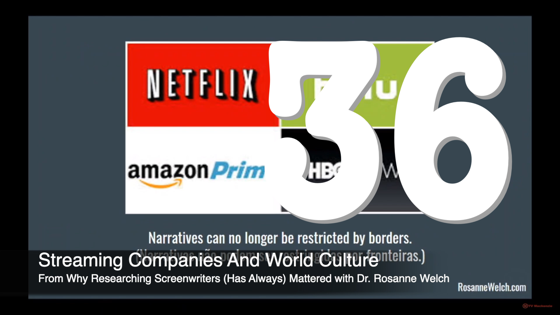
That’s why these services are so important to what we’re going to be able to do in the future because so many films are now co-productions with Netflix and they know they want to keep this worldwide audience because soon we’ll have the Disney streaming channel and we’re going to have an NBC streaming channel. There will be too many of those to pick from. The one thing Netflix has going for it is it’s done co-productions with so many countries. So people can have an interest in seeing their stories more than repetitive Disney stories, as much as I like Disney after a while I don’t need to see Aladdin filmed by 47 different actors again and again and again. So I think it’s really important and so even when I was preparing and thinking about doing this I watched some Brazilian television. I was able on my own television to simply dial up these programs and see what they were all about and because of that, I can then share them with my students who are very interested in finding out because my students come from many, many different backgrounds — many many different heritages and they don’t always see themselves represented on film. So the idea of seeing television shows and movies from their families home culture is a beautiful way for them to keep that culture even in a world where assimilation is the thing that more people are respecting, and they feel they lose their culture.
Watch this entire presentation
A Note About This Presentation
A clip from my keynote speech at the 10th Screenwriters´(hi)Stories Seminar for the interdisciplinary Graduation Program in “Education, Art, and History of Culture”, in Mackenzie Presbyterian University, at São Paulo, SP, Brazil, focused on the topic “Why Researching Screenwriters (has Always) Mattered.” I was especially pleased with the passion these young scholars have toward screenwriting and it’s importance in transmitting culture across the man-made borders of our world.
To understand the world we have to understand its stories and to understand the world’s stories we must understand the world’s storytellers. A century ago and longer those people would have been the novelists of any particular country but since the invention of film, the storytellers who reach the most people with their ideas and their lessons have been the screenwriters. My teaching philosophy is that: Words matter, Writers matter, and Women writers matte, r so women writers are my focus because they have been the far less researched and yet they are over half the population. We cannot tell the stories of the people until we know what stories the mothers have passed down to their children. Those are the stories that last. Now is the time to research screenwriters of all cultures and the stories they tell because people are finally recognizing the work of writers and appreciating how their favorite stories took shape on the page long before they were cast, or filmed, or edited. But also because streaming services make the stories of many cultures now available to a much wider world than ever before.
Many thanks to Glaucia Davino for the invitation.
* A portion of each sale from Amazon.com directly supports our blogs ** Many of these books may be available from your local library. Check it out! † Available from the LA Public Library
Subscribe to Rosanne’s Channel and receive notice of each new video!
Transcript:
Previously in the United States, the only way we could see a movie from Brazil would be if it won an Oscar or if it was nominated for an Oscar right and these are the only films that had wide release in the United States before Netflix because you would have to go to a theater. You would have to be the kind of person who liked to see international films, who were willing to read subtitles. I noticed — my son is 21 — and I notice in his generation there is more of a comfort with reading subtitles. He watches, because of Netflix, a lot of Japanese anime — a lot of movies from around the world — he doesn’t mind. About 10 years ago, before Netflix. if I assigned an international movie — and I would often assign some Italian films to my film students — they would complain because reading the screen was boring. Now it’s become more acceptable so that we have this opportunity. So until Netflix, this was the only way that in the United States we would have been exposed to any of these films except Kiss of the Spider Woman because that was a co-production between Brazil and the United States so it won some Oscars and we knew about it.
Watch this entire presentation
A Note About This Presentation
A clip from my keynote speech at the 10th Screenwriters´(hi)Stories Seminar for the interdisciplinary Graduation Program in “Education, Art, and History of Culture”, in Mackenzie Presbyterian University, at São Paulo, SP, Brazil, focused on the topic “Why Researching Screenwriters (has Always) Mattered.” I was especially pleased with the passion these young scholars have toward screenwriting and it’s importance in transmitting culture across the man-made borders of our world.
To understand the world we have to understand its stories and to understand the world’s stories we must understand the world’s storytellers. A century ago and longer those people would have been the novelists of any particular country but since the invention of film, the storytellers who reach the most people with their ideas and their lessons have been the screenwriters. My teaching philosophy is that: Words matter, Writers matter, and Women writers matte, r so women writers are my focus because they have been the far less researched and yet they are over half the population. We cannot tell the stories of the people until we know what stories the mothers have passed down to their children. Those are the stories that last. Now is the time to research screenwriters of all cultures and the stories they tell because people are finally recognizing the work of writers and appreciating how their favorite stories took shape on the page long before they were cast, or filmed, or edited. But also because streaming services make the stories of many cultures now available to a much wider world than ever before.
Many thanks to Glaucia Davino for the invitation.
* A portion of each sale from Amazon.com directly supports our blogs ** Many of these books may be available from your local library. Check it out! † Available from the LA Public Library


![01 Introduction from There And Back Again: Writing and Developing for American Television]: from Freelancing to Writers Rooms [Video] (1 minute)](https://rosannewelch.com/wp-content/uploads/2020/12/rmw-oxford-brookes-01.png)

![There And Back Again: Writing and Developing for American Television]: from Freelancing to Writers Rooms [Video] (52 minutes)](https://rosannewelch.com/wp-content/uploads/2020/12/oxford-brookes.png)