24 Diversity Makes Better Product from There And Back Again: Writing and Developing for American TV [Video]

24 Diversity Makes Better Product from There And Back Again: Writing and Developing for American TV [Video]

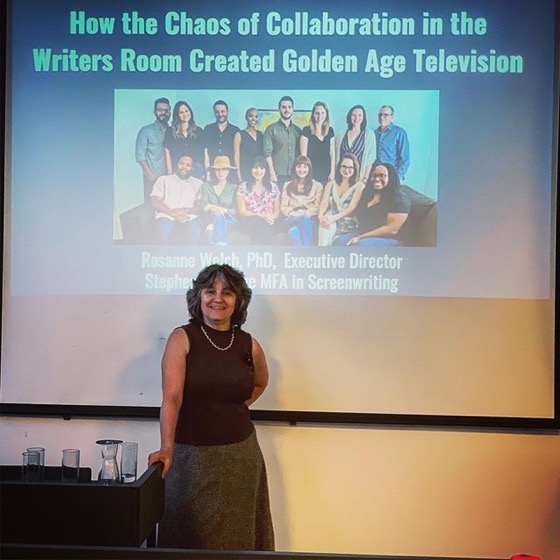
Thanks to the gracious invitation from my Screenwriting Research Network colleague Paolo Russo – and a grant he was able to procure (and in the before-Covid time) I was able to spend a week at Oxford Brookes University working with the screenwriting masters students in Paolo’s course. At the culmination of the week, I gave this lecture on how writers rooms worked in the States.

Transcript:

One of the big things about writer’s rooms these days is being as inclusive as we can be. You guys are better at that. I’m always impressed with British shows because it’s always kind of a mix of people — the ones that I get to see in America, all right, but that’s impressive to me and of course, we all know you went so far as to make The Doctor a woman. That’s huge. At least that was huge news in the states. I don’t know if it was huge news here but we’re very happy about that. So finally from the 90s and beyond we’re getting more inclusive writing rooms right, but you might notice we don’t yet have too many Asian American writers I mean there’s a lot of ethnicities not completely being represented but writer/producers are more responsible to that idea now because they recognize it makes the product better because a collaboration of many ideas is always going to be a more layered piece that you’re presenting.

Watch this entire presentation

Subscribe to Rosanne’s Channel and receive notice of each new video!


* A portion of each sale from Amazon.com directly supports our blogs
** Many of these books may be available from your local library. Check it out!
† Available from the LA Public Library

23 The importance of A Voice in the Room There And Back Again: Writing and Developing for American TV [Video]

23 The importance of A Voice in the Room There And Back Again: Writing and Developing for American TV [Video]

Thanks to the gracious invitation from my Screenwriting Research Network colleague Paolo Russo – and a grant he was able to procure (and in the before-Covid time) I was able to spend a week at Oxford Brookes University working with the screenwriting masters students in Paolo’s course. At the culmination of the week, I gave this lecture on how writers rooms worked in the States.

Transcript:

So, for instance, we were doing a story once about a young little girl. She was nine years old and she happened to be a young girl of color. She was lost at a park or something like that and you know the first thing that came to us — what do we do next in the story — well she’s gonna go find a policeman and the two African-American women in her room went “Oh no she’s not. My parents told me never to go to a policeman” and we were like but I was always told to find a policeman if I got lost somewhere. Yeah because you’re not a woman of color. So you can be safe with them. That was a whole new perspective, right? A perspective that I would not have had had I not had that other voice in the room.

Watch this entire presentation

Subscribe to Rosanne’s Channel and receive notice of each new video!


* A portion of each sale from Amazon.com directly supports our blogs
** Many of these books may be available from your local library. Check it out!
† Available from the LA Public Library

22 People of Color and Television from There And Back Again: Writing and Developing for American TV [Video]

22 People of Color and Television from There And Back Again: Writing and Developing for American TV [Video]

Thanks to the gracious invitation from my Screenwriting Research Network colleague Paolo Russo – and a grant he was able to procure (and in the before-Covid time) I was able to spend a week at Oxford Brookes University working with the screenwriting masters students in Paolo’s course. At the culmination of the week, I gave this lecture on how writers rooms worked in the States.

Transcript:

Still, there’s something missing in writer’s rooms in America.

There’s some girls in that picture because it’s executive produced by a girl.

Missing something else. (Audience: people of color)People of color because you know they exist in the world.Isn’t that interesting but they were not yet existing on very many TV shows. Again a whole font of stories not being told — not being told correctly. On my show Touched by Angel we had we had two women of color and you have to remember that you only have experiences until you do research that come from your own life and that’s good and that’s a building block but it’s not everything right?

Watch this entire presentation

Subscribe to Rosanne’s Channel and receive notice of each new video!


* A portion of each sale from Amazon.com directly supports our blogs
** Many of these books may be available from your local library. Check it out!
† Available from the LA Public Library

11 Donald Bellisario from How The Chaos Of Collaboration in the Writers Room Created Golden Age Television [Video]

With the full recording of “How The Chaos Of Collaboration in the Writers Room Created Golden Age Television”

11 Donald Bellisario from How The Chaos Of Collaboration in the Writers Room Created Golden Age Television [Video]

Subscribe to Rosanne’s Channel and receive notice of each new video!


When the folks hosting the conference announced their theme as “Screen Narratives: Chaos and Order” the word ‘chaos’ immediately brought to mind writers rooms. I offered a quick history of writers rooms (the presentations are only 20 minutes long) and then quoted several current showrunners on how they compose their rooms and how they run them.

Transcript

Don Belisario gave us the military on television and that is a very distinct voice in America. It speaks to a part of the population that doesn’t feel they’re serviced by television right which they think is all run by liberal elites. So to glorify our military is the thing that is very popular in some parts of the country and that’s because Don Belisario was from the military. So he wanted to express that part of his life in writing.

For more information on the Screenwriting Research Network, visit

Screenwriting Research Network Conference, Porto, Portugal, All Sessions


Ready to present my talk yesterday at the Screenwriting Research Conference here in Porto, Portugal via Instagram

Follow me on Instagram


* A portion of each sale from Amazon.com directly supports our blogs
** Many of these books may be available from your local library. Check it out!

21 Buffy The Vampire Slayer from There And Back Again: Writing and Developing for American TV [Video]

21 Buffy The Vampire Slayer from There And Back Again: Writing and Developing for American TV [Video]

Thanks to the gracious invitation from my Screenwriting Research Network colleague Paolo Russo – and a grant he was able to procure (and in the before-Covid time) I was able to spend a week at Oxford Brookes University working with the screenwriting masters students in Paolo’s course. At the culmination of the week, I gave this lecture on how writers rooms worked in the States.

Transcript:

Now. Lack of women. Ta-Da. Buffy the Vampire Slayer. Thank god, although we’ve discovered in the states that Joss Whedon, who ran the show and got all kinds of points for being a feminist was, in fact, having sex with every other girl he could meet so apparently not such a feminist. His wife has now left him — ta-da — but I academically am going to interpret to you that the reason the program maintained its level of feminist theory was because of all the women who he hired in his writer’s room. So perhaps subconsciously he knew he was a jerk and he wasn’t going to interpret this right and he wanted to get a room full of people who could give him a real interpretation of what it was like to be a girl in high school who was othered — who was different in this way. So Buffy is a pretty breakthrough and I highly recommend that show

Watch this entire presentation

Subscribe to Rosanne’s Channel and receive notice of each new video!


* A portion of each sale from Amazon.com directly supports our blogs
** Many of these books may be available from your local library. Check it out!
† Available from the LA Public Library

10 Steven Bochco from How The Chaos Of Collaboration in the Writers Room Created Golden Age Television [Video]

With the full recording of “How The Chaos Of Collaboration in the Writers Room Created Golden Age Television”

10 Steven Bocbco from How The Chaos Of Collaboration in the Writers Room Created Golden Age Television [Video]

Subscribe to Rosanne’s Channel and receive notice of each new video!


When the folks hosting the conference announced their theme as “Screen Narratives: Chaos and Order” the word ‘chaos’ immediately brought to mind writers rooms. I offered a quick history of writers rooms (the presentations are only 20 minutes long) and then quoted several current showrunners on how they compose their rooms and how they run them.

Transcript

Then, of course , we have Steven Bochco, who gave us — he, as was said in the keynote, the multi-level story, many characters with different goals. He brought that to television in a way that hadn’t existed before. Adam-12 is a very basic, two guys do cop things all day. This was now groups of people. Here we had the policemen with their own personal lives at home. Later will have LA Law. The lawyers with their own personal lives and NYPD Lue. So that was what Bochco brought to television.

For more information on the Screenwriting Research Network, visit

Screenwriting Research Network Conference, Porto, Portugal, All Sessions


Ready to present my talk yesterday at the Screenwriting Research Conference here in Porto, Portugal via Instagram

Follow me on Instagram


* A portion of each sale from Amazon.com directly supports our blogs
** Many of these books may be available from your local library. Check it out!

20 More On Russell T Davies from There And Back Again: Writing and Developing for American TV [Video]

20 More On  Russell T Davies from There And Back Again: Writing and Developing for American TV [Video]

Thanks to the gracious invitation from my Screenwriting Research Network colleague Paolo Russo – and a grant he was able to procure (and in the before-Covid time) I was able to spend a week at Oxford Brookes University working with the screenwriting masters students in Paolo’s course. At the culmination of the week, I gave this lecture on how writers rooms worked in the States.

Transcript:

This book here, I highly recommend if you like Doctor Who, but if you like writing, Benjamin Cook, the writer, the journalist asked Russell Davies in the last season of David Tennant’s era, could I email you across this year and just ask you questions like — what are you thinking of today and Russell was like sure and so it’s this it’s the collection of their emails as he wrote the last season. So you’ll start with something like well today I’m thinking what if water was deadly? I don’t know what to do with that but that’s on my brain today and a few weeks later it was — what if some astronauts were on Mars and Martian water was deadly and by the time you’re done we have an episode called Waters of Mars right? So he watched the progress and development of a story through these emails with Russell Davies.

Watch this entire presentation

Subscribe to Rosanne’s Channel and receive notice of each new video!


* A portion of each sale from Amazon.com directly supports our blogs
** Many of these books may be available from your local library. Check it out!
† Available from the LA Public Library

From The Journal Of Screenwriting V4 Issue 3: Bridges and gaps: The Singing Detective’s serial afterlife by Sean O’Sullivan

Highlighting the articles in the past editions of the Journal of Screenwriting, of which I am the Book Reviews Editor. Hopefully these abstracts will entice you to did a little deeper into the history and future of screenwriting. — Rosanne


Bridges and gaps: The Singing Detective’s serial afterlife by Sean O’Sullivan

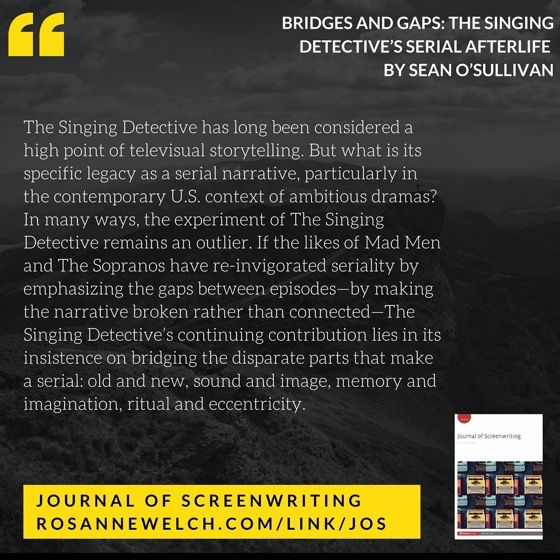
The Singing Detective has long been considered a high point of televisual storytelling. But what is its specific legacy as a serial narrative, particularly in the contemporary U.S. context of ambitious dramas? In many ways, the experiment of The Singing Detective remains an outlier. If the likes of Mad Men and The Sopranos have re-invigorated seriality by emphasizing the gaps between episodes—by making the narrative broken rather than connected—The Singing Detective’s continuing contribution lies in its insistence on bridging the disparate parts that make a serial: old and new, sound and image, memory and imagination, ritual and eccentricity.

From The Journal Of Screenwriting V4 Issue 3: Bridges and gaps: The Singing Detective’s serial afterlife by Sean O’Sullivan


Journal of Screenwriting Cover

The Journal of Screenwriting is an international double-blind peer-reviewed journal that is published three times a year. The journal highlights current academic and professional thinking about the screenplay and intends to promote, stimulate and bring together current research and contemporary debates around the screenplay whilst encouraging groundbreaking research in an international arena. The journal is discursive, critical, rigorous and engages with issues in a dynamic and developing field, linking academic theory to screenwriting practice. 

Get your copy and subscription to the Journal of Screenwriting Today!


* A portion of each sale from Amazon.com directly supports our blogs
** Many of these books may be available from your local library. Check it out!

09 More on Stephen J. Cannell from How The Chaos Of Collaboration in the Writers Room Created Golden Age Television [Video]

With the full recording of “How The Chaos Of Collaboration in the Writers Room Created Golden Age Television”

09 More on Stephen J. Cannell from How The Chaos Of Collaboration in the Writers Room Created Golden Age Television [Video]

Subscribe to Rosanne’s Channel and receive notice of each new video!


When the folks hosting the conference announced their theme as “Screen Narratives: Chaos and Order” the word ‘chaos’ immediately brought to mind writers rooms. I offered a quick history of writers rooms (the presentations are only 20 minutes long) and then quoted several current showrunners on how they compose their rooms and how they run them.

Transcript

I was able to interview a certain set of these men — actually, Stephen Cannell in the year before he died — to talk about their time at Universal and the transition from this pool into their own rooms and how they would comprise those rooms. again, all these men that I just mentioned are famous because of what they came up with. Cannel is someone we know from many action-adventure television shows. When he passed away the show, Castle, which was big in the United States — the men who worked on that show had been in his writer’s pools early in their career. So, he was famous for this ending on his show where he would type in the typewriter and pull the paper out — that was his brand. At the end of this show, Castle, which he did not work on. they gave this — colleague, mentor, friend ending — in tribute to him. So that’s how important he was to their careers. They learned how to run their own rooms from working with him. These are all the shows that we know him from at some point or another. So he’s certainly a man with a very distinct style that stood out for a long time.

For more information on the Screenwriting Research Network, visit

Screenwriting Research Network Conference, Porto, Portugal, All Sessions


Ready to present my talk yesterday at the Screenwriting Research Conference here in Porto, Portugal via Instagram

Follow me on Instagram


* A portion of each sale from Amazon.com directly supports our blogs
** Many of these books may be available from your local library. Check it out!

19 Russell T Davies and Doctor Who from There And Back Again: Writing and Developing for American TV [Video] (40 seconds)

18 Russell T Davies and Doctor Who from There And Back Again: Writing and Developing for American TV [Video] (40 seconds)

Thanks to the gracious invitation from my Screenwriting Research Network colleague Paolo Russo – and a grant he was able to procure (and in the before-Covid time) I was able to spend a week at Oxford Brookes University working with the screenwriting masters students in Paolo’s course. At the culmination of the week, I gave this lecture on how writers rooms worked in the States.

Transcript:

I got a beloved chance to interview Russell Davies who came to the states to do the fourth season of Torchwood and the editor Written By knew how much I love Doctor Who, so he asked me if I’d like to interview him? Which I did and this was something that he said that meant a lot. Again you probably know he’s an openly gay man and it bothered him what he was seeing on television. So obviously, he invented Queer As Folk, and from that, he invented and revived Doctor Who and invented Torchwood, which allowed us, Captain Jack. it was just so adorable. I can’t stand it, but not on my team. So there you go. So this is really important. He was recognizing that in what he was creating for television and again made the programming more inclusive.

Watch this entire presentation

Subscribe to Rosanne’s Channel and receive notice of each new video!


* A portion of each sale from Amazon.com directly supports our blogs
** Many of these books may be available from your local library. Check it out!
† Available from the LA Public Library