11 Torchwood and Doctor Who from Gender Diversity in the Who-niverse [Video] (0:44)

Watch this entire presentation: Gender Diversity in the Who-niverse: Paving the Way for a Lady Doctor with Dr. Rosanne Welch [Video] (36:58)
11 Torchwood and Doctor Who from Gender Diversity in the Who-niverse

For her 5th Doctor Who lecture to the CPP community, Dr. Rosanne Welch discusses how society – and the show’s writing staff – prepared the audience for a major change in this 50-year franchise – the creation of the first Lady Doctor!

Transcript:

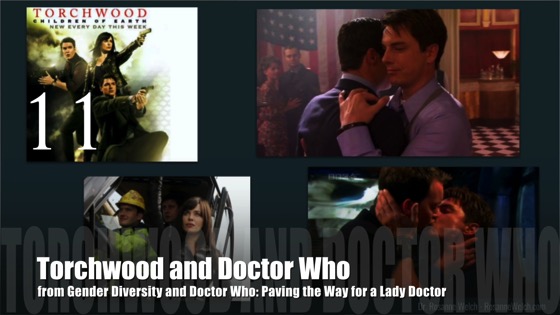
During Doctor Who, Russell also invented Torchwood which I think is a fascinating show, if you’ve never you should check it out because, again, playing with gender, on this program, Captain Jack is the head of the Torchwood unit. Hsi second in command is a female, Gwen, who was a policewoman. She joins this elite alien group. you know, of police, if you will and her husband is a stay at home kind of guy and he’s going to take care of the baby when they eventually have it. He’s got a construction job. He comes home at night and makes her dinner. She works funny hours. Russell Davies specifically said”I want to swap the gender stereotypes. I want to see how that works in the world and that is a way many marriages are working these days but it was still considered new.

Follow Dr. Welch on Twitter and Instagram
https://twitter.com/rosannewelchhttp://instagram.com/drrosannewelch


Dr. Rosanne Welch

Dr. Rosanne Welch teaches the History of Screenwriting and One-Hour Drama for the Stephens College MFA in Screenwriting.

Writing/producing credits include Beverly Hills 90210, Picket Fences, ABCNEWS: Nightline and Touched by an Angel. In 2016 she published the book Why The Monkees Matter: Teenagers, Television and American Pop; co-edited Women in American History: A Social, Political, and Cultural Encyclopedia; and placed “Transmitting Culture Transnationally Via the Characterization of Parents in Police Procedurals” in the New Review of Film and Television Studies. Essays appear in Torchwood Declassified: Investigating Mainstream Cult Television and Doctor Who and Race: An Anthology. Welch serves as Book Reviews editor for Journal of Screenwriting and on the Editorial Advisory Board for Written By magazine, the magazine of the Writers Guild.

Watch Dr. Welch’s talk “The Importance of Having a Female Voice in the Room” at the 2016 TEDxCPP.

Today I Became a Citation: Little Women, Feminism and Me!

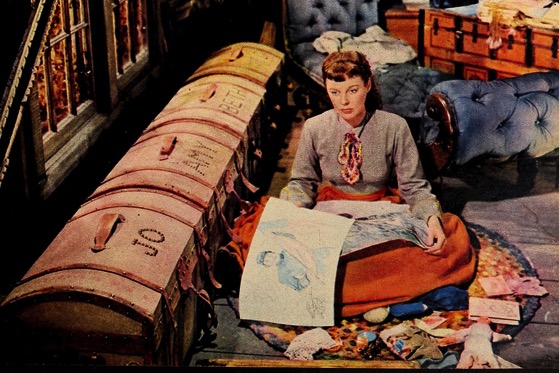
I usually use Google Alerts to find mentions of The Monkees but this weekend something interesting happened. Google Alerts found my name in an essay on the JSTOR Daily about the new BBC miniseries version of Little Women, adapted by Heidi Thomas of “Call the Midwife”) from a novel by a female writer (Louisa May Alcott, as if you didn’t know) and directed by a woman (Vanessa Caswill). 

My Summer of Watching Little Women by Benjamin Winterhalter

Little women movie 1050x700

The writer of the essay was a male, JSTOR Daily’s features editor Benjamin Winterhalter and he was reminiscing about a summer in his elementary years when his mother and friends dissected all the filmed adaptations of the novel  in preparation for writing an article —  “A Feminist Romance: Adapting Little Women to the Screen”  for Tulsa Studies in Women’s Literature. 

Read the Journal Article


Join the Rosanne Welch Mailing List for future book and event announcements!
 

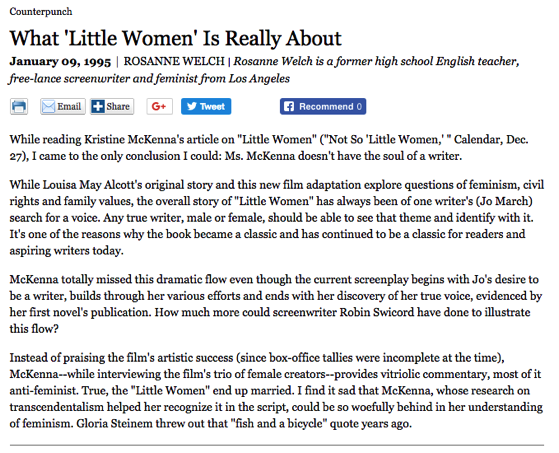
Winterhalter’s article came up because along his research way he came across an Op-Ed I had written for the Los Angeles Times, “What ‘Little Women’ Is Really About” about the 1995 Robin Schiff adaptation (starring Winona Ryder) which I had framed as both a more deeply feminist interpretation but, more importantly, accessible to all as the story of a writer finding their voice.

Today I Became a Citation: Little Women. Feminism and Me!

How fun to be reminded of that Op-Ed and to see how accessible my earlier work can be with archives going digital.  It’s also good timing as I often recommend to screenwriting students that they write for various local publications in order to get their names out there and to fill out their writing CVs.  Here’s an example of a piece I wrote when I had a passionate idea ( the one about how this is more the story of a writer finding their voice than merely a bunch of sisters surviving the Civil War). Since I did not see that idea represented in the mainstream press, I brought it to their attention and they noticed it and presented it to their readers.

Monkees Research Materials and Memorabilia via My Instagram

Monkees Research Materials and Memorabilia via My Instagram

Monkees Research Materials and Memorabilia

“How The Monkees Changed Television” at Cal Fullerton Lunchtime Lectures 


 Why The Monkees Matter: Teenagers, Television and American Pop Culture


McFarland (Direct from Publisher) | Amazon | Kindle Edition | Nook Edition

Presenting on “How The Monkees Changed Television” at Cal Fullerton Lunchtime Lectures via My Instagram

Presenting on “How The Monkees Changed Television” at Cal Fullerton Lunchtime Lectures via My Instagram

Presenting on “How The Monkees Changed Television” at Cal Fullerton Lunchtime Lectures 

More pictures and complete video coming soon!


 Why The Monkees Matter: Teenagers, Television and American Pop Culture


McFarland (Direct from Publisher) | Amazon | Kindle Edition | Nook Edition

20 Where Did We Get Gidget Right? from How Gidget Got Into the Girl Ghetto with Dr. Rosanne Welch [Video] (1:00)

20 Where Did We Get Gidget Right? from How Gidget Got Into the Girl Ghetto with Dr. Rosanne Welch

20 Where Did We Get Gidget Right? from How Gidget Got Into the Girl Ghetto with Dr. Rosanne Welch

Watch this entire presentation


Transcript:


So, I really wanted to wrap up with the idea, so where did we get the Gidget book right? Was it in the movies or in the TV show? I’m going to guess, just because I’m pushy and that’s what I pushed on you, it is, in fact, the TV show and I’m going to say that’s because TV is where meat-and-potatoes stories can be told. We have a hundred or 200 hours to tell you the story of one character. They can’t be weak and superficial or you won’t come back. We need to really get into their hearts and hear about them and that’s the beauty of television as opposed to bubblegum in films and also TV has often been — and I’m not saying Gidget is part of the golden age of television — but when we discuss the Golden Age of Television we discuss it like Dickensian novels, that every month, every week, you get another section of the story and that’s the power of television. We can expand on a character because you’ve come to love them and you’ll watch them go through two or three or seven years of their lives and that’s much more in-depth than you can get into a film which is where Gidget falls apart if you ask me.


At this year’s 10th Annual Screenwriting Research Network Conference at Otago University in Dunedin, New Zealand I presented…

“How Gidget Got Into the Girl Ghetto by Accident (and How We Can Get Her Out of it): Demoting Gidget: The Little Girl with Big Ideas from Edgy Coming of Age Novel to Babe on the Beach Genre Film via Choices made in the Adaptation Process.”

It’ a long title, as I joke up front, but covers the process of adapting the true life story of Kathy Kohner (nicknamed ‘Gidget’ by the group of male surfers who she spent the summers with in Malibu in the 1950s) into the film and television series that are better remembered than the novel. The novel had been well-received upon publication, even compared to A Catcher in the Rye, but has mistakenly been relegated to the ‘girl ghetto’ of films. Some of the adaptations turned the focus away from the coming of age story of a young woman who gained respect for her talent at a male craft – surfing – and instead turned the focus far too much on Kathy being boy crazy.

Along the way I found interesting comparisons between how female writers treated the main character while adapting the novel and how male writers treated the character.

Gidget


Dr. Rosanne Welch

Dr. Rosanne Welch teaches the History of Screenwriting and One-Hour Drama for the Stephens College MFA in Screenwriting.

Writing/producing credits include Beverly Hills 90210, Picket Fences, ABCNEWS: Nightline and Touched by an Angel. In 2016 she published the book Why The Monkees Matter: Teenagers, Television and American Pop; co-edited Women in American History: A Social, Political, and Cultural Encyclopedia; and placed “Transmitting Culture Transnationally Via the Characterization of Parents in Police Procedurals” in the New Review of Film and Television Studies. Essays appear in Torchwood Declassified: Investigating Mainstream Cult Television and Doctor Who and Race: An Anthology. Welch serves as Book Reviews editor for Journal of Screenwriting and on the Editorial Advisory Board for Written By magazine, the magazine of the Writers Guild.

Watch Dr. Welch’s talk “The Importance of Having a Female Voice in the Room” at the 2016 TEDxCPP.


SRN logo red


The Screenwriting Research Network is a research group consisting of scholars, reflective practitioners and practice-based researchers interested in research on screenwriting. The aim is to rethink the screenplay in relation to its histories, theories, values and creative practices.

10 The New Companions from Gender Diversity in the Who-niverse [Video] (0:59)

Watch this entire presentation: Gender Diversity in the Who-niverse: Paving the Way for a Lady Doctor with Dr. Rosanne Welch [Video] (36:58)

10 The New Companions from Gender Diversity in the Who-niverse

For her 5th Doctor Who lecture to the CPP community, Dr. Rosanne Welch discusses how society – and the show’s writing staff – prepared the audience for a major change in this 50-year franchise – the creation of the first Lady Doctor!

Transcript:

…and through Russell, we’re going to gain a new look both female and male characters particularly his first companion he is going to invent is Rose and Rose is very strong. We’re going to talk about how in a minute. We’re going to have Martha Jones who happens to be one of my favorite companions and I’ll explain why, because Iknow there are some people don’t like Martha and how she was treated. I think Martha was actually stronger than people are giving her credit for. Then, Donna Noble who was just a “friend” and there’s a whole discussion about the idea that women didn’t have to be a sexual or a partner companion, they could just be friends as of maybe Y’all actually have friends who are of the opposite sex. Really? That’s possible? I don’t know. Right? So that was a new thing. And of course, Captain Jack Harkness who was the first openly gay, but also omnisexual. He’s had sex with women, men, aliens, you name it he was good for it and that was an interesting thing to be said on a television program. And he’s just so gorgeous, what can you say?

Follow Dr. Welch on Twitter and Instagram
https://twitter.com/rosannewelchhttp://instagram.com/drrosannewelch


Dr. Rosanne Welch

Dr. Rosanne Welch teaches the History of Screenwriting and One-Hour Drama for the Stephens College MFA in Screenwriting.

Writing/producing credits include Beverly Hills 90210, Picket Fences, ABCNEWS: Nightline and Touched by an Angel. In 2016 she published the book Why The Monkees Matter: Teenagers, Television and American Pop; co-edited Women in American History: A Social, Political, and Cultural Encyclopedia; and placed “Transmitting Culture Transnationally Via the Characterization of Parents in Police Procedurals” in the New Review of Film and Television Studies. Essays appear in Torchwood Declassified: Investigating Mainstream Cult Television and Doctor Who and Race: An Anthology. Welch serves as Book Reviews editor for Journal of Screenwriting and on the Editorial Advisory Board for Written By magazine, the magazine of the Writers Guild.

Watch Dr. Welch’s talk “The Importance of Having a Female Voice in the Room” at the 2016 TEDxCPP.

Quotes from “Why The Monkees Matter” by Dr. Rosanne Welch – 99 in a series – The End

** Buy “Why The Monkees Matter” Today **

Quotes from

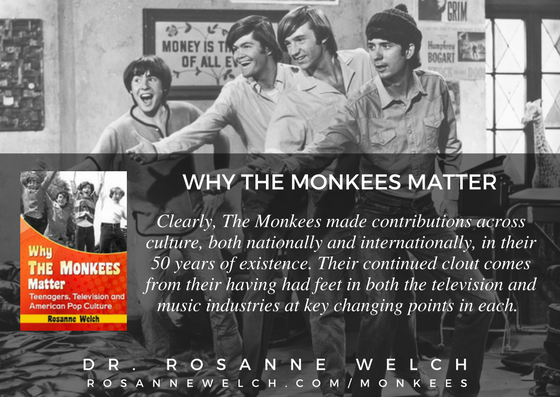
Clearly, The Monkees made contributions across culture, both nationally and internationally, in their 50 years of existence. Their continued clout comes from their having had feet in both the television and music industries at key changing points in each. 

from Why The Monkees Matter by Dr. Rosanne Welch —  Buy your Copy today!

 Why The Monkees Matter: Teenagers, Television and American Pop Culture


McFarland (Direct from Publisher) | Amazon | Kindle Edition | Nook Edition

19 Dorothy Cooper Foote and Gidget from How Gidget Got Into the Girl Ghetto with Dr. Rosanne Welch [Video] (0:50)

19 Dorothy Cooper Foote and Gidget from How Gidget Got Into the Girl Ghetto with Dr. Rosanne Welch

19 Dorothy Cooper Foote and Gidget from How Gidget Got Into the Girl Ghetto with Dr. Rosanne Welch

Watch this entire presentation


Transcript:

Then you flip over her to Dorothy Cooper Foote who was one of the freelance writers on the show. Gidget has a crush on an older man. That’s Daniel Travanti who will show up in Hill Street Blues as a grown man. He’s a photographer. He’s a war veteran from the Vietnam (Korean) War, although that war is unmentioned, but he’s a war veteran and he’s taking pictures of her for a magazine. She falls in love with him. She discovers he actually has a fiance. He didn’t realize she had a crush on him because he didn’t consider a younger girl as someone that he would go after and her and her Dad had this lovely moment because he says “(Your) always going to hurt a little.” and he knows because his wife has passed away and he’s a widow. So they make this connection on having experienced loss together. Which is a very mature thing for a young girl to be able to discuss and to share and again that mature attitude toward her comes from a female writer.

At this year’s 10th Annual Screenwriting Research Network Conference at Otago University in Dunedin, New Zealand I presented…

“How Gidget Got Into the Girl Ghetto by Accident (and How We Can Get Her Out of it): Demoting Gidget: The Little Girl with Big Ideas from Edgy Coming of Age Novel to Babe on the Beach Genre Film via Choices made in the Adaptation Process.”

It’ a long title, as I joke up front, but covers the process of adapting the true life story of Kathy Kohner (nicknamed ‘Gidget’ by the group of male surfers who she spent the summers with in Malibu in the 1950s) into the film and television series that are better remembered than the novel. The novel had been well-received upon publication, even compared to A Catcher in the Rye, but has mistakenly been relegated to the ‘girl ghetto’ of films. Some of the adaptations turned the focus away from the coming of age story of a young woman who gained respect for her talent at a male craft – surfing – and instead turned the focus far too much on Kathy being boy crazy.

Along the way I found interesting comparisons between how female writers treated the main character while adapting the novel and how male writers treated the character.

Gidget


Dr. Rosanne Welch

Dr. Rosanne Welch teaches the History of Screenwriting and One-Hour Drama for the Stephens College MFA in Screenwriting.

Writing/producing credits include Beverly Hills 90210, Picket Fences, ABCNEWS: Nightline and Touched by an Angel. In 2016 she published the book Why The Monkees Matter: Teenagers, Television and American Pop; co-edited Women in American History: A Social, Political, and Cultural Encyclopedia; and placed “Transmitting Culture Transnationally Via the Characterization of Parents in Police Procedurals” in the New Review of Film and Television Studies. Essays appear in Torchwood Declassified: Investigating Mainstream Cult Television and Doctor Who and Race: An Anthology. Welch serves as Book Reviews editor for Journal of Screenwriting and on the Editorial Advisory Board for Written By magazine, the magazine of the Writers Guild.

Watch Dr. Welch’s talk “The Importance of Having a Female Voice in the Room” at the 2016 TEDxCPP.


SRN logo red

The Screenwriting Research Network is a research group consisting of scholars, reflective practitioners and practice-based researchers interested in research on screenwriting. The aim is to rethink the screenplay in relation to its histories, theories, values and creative practices.

From The Research Vault: Film Genre for the Screenwriter by June Selbo

From The Research Vault: Film Genre for the Screenwriter by June Selbo

Film Genre for the Screenwriter is a practical study of how classic film genre components can be used in the construction of a screenplay. Based on Jule Selbo’s popular course, this accessible guide includes an examination of the historical origins of specific film genres, how and why these genres are received and appreciated by film-going audiences, and how the student and professional screenwriter alike can use the knowledge of film genre components in the ideation and execution of a screenplay.

Explaining the defining elements, characteristics and tropes of genres from romantic comedy to slasher horror, and using examples from classic films like Casablanca alongside recent blockbuster franchises like Harry Potter, Selbo offers a compelling and readable analysis of film genre in its written form. The book also offers case studies, talking points and exercises to make its content approachable and applicable to readers and writers across the creative field. — Amazon.com


Why The Monkees Matter: Teenagers, Television and American Pop Culture


Order Your Copy Now!

09 Regeneration of Doctor Who from Gender Diversity in the Who-niverse [Video] (0:57)

Watch this entire presentation: Gender Diversity in the Who-niverse: Paving the Way for a Lady Doctor with Dr. Rosanne Welch [Video] (36:58)

09 Regeneration of Doctor Who from Gender Diversity in the Who-niverse

For her 5th Doctor Who lecture to the CPP community, Dr. Rosanne Welch discusses how society – and the show’s writing staff – prepared the audience for a major change in this 50-year franchise – the creation of the first Lady Doctor!

Transcript:

The show was canceled in 1989. It had finally run its course at that time. In 2005, this gentleman, Russell Davies, who I was so excited to actually, — this is an article that I wrote about him in a magazine for the Writers Guild, so I got to interview him when he came to the United States and was working on his show Torchwood. He was the most successful producer at the BBC for this show, Queer as Folk. He happens to be a gay man and he was an openly gay man and so he wrote Queer As Folk. Huge success. It also was redone her in the United States, but because of the success of this program, the BBC said to him “What would you like to do next? Invent any show you like.” And he said, “I want to bring Doctor Who back.” Which had never happened to a show. Show’s canceled. It’s done. We’re finished with it, but they were like, “Hmm, whatever you want, Russell, you can do it!” So he revived the show, which is an amazing step.

Follow Dr. Welch on Twitter and Instagram
https://twitter.com/rosannewelchhttp://instagram.com/drrosannewelch


Dr. Rosanne Welch

Dr. Rosanne Welch teaches the History of Screenwriting and One-Hour Drama for the Stephens College MFA in Screenwriting.

Writing/producing credits include Beverly Hills 90210, Picket Fences, ABCNEWS: Nightline and Touched by an Angel. In 2016 she published the book Why The Monkees Matter: Teenagers, Television and American Pop; co-edited Women in American History: A Social, Political, and Cultural Encyclopedia; and placed “Transmitting Culture Transnationally Via the Characterization of Parents in Police Procedurals” in the New Review of Film and Television Studies. Essays appear in Torchwood Declassified: Investigating Mainstream Cult Television and Doctor Who and Race: An Anthology. Welch serves as Book Reviews editor for Journal of Screenwriting and on the Editorial Advisory Board for Written By magazine, the magazine of the Writers Guild.

Watch Dr. Welch’s talk “The Importance of Having a Female Voice in the Room” at the 2016 TEDxCPP.