Online Panel Discussion: It’s All Relative: Writing Diverse Television Families, Friday, August 6, 2021, 5:30 PM 7:00 PM – Stephens College MFA in TV and Screenwriting

Online Panel Discussion: It's All Relative: Writing Diverse Television Families, Friday, August 6, 2021, 5:30 PM  7:00 PM - Stephens College MFA in TV and Screenwriting

It’s All Relative: Writing Diverse Television Families
Friday, August 6, 2021
5:30 PM  7:00 PM

Online – RSVP Required

At every MFA Workshop we host a panel of writers in a joint event between the Writers Guild Foundation and the Stephens College MFA in TV and Screenwriting.

Our next will be focused on Writing Diverse Television Families.

Join us on Zoom on August 6th to hear from these writers:

  • Moderated by Dr. Rosanne Welch, Executive Director of Stephens College MFA in TV and Screenwriting
  • Sheryl J. Anderson – Creator and Executive Producer, Sweet Magnolias
  • Lang Fisher – Co-creator and Executive Producer, Never Have I Ever
  • Marja-Lewis Ryan – Executive Producer, The L Word: Generation Q
  • Anthony Sparks – Executive Producer, Queen Sugar.

Online Panel Discussion: It's All Relative: Writing Diverse Television Families, Friday, August 6, 2021, 5:30 PM  7:00 PM - Stephens College MFA in TV and Screenwriting

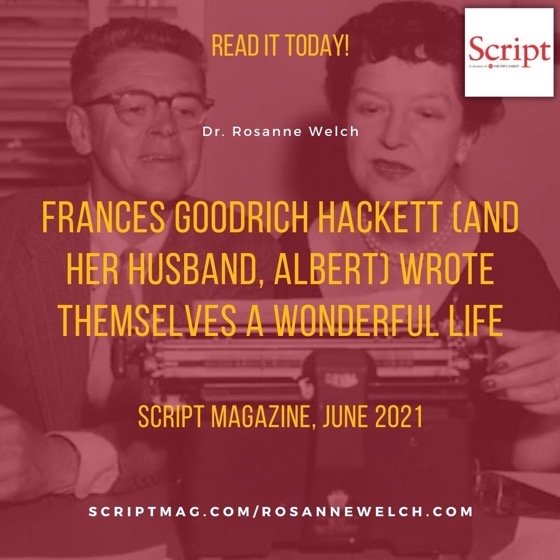
Frances Goodrich Hackett (and Her Husband, Albert) Wrote Themselves a Wonderful Life, Dr. Rosanne Welch, Script magazine, June 2021

Frances Goodrich Hackett (and Her Husband, Albert) Wrote Themselves a Wonderful Life, Dr. Rosanne Welch, Script magazine, June 2021

You have watched countless films written or adapted by Frances Goodrich Hackett. She has four Academy Award nominations for screenplays AND a Pulitzer Prize. Yet I bet you didn’t know her name until now. True to the title of one of her most enduring creations Frances had A Wonderful Life. Yep, she (and her writing partner and husband Albert Hackett) developed that beloved film from the bare bones of a postcard.

Though she was born in 1890, Goodrich found herself in an atypical family — one that accepted the idea of the theatre as a career — and she lived an atypical life for a woman of that era. Goodrich married three times (with the third to Albert being the charm that lasted over 50 years). When Goodrich showed an interest in the stage after her graduation from Vassar in 1912, her father arranged for her to join the Northampton Players stock company in Massachusetts. There her performances convinced her father that she should move to New York where she quickly earned bit parts on the Broadway stage.

Eventually, she started writing plays and asked a fellow actor, ten years her junior to read her script, give her notes, and help her on the rewrite. The play was Up Pops the Devil and the younger actor was Albert. When Metro-Goldwyn-Mayer studios offered the Hacketts a six-month writing contract at $750 per week in the midst of the Great Depression, they jumped on the steady money and made the move to Hollywood.

Like Wonderful Life the other stories the Hacketts brought to American films have made an indelible mark on our culture. They earned an Academy Award nomination for their adaption of the Edward Streeter novel Father of the Bride which became so entrenched in American memory it — and the sequel they also wrote– were remade in the 1990s for Steve Martin and Diane Keaton to headline (screenplay by then-also-married-screenwriting-couple Nancy Meyers & Charles Shyer). Few high school or college students graduate without once watching the film the Hacketts adapted from their own Broadway play, The Diary of Anne Frank (for which they earned a Pulitzer).

When Frances and Albert approached their first adaption – bringing The Thin Man (written by Dashiell Hammett) to the screen in 1934 — Nick and Nora Charles became synonymous with the emerging ideas of equality in modern marriage. Film studies have long held that the detective couple were patterned after Hammett and his companion, playwright Lillian Hellman. According to The Real Nick and Nora By Frances Goodrich & Albert Hackett, written by their nephew David L. Goodrich the relationship of Nick and Nora as it appears on film is in fact more closely connected to the relationship of the Hacketts.

Their marriage made their written work deeper and more sophisticated and whose shared work lives made the marriage stronger and more capable of lasting fifty-three years (ending only in Goodrich’s death in 1984.) In fact, as Nick and Nora are often referred to as the screen’s most beloved couple, Frances Goodrich Hackett and her husband Albert were often described as the “most beloved couple in Hollywood”.

Read Frances Goodrich Hackett (and Her Husband, Albert) Wrote Themselves a Wonderful Life on the Script web site


Read about more women from early Hollywood


A Woman Wrote That – 30 in a series – Sleepless in Seattle (1993)

This new “A Woman Wrote That” post is an echo of the Writers Guild campaign of a few years ago (“A Writer Wrote That”) where they noted famous movie quotes and credited the screenwriter rather than the director.  The difference here being that we will be posting lines from films written by female screenwriters.  Feel free to share! — Rosanne 

“Destiny is something that we’ve invented because we can’t stand the fact that everything that happens is accidental.”

ANNIE

“Destiny is something that we’ve invented because we can’t stand the fact that everything that happens is accidental.”

On Screenwriting: The Mary Tyler Moore Show, Title IV, and Today [Essay]

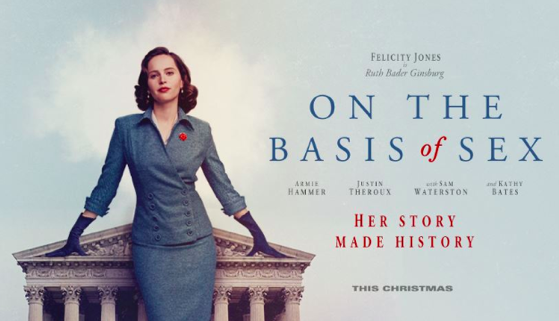
Working on this chapter about how the life of Ruth Bader Ginsburg was adapted for the screen in On the Basis of Sex, I was reminded of the interview scene in the pilot of The Mary Tyler Moore Show where Lou Grant asks her if she’s married and what religion she is.

On Screenwriting: The Mary Tyler Moore Show, Title IV, and Today [Essay]

In 1970 those questions were illegal thanks to Title IV of the Civil Rights Act of 1964.  But RBG had graduated in 1959 so the Act had not been around to help her.  She was turned down because she was a woman and because she was Jewish – despite achievements like graduating first in her class and the distinction of being the first woman to work on two major law reviews: the Harvard Law Review and Columbia Law Review.

Then I did some searching on the MTM script and found this article about how, though the scene was written in 1970 by James Brooks and Allan Burns, it is still relevant today.  Fascinating statistics between now and then including the fact that by 2017 in 38 percent of heterosexual marriages, women outearn their husbands.

3 ways ‘The Mary Tyler Moore Show’ pilot is still relevant today from the Washington Post

After Mary Tyler Moore’s death Wednesday, I watched the pilot episode of “The Mary Tyler Moore Show.” Though the show was revolutionary for its time for its portrayal of a single woman, working in journalism and living alone — I didn’t expect it to hold up all that well. Forty-seven years after the pilot aired, there are parts that are certainly retro. Louis “Lou” Grant (Edward Asner), for example, flat-out tells Mary Richards (Mary Tyler Moore) during a job interview: “I figured I’d hire a man for it, but we can talk about it.” But there’s a lot in that first episode that’s still relevant for single women today.

Read 3 ways ‘The Mary Tyler Moore Show’ pilot is still relevant today

And watch the scene if you don’t know it…

“On The Basis Of Sex” and Justice Ruth Bader Ginsberg’s Harvard Classmates

Working on a chapter about the film On the Basis of Sex which is a biopic based on the early life and career of Supreme Court associate Justice Ruth Bader Ginsburg I came across this podcast that researched the other 8 women who were part of her Harvard Law School class of 1956. 

If you’ve seen the film (and you should because it’s good!) or read much about the Justice you’ll have heard the story of how the Dean of the law school invited them along with some male students to his house for dinner.  Then he asked each of the women in the class to stand up and explain why she’s at Harvard, taking the place of a man. 

Ugh! 

We all know Ginsburg’s career was such a skyrocket that it put that jerk in his place – but then some journalists thought about researching those other 8 women to see how their careers went – and they started a podcast about the women’s lives. 

I love finds like this!

Read more about Justice Ruth Bader Ginsberg in the book series I am editing — Women Making History from ABC-CLIO.


Ruth Bader Ginsburg: A Life in American History (Women Making History) by Nancy Hendriks

Ruth Bader Ginsburg: A Life in American History explores Ginsburg’s path to holding the highest position in the judicial branch of U.S. government as a Supreme Court justice for almost three decades. Readers will learn about the choices, challenges, and triumphs that this remarkable American has lived through, and about the values that shape the United States.=

Ginsburg, sometimes referred to as The Notorious RBG or RBG was a professor of law, a member of the American Civil Liberties Union, an advocate for women’s rights, and more, before her tenure as Supreme Court justice. She has weighed in on decisions, such as Bush v. Gore (2000); King v. Burwell (2015); and Masterpiece Cakeshop v. Colorado Civil Rights Commission (2018), that continue to guide lawmaking and politics. Ginsburg’s crossover to stardom was unprecedented, though perhaps not surprising. Where some Americans see the Supreme Court as a decrepit institution, others see Ginsburg as an embodiment of the timeless principles on which America was founded.

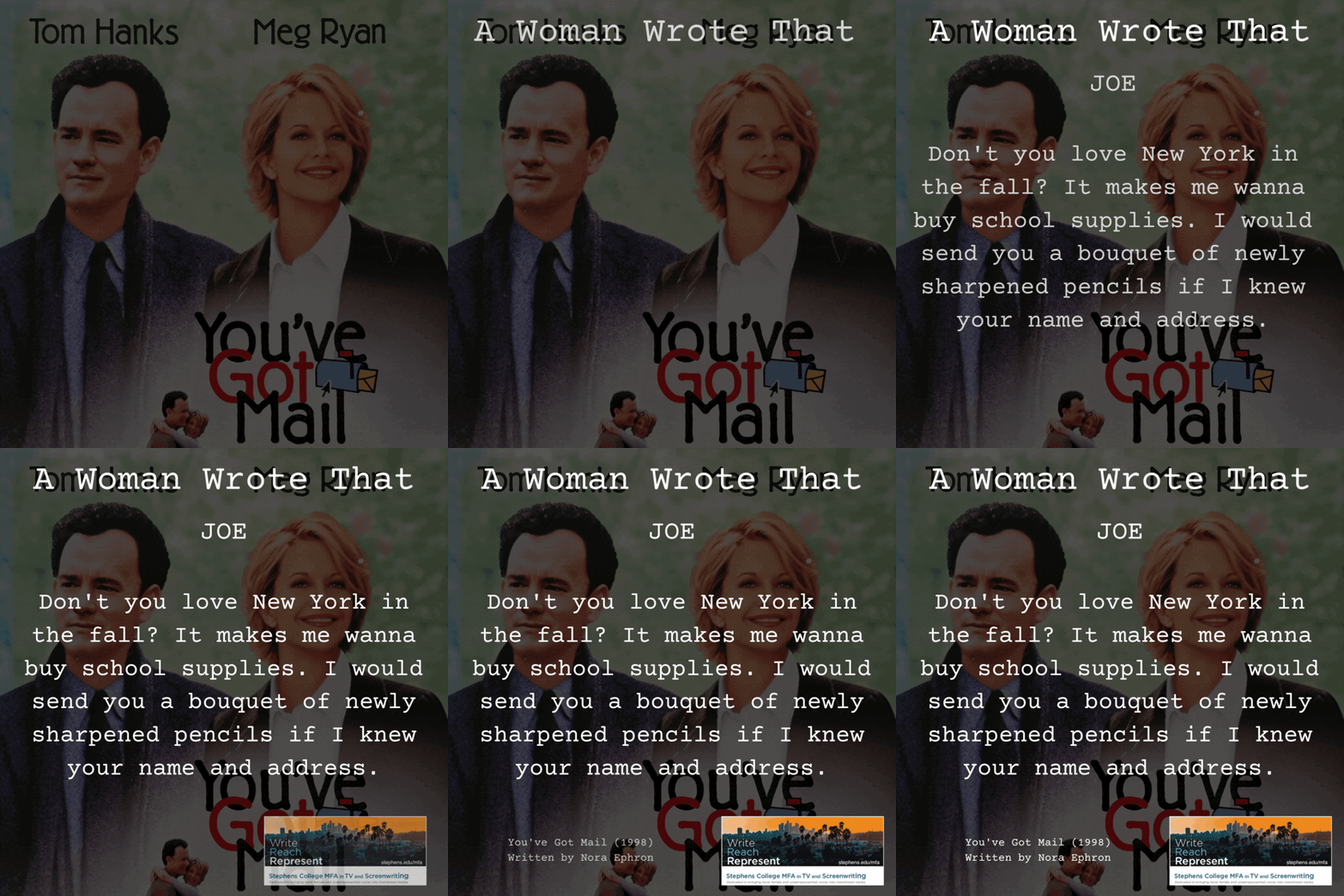
A Woman Wrote That – 29 in a series – You’ve Got Mail (1998), Writer: Nora Ephron

This new “A Woman Wrote That” post is an echo of the Writers Guild campaign of a few years ago (“A Writer Wrote That”) where they noted famous movie quotes and credited the screenwriter rather than the director.  The difference here being that we will be posting lines from films written by female screenwriters.  Feel free to share! — Rosanne

A Woman Wrote That - 29 in a series - You've Got Mail (1998), Writer: Nora Ephron

JOE


Don’t you love New York in the fall? It makes me wanna buy school supplies. I would send you a bouquet of newly sharpened pencils if I knew your name and address.

TikTok Response to comment from @itsmeimgarbage : Polly Platt [Video]

@drrosannewelch

Response to @itsmeimgarbage : Polly Platt ##screenwriting ##movies ##history ##women ##lastpictureshow ##film

♬ original sound – Dr. Rosanne Welch


TikTok Response to comment from @itsmeimgarbage : Polly Platt [Video]

A Woman Wrote That – 28 in a series – The Birdcage (1996), Witten by Elaine May

This new “A Woman Wrote That” post is an echo of the Writers Guild campaign of a few years ago (“A Writer Wrote That”) where they noted famous movie quotes and credited the screenwriter rather than the director.  The difference here being that we will be posting lines from films written by female screenwriters.  Feel free to share! — Rosanne

A Woman Wrote That - 28 in a series - The Birdcage (1996), Witten by Elaine May

ALBERT

There’s no need to get hysterical. All I have to remember is I can always get more toast.

Dorothy Parker: Born to be a Star of Poignant and Pointed Word Play, Dr. Rosanne Welch, Script magazine, May 2021

Dorothy Parker: Born to be a Star of Poignant and Pointed Word Play, Dr. Rosanne Welch, Script magazine, May 2021

Mention of the name “Dorothy Parker” conjures up thoughts of New York’s famed Algonquin Round Table and the lone woman (though Edna Ferber and Ruth Gordon often stopped by) trading quips with the greatest male writers of her day. Few know that Parker pounced on Hollywood, following in the footsteps of many those male writers looking for a quick – and hefty – payoff. Parker’s second husband Alan Campbell (who knew she was married?) had heard the call of the West but her name in their shared credits cinched those extra 000s on their shared studio checks.

The imbalance of fame in their marriage lead to one of Hollywood’s greatest stories, one that is remade in almost every generation. But Parker lived emotional experience gave the story its birth. If you’ve seen any of the myriad versions of A Star is Born I believe you have seen into Parker’s heart as much as if you’ve read any of her poetry or short stories. All these writings share a voice dripped in sarcastic wit and word play used as brain armor to combat an ever-present tide of melancholia and loneliness.\

Star originally focused on an up and coming actress (Janet Gaynor) who falls in love with a partner whose fame is on the wane. Remade in 1954 for an up and coming musical comedy performer (Judy Garland) it was reconfigured for a rock star (Barbara Streisand) in 1976 and a pop star (Lady Gaga) in 2018. All but the latest version share the tragic concept that society couldn’t condone a woman more successful than her man. Parker’s lived emotional experience encompassed more sadness than her marriage.

Born Dorothy Rothschild in New Jersey in 1893, her mother died when she was five years old. Her father raised her with the help of a stepmother Parker disliked. In her late teens Parker, who was even then witty, wrote what she characterized as ‘light verse’ that didn’t sell – until it did. Parker’s reputation as a writer grew from writing for The New Yorker and then publishing Enough Rope, a collection of poetry, in 1926.

Her first marriage failed after her husband returned from World War I. Her second ended in divorce, remarriage and then Campbell died of a drug over dose. Her career largely never wavered, moving from magazines to screenplays, including Saboteur for which Alfred Hitchcock courted her contributions and counted them as so important he offered her a shared cameo in the film.

You can find comments about how Parker and Campbell worked together in S.J.Perelman’s published letters or in reminiscences of prolific (and also married) screenwriters Frances Goodrich and Albert Hackett who had the office next door. It amounts to the idea that Dottie, as she was called by friends, did the bulk of the writing and character creation and Campbell did not. You’ll hear more about Goodrich next month! Meanwhile, it is hard to decide which cultural icon has become a more enduring and influential touchstone to the twentieth century – A Star is Born or Dorothy Parker.

Read Dorothy Parker: Born to be a Star of Poignant and Pointed Word Play on the Script web site


Read about more women from early Hollywood


A Woman Wrote That – 27 in a series – 10 Things I Hate About You (1999) Written by Karen McCullah & Kirsten Smith

This new “A Woman Wrote That” post is an echo of the Writers Guild campaign of a few years ago (“A Writer Wrote That”) where they noted famous movie quotes and credited the screenwriter rather than the director.  The difference here being that we will be posting lines from films written by female screenwriters.  Feel free to share! — Rosanne

A Woman Wrote That - 27 in a series - 10 Things I Hate About You (1999) Written by Karen McCullah & Kirsten Smith

KAT

But mostly I hate the way I don’t hate you. Not even close, not even a little bit, not even at all.