23 The importance of A Voice in the Room There And Back Again: Writing and Developing for American TV [Video]

23 The importance of A Voice in the Room There And Back Again: Writing and Developing for American TV [Video]

Thanks to the gracious invitation from my Screenwriting Research Network colleague Paolo Russo – and a grant he was able to procure (and in the before-Covid time) I was able to spend a week at Oxford Brookes University working with the screenwriting masters students in Paolo’s course. At the culmination of the week, I gave this lecture on how writers rooms worked in the States.

Transcript:

So, for instance, we were doing a story once about a young little girl. She was nine years old and she happened to be a young girl of color. She was lost at a park or something like that and you know the first thing that came to us — what do we do next in the story — well she’s gonna go find a policeman and the two African-American women in her room went “Oh no she’s not. My parents told me never to go to a policeman” and we were like but I was always told to find a policeman if I got lost somewhere. Yeah because you’re not a woman of color. So you can be safe with them. That was a whole new perspective, right? A perspective that I would not have had had I not had that other voice in the room.

Watch this entire presentation

Subscribe to Rosanne’s Channel and receive notice of each new video!


* A portion of each sale from Amazon.com directly supports our blogs
** Many of these books may be available from your local library. Check it out!
† Available from the LA Public Library

A Woman Wrote That – 27 in a series – 10 Things I Hate About You (1999) Written by Karen McCullah & Kirsten Smith

This new “A Woman Wrote That” post is an echo of the Writers Guild campaign of a few years ago (“A Writer Wrote That”) where they noted famous movie quotes and credited the screenwriter rather than the director.  The difference here being that we will be posting lines from films written by female screenwriters.  Feel free to share! — Rosanne

A Woman Wrote That - 27 in a series - 10 Things I Hate About You (1999) Written by Karen McCullah & Kirsten Smith

KAT

But mostly I hate the way I don’t hate you. Not even close, not even a little bit, not even at all.

Where’s Her Movie? Fashion Designer, Anne Lowe – 20 In A Series

“Where’s HER Movie” posts will highlight interesting and accomplished women from a variety of professional backgrounds who deserve to have movies written about them as much as all the male scientists, authors, performers, and geniuses have had written about them across the over 100 years of film.  This is our attempt to help write these women back into mainstream history.  — Rosanne

Where's Her Movie? Fashion Designer, Anne Lowe  - 20 In A Series

Ann Cole Lowe (December 14, 1898 – February 25, 1981) was an American fashion designer and the first African American to become a noted fashion designer.[1] Lowe’s one-of-a-kind designs were a favorite among high society matrons from the 1920s to the 1960s. She was best known for designing the ivory silk taffeta wedding dress worn by Jacqueline Bouvier when she married John F. Kennedy in 1953 — Wikipedia

22 People of Color and Television from There And Back Again: Writing and Developing for American TV [Video]

22 People of Color and Television from There And Back Again: Writing and Developing for American TV [Video]

Thanks to the gracious invitation from my Screenwriting Research Network colleague Paolo Russo – and a grant he was able to procure (and in the before-Covid time) I was able to spend a week at Oxford Brookes University working with the screenwriting masters students in Paolo’s course. At the culmination of the week, I gave this lecture on how writers rooms worked in the States.

Transcript:

Still, there’s something missing in writer’s rooms in America.

There’s some girls in that picture because it’s executive produced by a girl.

Missing something else. (Audience: people of color)People of color because you know they exist in the world.Isn’t that interesting but they were not yet existing on very many TV shows. Again a whole font of stories not being told — not being told correctly. On my show Touched by Angel we had we had two women of color and you have to remember that you only have experiences until you do research that come from your own life and that’s good and that’s a building block but it’s not everything right?

Watch this entire presentation

Subscribe to Rosanne’s Channel and receive notice of each new video!


* A portion of each sale from Amazon.com directly supports our blogs
** Many of these books may be available from your local library. Check it out!
† Available from the LA Public Library

From The Journal Of Screenwriting V4 Issue 3: The pleasure of immersion: Some thoughts on how The Singing Detective sustains narrative by Anne Karpf

Highlighting the articles in the past editions of the Journal of Screenwriting, of which I am the Book Reviews Editor. Hopefully these abstracts will entice you to did a little deeper into the history and future of screenwriting. — Rosanne


The pleasure of immersion: Some thoughts on how The Singing Detective sustains narrative by Anne Karpf

This article argues that while Dennis Potter’s television drama series The Singing Detective is commonly celebrated for its multi-layered narrative and the post-modern way that it played with genre, another of its critical features has remained relatively neglected: the sustained narrative pleasure that it afforded. It suggests that Potter allowed viewers the deep immersive experience of realist TV drama and storytelling, even while he was experimenting with narrative, so providing a bridge between modernist and traditional forms, and rewarding viewers (who had to try and integrate the series’ different fragments and layers into some sort of quasi-cohesive narrative) with abundant dramatic gratification. Narrative, it claims, is not effaced, only displaced, partly onto the central character of Marlow, whose subjectivity unifies the fragmented narrative. Potter broke radically with the conventions of TV medical drama, and the painful experience of Marlow-as-patient acts as another binding agent.

From The Journal Of Screenwriting V4 Issue 3: The pleasure of immersion: Some thoughts on how The Singing Detective sustains narrative by Anne Karpf


Journal of Screenwriting Cover

The Journal of Screenwriting is an international double-blind peer-reviewed journal that is published three times a year. The journal highlights current academic and professional thinking about the screenplay and intends to promote, stimulate and bring together current research and contemporary debates around the screenplay whilst encouraging groundbreaking research in an international arena. The journal is discursive, critical, rigorous and engages with issues in a dynamic and developing field, linking academic theory to screenwriting practice. 

Get your copy and subscription to the Journal of Screenwriting Today!


* A portion of each sale from Amazon.com directly supports our blogs
** Many of these books may be available from your local library. Check it out!

A Woman Wrote That – 26 in a series – Fleabag (2016), Writer, Phoebe Waller-Bridge

This new “A Woman Wrote That” post is an echo of the Writers Guild campaign of a few years ago (“A Writer Wrote That”) where they noted famous movie quotes and credited the screenwriter rather than the director.  The difference here being that we will be posting lines from films written by female screenwriters.  Feel free to share! — Rosanne

A Woman Wrote That - 26 in a series - Fleabag (2016), Writer, Phoebe Waller-Bridge

CLAIRE

The only person I’d run through an airport for is you.

Where’s Her Movie? Activist, Mary Church Terrell – 19 in a series

“Where’s HER Movie” posts will highlight interesting and accomplished women from a variety of professional backgrounds who deserve to have movies written about them as much as all the male scientists, authors, performers, and geniuses have had written about them across the over 100 years of film.  This is our attempt to help write these women back into mainstream history.  — Rosanne

Where's Her Movie? Activist, Mary Church Terrell  - 19 in a series

Mary Church Terrell (born Mary Eliza Church; September 23, 1863 – July 24, 1954) was one of the first African-American women to earn a college degree, and became known as a national activist for civil rights and suffrage.[1] She taught in the Latin Department at the M Street school (now known as Paul Laurence Dunbar High School)—the first African American public high school in the nation—in Washington, DC. In 1896, she was the first African-American woman in the United States to be appointed to the school board of a major city, serving in the District of Columbia until 1906. Terrell was a charter member of the National Association for the Advancement of Colored People (1909) and the Colored Women’s League of Washington (1894). She helped found the National Association of Colored Women (1896) and served as its first national president, and she was a founding member of the National Association of College Women (1910) Wikipedia

21 Buffy The Vampire Slayer from There And Back Again: Writing and Developing for American TV [Video]

21 Buffy The Vampire Slayer from There And Back Again: Writing and Developing for American TV [Video]

Thanks to the gracious invitation from my Screenwriting Research Network colleague Paolo Russo – and a grant he was able to procure (and in the before-Covid time) I was able to spend a week at Oxford Brookes University working with the screenwriting masters students in Paolo’s course. At the culmination of the week, I gave this lecture on how writers rooms worked in the States.

Transcript:

Now. Lack of women. Ta-Da. Buffy the Vampire Slayer. Thank god, although we’ve discovered in the states that Joss Whedon, who ran the show and got all kinds of points for being a feminist was, in fact, having sex with every other girl he could meet so apparently not such a feminist. His wife has now left him — ta-da — but I academically am going to interpret to you that the reason the program maintained its level of feminist theory was because of all the women who he hired in his writer’s room. So perhaps subconsciously he knew he was a jerk and he wasn’t going to interpret this right and he wanted to get a room full of people who could give him a real interpretation of what it was like to be a girl in high school who was othered — who was different in this way. So Buffy is a pretty breakthrough and I highly recommend that show

Watch this entire presentation

Subscribe to Rosanne’s Channel and receive notice of each new video!


* A portion of each sale from Amazon.com directly supports our blogs
** Many of these books may be available from your local library. Check it out!
† Available from the LA Public Library

From The Journal Of Screenwriting V4 Issue 3: Chaos, culture and fantasy: The television plays of Howard Schuman by Leah Panos

Highlighting the articles in the past editions of the Journal of Screenwriting, of which I am the Book Reviews Editor. Hopefully these abstracts will entice you to did a little deeper into the history and future of screenwriting. — Rosanne


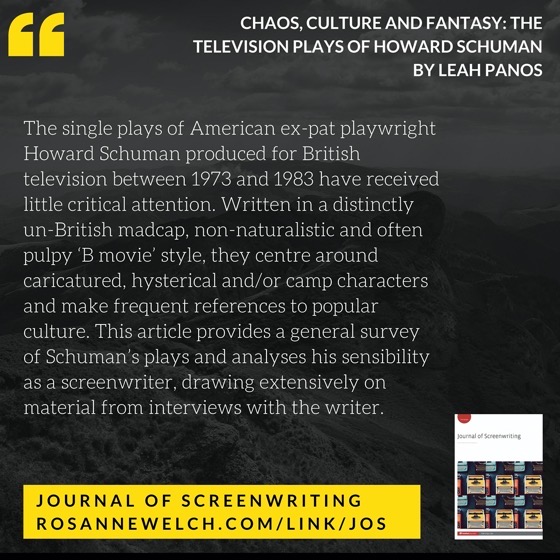
Chaos, culture and fantasy: The television plays of Howard Schuman by Leah Panos
 
The single plays of American ex-pat playwright Howard Schuman produced for British television between 1973 and 1983 have received little critical attention. Written in a distinctly un-British madcap, non-naturalistic and often pulpy ‘B movie’ style, they centre around caricatured, hysterical and/or camp characters and make frequent references to popular culture. This article provides a general survey of Schuman’s plays and analyses his sensibility as a screenwriter, drawing extensively on material from interviews with the writer. The article’s particular focus is how and why different cultural forms including music, film and theatre are used and referred to in Schuman’s plays, and how this conditions the plays’ narrative content and visual and aural form. It also considers the reception of Schuman’s plays and their status as non-naturalistic dramas that engage heavily with American pop culture, within the context of British drama. Finally, it explores the writer’s relationship to style and aesthetics, and considers how his written works have been enhanced through creative design decisions, comparing his directions (in one of his scripts) with the realized play to reflect on the use of key devices.

From The Journal Of Screenwriting V4 Issue 3: Chaos, culture and fantasy: The television plays of Howard Schuman by Leah Panos


Journal of Screenwriting Cover

The Journal of Screenwriting is an international double-blind peer-reviewed journal that is published three times a year. The journal highlights current academic and professional thinking about the screenplay and intends to promote, stimulate and bring together current research and contemporary debates around the screenplay whilst encouraging groundbreaking research in an international arena. The journal is discursive, critical, rigorous and engages with issues in a dynamic and developing field, linking academic theory to screenwriting practice. 

Get your copy and subscription to the Journal of Screenwriting Today!


* A portion of each sale from Amazon.com directly supports our blogs
** Many of these books may be available from your local library. Check it out!

Dr. Rosanne Welch Quoted in Bitch Media article on Women Screenwriters

Journalist Alexis Schwartz contacted me a few weeks ago to be interviewed for an article she was writing about female writers in Hollywood on the eve of hoping a woman would win this year’s Oscar for Best Screenplay.

Alexis noted, teenagers entering high school this fall would never have seen a female win in that category since the last win was 13 years ago (Diablo Cody for Juno).  Happily, Emerald Fennell did win – for Promising Young Woman. Then Chloe Zhao won for directing Nomadland.  Yet notice how in the Chloe Zhao descriptions no one calls her the writer-director of Nomadland even though she adapted the book. They only call her the director – though she did both important tasks on that now Academy Award-winning film.  So there is still much work to be done for writers to be recognized on an equal level.

We had so much fun talking and there was so much to say that it’s no surprise something got mixed up.  The initial published version of the story reported that Eve Unsell was Cecil B. deMille’s mother – but that was playwright, Broadway producer Beatrice deMille who had hired Unsell after reading one of her short stories and therefore began Unsell’s career as one of Hollywood’s earliest writer-producer-directors – and as the woman who taught Hitchcock how to direct.  Read the article to learn more.  And then read our book – When Women Wrote Hollywood – to learn more about the important work women have been doing since the founding of the film industry.

As Alexis and I noted during the interview – we really could talk about this all day – and look – how wonderful for both Fennel and Zhao to win that night.

Dr. Rosanne Welch

Emerald Fennell attends the 2020 Sundance Film Festival  Promising Young Woman premiere on January 25 2020 in Park City Utah header

A Woman Hasn’t Won a Writing Oscar in 13 Years. That Could Change on Sunday by Alexis Schwartz

The 2007 Academy Awards’ futuristic stage was adorned with three large pillars—some 25 feet in diameter—superficially holding up the Dolby Theatre. Within the stage’s center, an equally large Oscar statue loomed over the diminutive presenters like a god demanding hecatomb. Throughout the evening, celebrities weaved through the stage, including winners Alan Arkin, Helen Mirren, Forest Whitaker, and Martin Scorsese, the latter of whom’s cop-and-mob film The Departed (2006) would go on to win four statues that evening. But something happened in the middle-pack of the awards—more “popular” than sound editing, less “popular” than original score —an unsuspecting former exotic dancer and first-time screenwriter, Diablo Cody, won Best Original Screenplay for her freshman film, Juno.

[…]

Writers such as Jeanie MacPherson, who wrote most of the profitable films credited to director and Hollywood tycoon Cecil B. deMille, have been all but forgotten. Meanwhile, deMille is described as “a founder of the Hollywood motion-picture industry” and is the namesake for the Cecil B. deMille Award of Excellence presented annually at the Golden Globes. Paradoxically, deMille’s mother, Eve Unsell, who taught Alfred Hitchcock everything he knew was later regarded as an erasable footnote by Hitchock himself. She was left uncredited in his memoir—only to be known as “a middle-aged woman.” Even worse, these titans set a precedent by often discrediting writers’ work during interviews. This became standard practice—if the writer was mentioned at all. “The [director-ownership model] destroyed writers, even great men, like Preston Sturges [the first-ever winner of the Academy Award for Original Screenplay], had to become directors to protect their words and characters,” Rosanne Welch, PhD, screenwriting historian and former Beverly Hills 90210 writer says. “No one was safe.”

[…]

Read the entire article — A Woman Hasn’t Won a Writing Oscar in 13 Years. That Could Change on Sunday by Alexis Schwartz