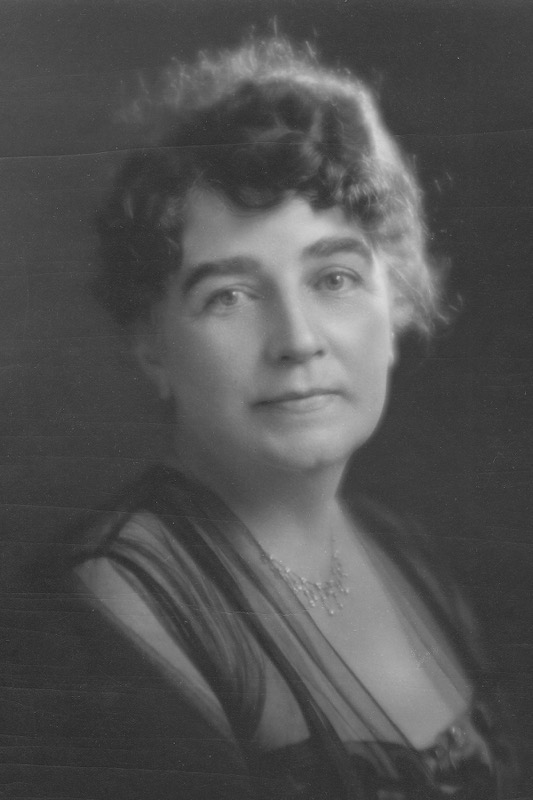
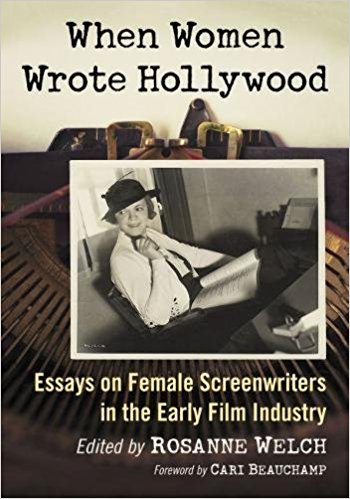
Though born in 1894 in Washington, D.C., the family business was theatre, not the politics of President Grover Cleveland’s administration. With an actor for a father – Henry Dupree Sinclair – the future Ruth Sinclair would also begin her career on the stage before turning to film, where she wrote for silent stars such as Lillian Gish, Greta Garbo, and Joan Crawford.
I had the chance to introduce the attendees to some wonderfully emotional monologues written by a few highly accomplished female television writers, from Susan Harris (on SOAP) to Linda Bloodworth Thomason (on Designing Women) to Maxine Alderton, who wrote a great monologue for the Jodie Whitaker Doctor in her episode “The Haunting of Villa Diadoti”. (Doing a bit of history by showing monologues from TV shows from the 1970s and 80s is one of my goals in our MFA – along with celebrating female screenwriters).
Then I introduced an exercise in writing monologues that involves Thornton Wilder’s Our Town as an inspiration. A few of the attendees shared what they wrote so we could all learn more about how the specificity we bring from our own lives makes our work more universal.
Thanks to Leslie Kreiner for inviting me to do a presentation on Monologues to a conference last year, which created the seed of this exercise. Thanks to Chris for the invitation to share it – and to all the attendees for… attending. Special thanks to those who shared what they wrote to help others see if this is an exercise they would like to incorporate into their teaching.
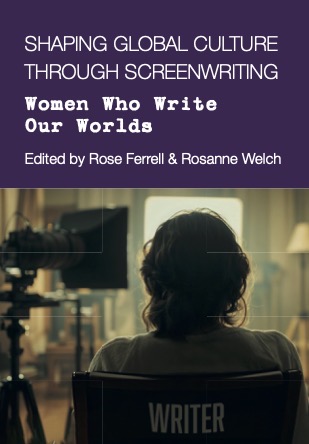
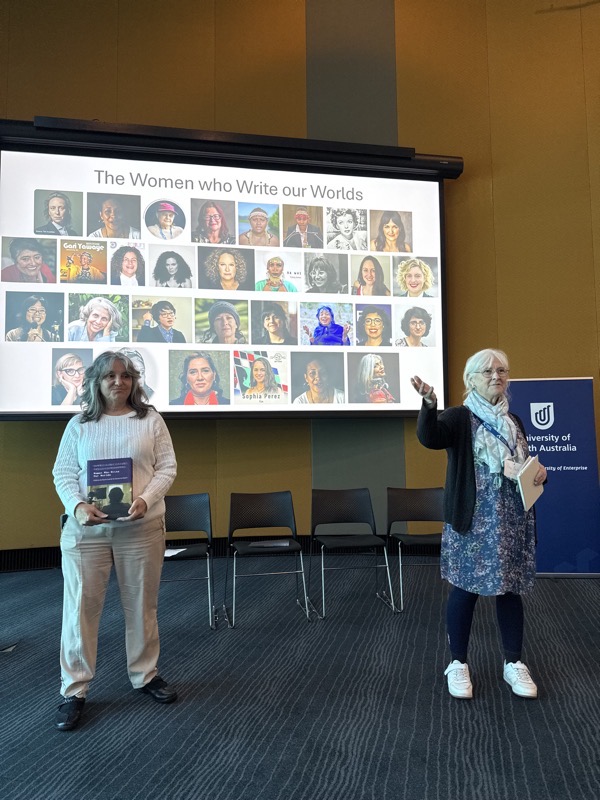
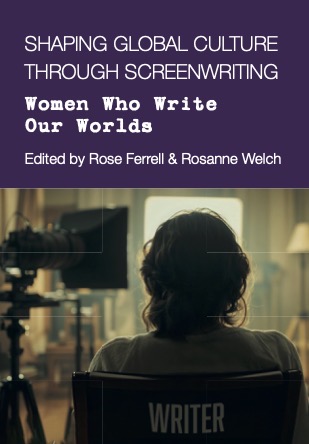
I was happy to discuss the inspiration for the book, which came from a conversation Rose and I had during a conference. That’s one of the best things about gathering for conferences – the casual conversations that create new collaborations.
I was also happy to discuss the way we arranged the book in “Worlds” because continents are the easiest classification. I give a quick thumbnail of one chapter in each of those Worlds to highlight what type of social or legal advocacy the screenwriter in discussion addressed. It was lovely to be reminded of all the interesting stories told by the writers of each chapter and to appreciate the cultural diversity of storytelling around the world that Intellect made possible by publishing the book.
Chapters cover a spectrum of storytelling from artists offering a window into how women around the world use the screen to advocate for social or legal change. For example, the Samoan performance artist Angela Tiatia, known for her 2014 work, ‘Walking the Wall.” Tiatia displays her Malu Tatau tattoo, which symbolizes the preservation and documentation of cultural practice and identity in online spaces.
One chapter focuses on a junior Pacific Islander lawyer who created a music video calling on the International Court of Justice to issue an advisory opinion on climate change, a matter of concern as rising sea levels threaten the homes and histories of island communities. Other readings in the book examine the film “Kajillionaire” by Miranda July as a platform for imagining queer utopias, the transformative power of the female gaze in the Italian documentary “Trial for Rape,” and the frequently ignored creative roles and contributions that women make behind the scenes of the beloved children’s television show “Bluey.”
It was a pleasure to make this presentation for my colleagues. I hope you enjoy it, too.
In the Silent Era, before the existence of the Hays Code (and largely a cause for it), many female screenwriters wrote heroines who flouted the brazen sexual freedom of the new century, a specialty of Josephine “Jo” Lovett. Born in October 1877 in San Francisco Lovett would spend some time as a lead actress on the Broadway stage before moving to Los Angeles to both act and write what were called scenarios for the bulk of her career.
Born on April 25, 1899 in St. Louis, Missouri to Alice Kern and Robert M. Yost, Dorothy moved to Los Angeles to work in the burgeoning film industry and clearly succeeded in that goal. By the time she died in 1967 Yost had written over 80 films and achieved what many other writers did not – thriving in both Silent Films and into the Sound Era. Interestingly, it was her foray into film that brought her journalist brother Robert Yost into the film industry after she found her footing there. Her first screenwriting credit came in 1920, his in 1935 after some years on the staff of local newspapers, as publicity director for Fox West Coast Studios and finally head of the scenario department for Fox.
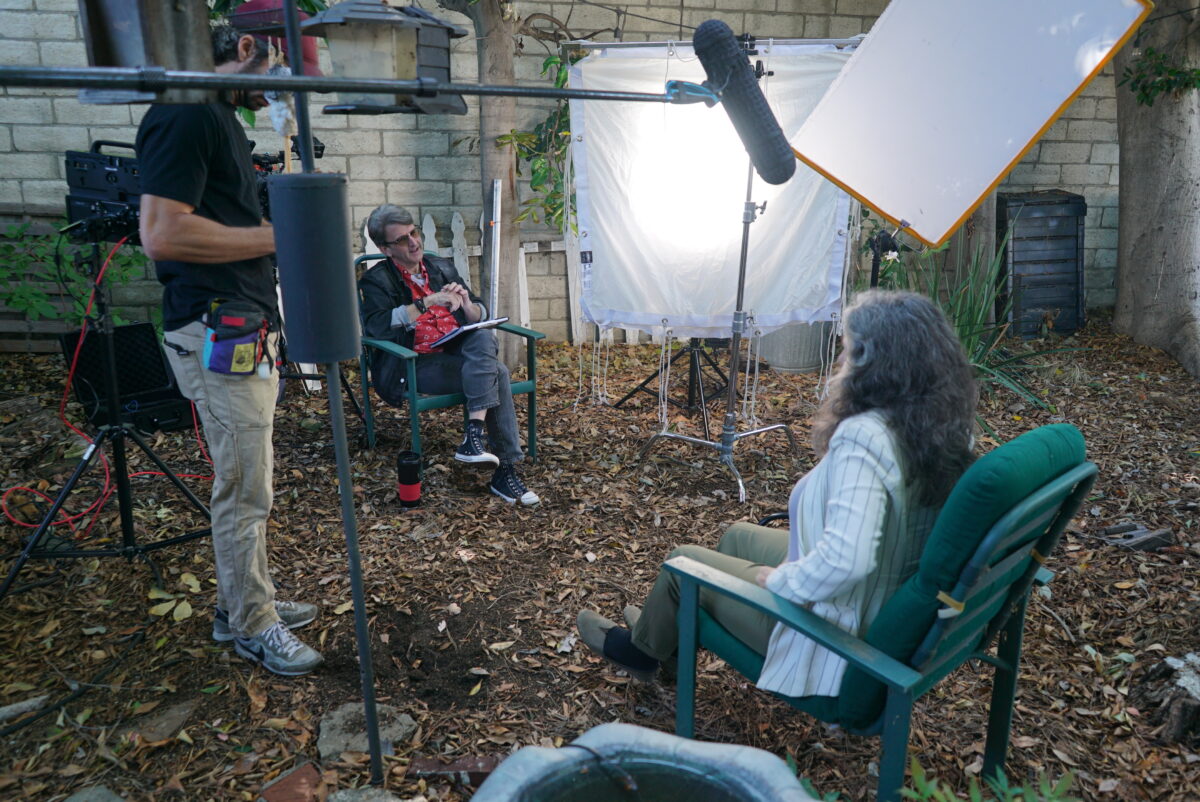
It’s the story of Pippa Latour, the last surviving female radio operator who was parachuted into occupied France to travel from hidden radio to hidden radio, sending back information to help the Allies land in Normandy on D-Day. She wasn’t going to tell her story until her sons convinced her it would help people understand those times and the ultimate sacrifice many other radio operators made.
As a Doctor Who fan it was cool to see Noor Inayat Khan mentioned as she appeared as a historic figure in the Jodie Whittaker era in “Spyfall, Part 2”, the 2nd episode of series 12. I mention Noor, in a lecture I’ve given about all the feminism show runner Chris Chibnall put into that era, including having the Doctor meet a strong collection of historic females: “She is Wise and Unafraid: Writing the 1st Female Doctor and a Diverse Universe for her to Protect”:
In September 1944 Noor was executed at the Dachau concentration camp along with fellow agents Yolande Beekman, Madeleine Damerment and Eliane Plewman – all women who had volunteered for these deeply dangerous missions. Reading books about female heroes is a great way to spend a rainy day – and find some more amazing stories that ought to be adapted into films or included in our other writing as often as possible!
“When Women Write What They Say, They Say So Much More: Powerful Actress-writer-producers Past, Present & Future”.
It covers writers like Emma Thompson, who adapted Jane Austen’s Sense and Sensibility, in which she starred as Eleanor, and Gertrude Berg, creator, writer, and star of The Goldbergs, and then everyone from Tina Fey to Issa Rae, to Mindy Kaling to Lena Waithe. This presentation discusses the way women writing their own characters, dialogue, and worlds into existence impacts the audience, the industry, and the way women are seen in society.
Now available to stream is our latest panel, “Unapologetically Herself: Writing Bold and Complex Young Women”. I always try to include one of our MFA alums who have gained spots on TV shows so this one has Alexandra Fernandez who has been on the writing staff of Station 19. Other panelists for this event were Karen Joseph Adcock (Yellowjackets), Beth Appel (The Sex Lives of College Girls), and Stephens alum!!, and Autumn Joy Jimerson (Forever).
Several past WGA panels have included such screenwriters as Marta Kauffman (Creator and Executive Producer of Grace and Frankie), Lucia Aniello (Co-Creator, Executive Producer, and Director of Hacks), Meg DeLoatch (Executive Producer of The Neighborhood and Family Reunion),Joan Rater (A Small Light); and Nia Vardalos (My Big Fat Greek Wedding – and sequels). You can check those out here on our Stephens College MFA in TV and Screenwriting website.