Months of research went into the creation of the essays in “When Women Wrote Hollywood.” Here are some of the resources used to enlighten today’s film lovers to the female pioneers who helped create it.
* A portion of each sale from Amazon.com directly supports our blogs
** Many of these books may be available from your local library. Check it out!
† Available from the LA Public Library
As you know I always LOVE talking television so when fellow Dr. Sarah Clark of Zilch Nation asked me a while back if I’d like to cohost an ongoing segment of Zilch where we analyze each of the 58 episodes of The Monkees — I jumped at the chance.
Even though I did a lot of this work in the book – I couldn’t cover all the episodes so this segment allows us to take one at a time and do our own critical studies and popular culture coverage.
Check out the current segment on the episode “Monkees in a Ghost Town” with all his homage to “Of Mice and Men”
Zilch! The Year in Review, Monkees News with Tim Powers & Christine Wolfe then “Monkees 101” does “Monkees in a Ghost Town” episode 7 of the series. See you next year!
A hit television show about a fictitious rock band, The Monkees (1966-1968) earned two Emmys–Outstanding Comedy Series and Outstanding Directorial Acheivement in Comedy.
Capitalizing on the show’s success, the actual band formed by the actors, at their peak, sold more albums than The Beatles and The Rolling Stones combined, and set the stage for other musical TV characters from The Partridge Family to Hannah Montana. In the late 1980s, the Monkees began a series of reunion tours that continued into their 50th anniversary.
This book tells the story of The Monkees and how the show changed television, introducing a new generation to the fourth-wall-breaking slapstick created by Laurel and Hardy and the Marx Brothers.
Its creators contributed to the innovative film and television of 1970s with projects like Bob & Carol & Ted & Alice, The Mary Tyler Moore Show, Laugh-In and Welcome Back, Kotter. Immense profits from the show, its music and its merchandising funded the producers’ move into films such as Head, Easy Riderand Five Easy Pieces.
Subscribe to Rosanne’s Channel and receive notice of each new video!
This one allowed me to riff on some of my favorite female science fiction writers across time, whether they be novelists or television writers. It also opened up a good conversation on what art we support and include in our lives – and what that art says to us and about us. — Rosanne
Transcript:
Likewise, she wrote many Buffy’s but one of the best is an episode called Earshot and Buffy’s all streaming for free on Facebook right now so you can watch. (Audience: I grew up watching that.) I Iove Buffy, I know. It’s really brilliantly written show. Earshot was a brilliant episode about Buffy who is the Vampire Slayer being cursed with the ability to hear what everyone is thinking — so mental telepathy and the problem is the cacophony in your head starts to make you crazy because if you can hear what everyone was thinking you couldn’t think your own thoughts and along the way — she’s in high school — she hears someone say “It doesn’t matter tomorrow by noon they’ll all be dead.” So now she knows she’s in a school with a shooter but who is it because she can’t pinpoint where the voice came from. So the whole episode is about trying to find the kid and of course, you trace the kid who looks the most bullied and seems to be the most stereotypically that kid. I’m not going to tell you you did it but — spoiler alert — it ain’t that kid right? So it’s really again excellently written episode using all the tropes of the era so Jane Espenson a pretty important writer.
* A portion of each sale from Amazon.com directly supports our blogs ** Many of these books may be available from your local library. Check it out!
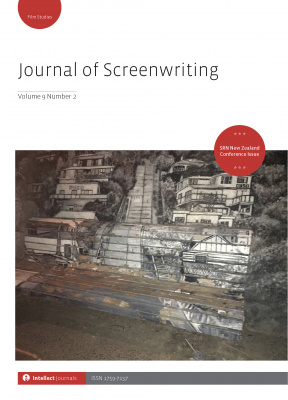
Highlighting the articles in the past editions of the Journal of Screenwriting, of which I am the Book Reviews Editor. Hopefully these abstracts will entice you to did a little deeper into the history and future of screenwriting. — Rosanne
This article analyses how eight successful English Canadian screenwriters negotiate various norms of screenwriting practice, in particular the criteria for three-act structure, character development and closure as advocated by Hollywood. The writers discuss their interpretations of what they consider essential narrative elements in screenplay projects, while dismissing other edicts of the screenwriting industry. Analysis of interview transcripts reveals that most of these writers take their inspiration from their own experience of screenwriting and their interpretations of other screenplays and historic texts on narrative rather than from contemporary screenwriting textbooks. The focus for almost all of these screenwriters is on writing screen stories in original ways, rather than adopting standardized narrative directives, even when elements of these directives have their uses.
The Journal of Screenwriting is an international double-blind peer-reviewed journal that is published three times a year. The journal highlights current academic and professional thinking about the screenplay and intends to promote, stimulate and bring together current research and contemporary debates around the screenplay whilst encouraging groundbreaking research in an international arena. The journal is discursive, critical, rigorous and engages with issues in a dynamic and developing field, linking academic theory to screenwriting practice.
Subscribe to Rosanne’s Channel and receive notice of each new video!
Transcript:
In Adam’s Rib they’re two lawyers who work on the opposite side of a case. In real life, she and her husband were equally famous writers. They shared a profession together at which they both excelled right? So that was exactly her experience and the kind of dialogue and language — the kind of attitude that comes from Katharine Hepburn and all her in all the films written by Ruth, that’s Ruth Gordon talking right? She’s the feminist we should think about. She was an early Broadway actress. Best friends of Thornton Wilder who wrote Our Town. He wrote the matchmaker for her which became — Hello Dolly — and when she was young her husband died. Her first husband died of disease when he was like 28 which was very sad and she ended up in a relationship with a famous producer — Broadway producer. They had a baby out of wedlock. She was supposed to have the baby adopted away because you weren’t supposed to tell people you had gotten pregnant and had sex outside of marriage but she kept it instead and everybody said “Well your acting career will be over!” and she said “Only if you say it’s over.” and she kept working. So she was breaking the societal rules that were trying to trap her all right? So she is who Katharine Hepburn is in those movies and we should pay more attention.
Dr. Rosanne Welch discusses the women in her new book “When Women Wrote Hollywood” which covers female screenwriters from the Silents through the early 1940s when women wrote over 50% of films and Frances Marion was the highest paid screenwriter (male or female) and the first to win 2 Oscars. Yet, she fails to appear in film history books, which continue to regurgitate the myth that male directors did it all – even though it’s been proven that the only profitable movies Cecil B. de Mille ever directed were all written by Jeannie Macpherson film ever won for Best Picture was written by Robert E. Sherwood (who people have heard of, mostly due to his connection to Dorothy Parker) and Joan Harrison.
* A portion of each sale from Amazon.com directly supports our blogs ** Many of these books may be available from your local library. Check it out! † Available from the LA Public Library
Dawn is an Emmy-nominated, award-winning writer. On television, Comer Jefferson wrote on the CBS family drama Judging Amy, served as writer/consulting producer on MTV’s teen drama, South of Nowhere, freelanced on the CBS hit NCIS, and developed a drama pilot at NBC Universal Studios. She was nominated for an Emmy for writing the Fox-animated family film, Our Friend, Martin, and for the last nine years has written Emmy-winning arts programming for PBS, performed at the Walt Disney Concert Hall and the Dorothy Chandler Pavilion.
As a non-fiction writer, Comer Jefferson has written about children, families and public policy issues for national print and online media including Garnet News, Working Mother, Fit Pregnancy Magazine and MomsRising, and her essays have been featured in the anthologies A Woman Alone (Seal Press) and Go Girl (Eighth Mountain Press). She adapted, produced and directed the eight-part NPR radio series adaptation of the biography Maggie’s American Dream, co-wrote the nonfiction book Three Ring Circus: How Real Couples Balance Marriage, Work, and Family, and the African American historical children’s fiction, The Promise.
Wherever you go, you find Monkees fans and the Denver Popular Culture Con was no different. Amid rooms full of caped crusaders and cosplay creations, I was initially not sure how many folks would attend a talk on a TV show from the 1960s – but happily I was met by a nice, engaged audience for my talk on Why the Monkees Matter – and afterward they bought books! What more could an author ask for?
Subscribe to Rosanne’s Channel and receive notice of each new video!
Transcript
This is Micky with who? I mean Davy with who? (Audience: Sissy Spacek?) Close. Sally Field. Sally Field of Gidget fame at that time Gidget had been on the season before. She’s going to move into the Flying Nun right after that. This is Micky with his wife , Samantha Just. This is Davy with his first wife and then this is Nesmith with his first wife Phyllis and their son. So they’re all over these magazines so they’re beginning to sell things outside of the television show. So the program is very important commercially. It’s making money for a lot of people. They do commercials on the show right? Sponsorships. Look at me. I’m eating Rice Krispies. Sure. Maybe. I don’t know. but they’re that you could get an album off the back of your cereal box and it would actually play on a record player which is pretty cool and if you go to like antique stores and whatnot now people sell this stuff for way too much money, when that that was free but again a great way to show the value — the commercial value — program.
A hit television show about a fictitious rock band, The Monkees (1966-1968) earned two Emmys–Outstanding Comedy Series and Outstanding Directorial Acheivement in Comedy.
Capitalizing on the show’s success, the actual band formed by the actors, at their peak, sold more albums than The Beatles and The Rolling Stones combined, and set the stage for other musical TV characters from The Partridge Family to Hannah Montana. In the late 1980s, the Monkees began a series of reunion tours that continued into their 50th anniversary.
This book tells the story of The Monkees and how the show changed television, introducing a new generation to the fourth-wall-breaking slapstick created by Laurel and Hardy and the Marx Brothers.
Its creators contributed to the innovative film and television of 1970s with projects like Bob & Carol & Ted & Alice, The Mary Tyler Moore Show, Laugh-In and Welcome Back, Kotter. Immense profits from the show, its music and its merchandising funded the producers’ move into films such as Head, Easy Riderand Five Easy Pieces.
Months of research went into the creation of the essays in “When Women Wrote Hollywood.” Here are some of the resources used to enlighten today’s film lovers to the female pioneers who helped create it.
* A portion of each sale from Amazon.com directly supports our blogs
** Many of these books may be available from your local library. Check it out!
† Available from the LA Public Library
Subscribe to Rosanne’s Channel and receive notice of each new video!
This one allowed me to riff on some of my favorite female science fiction writers across time, whether they be novelists or television writers. It also opened up a good conversation on what art we support and include in our lives – and what that art says to us and about us. — Rosanne
Transcript:
This lady I love. Jane Espenson. She got her start in Star Trek. Many women writers in television were first given a script on some version of Star Trek whether it was Deep Space 9 or The Next Generation. She’s been around a long time. She also worked on Buffy which is one of my favorite shows which is really particularly well-written. She created Warehouse 13 which I thought was an adorable show and a great interesting premise about all the objects in the world that were alien objects and when they passed through history they were hidden in a big warehouse. If they got stolen, people could take the powers of early people because they were inside the object. So, you know, Marilyn Monroe’s hairbrush made you sexy because it turned you into a platinum blonde and we couldn’t put that out in the world because there’d be way too much of that going on. Really cute interesting stuff. Of course, she also wrote the Battlestar Galactica. She wrote one of the best episodes of Once Upon A Time. It was called Red-Handed and it has to do with the real story of Red Riding Hood and werewolves and how those two stories converge and it’s just so brilliantly and it uses our biases about gender and power against us to not predict where it’s going. So it’s a really lovely interesting piece of writing. I think is in the third season.
* A portion of each sale from Amazon.com directly supports our blogs ** Many of these books may be available from your local library. Check it out!
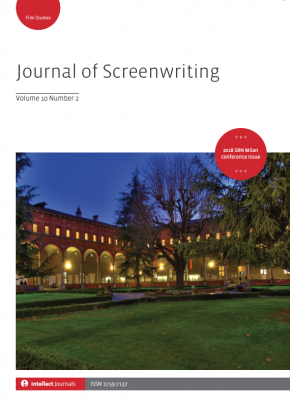
Highlighting the articles in the past editions of the Journal of Screenwriting, of which I am the Book Reviews Editor. Hopefully these abstracts will entice you to did a little deeper into the history and future of screenwriting. — Rosanne
The machinations of industry, the exigencies of film funding and the producer’s prominent role in setting fiscal and marketing objectives for film production seem incongruous with scriptwriting as a generative creative practice in the filmmaking process. This article presents a case study that investigates the agency of creative practice from the insider perspective of a scriptwriter. In mobilizing the concept of the boundary object, the case links the problematic and transitional status of the script – as it passes out of the hands of the writer – to other roles under the control of filmmaking practitioners. In combining a practice-based reflexive narrative with theoretical observations, the article explores the processes and imperatives that mediate the script and scriptwriting as an embodied experience for the scriptwriter.
The Journal of Screenwriting is an international double-blind peer-reviewed journal that is published three times a year. The journal highlights current academic and professional thinking about the screenplay and intends to promote, stimulate and bring together current research and contemporary debates around the screenplay whilst encouraging groundbreaking research in an international arena. The journal is discursive, critical, rigorous and engages with issues in a dynamic and developing field, linking academic theory to screenwriting practice.
![Drs. Rosanne Welch and Sarah Clark discuss “Monkees in a Ghost Town” on the Zilch Podcast’s Monkees 101 Series [Audio]](https://rosannewelch.com/wp-content/uploads/2019/12/zilch-148-1.jpg)


![30 More On Jane Espenson from The Sisterhood of Science Fiction – Dr. Rosanne Welch [Video] (58 seconds)](https://rosannewelch.com/wp-content/uploads/2019/12/scifi-rmw-cpp-30.jpeg)
![32 Adam’s Rib and Ruth Gordon from “When Women Wrote Hollywood” with Dr. Rosanne Welch [Video] (1 minute 7 seconds)](https://rosannewelch.com/wp-content/uploads/2019/12/csuf-rmw-w3h-32.jpeg)

![17 Commercial Value and The Monkees from “Why The Monkees Matter: Even 50 Years Later [Video] (1 minute)](https://rosannewelch.com/wp-content/uploads/2019/12/monkees-popcon-2019-17.jpeg)

![29 Jane Espenson from The Sisterhood of Science Fiction – Dr. Rosanne Welch [Video] (1 minute 15 seconds)](https://rosannewelch.com/wp-content/uploads/2019/12/scifi-rmw-cpp-29.jpeg)