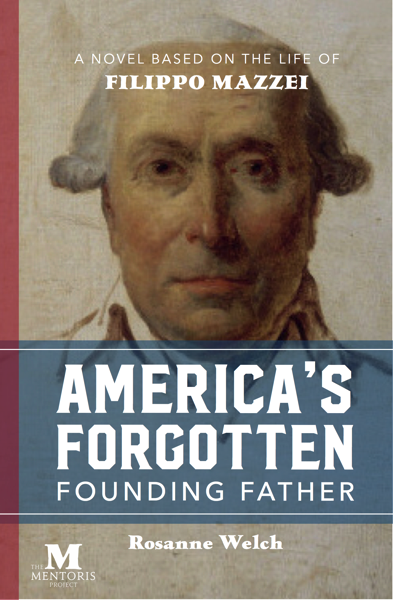
The friendship that was to last a lifetime began as the Adams’ carriages rode up the grand driveway of Monticello and Filippo saw at a glance how much Jefferson esteemed all things Italian. The neoclassical design of the main home came from principles described by Italian Renaissance architect Andrea Palladio.
Many thanks to the essay contributors who joined us and spoke so eloquently about the women writers they had researched: Toni Anita Hull, Laura Kirk, Amelia Phillips, Sarah Phillips, Julie Berkobien, Khanisha Foster, Lauren Smith, and to Cari Beauchamp, who wrote the Forward to the collection.
* A portion of each sale from Amazon.com directly supports our blogs ** Many of these books may be available from your local library. Check it out! † Available from the LA Public Library
A multi-faceted personality of the European Enlightenment and American Independence, Filippo Mazzei (1730-1816) retraces his wanderings between the Old and the New Worlds in his Memorie, written from 1810 to 1813. This paper argues that the apparent lack of theoretical depth and rhetorical strength of Mazzei’s Memorie represents rather the narrator’s ironic, pragmatic strategy of resistance to various forms of censorship, which he experienced in particular through his interactions with the Tribunal of the Inquisition. We will examine two specific episodes of the Memorie through the lens of Wilhelm Dilthey’s philosophical notion of Erlebnis or ‘lived experience.’ From the perspective of Erlebnis and the inherent interrelation between lived experience, understanding and expression articulated in Dilthey’s The Formation of the Historical World in the Human Sciences of 1910, Mazzei’s autobiographical narrative emerges as a hermeneutic strategy of resistance that weaves together History and histories, universality and individuality.
In honor of the launch of our book of essays – When Women Wrote Hollywood – Jake Flynn, Communications Director for Councilmember Bob Blumenfield presented us this Certificate of Recognition from the Los Angeles City Council for “bringing students from throughout the country to Los Angeles and pairing them with mentors in the heart of the entertainment business…
The flexibility of the program allows for a diverse student body which in turn promotes the telling of stories that have not been heard before.” One certificate will return home to Stephens College with Dean Gail Humphries Mardirosian, who flew out to attend the launch, and the other two will stay with Ken and I here in Los Angeles.
Many thanks to the essay contributors who joined us and spoke so eloquently about the women writers they had researched: Toni Anita Hull, Laura Kirk, Amelia Phillips, Sarah Phillips, Julie Berkobien, Khanisha Foster, Lauren Smith, and to Cari Beauchamp, who wrote the Forward to the collection.
* A portion of each sale from Amazon.com directly supports our blogs ** Many of these books may be available from your local library. Check it out! † Available from the LA Public Library
For her 5th Doctor Who lecture to the CPP community, Dr. Rosanne Welch discusses how society – and the show’s writing staff – prepared the audience for a major change in this 50-year franchise – the creation of the first Lady Doctor!
Transcript:
Then we had Nyssa who I really enjoyed. Nyssa came in with the Peter Davison era with Teegan — who’s alright. Teegan has her moments. But Nyssa is an alien, super intelligent from her alien race and at the end of her time with The Doctor — thy end up on a planet where there’s a leper colony and nobody is taking care of these people and rather than — again — continuing to travel with The Doctor she chooses to stay and be a caregiver to these people. She’s a doctor so she can take care of them and imagines that she will find a cure for this if she stays behind and he’s like “well maybe this will never be cured” and she’s like “it won’t ever be cured if no one tries.” So she’s willing to give it that time which I think is a beautiful strength being evidenced by a female character. Not that hard.
Rosanne Welch PhD teaches the History of Screenwriting and One-Hour Drama for the Stephens College MFA in Screenwriting.
Writing/producing credits include Beverly Hills 90210, Picket Fences, ABCNEWS: Nightline and Touched by an Angel. In 2016 she published the book Why The Monkees Matter: Teenagers, Television and American Pop; co-edited Women in American History: A Social, Political, and Cultural Encyclopedia; and placed “Transmitting Culture Transnationally Via the Characterization of Parents in Police Procedurals” in the New Review of Film and Television Studies. Essays appear in Torchwood Declassified: Investigating Mainstream Cult Television and Doctor Who and Race: An Anthology. Welch serves as Book Reviews editor for Journal of Screenwriting and on the Editorial Advisory Board for Written By magazine, the magazine of the Writers Guild.
“A collection of herstories about how these women lived, loved and created the stories that gave their audiences reasons to live and love in their own lives.”
* A portion of each sale from Amazon.com directly supports our blogs ** Many of these books may be available from your local library. Check it out! † Available from the LA Public Library
This is a low-residency program where most of the work is done online but each cohort (1st year and 2nd year) comes to LA twice each year and meets for 10 days of intense workshops and research at the Jim Henson Studio (originally the Chaplin Studio) in the heart of Hollywood.
This week is the first workshop for our new class of 2020.
* A portion of each sale from Amazon.com directly supports our blogs ** Many of these books may be available from your local library. Check it out! † Available from the LA Public Library
Early 1960s television characters came in a one-size-fits-all, squeaky-clean-cut style, from Dr. Kildare in his white lab coat, to Hoss Cartwright in his white Stetson, to Sr. Bertrille in her white habit. That lasted until 7:30 p.m. Monday, September 12, 1966 when four long-haired teenagers began dancing a Monkeewalk while singing, “Hey, Hey, We’re the Monkees.”
Though it looked simple enough, the comedy was about more than four struggling musicians living in a beach house they couldn’t afford, without adult supervision, and hoping for success while engaging in Marx(Bros)ian humor. According to star Micky Dolenz, the only actor with previous television series experience: “It brought long hair into the living room and changed the way teenagers were portrayed on television.”
Dolenz’s opinion is backed up by psychologist and author Timothy Leary in The Politics of Ecstasy: “While it lasted, it was a classic Sufi[ism] put-on. An early-Christian electronic satire. A mystic magic show. A jolly Buddha laugh at hypocrisy. And woven into the fast-moving psychedelic stream of action were the prophetic, holy, challenging words. Micky was rapping quickly, dropping literary names, making scholarly references.”
* A portion of each sale from Amazon.com directly supports our blogs ** Many of these books may be available from your local library. Check it out! † Available from the LA Public Library
All of the callers shared Filippo’s enthusiasm for the making – and drinking – of wine, knowing that in 1768, Virginians exported from Britain a little more than thirteen tons of wine from overseas, and another 78,264 from other North American colonies. But a few warned him that Virginia soil had been tried and so far unproven to be suitable.
For her 5th Doctor Who lecture to the CPP community, Dr. Rosanne Welch discusses how society – and the show’s writing staff – prepared the audience for a major change in this 50-year franchise – the creation of the first Lady Doctor!
Transcript:
Sarah Jane is one of my favorite companions. She’s come from the old Who to new Who and then she even had her own program The Sarah Jane Adventures. So what happened was she came into the Third Doctor’s life. She was an investigative reporter so she wasn’t some girl who did nothing and she wasn’t just reporting on fashion and/or celebrities. She was an investigative reporter. She looked for things that were wrong in her society and she highlighted that with being her newspaper writer. So that’s how she came to meet The Doctor. She traveled with him through Tom Baker obviously. Then she left and returned in an episode called School Reunion with David Tennant. So in the new Who era and at that time, of course, time had passed and she was invited to continue traveling and she had the strength and the intelligence to say No. I need to move on with my life. I’ve been thinking of you for too long. I need to have my own life.
Rosanne Welch PhD teaches the History of Screenwriting and One-Hour Drama for the Stephens College MFA in Screenwriting.
Writing/producing credits include Beverly Hills 90210, Picket Fences, ABCNEWS: Nightline and Touched by an Angel. In 2016 she published the book Why The Monkees Matter: Teenagers, Television and American Pop; co-edited Women in American History: A Social, Political, and Cultural Encyclopedia; and placed “Transmitting Culture Transnationally Via the Characterization of Parents in Police Procedurals” in the New Review of Film and Television Studies. Essays appear in Torchwood Declassified: Investigating Mainstream Cult Television and Doctor Who and Race: An Anthology. Welch serves as Book Reviews editor for Journal of Screenwriting and on the Editorial Advisory Board for Written By magazine, the magazine of the Writers Guild.



![When Women Wrote Hollywood Book Launch Event – August 11, 2018 [Photos]](https://rosannewelch.com/wp-content/uploads/2018/08/stephens-w3h-presentation.jpg)
![24 Nyssa from Gender Diversity in the Who-niverse [Video] (0:42)](https://rosannewelch.com/wp-content/uploads/2018/08/gender-dw-24-nyssa.jpeg)


 †
†


![23 Sarah Jane Smith from Gender Diversity in the Who-niverse [Video] (0:54)](https://rosannewelch.com/wp-content/uploads/2018/08/gender-dw-23-sarah-jane-smith.jpeg)