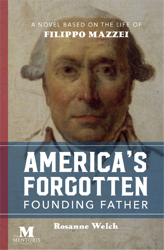
Quote from “America’s Forgotten Founding Father” by Dr. Rosanne Welch – 20 in a series – Come invent a new world with us

Quote from

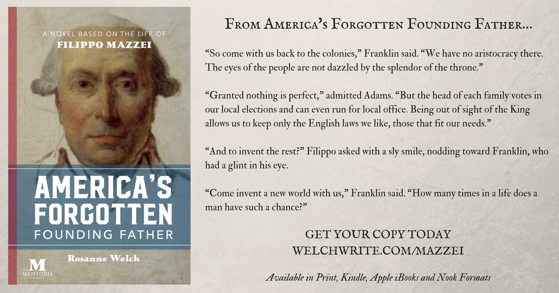
“So come with us back to the colonies,” Franklin said. “We have no aristocracy there. The eyes of the people are not dazzled by the splendor of the throne.”

“Granted nothing is perfect,” admitted Adams. “But the head of each family votes in our local elections and can even run for local office. Being out of sight of the King allows us to keep only the English laws we like, those that fit our needs.”

“And to invent the rest?” Filippo asked with a sly smile, nodding toward Franklin, who had a glint in his eye.

“Come invent a new world with us,” Franklin said. “How many times in a life does a man have such a chance?”

 From America’s Forgotten Founding Father — Get Your Copy Today!


Join the Rosanne Welch Mailing List for future book and event announcements!
 

Order an autographed copy of America’s Forgotten Founding Father

Print Edition | Kindle Edition | Apple iBooks Edition | Nook Edition

Want to use this book in your classroom? Contact the Mentoris Project!

More on Mazzei: The Domestic Life of Thomas Jefferson – Letters to Mazzei

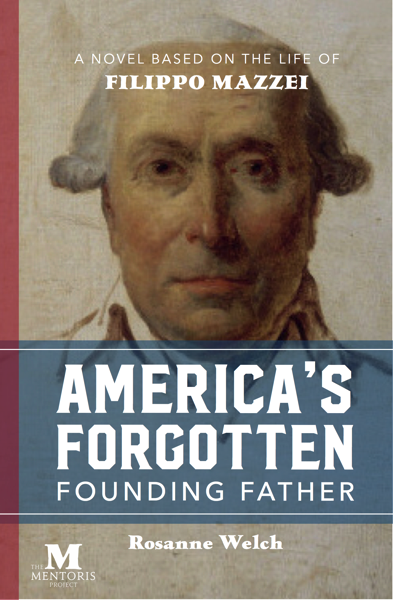
Mazzei cover small 2This series will focus on material I found while researching my book, America’s Forgotten Founding Father: A Novel Based on the Life of Filippo Mazzei.

While I only used a portion of my total research, there are a host of little tidbits of information on this amazing man which I wanted to share here. — Rosanne.


Mazzei gets a couple of mentions in this book, available FREE from Gutenber.org in Text, ePub and web editions. Open the book and search on Mazzei to find the mentions. — Rosanne

More on Mazzei: The Domestic Life of Thomas Jefferson – Letters to Mazzei

More on Mazzei: The Domestic Life of Thomas Jefferson - Letters to Mazzei

I do not in this volume write of Jefferson either as of the great man or as of the statesman. My object is only to give a faithful picture of him as he was in private life—to show that he was, as I have been taught to think of him by those who knew and loved him best, a beautiful domestic character. With this view I have collected the reminiscences of him which have been written by his daughter and grandchildren. From his correspondence, published and unpublished, I have culled his family letters, and here reproduce them as being the most faithful witnesses of the warmth of his affections, the elevation of his character, and the scrupulous fidelity with which he discharged the duties of every relation in life.

I am well aware that the tale of Jefferson’s life, both public and private, has been well told by the most faithful of biographers in “Randall’s Life of Jefferson,” and that much of what is contained in these pages will be found in that admirable work, which, from the author’s zealous devotion to truth, and his indefatigable industry in collecting his materials, must ever stand chief among the most valuable contributions to American history. I propose, however, to give a sketch of Jefferson’s private life in a briefer form than it can be found in either the thirteen volumes of the two editions of his published correspondence, or in the three stout octavo volumes of his Life by Randall. To give a bird’s-eye view of his whole career,[viii] and to preserve unbroken the thread of this narrative, I quote freely from his Memoir, and from such of his letters as cast any light upon the subject, filling up the blanks with my own pen.

Jefferson’s executor having a few months ago recovered from the United States Government his family letters and private papers, which had been exempted from the sale of his public manuscripts, I am enabled to give in these pages many interesting letters never before published.

No man’s private character has been more foully assailed than Jefferson’s, and none so wantonly exposed to the public gaze, nor more fully vindicated. I shall be more than rewarded for my labors should I succeed in imparting to my readers a tithe of that esteem and veneration which I have been taught to feel for him by the person with whom he was most intimate during life—the grandson who, as a boy, played upon his knee, and, as a man, was, as he himself spoke of him, “the staff” of his old age.

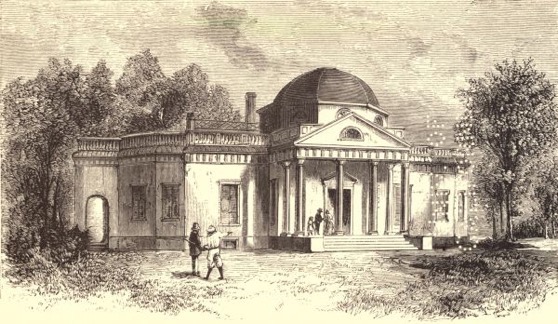
The portrait of Jefferson is from a painting by Gilbert Stuart, in the possession of his family, and by them considered as the best likeness of him. The portrait of his daughter, Martha Jefferson Randolph, is from a painting by Sully. The view of Monticello represents the home of Jefferson as it existed during his lifetime, and not as it now is—a ruin.
More on Mazzei: The Domestic Life of Thomas Jefferson - Letters to Mazzei


Join the Rosanne Welch Mailing List for future book and event announcements!
 

Order an autographed copy of America’s Forgotten Founding Father

Print Edition | Kindle Edition | Apple iBooks Edition | Nook Edition

Want to use this book in your classroom? Contact the Mentoris Project!
20 More Preparations For A Lady Doctor for Lady Doctor from Gender Diversity in the Who-niverse [Video] (1:04)

Watch this entire presentation: Gender Diversity in the Who-niverse: Paving the Way for a Lady Doctor with Dr. Rosanne Welch [Video] (36:58)

20 More Preparations For A Lady Doctor for Lady Doctor from Gender Diversity in the Who-niverse

For her 5th Doctor Who lecture to the CPP community, Dr. Rosanne Welch discusses how society – and the show’s writing staff – prepared the audience for a major change in this 50-year franchise – the creation of the first Lady Doctor!

Transcript:

Then he wrote this lovely short piece called “Night of the Doctor” which blended the movie — that was not very good, back in the day — with the modern story and again gave us the concept that regeneration could change your gender. So they’ve been laying the groundwork. They had to warm us up to get us ready for this and it’s all the writers that did that work. Then, Chris Chibnall took over as I said as Moffat retired and I love what David Tennant said. He really thinks Chris is going to do a good job and I tend to agree because I love the work that Chris Chibnall has done in the past, soi am looking forward to what he might do with this character and he’s the guy who had the guts to say “I’m going to be the one who changes. I’m going to make the full change.” So that’s a big deal. When Jody was chosen, she knew there was some controversy — people back and forth on the idea — turns out it’s about 80 Pro/20% against it so the against people always get the bigger voices. So we have to be louder than them and make sure the show gets really good ratings to prove its a good idea to have switched it into a girl. So we have to have viewing parties on opening night, right. Write about it on your blogs and Twitter and all that.

Follow Dr. Welch on Twitter and Instagram
https://twitter.com/rosannewelchhttp://instagram.com/drrosannewelch


Rosanne Welch, PhD

Rosanne Welch PhD teaches the History of Screenwriting and One-Hour Drama for the Stephens College MFA in Screenwriting.

Writing/producing credits include Beverly Hills 90210, Picket Fences, ABCNEWS: Nightline and Touched by an Angel. In 2016 she published the book Why The Monkees Matter: Teenagers, Television and American Pop; co-edited Women in American History: A Social, Political, and Cultural Encyclopedia; and placed “Transmitting Culture Transnationally Via the Characterization of Parents in Police Procedurals” in the New Review of Film and Television Studies. Essays appear in Torchwood Declassified: Investigating Mainstream Cult Television and Doctor Who and Race: An Anthology. Welch serves as Book Reviews editor for Journal of Screenwriting and on the Editorial Advisory Board for Written By magazine, the magazine of the Writers Guild.

Watch Dr. Welch’s talk “The Importance of Having a Female Voice in the Room” at the 2016 TEDxCPP.

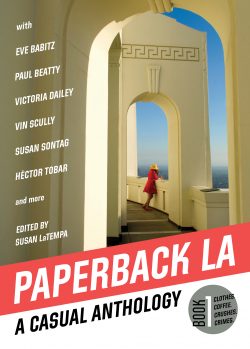
Paperback LA is Reprinting The Monkees Article that Started it All!

Paperback LA is Reprinting The Monkees Article that Started it All!

I was so proud to receive a request from Susan La Tempa, editor of the new Paperback L.A about reprinting my first article, Hey, Hey, They Wrote The Monkees!, on the writers of The Monkees, which I had done for Written By magazine in 2012.

Her new anthology covers life in LA and she found both the lives of writers AND, of course, the existence of The Monkees to be iconic to Los Angeles. 

Check out her first book in the series:  Book 1, A Casual Anthology: Clothes. Coffee. Crushes. Crimes

And look out for the announcement when the issue containing “Hey, Hey, They Wrote The Monkees!” publishes!


 Why The Monkees Matter: Teenagers, Television and American Pop Culture


McFarland (Direct from Publisher) | Amazon | Kindle Edition | Nook Edition

Want to use “Why The Monkees Matter” in your classroom?

Order Examination Copies, Library and Campus Bookstore orders directly from McFarland

McFarland Company logo

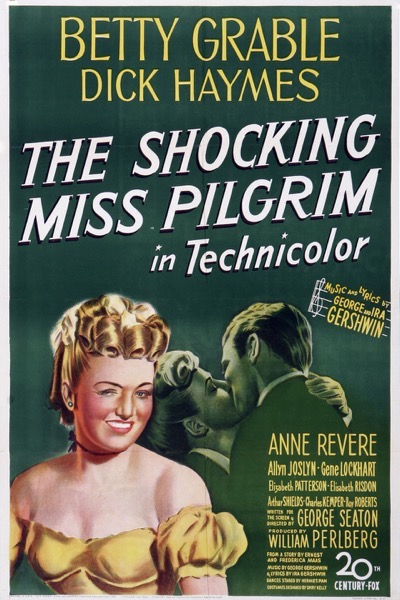
When Women Wrote Hollywood – 11 in a series – The Shocking Miss Pilgrim (1947), Story: Frederica Sagor Maas

To highlight the wonderful yet largely forgotten work of a collection of female screenwriters from the early years of Hollywood (and as a companion to the book, When Women Wrote Hollywood) we will be posting quick bits about the many films they wrote along with links to further information and clips from their works which are still accessible online. Take a few moments once or twice a week to become familiar with their names and their stories. I think you’ll be surprised at how much bold material these writers tackled at the birth of this new medium. — Rosanne Welch

When Women Wrote Hollywood – 11 in a series – The Shocking Miss Pilgrim (1947), Story: Frederica Sagor Maas

When Women Wrote Hollywood - 11 in a series - The Shocking Miss Pilgrim (1947), Wr: Frederica Sagor Maas

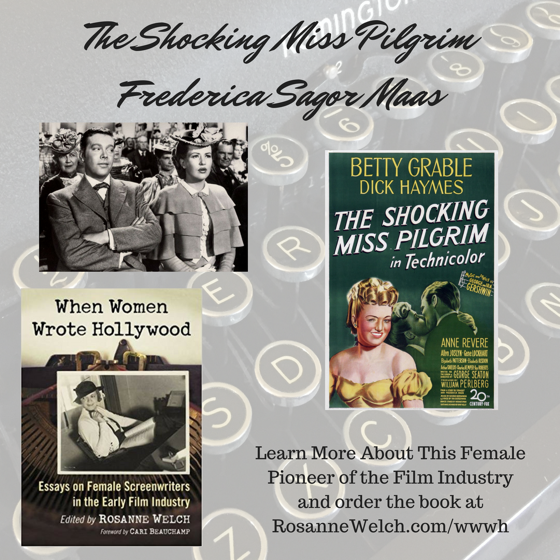
The Shocking Miss Pilgrim is a 1947 American musical comedy film in Technicolor written and directed by George Seaton, and starring Betty Grable and Dick Haymes.

The screenplay, based on a story by Frederica Sagor Maas and Ernest Maas, focuses on a young typist who becomes involved in the Women’s Suffrage movement in 1874. The songs were composed by George and Ira Gershwin. Marilyn Monroe made her film debut as an uncredited voice as a telephone operator.

In 1941, husband-and-wife screenwriting team Ernest Maas and Frederica Sagor collaborated on Miss Pilgrim’s Progress, a story about a young woman who enters the business world by demonstrating the newly invented typewriter in the window of a Wall Street establishment. When she tries to fend off the unwanted advances of one of the firm’s clerks, her employer comes to her rescue but is killed when he falls down the stairs in the ensuing altercation. Abigail Pilgrim becomes the focus of a murder trial that attracts widespread coverage by the media and the attention of Susan B. Anthony when the concept of women working in offices comes under fire.[2] Wikipedia 

Miss pilgrim

More about Frederica Sagor Maas


Buy a signed copy of when Women Write Hollywood

Also available soon via Amazon.com in Print and eBook editions


* A portion of each sale from Amazon.com directly supports our blogs
** Many of these books may be available from your local library. Check it out!
† Available from the LA Public Library

08 Television After 1968 from How The Monkees Changed Television [Video] (0:55)

What this entire presentation — How The Monkees Changed Television with Rosanne Welch, PhD (Complete Presentation and Q&A) [Video] (45:06)

08 Television After 1968 from How The Monkees Changed Television

Rosanne Welch, PhD, Author of Why The Monkees Matter, presents “How The Monkees Changed Television” at a Cal State Fullerton Lunch Lecture on May 8, 2018.

In this talk, she shows how The Monkees, and specifically their presence on television, set the stage for large changes to come in the late 1960s.


Transcript

Back in the day — I just mentioned the war — they did have many moments where they referenced the war — the war on poverty — and President Lyndon Johnson and they mentioned particularly — there was a great episode where they were playing dominoes and they dropped all the dominoes and then Davy Jones said to Peter Tork “what do you call this game?” and Peter Tork said “Southeast Asia” and nobody cut that, right, because nobody who is a censor at the network understood what it meant which is pretty shocking if you ask me.

This is Dr. Timothy Leary who was famous back in the day for dropping LSD and whatnot and taking experiments with the psyche and he was watching the program and defining it and recognizing that it was far deeper than anyone else had given it the thought before. So already in the 60s people in the know knew that this was something different and worth paying attention to.


 Why The Monkees Matter: Teenagers, Television and American Pop Culture


McFarland (Direct from Publisher) | Amazon | Kindle Edition | Nook Edition

Want to use “Why The Monkees Matter” in your classroom?

Order Examination Copies, Library and Campus Bookstore orders directly from McFarland

McFarland Company logo


About Rosanne Welch, PhD

Rosanne Welch, PhD is a writer, producer and university professor with credits that include Beverly Hills 90210, Picket Fences, Touched by an Angel and ABC NEWS/Nightline. Other books include Why The Monkees Matter: Teenagers, Television and American Pop Culture (McFarland, 2017) and Women in American History: A Social, Political, and Cultural Encyclopedia and Document Collection (ABC-CLIO, 2017), named to the 2018 Outstanding References Sources List, by the Reference and User Services Association (RUSA), a division of the American Library Association. Welch has also published chapters in Torchwood Declassified: Investigating Mainstream Cult Television (I.B.Tauris) and The American Civil War on Film and TV: Blue and Gray in Black and White and Color (Lexington Books, 2018) and essays in Doctor Who and Race: An Anthology and Outside In Makes it So, and Outside in Boldly Goes (both edited by Robert Smith). By day she teaches courses on the history of screenwriting and on television writing for the Stephens College MFA in Screenwriting programs. Her talk “The Importance of Having a Female Voice in the Room” at the 2016 TEDxCPP is available on YouTube.

My next book in progress! — Follow Me On Instagram!

My next book in progress! -- Follow Me On Instagram!

My next book in progress!

Working hard every day on my book on Giuseppe Garibaldi — “In Search of Unity” — for the Mentoris Project. 

Done by the end of Summer. 

Instagram and Follow


Join the Rosanne Welch Mailing List for future book and event announcements!
 

My Previous Mentoris Project Title

Order an autographed copy of America’s Forgotten Founding Father

Print Edition | Kindle Edition | Apple iBooks Edition | Nook Edition

Want to use this book in your classroom? Contact the Mentoris Project!


When Women Wrote Hollywood – 10 in a series – Frederica Sagor Maas

To highlight the wonderful yet largely forgotten work of a collection of female screenwriters from the early years of Hollywood (and as a companion to the book, When Women Wrote Hollywood) we will be posting quick bits about the many films they wrote along with links to further information and clips from their works which are still accessible online. Take a few moments once or twice a week to become familiar with their names and their stories. I think you’ll be surprised at how much bold material these writers tackled at the birth of this new medium. — Rosanne Welch

When Women Wrote Hollywood – 10 in a series – Frederica Sagor Maas

When Women Wrote Hollywood - 10 in a series - Frederica Sagor Maas

Frederica Alexandrina Sagor Maas (/ˌfɹɛdəˈɹikə səˈgɔɹ mæs/; July 6, 1900 – January 5, 2012) was an American dramatist and playwright, screenwriter, memoirist, and author,[1] the youngest daughter of Russian immigrants. As an essayist, Maas was best known for a detailed, tell-all memoir of her time spent in early Hollywood.[2] She was one of the oldest surviving entertainers from the silent film era.[3]

Once in Hollywood, Maas negotiated a contract with Preferred Pictures to adapt Percy Marks’s novel The Plastic Age for film. Based on this, she was signed to a three-year contract with MGM for $350 per week, though in her words: “I had the peculiar feeling that wily Louis B. [Mayer] was less interested in my writing ability than in signing someone who had worked for Ben Schulberg and Al Lichtman.”[5] It was in this period that she wrote the screenplays for silent films Dance Madnessand The Waning Sex. Wikipedia 

Miss pilgrim

More about Frederica Sagor Maas


Buy a signed copy of when Women Write Hollywood

Also available soon via Amazon.com in Print and eBook editions


* A portion of each sale from Amazon.com directly supports our blogs
** Many of these books may be available from your local library. Check it out!
† Available from the LA Public Library

“When Women Wrote Hollywood” In The News: Uncovering the secret history of women in Hollywood, University of Kansas

What a great read! 

Check out this profile of professor Laura Kirk, who contributed 2 chapters to When Women Wrote Hollywood, published by the University of Kansas where she teaches film acting for the Department of Film & Media Studies. 

Her chapters involve Silent Era writer Eve Unsell and musical scenario writer Bella Spewack.

Read more about these – and all the great early female screenwriters in the book!

Rosanne Welch


When Women Wrote Hollywood In The News: Uncovering the secret history of women in Hollywood, University of Kansas

LAWRENCE — After working for many years as an actor and producer, Laura Kirk returned to her native Kansas in 2012 and joined the University of Kansas Department of Film & Media Studies as a lecturer, teaching film acting.

Now, in her first big work of academic scholarship, Kirk has contributed two chapters to “When Women Wrote Hollywood” (McFarland), a new book aimed at bringing the secret female history of Hollywood to light.

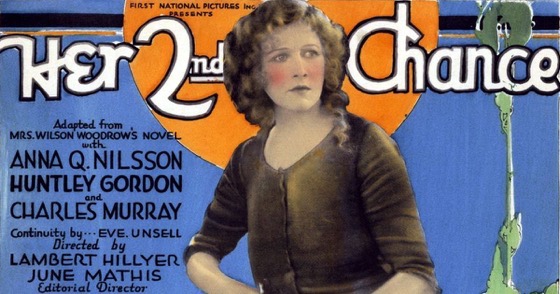
Kirk wrote about Kansan Eve Unsell, a screenwriter whose career spanned the silent and talkie era, and Bella Spewack, the journalist, author and screenwriter best known for “Kiss Me Kate.”

“When this industry started, women wrote 50 percent of the screenplays,” Kirk said. “And yet Eve Unsell was not in the index of any history book. Many of the women who have chapters in this book have not been written about in any real way.”

Unsell, for instance, got a two-line obituary in the Los Angeles Times when she died in 1937 at age 50. She was born in Chicago and grew up in Caldwell, a small Kansas town in Sumner County.

“She has 96 credits on IMDb,” the Internet Movie Database, Kirk said. “She was credited with training Alfred Hitchcock. She ran the Paramount studio in England. … I talk about how she was one of the first people to settle in Malibu when it was wild and natural and scenic.”

Eve unsell inset 250Laura kirk 172

Read this entire article – Uncovering the secret history of women in Hollywood, University of Kansas

Order your copy of When Women Wrote Hollywood Today

* A portion of each sale from Amazon.com directly supports our blogs
** Many of these books may be available from your local library. Check it out!
† Available from the LA Public Library

19 Steven Moffatt Prepares for Lady Doctor from Gender Diversity in the Who-niverse [Video] (1:13)

Watch this entire presentation: Gender Diversity in the Who-niverse: Paving the Way for a Lady Doctor with Dr. Rosanne Welch [Video] (36:58)

Steven Moffatt Prepares for Lady Doctor from Gender Diversity in the Who-niverse

For her 5th Doctor Who lecture to the CPP community, Dr. Rosanne Welch discusses how society – and the show’s writing staff – prepared the audience for a major change in this 50-year franchise – the creation of the first Lady Doctor!

Transcript:

Have to give Steven for laying the groundwork finally and, as I said, if you look at his writing, when Matt changed he gave us “Not a girl. Still not ginger.” — a little ginger joke there. Which is fine. he made everyone think they were going to pick — oh my gosh I never forgot his name — Ron Weasley — yes — Rupert Grint, thank you so much. There was discussion that Rupert Grint would become a new Doctor, so a little joke there, the ginger is referencing that. So he knows what’s happening in culture. What people are saying about his program, right? So he laid that in. he also laid in in “The Doctor’s Wife” which is a marvelous episode — written by Neil Gaiman, wh you might know form American Gods and the other very cool novels. So they invited Nei Gaiman to come in and write an episode and they found old, dead, Timelords trapped in these little boxes and this is what he said about this guy, right? “He didn’t feel himself unless he had the tattoo. Or herself, a couple of times. Ooooo, she was a bad girl.” So Timelord who switched their gender It is possible. So Steven is writing or Executive Producing the writing in all these episodes. So he’s laying the groundwork for all this to happen.

Follow Dr. Welch on Twitter and Instagram
https://twitter.com/rosannewelchhttp://instagram.com/drrosannewelch


Rosanne Welch, PhD

Rosanne Welch PhD teaches the History of Screenwriting and One-Hour Drama for the Stephens College MFA in Screenwriting.

Writing/producing credits include Beverly Hills 90210, Picket Fences, ABCNEWS: Nightline and Touched by an Angel. In 2016 she published the book Why The Monkees Matter: Teenagers, Television and American Pop; co-edited Women in American History: A Social, Political, and Cultural Encyclopedia; and placed “Transmitting Culture Transnationally Via the Characterization of Parents in Police Procedurals” in the New Review of Film and Television Studies. Essays appear in Torchwood Declassified: Investigating Mainstream Cult Television and Doctor Who and Race: An Anthology. Welch serves as Book Reviews editor for Journal of Screenwriting and on the Editorial Advisory Board for Written By magazine, the magazine of the Writers Guild.


Watch Dr. Welch’s talk “The Importance of Having a Female Voice in the Room” at the 2016 TEDxCPP.