This lack of female representation at the creative/gatekeeper levels is precisely what the Stephens College MFA in TV and Screenwriting aims to change! More prepared female writers = more prepared female showrunners = more believable female character and stories permeating our lives. — Rosanne
For the 2018-19 season, 96% of TV programs had no women directors of photography; 79% had no women directors; 77% had no women editors; and 77% had no women creators.
As a number of female-fronted TV shows, including “Veep” and “The Marvelous Mrs. Maisel,” vie for Emmys later this month, a study released Wednesday finds that “historic highs” for women in television still leave them vastly underrepresented in key behind-the-scenes roles.
Really more interesting, I want to know more about Jennie Louise Toussaint Welcome. That is actually her full name, which is beautiful. She as well, she wrote a movie that was meant to be the answer to “Birth of a Nation”, right? She wrote a movie in defense of how badly African-Americans were treated in “Birth of a Nation”, that doesn’t exist anymore. Bits and pieces online you can find of “The Charge of the Colored Divisions”. She was covering the African-American men in World War I, right? So she did some work like that, both reality and fiction. I have to believe we’ll find some more work on her, because her brother was Booker T. Washington’s personal photographer during the Harlem Renaissance and her parents were the butler and maid to President Ulysses S. Grant, so there’s got to be somebody mentioning them somewhere. It’s just that nobody’s put all that together, but I really think we’re going to to get more about her pretty soon.
Dr. Rosanne Welch discusses the women in her new book “When Women Wrote Hollywood” which covers female screenwriters from the Silents through the early 1940s when women wrote over 50% of films and Frances Marion was the highest paid screenwriter (male or female) and the first to win 2 Oscars. Yet, she fails to appear in film history books, which continue to regurgitate the myth that male directors did it all – even though it’s been proven that the only profitable movies Cecil B. de Mille ever directed were all written by Jeannie Macpherson film ever won for Best Picture was written by Robert E. Sherwood (who people have heard of, mostly due to his connection to Dorothy Parker) and Joan Harrison.
* A portion of each sale from Amazon.com directly supports our blogs ** Many of these books may be available from your local library. Check it out! † Available from the LA Public Library
Whether big city or small-town USA, a show’s location can have a powerful impact. We are teaming up with Columbia College Chicago on this special evening to sit down with a panel of TV writers for a discussion about how writing location, whether real or fictional, sets the scene and can shape the motivations of the characters.
Panelists:
Ayanna Floyd – Writer, Executive Producer, The Chi
Anthony Sparks – Writer, Executive Producer, Queen Sugar
Stay tuned for more panelist announcements!
Moderated by Dr. Rosanne Welch.
Doors open at 7pm. Event starts at 7:30pm.
All events advertised on our Events page are open to anyone who wants to buy a ticket—not just WGA members!
In the case the event is sold out, we will have a first come, first serve stand-by line at the event. The stand-by line does not guarantee entry into the event and we will only accept credit card transactions for any released seats.
Proceeds benefit the Foundation’s library, archive and other outreach programs.
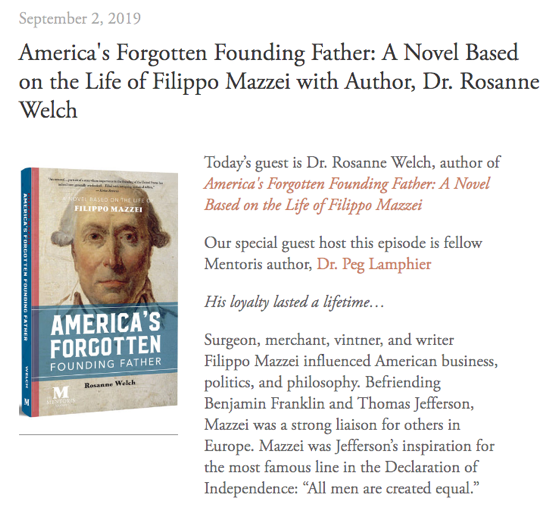
Surgeon, merchant, vintner, and writer Filippo Mazzei influenced American business, politics, and philosophy. Befriending Benjamin Franklin and Thomas Jefferson, Mazzei was a strong liaison for others in Europe. Mazzei was Jefferson’s inspiration for the most famous line in the Declaration of Independence: “All men are created equal.”
About the Author
Rosanne Welch is a writer, producer, and university professor with credits that include Beverly Hills 90210, Picket Fences, Touched by an Angel, and ABC NEWS/Nightline. She is the author of Why The Monkees Matter: Teenagers, Television and American Pop Culture (McFarland, 2017). She is co-editor, with Peg A. Lamphier, of Women in American History: A Social, Political, and Cultural Encyclopedia and Document Collection (ABC-CLIO, 2017).
Welch has also published chapters in Torchwood Declassified: Investigating Mainstream Cult Television (I. B.Tauris) and The American Civil War on Film and TV: Blue and Gray in Black and White and Color (Lexington Books, 2018), and an essay in Doctor Who and Race: An Anthology.
By day she teaches courses on the history of screenwriting and on television writing for the Stephens College MFA in screenwriting programs. You can also watch her TEDx talk, “The Importance of Having a Female Voice in the Room”
Wherever you go, you find Monkees fans and the Denver Popular Culture Con was no different. Amid rooms full of caped crusaders and cosplay creations, I was initially not sure how many folks would attend a talk on a TV show from the 1960s – but happily I was met by a nice, engaged audience for my talk on Why the Monkees Matter – and afterward they bought books! What more could an author ask for?
Transcript
I got very involved on this one. I wrote an article for Written By about The Monkees — the writers of The Monkees. I wanted to find out who it is people who had stories to tell and who were telling their philosophy through these four characters right and so that really interested me and these are most of the folks that I got to meet. Obviously when I met them they were in their late 70s and had been around for a while and they have some marvelous stories to tell. Gerald Gardner, the gentleman just to the left of my book picture was actually a script writer and a speech writer for a Robert Kennedy’s Senate campaign in New York. He came to television through a show called That Was The Week That Was, which is kind of the SNL Weekend Update of its time and then he moved to Get Smart and when they started The Monkees the folks in charge were like “We need some cool funny, young men,” and he and his partner showed up. So that’s Gerald Gardner.
A hit television show about a fictitious rock band, The Monkees (1966-1968) earned two Emmys–Outstanding Comedy Series and Outstanding Directorial Acheivement in Comedy.
Capitalizing on the show’s success, the actual band formed by the actors, at their peak, sold more albums than The Beatles and The Rolling Stones combined, and set the stage for other musical TV characters from The Partridge Family to Hannah Montana. In the late 1980s, the Monkees began a series of reunion tours that continued into their 50th anniversary.
This book tells the story of The Monkees and how the show changed television, introducing a new generation to the fourth-wall-breaking slapstick created by Laurel and Hardy and the Marx Brothers.
Its creators contributed to the innovative film and television of 1970s with projects like Bob & Carol & Ted & Alice, The Mary Tyler Moore Show, Laugh-In and Welcome Back, Kotter. Immense profits from the show, its music and its merchandising funded the producers’ move into films such as Head, Easy Riderand Five Easy Pieces.
This one allowed me to riff on some of my favorite female science fiction writers across time, whether they be novelists or television writers. It also opened up a good conversation on what art we support and include in our lives – and what that art says to us and about us. — Rosanne
Transcript:
So and this is a really brilliant interesting book because basically, she’s talking about Indiana Jones — that character — what if someone who did that archaeological work could commune with the spirit of the people who own the things that you’re digging up and what would happen if you could connect to them and learn about their world? I think that’s it’s a really fascinating book and written by Pat Murphy, which is pretty cool.
†
Winner of the Nebula Award: “A lovely and literate exploration of the dark moment where myth and science meet” (Samuel R. Delany).
When night falls over the Yucatan, the archaeologists lay down their tools. But while her colleagues relax, Elizabeth Butler searches for shadows. A famous scientist with a reputation for eccentricity, she carries a strange secret. Where others see nothing but dirt and bones and fragments of pottery, Elizabeth sees shades of the men and women who walked this ground thousands of years before. She can speak to the past—and the past is beginning to speak back.
As Elizabeth communes with ghosts, the daughter she abandoned flies to Mexico hoping for a reunion. She finds a mother embroiled in the supernatural, on a quest for the true reason for the Mayans’ disappearance. To dig up the truth, the archaeologist who talks to the dead must learn a far more difficult skill: speaking to her daughter.
* A portion of each sale from Amazon.com directly supports our blogs ** Many of these books may be available from your local library. Check it out!
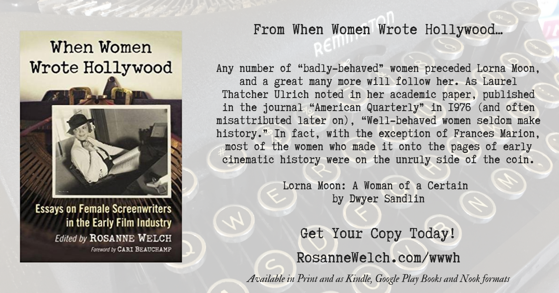
Any number of “badly-behaved” women preceded Lorna Moon, and a great many more will follow her. As Laurel Thatcher Ulrich noted in her academic paper, published in the journal “American Quarterly” in 1976 (and often misattributed later on), “Well-behaved women seldom make history.” In fact, with the exception of Frances Marion, most of the women who made it onto the pages of early cinematic history were on the unruly side of the coin.
* A portion of each sale from Amazon.com directly supports our blogs
** Many of these books may be available from your local library. Check it out!
† Available from the LA Public Library
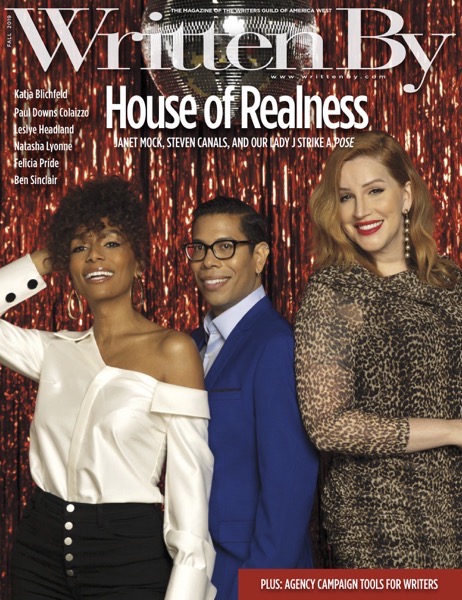
Just on time for your Labor Day Reading! The Fall 2019 issue of Written By magazine, the magazine of the Writers Guild of America, West is now available online.
Stephens College MFA in TV and Screenwriting Executive Director Dr. Rosanne Welch, who serves on the Editorial Board of the magazine (along with program friend Glen Mazzara) is proud of this truly groundbreaking issue: it’s the first issue featuring transgender writers (and on the cover!); entry- or mid-level writers; LGBTQIA writers; female writers; and writers of color in every story.
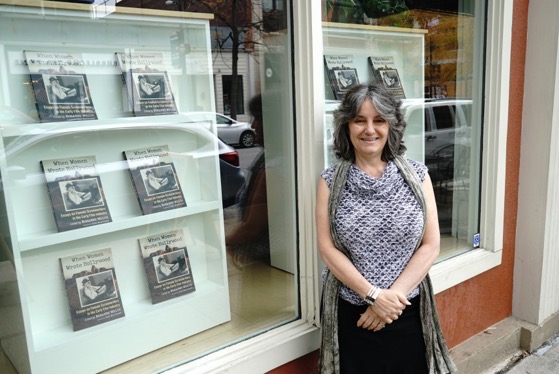
It’s always wonderful to be given another chance to talk about “When Women Wrote Hollywood” – the book of essays on female screenwriters who deserve to be much more famous and spoken of much more often in modern day film history courses.
Women writers are fascinated to know how many women blazed the trail for them and more than happy to help make their names more well known. So this interview with Susan Gil Vardon of the OC Register turned into an hour and a half chat between two new friends. — Rosanne
Rosanne Welch has advice for female students who want to get their screenplays noticed: Speak up.
A lecturer in screenwriting at Cal State Fullerton, Welch says she has seen a pattern — even in her master’s classes. When she asks her students to pitch their scripts, the men start talking while the women sit quietly, as if they’re waiting their turn.
“They’re so polite,” Welch said about the women. “I say, Hollywood will never give you a turn. Open your mouth, overspeak the boy. You gotta be loud and proud of what you do.”
Welch did it. Leaving Cleveland, Ohio, with a degree in secondary education, she worked her way up in television from a job as a receptionist for a production company to writing for the shows “Beverly Hills 90210,” “Picket Fences,” ABC’s “Nightline” and “Touched by an Angel.”
In recent years she has focused on writing books, including several on women whose achievements and legacies have been sidelined or lost to history.
Her latest is “When Women Wrote Hollywood: Essays on Female Screenwriters in the Early Film Industry.” The book, which she edited, features 24 essays her students wrote in a master’s of fine arts class at Stephens College in Missouri on such pioneering women writers as Adela Rogers St. Johns, Anita Loos, Lillian Hellman and Dorothy Parker.
* A portion of each sale from Amazon.com directly supports our blogs ** Many of these books may be available from your local library. Check it out! † Available from the LA Public Library
Tara Hernandez started working on The Big Bang Theory as an assistant to the executive producer in season 4, and became a staff writer in the middle of season 5. From there she rose in the ranks to be a co-executive producer, helping to craft the series finale before moving to work on the show’s spin-off Young Sheldon.
The key to pitching sitcoms – there’s the event and then there’s the story. The event is the thing that happens but the story is her emotional realization that comes from the event… So for my first story that sold on Big Bang Theory was about the time Bernadette was getting married and Amy was going overboard so the girls decide to go dress shopping without Amy. That was the event that happened and then, because she was so devastated, Sheldon had to step up as a boyfriend and comfort her and it lead to their first cuddle. – Tara Hernandez
![18 Jennie Louise Toussaint Welcome from “When Women Wrote Hollywood” with Dr. Rosanne Welch [Video] (52 seconds)](https://rosannewelch.com/wp-content/uploads/2019/09/csuf-rmw-w3h-18.jpeg)



![03 The Writers of The Monkees from “Why The Monkees Matter: Even 50 Years Later – Dr. Rosanne Welch [Video] (50 seconds)](https://rosannewelch.com/wp-content/uploads/2019/09/monkees-popcon-2019-03.jpeg)


![15 More On Pat Murphy from The Sisterhood of Science Fiction – Dr. Rosanne Welch [Video] (25 seconds)](https://rosannewelch.com/wp-content/uploads/2019/09/scifi-rmw-cpp-15.jpeg)
![Listen to the latest “How I Wrote That” Podcast with Screenwriter/Producer Tara Hernandez of The Big Bang Theory [Audio]](https://rosannewelch.com/wp-content/uploads/2019/08/hiwt-stephens-logo-1-1.png)
![Listen to the latest How I Wrote That Podcast with Tera Hernandez of The Big Bang Theory [Audio]](https://rosannewelch.com/wp-content/uploads/2019/08/Tara-Hernandez-promo-photo-1.png)