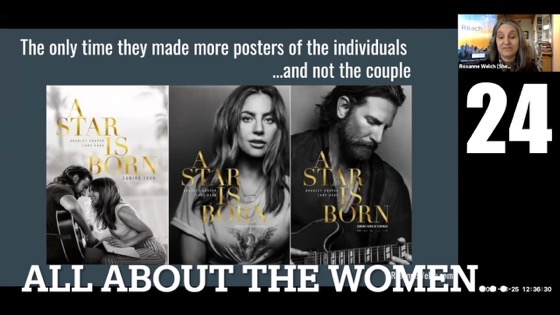
This is the only time they made separate posters and focused on them. Almost every movie iteration you see them both together because it’s a love story. That’s what you’re being told in that poster. I don’t know what these posters are telling you except do you know the title of the movie then you’ll understand but I had several students who never knew it was a remake when they went to see it. So they had no idea. The title meant nothing to them. It’s always the female that carries the story right? This is this giant poster of Ally. That’s what this is all about. All these women are the reasons these movies were made in the first place. That’s what drew the box office. That’s what drew the studios to support and every one of these is the story of a woman doing something new against the culture of her time. Facing one of the various waves of feminism right? If you think about 1937 women had had the vote for under 20 years. A bunch of women were still not voting because their husbands wouldn’t let them even though it was legal right and 54 we’re 10 years after the end of the war and the Rosie the Riveter and all that stuff when women were told to go back home, put on your pearls, and start vacuuming right? Don’t try to be in the man’s world. That’s your job. We get around to 76 and we’re in the second wave of feminism. That’s just three years after Roe versus Wade and we’re still doing the equal pay marches. We’re still looking for equal pay and if you get around to the current version, it’s ten years after the Lilly Ledbetter act, which gave fair pay to people doing the same job. So each of these movies takes place in their female characters working truly in a world where there were still feminist issues going on. Which i think is also part of what Dorothy started with.
Watch this entire presentation
Connections at conferences matter! Through the most recent SCMS, I met Vicki Callahan, whose film history focus right now is on Mabel Normand. When she learned I could put together a lecture on the importance of the female voice in the A Star is Born franchise she asked me to give that lecture to her master students.
It made for a great opportunity for me to hone the ideas I’m working on for a chapter on that franchise that I’m writing for a new book from Bloomsbury: The Bloomsbury Handbook Of International Screenplay Theory. It’s always nice when one piece of research can be purposed in other ways – and it’s always fun revisiting such a female-centric film franchise – one that drew the talents of such powerful performers as Janet Gaynor, Judy Garland, Barbara Streisand, and Lady Gaga.
It was great to be able to attend this year’s SD WhoCon in San Diego and present this lecture on “The Difficulties and Delicacies of Writing the First Female Doctor in 50+ years” in which I discuss how successful I think showrunner Christopher Chibnall was in making that transition.
It gave me a chance to talk about the creative work of a showrunner/screenwriter while also reconnecting to some friends we had met at this same convention some 3 years ago – and to talk about one of my favorite subjects – Doctor Who!
Transcript:
All right, ladies and gentlemen, it’s lovely to have you here. On my campuses, I’m kind of the Doctor of Doctor Who which makes people laugh. They’re like can you look at this academically and you can. What I’m going to talk about today is based on a chapter that I’ve written in a new book. I always feel bad about academic books. This thing is like 120 bucks because it’s meant for college libraries or whatnot and there are academics all over the UK and the US who’ve written chapters in it and of course it’s about the era of the New Dawn, the era of the Jody Whitaker Doctor. So when I saw this go up I said well I have a lot to say about screenwriting because officially this is who I am. I love that picture because it was taken at my college for an article they did on me. I worked for schools called Stephens College and we teach an MFA in screenwriting and so I always look at everything from the point of view of the person who wrote this material. I really am very interested in screenwriters more than directors because people sometimes will credit a director and I’m like well they didn’t make up the story. If you liked the twist or the character or piece of dialogue, they didn’t make that up. They just put the cameras at a lovely place and accented it. So let’s think about the people who wrote these things and so that’s what I do.
Host: I mean how do you — how did you do it? How do you practice on your schedule? Do you like time limit yourself. You’re like, oh like one month or like one week to do three acts or something like that.
Rosanne: Well you get into a pattern when you do it. I mean the Writers Guild offers two weeks to write a script. That’s what if you’re a freelance writer they have to give you two weeks to go home but when you’re on a staff they expect you to write it in one week. They expect you to be able to write 10 to 15 producible pages a day. So that’s where you have to get yourself to if you’re really going to take it seriously. So yeah this took two months. This takes one month and you get it down to three weeks and two weeks and the best you can. You have to find the times a day that works for you. Some people are night writers. I am not but some people can work really great from 10 in the evening till two in the morning and then sleep from three to ten right? Okay then you have to know that and then you need to build a day job that allows you to do that right because that’s gonna do the most work. Some people — I go from like 6 am to like 2 p.m and then I make phone calls and do other kinds of email work and stuff like that because then I sort of run out of my creative excitement or whatever. So I have to make sure that I don’t do anything else until later. I don’t take meetings or do things like that until later in the day. If you don’t do that when you finally approach your computer to start writing something, it will take you so much longer and it will be so much more frustrating that you won’t get to the point you want and you might turn away right? So you have to be in a comfortable place to do that and you know this town is full of different kinds of jobs you can make work for that whatever is the time frame that you need.
It’s always fun to sit down with students and share stories about entering the television industry and how things work at all stages and I had that opportunity the other day.
Daniela Torres, a just-graduated (Congratulations!) student of the Columbia College Semester in LA program asked me to guest on a podcast she had recently begun hosting with another college student she met during her internship (good example of networking in action!).
We could have talked all morning (the benefit of a 3 hour class session) but we held it to about an hour and fifteen minutes or so. Hopefully, along the way I answered some questions you might have about how the business works. So often it amounts to working hard at being a better writer and gathering a group of other talented, hard-working people around you so you can all rise together.
Dr. Rosanne Welch is a television writer with credits that include Beverly Hills 90210, Picket Fences, ABCNEWS: Nightline and Touched by an Angel. She also teaches Television Writing and the Art of Film at San Jose State University.
Rosanne discusses what made shows like Beverly Hills 90210 compelling, what to do and not to do when attempting to pitch a show to broadcast or streaming, what most young writers neglect in their writing process, and much more!
The Courier Thirteen Podcast is available on YouTube, Spotify, Apple Podcasts, SoundCloud, and Audible.
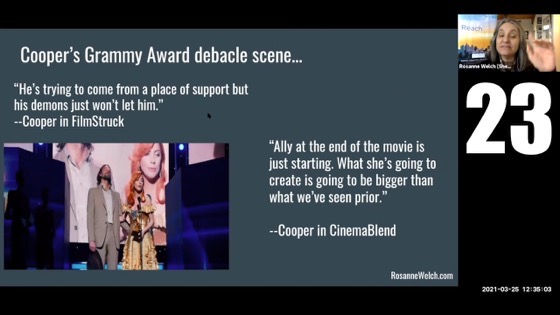
In this scene, and these are quotes from Bradley Cooper as he was making the film he’s being interviewed right, he says he’s on stage trying to support her but his demons won’t let him right? So we still have the debacle but it’s not because he wants to ruin her night. He’s trying to be there to support her and then it’s embarrassing and terrible and sad and also he says that at the end of the movie, she’s just starting right and what she’s going to create is going to be bigger than what we’ve seen prior. That means her movie isn’t this movie — that her movie is the next one which will never be made. That means this is the Jackson Maine story and that’s not what I signed up for. I signed up for the star — the female star — being born. So I think that’s a huge change that he as a male writer has brought to this franchise. You look at the writing credits, right? So if Bradley wrote it with this guy Will Fetters. If you go to the Writers Guild when you have time when it’s open again in the library, they have a copy of the first draft and if you read it to compare to the film that you saw in 2019 you will be shocked because it is not brilliant. It is this guy who’s an Academy Award winner for Forrest Gump and I think he has two Academy Awards, Eric Roth who came in to do the rewrite that really molded the piece but he’s taking the ideas that Bradley Cooper had which are to focus more on Jackson Maine’s character. They base themselves on the Moss Heart screenplay, right? So by the time we’re done with this Dorothy’s name has finally disappeared entirely even though all the bones of it are really still there and really still her if you ask me.
Watch this entire presentation
Connections at conferences matter! Through the most recent SCMS, I met Vicki Callahan, whose film history focus right now is on Mabel Normand. When she learned I could put together a lecture on the importance of the female voice in the A Star is Born franchise she asked me to give that lecture to her master students.
It made for a great opportunity for me to hone the ideas I’m working on for a chapter on that franchise that I’m writing for a new book from Bloomsbury: The Bloomsbury Handbook Of International Screenplay Theory. It’s always nice when one piece of research can be purposed in other ways – and it’s always fun revisiting such a female-centric film franchise – one that drew the talents of such powerful performers as Janet Gaynor, Judy Garland, Barbara Streisand, and Lady Gaga.
Rosanne: …which is also what I say to students both in internships and within classes. You’re not going to call Steven Spielberg and become his best friend to get a job but somewhere in your group of friends that you’re all connecting with right now one of you is going to go become Steven Spielberg and that you’re all then going to stay connected to each other and help each other move up.
Host: That’s yeah as far as networking goes, I think that’s probably one of the best pieces of advice you can give to someone. It’s like understand that everything — it’s you know, it’s the right thing to be nice to people and cultivate relationships but also it’s almost like you’re moving up with your generation. Like everyone rises up together…
Rosanne:… exactly and you will immediately kick off your you know the end of your boot anybody who you don’t want to be around.
Host: That’s also true.
Rosanne: Yeah because they’ll just get in your way and they’re not going to help you. As long as you’re the kind of person who wants to help other people and with their ideas with you know doing writer’s groups together, reading each other’s scripts out loud, going to Q and A’s in town and then you know talking about the thing you saw afterwards. Running into other people at those events and you know hey let’s all get together and have a meet up two weeks from now at such and such a pizza place or a coffee house or a bar whatever it is. Building those relationships because that’s you know you’re the next generation of assistants who are the next generation of writers or executives or whatever people choose to be.
It’s always fun to sit down with students and share stories about entering the television industry and how things work at all stages and I had that opportunity the other day.
Daniela Torres, a just-graduated (Congratulations!) student of the Columbia College Semester in LA program asked me to guest on a podcast she had recently begun hosting with another college student she met during her internship (good example of networking in action!).
We could have talked all morning (the benefit of a 3 hour class session) but we held it to about an hour and fifteen minutes or so. Hopefully, along the way I answered some questions you might have about how the business works. So often it amounts to working hard at being a better writer and gathering a group of other talented, hard-working people around you so you can all rise together.
Dr. Rosanne Welch is a television writer with credits that include Beverly Hills 90210, Picket Fences, ABCNEWS: Nightline and Touched by an Angel. She also teaches Television Writing and the Art of Film at San Jose State University.
Rosanne discusses what made shows like Beverly Hills 90210 compelling, what to do and not to do when attempting to pitch a show to broadcast or streaming, what most young writers neglect in their writing process, and much more!
The Courier Thirteen Podcast is available on YouTube, Spotify, Apple Podcasts, SoundCloud, and Audible.
Now I tend to call this the Bradley Cooper version and as Jacob asked me”Do I like it?” I like it to the extent that I like the bones of this story but because a male wrote it, and had two other male screenwriters rewrite him, it becomes his story. It becomes the Jackson Maine story. We have much more focus on his character, his backstory, and while giving a female superstar one name seems modern, in many ways it erases part of her own history. What is her actual last name right? A female character without a last name is not one who’s been thought through all the way, I would say in reading a script. So in this case, we focus so much on his backstory. So much about his own family. It’s his brother that’s part of the story. So much is more about the star who’s dying than the star who is being born in this movie. She doesn’t really have the same agency. Certainly not that Barbra Streisand gave her character. Really not that we had out of Julie or Janet either.
Watch this entire presentation
Connections at conferences matter! Through the most recent SCMS, I met Vicki Callahan, whose film history focus right now is on Mabel Normand. When she learned I could put together a lecture on the importance of the female voice in the A Star is Born franchise she asked me to give that lecture to her master students.
It made for a great opportunity for me to hone the ideas I’m working on for a chapter on that franchise that I’m writing for a new book from Bloomsbury: The Bloomsbury Handbook Of International Screenplay Theory. It’s always nice when one piece of research can be purposed in other ways – and it’s always fun revisiting such a female-centric film franchise – one that drew the talents of such powerful performers as Janet Gaynor, Judy Garland, Barbara Streisand, and Lady Gaga.
Rosanne: …which is also what I say to students both in internships and within classes. You’re not going to call Steven Spielberg and become his best friend to get a job but somewhere in your group of friends that you’re all connecting with right now one of you is going to go become Steven Spielberg and that you’re all then going to stay connected to each other and help each other move up.
Host: That’s yeah as far as networking goes, I think that’s probably one of the best pieces of advice you can give to someone. It’s like understand that everything — it’s you know, it’s the right thing to be nice to people and cultivate relationships but also it’s almost like you’re moving up with your generation. Like everyone rises up together…
Rosanne:… exactly and you will immediately kick off your you know the end of your boot anybody who you don’t want to be around.
Host: That’s also true.
Rosanne: Yeah because they’ll just get in your way and they’re not going to help you. As long as you’re the kind of person who wants to help other people and with their ideas with you know doing writer’s groups together, reading each other’s scripts out loud, going to Q and A’s in town and then you know talking about the thing you saw afterwards. Running into other people at those events and you know hey let’s all get together and have a meet up two weeks from now at such and such a pizza place or a coffee house or a bar whatever it is. Building those relationships because that’s you know you’re the next generation of assistants who are the next generation of writers or executives or whatever people choose to be.
It’s always fun to sit down with students and share stories about entering the television industry and how things work at all stages and I had that opportunity the other day.
Daniela Torres, a just-graduated (Congratulations!) student of the Columbia College Semester in LA program asked me to guest on a podcast she had recently begun hosting with another college student she met during her internship (good example of networking in action!).
We could have talked all morning (the benefit of a 3 hour class session) but we held it to about an hour and fifteen minutes or so. Hopefully, along the way I answered some questions you might have about how the business works. So often it amounts to working hard at being a better writer and gathering a group of other talented, hard-working people around you so you can all rise together.
Dr. Rosanne Welch is a television writer with credits that include Beverly Hills 90210, Picket Fences, ABCNEWS: Nightline and Touched by an Angel. She also teaches Television Writing and the Art of Film at San Jose State University.
Rosanne discusses what made shows like Beverly Hills 90210 compelling, what to do and not to do when attempting to pitch a show to broadcast or streaming, what most young writers neglect in their writing process, and much more!
The Courier Thirteen Podcast is available on YouTube, Spotify, Apple Podcasts, SoundCloud, and Audible.
So the idea lagged for a while and then all of a sudden the Lady Gaga version comes up, which I’m sure most of you have seen. Let’s see — similarities. She’s not a rock star so much as she’s a pop star and that’s because we have the dancers behind her and we’re sort of working in a different world. He more or less though is a rock idol because it’s cooler for boys to do rock than pop right? We giggle at Justin Bieber. We think rock stars are hot. So he maintains the rock business but here’s a change that Bradley Cooper — who’s one of the writers on the movie definitely made — his dude is not jealous of her. He is supportive and happy. His problem is that he’s an addict and he can’t break his addiction. It has nothing to do — he’s an addict before he meets her. Her popularity does nothing has no change to that. So I think that’s an important difference and we’re going to talk about why that difference happens. Same thing they’re going to write a song together –a beautiful song. Again that’s a very sexy thing for them to do. At the Grammy Awards, he’s going to embarrass her but not out of anger that she’s getting attention and I’ve got a little slide I’m gonna show you on that. We’re gonna use the “one more look at you” line, so Dorothy Parker is still hanging out not only in the plot but in these lines. This time her guy — and they call him Jackson Maine because Norman is boring and so is John by the time we get to 2019. What we do is — he doesn’t cheat on her. In the other ones the woman finds the guy cheating because he finds another young girl that you know will make him feel better because his wife is better than he is. He does not do that. Bradley Cooper did not want his character to do that. Like Kris Kristofferson, though, he will commit suicide essentially on screen. We’re gonna know what he’s doing and it’s not off — lose his body and nobody has to see him. She’s gonna see his body when they find him and in the more modern world, if you want to call it that, she is just Ally like Cher is Cher right and Beyonce is Beyonce. She is Ally. So at the end of the movie, she can’t change her name but she does in fact introduce herself as Ally Maine. So she establishes that last name repetition from the previous versions.
Watch this entire presentation
Connections at conferences matter! Through the most recent SCMS, I met Vicki Callahan, whose film history focus right now is on Mabel Normand. When she learned I could put together a lecture on the importance of the female voice in the A Star is Born franchise she asked me to give that lecture to her master students.
It made for a great opportunity for me to hone the ideas I’m working on for a chapter on that franchise that I’m writing for a new book from Bloomsbury: The Bloomsbury Handbook Of International Screenplay Theory. It’s always nice when one piece of research can be purposed in other ways – and it’s always fun revisiting such a female-centric film franchise – one that drew the talents of such powerful performers as Janet Gaynor, Judy Garland, Barbara Streisand, and Lady Gaga.
I enjoyed sharing the names and careers of women like Peg Lynch, Gertrude Berg, Selma Diamond, and D.C. Fontana to the members who gathered on Zoom last Wednesday morning. There are so many more I could have talked about whose names don’t appear in mainstream books about the history of television so we have to learn who they are and carry those names forward ourselves. It’s one of the missions of the Stephens College MFA in TV and Screenwriting – and has been one of my missions all my life.
Transcript:
Madeline Pugh is not a woman who is forgotten in the books because she wrote for, of course, the most iconic woman on television, Lucille Ball and Madeleine Pugh was at the very beginning of Lucille Ball’s television career and stayed with her all the way through each of the three major shows she was ever a star of. You’ll notice here very tiny on her chair. It said Madeline Pugh Girl Writer. Imagine that. She is not a girl at this stage in her career. She is a grown woman who has a good history behind her of writing radio programs and then moving into this world. She co-wrote with this gentleman Bob Carroll whom she never married. They were just writing partners which was marvelous. She had her own personal life. She, in fact, married a man who had three children and eventually left Hollywood for a while and then decided she missed it and they as a whole family moved back and she continued. so Madeline Pugh is a huge, huge person in the history of television. She’s one of the few who might show up in a book because if you talk about The Lucille Ball Show you must talk about Madeline. One of the things madeleine did was as they wrote gags or the particular physical comedy that they would expect Lucy to do, Madeline would perform those tricks first. She would have to see if they were safe and they were doable and in fact, were they really funny when you saw them finished. So she was both sort of a side performer and of course a writer on the show. So I think Madeline Pugh is someone you should never forget as well as of course Lucille Ball.1
Many thanks to Janice Law of the American Women Writers National Museum who invited me to give a short talk on The Women of Early TV.
I enjoyed sharing the names and careers of women like Peg Lynch, Gertrude Berg, Selma Diamond, and D.C. Fontana to the members who gathered on Zoom last Wednesday morning. There are so many more I could have talked about whose names don’t appear in mainstream books about the history of television so we have to learn who they are and carry those names forward ourselves. It’s one of the missions of the Stephens College MFA in TV and Screenwriting – and has been one of my missions all my life.
Watch this entire presentation
Women pioneers who created, produced, or shepherded many of America’s most wildly popular, early television programs will be profiled by Dr. Rosanne Welch.
Yeah. It doesn’t even — they don’t have to like your story. If they like you they can bring you and you know that’s the other thing that happens — if they like you but they don’t buy your story, your pitch, whether, it’s a tv show or a movie whatever it is but they have a book that they have bought their rights to and they want someone to come in with what is your idea and how this book will work. That’s when they’ll go oh I really like working with you. I really feel a connection to you. Go home and think about this and come back in a couple weeks and tell me how you would attack this and maybe you’ll get that gig. So that’s what you’re trying in a meeting if nothing else happens or you know I ended up doing that Picket Fences episode because I had temped on a show that Jeff Melvoin was an executive — that time he’s a supervising producer — and so we met for like two weeks and he read something of mine and he was impressed and we stayed in touch. It was four years before he got the job where he could hire me. One, two-week job gave me a story — a script — four years later. You gotta always think about the future of the relationships that you’re making.
It’s always fun to sit down with students and share stories about entering the television industry and how things work at all stages and I had that opportunity the other day.
Daniela Torres, a just-graduated (Congratulations!) student of the Columbia College Semester in LA program asked me to guest on a podcast she had recently begun hosting with another college student she met during her internship (good example of networking in action!).
We could have talked all morning (the benefit of a 3 hour class session) but we held it to about an hour and fifteen minutes or so. Hopefully, along the way I answered some questions you might have about how the business works. So often it amounts to working hard at being a better writer and gathering a group of other talented, hard-working people around you so you can all rise together.
Dr. Rosanne Welch is a television writer with credits that include Beverly Hills 90210, Picket Fences, ABCNEWS: Nightline and Touched by an Angel. She also teaches Television Writing and the Art of Film at San Jose State University.
Rosanne discusses what made shows like Beverly Hills 90210 compelling, what to do and not to do when attempting to pitch a show to broadcast or streaming, what most young writers neglect in their writing process, and much more!
The Courier Thirteen Podcast is available on YouTube, Spotify, Apple Podcasts, SoundCloud, and Audible.

![01 Introduction from The Difficulties and Delicacies of Writing the First Female Doctor in 50+ years [Video]](https://rosannewelch.com/wp-content/uploads/2022/02/rmw-whocon-2021-chibnall-01.jpg)
![35 Finding The Time To Write...from Worry and Wonder | The Courier Thirteen Podcast [Video]](https://rosannewelch.com/wp-content/uploads/2022/02/rmw-courier-13-35.jpg)


![33 Create Your Own Network...from Worry and Wonder | The Courier Thirteen Podcast [Video]](https://rosannewelch.com/wp-content/uploads/2022/01/rmw-courier-13-33.jpg)

![07 Madeline Pugh From Women in Early TV for the American Women Writers National Museum [Video]](https://rosannewelch.com/wp-content/uploads/2022/01/rmw-visible-stars-early-tv-07.jpg)


![32 More On Pitching...from Worry and Wonder | The Courier Thirteen Podcast [Video]](https://rosannewelch.com/wp-content/uploads/2022/01/rmw-courier-13-32.jpg)