It was great to be able to attend this year’s SD WhoCon in San Diego and present this lecture on “The Difficulties and Delicacies of Writing the First Female Doctor in 50+ years” in which I discuss how successful I think showrunner Christopher Chibnall was in making that transition.
It gave me a chance to talk about the creative work of a showrunner/screenwriter while also reconnecting to some friends we had met at this same convention some 3 years ago – and to talk about one of my favorite subjects – Doctor Who!
Transcript:
So I think Chibnall was set up to do this. So when I think about the job of a head writer in the states we call that a showrunner and they’re using that term a little bit in England not so much but a little they’re sort of getting into that. So the showrunner’s job is everything. You’re really truly in television the writer is in charge. You’re producing the whole thing. In film, a director comes in after a script has been bought. They can hire other writers. They can make changes. By the time it’s done sometimes you don’t even recognize it as your own work. In tv – you know if you know about Shonda Rhimes and the other big showrunners – they’re in charge all the way through and it’s the directors who come and go episode to episode. So, in this case, I’m looking at him as a showrunner and what he provided to the show. In the very beginning of course he’s the first guy that had the guts to change the character into a female. It had been hinted at, chatted about since Tom Baker’s day. We knew that it could happen. We heard about other Time Lords who changed genders. Nobody quite had the guts to do it.
Host: You put your personality into your own writing as well.
Rosanne: Exactly you can only really tell the world from your perspective and that’s the only thing you have different. You can learn all the structure and all the rules about writing. You can be really good with dialogue and all those things. The only thing that makes you different is you have a way that you look at the world and you’re going — your characters are going to see the world that way and that’s interesting. That’s what we haven’t seen yet right? That’s what you can bring to the table and I think that really — the shoe thing. That’s the trick of it. Everyone thinks what am I writing about my shoes but really you’re telling me the story of who you are.
Host: So is the exercise you literally describing your shoes and like what kind of person would wear such a shoe like —
Rosanne: You don’t want too tight a prompt, It’s literally telling me the story of your shoes. Some people will tell it from the point of view of the shoes — as if they picked the person. Some people will talk about the shoes because — I had a guy in a different class once. He was wearing a pair of shoes — I forget the style even now — but they were the same style his father had worn and his father left when he was like 10 and he realized he was still trying to become the person that he didn’t know and that’s where he picked those shoes from. So we learned all about the baggage he’s carrying right and the message he’s really got for the world is being a father is a really important job don’t screw it up right? I want people to really think about the obligation they’ve made when they have a kid. So he was all wrapped up in that as a theme in the body of work that he put together. Yeah, you never know. Some people tell — make it funny and they go so you’re the comic right? Everything’s funny to you, Even shoes can be funny because your perspective is looking at the world with that warped funny sense of humor. You just accidentally your personality comes out in however you write it.
It’s always fun to sit down with students and share stories about entering the television industry and how things work at all stages and I had that opportunity the other day.
Daniela Torres, a just-graduated (Congratulations!) student of the Columbia College Semester in LA program asked me to guest on a podcast she had recently begun hosting with another college student she met during her internship (good example of networking in action!).
We could have talked all morning (the benefit of a 3 hour class session) but we held it to about an hour and fifteen minutes or so. Hopefully, along the way I answered some questions you might have about how the business works. So often it amounts to working hard at being a better writer and gathering a group of other talented, hard-working people around you so you can all rise together.
Dr. Rosanne Welch is a television writer with credits that include Beverly Hills 90210, Picket Fences, ABCNEWS: Nightline and Touched by an Angel. She also teaches Television Writing and the Art of Film at San Jose State University.
Rosanne discusses what made shows like Beverly Hills 90210 compelling, what to do and not to do when attempting to pitch a show to broadcast or streaming, what most young writers neglect in their writing process, and much more!
The Courier Thirteen Podcast is available on YouTube, Spotify, Apple Podcasts, SoundCloud, and Audible.
I enjoyed sharing the names and careers of women like Peg Lynch, Gertrude Berg, Selma Diamond, and D.C. Fontana to the members who gathered on Zoom last Wednesday morning. There are so many more I could have talked about whose names don’t appear in mainstream books about the history of television so we have to learn who they are and carry those names forward ourselves. It’s one of the missions of the Stephens College MFA in TV and Screenwriting – and has been one of my missions all my life.
Transcript:
That particular season The Emmys also gave an overall Emmy for best writer of the whole year and Treva won that. So she’s the only person to win two Emmys in one year. Happens to be a female who worked alone right which I love. Now before that she worked on – she did a couple episodes of That Girl and I simply want to mention that because we often say Mary Tyler Moore was the first single woman on television. She was not. Actually, That Girl was because she was an actress but we don’t take that job seriously but she was the first show. She came on two seasons before Mary Tyler Moore and even before that we should say that Julia was the first working woman on television right and that’s an early just before Mary Tyler Moore as well. So we have a few things to think about in terms of Treva Silverman. After she did television she did script doctoring. So we don’t see her name come up very often because she’s someone that would be hired — in this case for this movie Romancing The Stone — to fix it right? There’s something wrong. We want to make this movie but it’s not working. In this case, the adorable thing was the Kathleen Turner character everyone thought was too harsh and what can we do to soften her up without giving her, you know, a boyfriend or whatever because she’s going to end up you know with Michael Douglas and Treva’s idea was the idea that has spawned a series of books on how to write film and that’s called Save The Cat. She brought in a cat. She wrote an early scene where Kathleen Turner was feeding her cat and because she loved a pet the audience loved her and that salvaged the character. So that’s the kind of script doctoring that she would do pretty much for the rest of her career.
Many thanks to Janice Law of the American Women Writers National Museum who invited me to give a short talk on The Women of Early TV.
I enjoyed sharing the names and careers of women like Peg Lynch, Gertrude Berg, Selma Diamond, and D.C. Fontana to the members who gathered on Zoom last Wednesday morning. There are so many more I could have talked about whose names don’t appear in mainstream books about the history of television so we have to learn who they are and carry those names forward ourselves. It’s one of the missions of the Stephens College MFA in TV and Screenwriting – and has been one of my missions all my life.
Watch this entire presentation
Women pioneers who created, produced, or shepherded many of America’s most wildly popular, early television programs will be profiled by Dr. Rosanne Welch.
It was great to be able to attend this year’s SD WhoCon in San Diego and present this lecture on “The Difficulties and Delicacies of Writing the First Female Doctor in 50+ years” in which I discuss how successful I think showrunner Christopher Chibnall was in making that transition.
It gave me a chance to talk about the creative work of a showrunner/screenwriter while also reconnecting to some friends we had met at this same convention some 3 years ago – and to talk about one of my favorite subjects – Doctor Who!
Transcript:
I tend to teach Broadchurch. I think it’s one of the best mini-series that I’ve ever seen. I always think something’s really good if I can’t guess the ending because yeah then you’re like okay you got me because I’m really looking at every single moment and if I don’t know then you have done some very good writing and I really love that. I think of course looking at the fact that Olivia Coleman before she won her Oscar and now her Emmy for The Crown recognizing a powerful actress a little bit earlier than other people did and bringing her forth and of course because of Broadchurch, we get to Jody right and I just — she — in the midst of this terrible tragedy was as strong a person as she could be. She wasn’t just in a corner weeping and crying and all that. So I think he’s always treated women intelligently and respectfully.
When Netflix first really started running and doing a lot of reruns and stuff like that — and I think it’s still true — Gray’s Anatomy tends to fall on the top of the viewing of Netflix because people fell in love with those characters. They want to see them succeed. They want to watch people — a character that’s interesting is someone who wants to be better at what they do for interesting reasons. Walter White wanted to be better at what he did for interesting — they were bad reasons but they were interesting right? The Gray’s Anatomy doctors want to be the best doctors. Whether it’s because they have a competitive streak and they have to be better than everybody else — which is kind of a bad reason put to a good use right or because, in that case, Meredith Gray was trying to live up to the reputation of her mother and that’s something you’ll probably never do because she was a groundbreaking person. So then she had the confidence issue and all that which made us love her even though she could be a real pain in the butt sometimes. So you have to have a character who is moving toward learning something that you would like other people to learn. I think if you start there you will invent something interesting.
It’s always fun to sit down with students and share stories about entering the television industry and how things work at all stages and I had that opportunity the other day.
Daniela Torres, a just-graduated (Congratulations!) student of the Columbia College Semester in LA program asked me to guest on a podcast she had recently begun hosting with another college student she met during her internship (good example of networking in action!).
We could have talked all morning (the benefit of a 3 hour class session) but we held it to about an hour and fifteen minutes or so. Hopefully, along the way I answered some questions you might have about how the business works. So often it amounts to working hard at being a better writer and gathering a group of other talented, hard-working people around you so you can all rise together.
Dr. Rosanne Welch is a television writer with credits that include Beverly Hills 90210, Picket Fences, ABCNEWS: Nightline and Touched by an Angel. She also teaches Television Writing and the Art of Film at San Jose State University.
Rosanne discusses what made shows like Beverly Hills 90210 compelling, what to do and not to do when attempting to pitch a show to broadcast or streaming, what most young writers neglect in their writing process, and much more!
The Courier Thirteen Podcast is available on YouTube, Spotify, Apple Podcasts, SoundCloud, and Audible.
I enjoyed sharing the names and careers of women like Peg Lynch, Gertrude Berg, Selma Diamond, and D.C. Fontana to the members who gathered on Zoom last Wednesday morning. There are so many more I could have talked about whose names don’t appear in mainstream books about the history of television so we have to learn who they are and carry those names forward ourselves. It’s one of the missions of the Stephens College MFA in TV and Screenwriting – and has been one of my missions all my life.
Transcript:
She moved on from that show, as I said, to win two Emmys for writing this beloved show — The Mary Tyler Moore Show. When James Brooks put that show together and James again a very respectable Executive Producer in television. Love all of what he’s done. He was a very progressive thinking man and he knew that if the show was about a single woman they ought to have a female on staff and so he asked Treva if she would join the show. The Emmys she won twofold. She won this Emmy for writing an episode about Lou Grant. she had single female friends who thought Ed Asner was appealing but his character on the show, Lou, was married and they felt guilty for liking a man who had a wife because it meant that they might be you know stealing a man from another woman. So she came up with the idea that Lou’s wife and he should get a divorce but the progressive new thought was not because Lou did anything bad. He’s not a gambler. He’s not cheating on her. It was that Edie Grant had decided that she wasn’t fulfilled — that she hadn’t done in her life what she wanted to do. She had only ever served him and it was her turn before she got too old and that was such a wildly innovative idea and it was so poignant and so sad because the audience loved him but we liked her as well and we understood that this was such a problem and she had to take this chance. So it was a brilliant episode. It won her an Emmy.
Many thanks to Janice Law of the American Women Writers National Museum who invited me to give a short talk on The Women of Early TV.
I enjoyed sharing the names and careers of women like Peg Lynch, Gertrude Berg, Selma Diamond, and D.C. Fontana to the members who gathered on Zoom last Wednesday morning. There are so many more I could have talked about whose names don’t appear in mainstream books about the history of television so we have to learn who they are and carry those names forward ourselves. It’s one of the missions of the Stephens College MFA in TV and Screenwriting – and has been one of my missions all my life.
Watch this entire presentation
Women pioneers who created, produced, or shepherded many of America’s most wildly popular, early television programs will be profiled by Dr. Rosanne Welch.
It was great to be able to attend this year’s SD WhoCon in San Diego and present this lecture on “The Difficulties and Delicacies of Writing the First Female Doctor in 50+ years” in which I discuss how successful I think showrunner Christopher Chibnall was in making that transition.
It gave me a chance to talk about the creative work of a showrunner/screenwriter while also reconnecting to some friends we had met at this same convention some 3 years ago – and to talk about one of my favorite subjects – Doctor Who!
Transcript:
I think we have to look at his early work to see that he was capable of doing this right? When I think about the early episodes that he wrote obviously before he became the Executive Producer almost every episode had an important leader who was a female and that just sort of glosses over you when you’re looking at it but when you put it all together like every single time he was trying to find a way to show us a woman in charge. So he was really building up to be the guy, the showrunner, who would be able to do a full female character but if you think about this right Hungry Earth we’ve got Dr. Chaudry. That’s a really cool thing. Could have been a boy doctor. Was a girl doctor right? Writers make those choices all the time. Captain Kath in 42 right has to go through that terrible experience. She could have been a male captain of the ship right. It wouldn’t have hurt and then I just adore Kate Lethbridge Stewart. I think she’s marvelous. There’s actually another tv show in the UK called Grantchester. It’s about a vicar. Now his mother is played by the actress who played Kate. So it’s kind of fun to see her in different roles but so he did this — so Chibnalll did this in his early work and now both outside of Doctor Who, I’m really impressed with some of the stuff he’s done again involving strong female characters.
Host: Like what do you think are like the principles of good television writing that you try to teach your students? Like what’s the things you want them to get from your classes.
Rosanne: Well I want them to think that whatever they’re writing is a message. So I think they should start with a theme. What is the message you want to put out in the world and what’s a story that’s like the metaphor or that’s the parable that will tell that idea? Plant that idea in people’s minds? I think you always — you have your own life philosophy. I don’t care how old you are. You don’t have to be old or young to have it right? You have some ideas and those make everything stronger. The stuff you really like is because you really agreed with what was being said about how to live or how to treat other people right and so you really have to think about those things and that’s going to make whatever you do richer. So I like to start from a place of theme and of course then tv is all about characters because I need someone I’m going to want to come and meet over and over again either 20 hours in a row or 20 weeks in a row however I choose to do that. So I need to find someone that I can connect with and I think that’s something that in the movies you know you could do a lot of explosions, fun stuff, tent poll movies and all that. Although I suppose my son would say Transformers were characters he really cared to watch right but they’re a little different than you know the kind of people you’d see let’s say on Grey’s Anatomy speaking of Shonda Rhimes.
It’s always fun to sit down with students and share stories about entering the television industry and how things work at all stages and I had that opportunity the other day.
Daniela Torres, a just-graduated (Congratulations!) student of the Columbia College Semester in LA program asked me to guest on a podcast she had recently begun hosting with another college student she met during her internship (good example of networking in action!).
We could have talked all morning (the benefit of a 3 hour class session) but we held it to about an hour and fifteen minutes or so. Hopefully, along the way I answered some questions you might have about how the business works. So often it amounts to working hard at being a better writer and gathering a group of other talented, hard-working people around you so you can all rise together.
Dr. Rosanne Welch is a television writer with credits that include Beverly Hills 90210, Picket Fences, ABCNEWS: Nightline and Touched by an Angel. She also teaches Television Writing and the Art of Film at San Jose State University.
Rosanne discusses what made shows like Beverly Hills 90210 compelling, what to do and not to do when attempting to pitch a show to broadcast or streaming, what most young writers neglect in their writing process, and much more!
The Courier Thirteen Podcast is available on YouTube, Spotify, Apple Podcasts, SoundCloud, and Audible.
I enjoyed sharing the names and careers of women like Peg Lynch, Gertrude Berg, Selma Diamond, and D.C. Fontana to the members who gathered on Zoom last Wednesday morning. There are so many more I could have talked about whose names don’t appear in mainstream books about the history of television so we have to learn who they are and carry those names forward ourselves. It’s one of the missions of the Stephens College MFA in TV and Screenwriting – and has been one of my missions all my life.
Transcript:
Moving into the 1960s one of my favorite people is Treva Silverman. She is one of the first female writers to win an Emmy. In fact, she won two in the same year for writing without a male partner. All the previous women who had won had had a male partner. Treva was a solo writer. She originally wrote for The Monkees. One show that I have written an entire book about that I’m very interested in and I will credit her with the fact that in 58 episodes of a show about rock and roll singers, every girl they met had a job and a career. They did not ever date bimbos. They dated girls who were journalists and who were worked at record stores or there was one who was a princess and a princess is a job right? So I think Treva was the feminist voice on that show.
Many thanks to Janice Law of the American Women Writers National Museum who invited me to give a short talk on The Women of Early TV.
I enjoyed sharing the names and careers of women like Peg Lynch, Gertrude Berg, Selma Diamond, and D.C. Fontana to the members who gathered on Zoom last Wednesday morning. There are so many more I could have talked about whose names don’t appear in mainstream books about the history of television so we have to learn who they are and carry those names forward ourselves. It’s one of the missions of the Stephens College MFA in TV and Screenwriting – and has been one of my missions all my life.
Watch this entire presentation
Women pioneers who created, produced, or shepherded many of America’s most wildly popular, early television programs will be profiled by Dr. Rosanne Welch.
It was great to be able to attend this year’s SD WhoCon in San Diego and present this lecture on “The Difficulties and Delicacies of Writing the First Female Doctor in 50+ years” in which I discuss how successful I think showrunner Christopher Chibnall was in making that transition.
It gave me a chance to talk about the creative work of a showrunner/screenwriter while also reconnecting to some friends we had met at this same convention some 3 years ago – and to talk about one of my favorite subjects – Doctor Who!
Transcript:
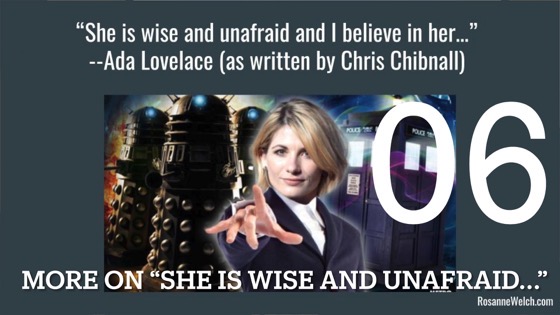
…but this line I really like. I also think it’s an example of how he promised to sort of give the show a bit of a female gaze right and I love all the dudes who’ve ever been on Doctor Who — well maybe not Colin Baker so much — but you know in general do love them all but he made a promise and I think he kept it. I think he didn’t just sort of gloss over and pretend and I think we’ll see that in the choice of guest characters, the choice of people we get to meet, right down to the fact that we met Ada Lovelace, who we’ve kind of heard about but I’ll still mention her in some classes and people don’t know who she is. So the fact that he’s giving a moment here for people to go oh oh that’s an interesting woman I need to know some more about and I think he scattered the show with those types of characters — those types of historical people we would not have met had he not kept in mind, I’ve promised to give this a kind of a different spin right? So that really impresses me.
![09 In TV, The Showrunner is in Charge...from The Difficulties and Delicacies of Writing the First Female Doctor in 50+ years [Video] [Doctor Who]](https://rosannewelch.com/wp-content/uploads/2022/04/rmw-whocon-2021-chibnall-09.jpg)
![43 Your Personality Is Your Writing... from Worry and Wonder | The Courier Thirteen Podcast [Video]](https://rosannewelch.com/wp-content/uploads/2022/03/rmw-courier-13-43.jpg)
![17 Even More On Treva Silverman From Women in Early TV for the American Women Writers National Museum [Video]](https://rosannewelch.com/wp-content/uploads/2022/03/rmw-visible-stars-early-tv-17.jpg)



![08 More On Chibnall's Earlier Writing...from The Difficulties and Delicacies of Writing the First Female Doctor in 50+ years [Video] [Doctor Who]](https://rosannewelch.com/wp-content/uploads/2022/03/rmw-whocon-2021-chibnall-08.jpg)
![42 More On Characters...from Worry and Wonder | The Courier Thirteen Podcast [Video]](https://rosannewelch.com/wp-content/uploads/2022/03/rmw-courier-13-42.jpg)
![16 More On Treva Silverman From Women in Early TV for the American Women Writers National Museum [Video]](https://rosannewelch.com/wp-content/uploads/2022/03/rmw-visible-stars-early-tv-16.jpg)
![07 Chibnall's Earlier Writing...from The Difficulties and Delicacies of Writing the First Female Doctor in 50+ years [Video] [Doctor Who]](https://rosannewelch.com/wp-content/uploads/2022/03/rmw-whocon-2021-chibnall-07.jpg)
![41 Theme and Character...from Worry and Wonder | The Courier Thirteen Podcast [Video]](https://rosannewelch.com/wp-content/uploads/2022/03/rmw-courier-13-41.jpg)
![15 Treva Silverman From Women in Early TV for the American Women Writers National Museum [Video]](https://rosannewelch.com/wp-content/uploads/2022/03/rmw-visible-stars-early-tv-15.jpg)