Dorothy Parker: Born to be a Star of Poignant and Pointed Word Play, Dr. Rosanne Welch, Script magazine, May 2021

Dorothy Parker: Born to be a Star of Poignant and Pointed Word Play, Dr. Rosanne Welch, Script magazine, May 2021

Mention of the name “Dorothy Parker” conjures up thoughts of New York’s famed Algonquin Round Table and the lone woman (though Edna Ferber and Ruth Gordon often stopped by) trading quips with the greatest male writers of her day. Few know that Parker pounced on Hollywood, following in the footsteps of many those male writers looking for a quick – and hefty – payoff. Parker’s second husband Alan Campbell (who knew she was married?) had heard the call of the West but her name in their shared credits cinched those extra 000s on their shared studio checks.

The imbalance of fame in their marriage lead to one of Hollywood’s greatest stories, one that is remade in almost every generation. But Parker lived emotional experience gave the story its birth. If you’ve seen any of the myriad versions of A Star is Born I believe you have seen into Parker’s heart as much as if you’ve read any of her poetry or short stories. All these writings share a voice dripped in sarcastic wit and word play used as brain armor to combat an ever-present tide of melancholia and loneliness.\

Star originally focused on an up and coming actress (Janet Gaynor) who falls in love with a partner whose fame is on the wane. Remade in 1954 for an up and coming musical comedy performer (Judy Garland) it was reconfigured for a rock star (Barbara Streisand) in 1976 and a pop star (Lady Gaga) in 2018. All but the latest version share the tragic concept that society couldn’t condone a woman more successful than her man. Parker’s lived emotional experience encompassed more sadness than her marriage.

Born Dorothy Rothschild in New Jersey in 1893, her mother died when she was five years old. Her father raised her with the help of a stepmother Parker disliked. In her late teens Parker, who was even then witty, wrote what she characterized as ‘light verse’ that didn’t sell – until it did. Parker’s reputation as a writer grew from writing for The New Yorker and then publishing Enough Rope, a collection of poetry, in 1926.

Her first marriage failed after her husband returned from World War I. Her second ended in divorce, remarriage and then Campbell died of a drug over dose. Her career largely never wavered, moving from magazines to screenplays, including Saboteur for which Alfred Hitchcock courted her contributions and counted them as so important he offered her a shared cameo in the film.

You can find comments about how Parker and Campbell worked together in S.J.Perelman’s published letters or in reminiscences of prolific (and also married) screenwriters Frances Goodrich and Albert Hackett who had the office next door. It amounts to the idea that Dottie, as she was called by friends, did the bulk of the writing and character creation and Campbell did not. You’ll hear more about Goodrich next month! Meanwhile, it is hard to decide which cultural icon has become a more enduring and influential touchstone to the twentieth century – A Star is Born or Dorothy Parker.

Read Dorothy Parker: Born to be a Star of Poignant and Pointed Word Play on the Script web site


Read about more women from early Hollywood


23 The importance of A Voice in the Room There And Back Again: Writing and Developing for American TV [Video]

23 The importance of A Voice in the Room There And Back Again: Writing and Developing for American TV [Video]

Thanks to the gracious invitation from my Screenwriting Research Network colleague Paolo Russo – and a grant he was able to procure (and in the before-Covid time) I was able to spend a week at Oxford Brookes University working with the screenwriting masters students in Paolo’s course. At the culmination of the week, I gave this lecture on how writers rooms worked in the States.

Transcript:

So, for instance, we were doing a story once about a young little girl. She was nine years old and she happened to be a young girl of color. She was lost at a park or something like that and you know the first thing that came to us — what do we do next in the story — well she’s gonna go find a policeman and the two African-American women in her room went “Oh no she’s not. My parents told me never to go to a policeman” and we were like but I was always told to find a policeman if I got lost somewhere. Yeah because you’re not a woman of color. So you can be safe with them. That was a whole new perspective, right? A perspective that I would not have had had I not had that other voice in the room.

Watch this entire presentation

Subscribe to Rosanne’s Channel and receive notice of each new video!


* A portion of each sale from Amazon.com directly supports our blogs
** Many of these books may be available from your local library. Check it out!
† Available from the LA Public Library

A Woman Wrote That – 27 in a series – 10 Things I Hate About You (1999) Written by Karen McCullah & Kirsten Smith

This new “A Woman Wrote That” post is an echo of the Writers Guild campaign of a few years ago (“A Writer Wrote That”) where they noted famous movie quotes and credited the screenwriter rather than the director.  The difference here being that we will be posting lines from films written by female screenwriters.  Feel free to share! — Rosanne

A Woman Wrote That - 27 in a series - 10 Things I Hate About You (1999) Written by Karen McCullah & Kirsten Smith

KAT

But mostly I hate the way I don’t hate you. Not even close, not even a little bit, not even at all.

22 People of Color and Television from There And Back Again: Writing and Developing for American TV [Video]

22 People of Color and Television from There And Back Again: Writing and Developing for American TV [Video]

Thanks to the gracious invitation from my Screenwriting Research Network colleague Paolo Russo – and a grant he was able to procure (and in the before-Covid time) I was able to spend a week at Oxford Brookes University working with the screenwriting masters students in Paolo’s course. At the culmination of the week, I gave this lecture on how writers rooms worked in the States.

Transcript:

Still, there’s something missing in writer’s rooms in America.

There’s some girls in that picture because it’s executive produced by a girl.

Missing something else. (Audience: people of color)People of color because you know they exist in the world.Isn’t that interesting but they were not yet existing on very many TV shows. Again a whole font of stories not being told — not being told correctly. On my show Touched by Angel we had we had two women of color and you have to remember that you only have experiences until you do research that come from your own life and that’s good and that’s a building block but it’s not everything right?

Watch this entire presentation

Subscribe to Rosanne’s Channel and receive notice of each new video!


* A portion of each sale from Amazon.com directly supports our blogs
** Many of these books may be available from your local library. Check it out!
† Available from the LA Public Library

11 Donald Bellisario from How The Chaos Of Collaboration in the Writers Room Created Golden Age Television [Video]

With the full recording of “How The Chaos Of Collaboration in the Writers Room Created Golden Age Television”

11 Donald Bellisario from How The Chaos Of Collaboration in the Writers Room Created Golden Age Television [Video]

Subscribe to Rosanne’s Channel and receive notice of each new video!


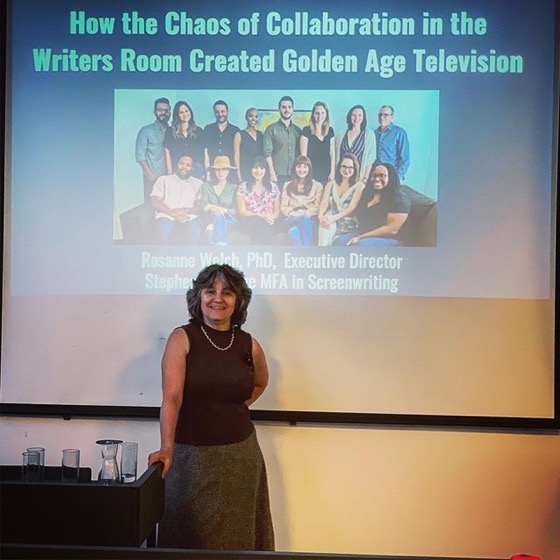
When the folks hosting the conference announced their theme as “Screen Narratives: Chaos and Order” the word ‘chaos’ immediately brought to mind writers rooms. I offered a quick history of writers rooms (the presentations are only 20 minutes long) and then quoted several current showrunners on how they compose their rooms and how they run them.

Transcript

Don Belisario gave us the military on television and that is a very distinct voice in America. It speaks to a part of the population that doesn’t feel they’re serviced by television right which they think is all run by liberal elites. So to glorify our military is the thing that is very popular in some parts of the country and that’s because Don Belisario was from the military. So he wanted to express that part of his life in writing.

For more information on the Screenwriting Research Network, visit

Screenwriting Research Network Conference, Porto, Portugal, All Sessions


Ready to present my talk yesterday at the Screenwriting Research Conference here in Porto, Portugal via Instagram

Follow me on Instagram


* A portion of each sale from Amazon.com directly supports our blogs
** Many of these books may be available from your local library. Check it out!

The Civil War On Film – 30 in a series – “… some took issue with the way a movie about black soldiers focused on the regiment’s white colonel.”

The Civil War On Film - 30 in a series -

Film critics universally embraced Glory as both a cinematic success and social justice tour de force. Leonard Maltin called it “breathtakingly filmed” and “faultlessly performed” (Maltin 2008). Historians liked the film nearly as much, though some took issue with the way a movie about black soldiers focused on the regiment’s white colonel, but most critics tempered their criticisms with some discussion of the need to make movies for diverse audiences.

Movies profiled in this book:

A Woman Wrote That – 26 in a series – Fleabag (2016), Writer, Phoebe Waller-Bridge

This new “A Woman Wrote That” post is an echo of the Writers Guild campaign of a few years ago (“A Writer Wrote That”) where they noted famous movie quotes and credited the screenwriter rather than the director.  The difference here being that we will be posting lines from films written by female screenwriters.  Feel free to share! — Rosanne

A Woman Wrote That - 26 in a series - Fleabag (2016), Writer, Phoebe Waller-Bridge

CLAIRE

The only person I’d run through an airport for is you.

Where’s Her Movie? Activist, Mary Church Terrell – 19 in a series

“Where’s HER Movie” posts will highlight interesting and accomplished women from a variety of professional backgrounds who deserve to have movies written about them as much as all the male scientists, authors, performers, and geniuses have had written about them across the over 100 years of film.  This is our attempt to help write these women back into mainstream history.  — Rosanne

Where's Her Movie? Activist, Mary Church Terrell  - 19 in a series

Mary Church Terrell (born Mary Eliza Church; September 23, 1863 – July 24, 1954) was one of the first African-American women to earn a college degree, and became known as a national activist for civil rights and suffrage.[1] She taught in the Latin Department at the M Street school (now known as Paul Laurence Dunbar High School)—the first African American public high school in the nation—in Washington, DC. In 1896, she was the first African-American woman in the United States to be appointed to the school board of a major city, serving in the District of Columbia until 1906. Terrell was a charter member of the National Association for the Advancement of Colored People (1909) and the Colored Women’s League of Washington (1894). She helped found the National Association of Colored Women (1896) and served as its first national president, and she was a founding member of the National Association of College Women (1910) Wikipedia

Screenwriting Question #4 : Books for the Screenwriter w/ Dr. Rosanne Welch via TikTok [Video]

@drrosannewelch

##Screenwriting ##Question ##4: ##Books for the ##Screenwriter w/ Dr. Rosanne Welch ##genre ##writing ##tips ##hints

♬ original sound – Dr. Rosanne Welch

creenwriting Question #4 : Books for the Screenwriter w/ Dr. Rosanne Welch via TikTok [Videol]


Read more about screenwriting with these books

* A portion of each sale from Amazon.com directly supports our blogs
** Many of these books may be available from your local library. Check it out!
† Available from the LA Public Library

21 Buffy The Vampire Slayer from There And Back Again: Writing and Developing for American TV [Video]

21 Buffy The Vampire Slayer from There And Back Again: Writing and Developing for American TV [Video]

Thanks to the gracious invitation from my Screenwriting Research Network colleague Paolo Russo – and a grant he was able to procure (and in the before-Covid time) I was able to spend a week at Oxford Brookes University working with the screenwriting masters students in Paolo’s course. At the culmination of the week, I gave this lecture on how writers rooms worked in the States.

Transcript:

Now. Lack of women. Ta-Da. Buffy the Vampire Slayer. Thank god, although we’ve discovered in the states that Joss Whedon, who ran the show and got all kinds of points for being a feminist was, in fact, having sex with every other girl he could meet so apparently not such a feminist. His wife has now left him — ta-da — but I academically am going to interpret to you that the reason the program maintained its level of feminist theory was because of all the women who he hired in his writer’s room. So perhaps subconsciously he knew he was a jerk and he wasn’t going to interpret this right and he wanted to get a room full of people who could give him a real interpretation of what it was like to be a girl in high school who was othered — who was different in this way. So Buffy is a pretty breakthrough and I highly recommend that show

Watch this entire presentation

Subscribe to Rosanne’s Channel and receive notice of each new video!


* A portion of each sale from Amazon.com directly supports our blogs
** Many of these books may be available from your local library. Check it out!
† Available from the LA Public Library