Months of research went into the creation of the essays in “When Women Wrote Hollywood.” Here are some of the resources used to enlighten today’s film lovers to the female pioneers who helped create it.
* A portion of each sale from Amazon.com directly supports our blogs
** Many of these books may be available from your local library. Check it out!
† Available from the LA Public Library
Subscribe to Rosanne’s Channel and receive notice of each new video!
This one allowed me to riff on some of my favorite female science fiction writers across time, whether they be novelists or television writers. It also opened up a good conversation on what art we support and include in our lives – and what that art says to us and about us. — Rosanne
Transcript:
This lady I love. Jane Espenson. She got her start in Star Trek. Many women writers in television were first given a script on some version of Star Trek whether it was Deep Space 9 or The Next Generation. She’s been around a long time. She also worked on Buffy which is one of my favorite shows which is really particularly well-written. She created Warehouse 13 which I thought was an adorable show and a great interesting premise about all the objects in the world that were alien objects and when they passed through history they were hidden in a big warehouse. If they got stolen, people could take the powers of early people because they were inside the object. So, you know, Marilyn Monroe’s hairbrush made you sexy because it turned you into a platinum blonde and we couldn’t put that out in the world because there’d be way too much of that going on. Really cute interesting stuff. Of course, she also wrote the Battlestar Galactica. She wrote one of the best episodes of Once Upon A Time. It was called Red-Handed and it has to do with the real story of Red Riding Hood and werewolves and how those two stories converge and it’s just so brilliantly and it uses our biases about gender and power against us to not predict where it’s going. So it’s a really lovely interesting piece of writing. I think is in the third season.
* A portion of each sale from Amazon.com directly supports our blogs ** Many of these books may be available from your local library. Check it out!
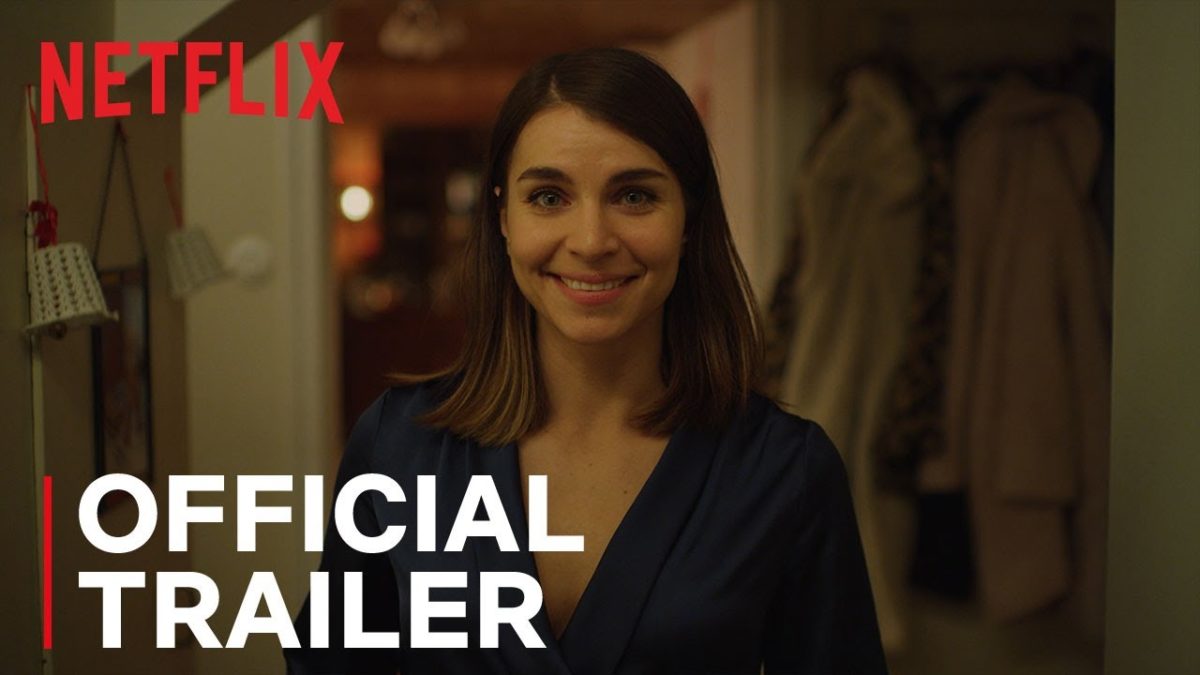
In my journey to watch television from other countries thanks to Netflix (hence ‘Samantha!’ and ‘Sintonia‘ from Brazil which I recommended here a bit ago) I’ve stumbled on a 6 episode 30 minute Norwegian comedy (with heart) about a single female nurse from a big family who pretends she’ll be bringing a boyfriend to Christmas Eve – and hen tries hard to find one.
I suggest watching it in the original language and reading the subtitles as it sounds so much more natural. You find it on Netflix under the Norwegian title – Hjem til jul, which means “Home for Christmas”. The last episode made me cry – the good kind of natural cry, not a forced one.
Everyone else is loved up, matched up and ready to hit those family dinners this Christmas season. Everyone that is, except Johanne. Determined to fend off those prying questions on her love life, Johanne sets off to find the perfect date for Christmas.
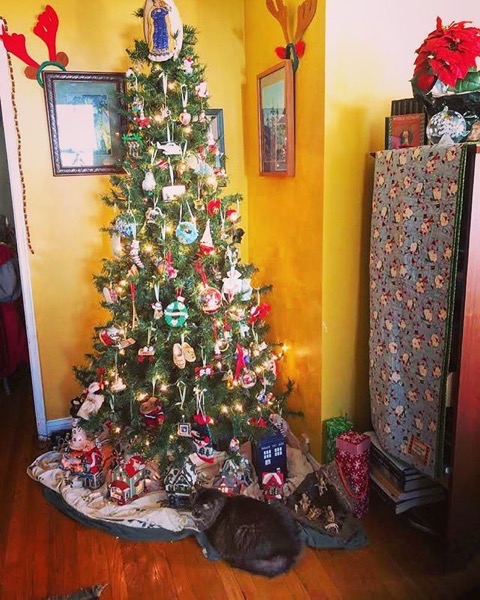
It’s not a tree until there’s a kitty sitting under it!
* A portion of each sale from Amazon.com directly supports our blogs ** Many of these books may be available from your local library. Check it out! † Available from the LA Public Library
One of the loveliest things about the campus at Cal Poly Pomona is the duck pond that is home to not only ducks and turtles but this beautiful creature who flies majestically around campus – or sometimes sits so nice and still along the pathway from my parking lot to my office. He or she creates a peaceful start to each new day.
Highlighting the articles in the past editions of the Journal of Screenwriting, of which I am the Book Reviews Editor. Hopefully these abstracts will entice you to did a little deeper into the history and future of screenwriting. — Rosanne
The machinations of industry, the exigencies of film funding and the producer’s prominent role in setting fiscal and marketing objectives for film production seem incongruous with scriptwriting as a generative creative practice in the filmmaking process. This article presents a case study that investigates the agency of creative practice from the insider perspective of a scriptwriter. In mobilizing the concept of the boundary object, the case links the problematic and transitional status of the script – as it passes out of the hands of the writer – to other roles under the control of filmmaking practitioners. In combining a practice-based reflexive narrative with theoretical observations, the article explores the processes and imperatives that mediate the script and scriptwriting as an embodied experience for the scriptwriter.
The Journal of Screenwriting is an international double-blind peer-reviewed journal that is published three times a year. The journal highlights current academic and professional thinking about the screenplay and intends to promote, stimulate and bring together current research and contemporary debates around the screenplay whilst encouraging groundbreaking research in an international arena. The journal is discursive, critical, rigorous and engages with issues in a dynamic and developing field, linking academic theory to screenwriting practice.
Welcome Back, Lady Mary, Lady Edith, and the Dowager Countess.
Downton Abbey (2019. Screenplay by Julian Fellowes, Characters by Julian Fellowes. 122 minutes)
A letter is signed in flowery handwriting. It goes to the post office. It goes on the Night Mail train to northern England (we know it is the Night Mail train because this montage bears more than a passing resemblance to the great 1936 documentary of the same name). The letter goes into the post office van, then the post office. A postal employee rides on a bicycle through the countryside . He goes up a familiar path to…Downton Abbey. He gives the letter to Andy, one of the footmen at the Abbey, who looks at the letter and says, “Blimey.” Andy takes the letter to Barrow, the head of household staff, who takes it to Robert, the Earl of Grantham. Robert opens the letter and tells his eldest daughter, Lady Mary, the contents. Lady Mary’s reply is, “What?”
Subscribe to Rosanne’s Channel and receive notice of each new video!
Transcript:
Ruth Gordon. Now we’re up to Ruth. Ruth only wrote four movies together with her husband Garson Kanin. Two of them you’ve heard of Adam’s Rib and Pat and Mike these are Katharine Hepburn and Spencer Tracy vehicles. This couple was best friends with Gordon and Kanin and they wrote the movies outside of the studio system. If you worked as a writer in a studio you got assigned something to work on. These two just wrote movies they wanted to in their own house and then sold them to the studio to actors they knew so nobody rewrote them and they were on the set through most of the production because they hired George Cukor who was a famous director, and another friend of theirs, to direct them. What I think is important for us to think about Ruth is that — and I love Katharine Hepburn and I don’t want to like mess with her reputation too much — but she has a reputation for being a feminist. That’s wrong. Katharine Hepburn stayed the mistress of Spencer Tracy their entire relationship. He never left his wife and she never left him for not leaving his wife. Rumor has it — stuff has come out lately — that he actually beat on her and she put up with that. That’s not a feminist woman. Her characters in the films were feminists because guess why? Ruth was. Ruth was writing herself and her own attitude.
Dr. Rosanne Welch discusses the women in her new book “When Women Wrote Hollywood” which covers female screenwriters from the Silents through the early 1940s when women wrote over 50% of films and Frances Marion was the highest paid screenwriter (male or female) and the first to win 2 Oscars. Yet, she fails to appear in film history books, which continue to regurgitate the myth that male directors did it all – even though it’s been proven that the only profitable movies Cecil B. de Mille ever directed were all written by Jeannie Macpherson film ever won for Best Picture was written by Robert E. Sherwood (who people have heard of, mostly due to his connection to Dorothy Parker) and Joan Harrison.
* A portion of each sale from Amazon.com directly supports our blogs ** Many of these books may be available from your local library. Check it out! † Available from the LA Public Library
Wherever you go, you find Monkees fans and the Denver Popular Culture Con was no different. Amid rooms full of caped crusaders and cosplay creations, I was initially not sure how many folks would attend a talk on a TV show from the 1960s – but happily I was met by a nice, engaged audience for my talk on Why the Monkees Matter – and afterward they bought books! What more could an author ask for?
Subscribe to Rosanne’s Channel and receive notice of each new video!
Transcript
Obviously popular culture, which were here to celebrate. It mattered on The Monkees. They were moments in popular culture. A moment that has lasted for the last 50 years but a lot of what they did affected the other popular culture we know. Some people do or don’t know that when they added the Chekhov character to Star Trek in their second season Gene Roddenberry said “He needs to have a haircut that matches that kid on the Monkees” because he is here to appeal to the young girls right? So if you think about it, that’s that’s considered a hippie long hair haircut.
A hit television show about a fictitious rock band, The Monkees (1966-1968) earned two Emmys–Outstanding Comedy Series and Outstanding Directorial Acheivement in Comedy.
Capitalizing on the show’s success, the actual band formed by the actors, at their peak, sold more albums than The Beatles and The Rolling Stones combined, and set the stage for other musical TV characters from The Partridge Family to Hannah Montana. In the late 1980s, the Monkees began a series of reunion tours that continued into their 50th anniversary.
This book tells the story of The Monkees and how the show changed television, introducing a new generation to the fourth-wall-breaking slapstick created by Laurel and Hardy and the Marx Brothers.
Its creators contributed to the innovative film and television of 1970s with projects like Bob & Carol & Ted & Alice, The Mary Tyler Moore Show, Laugh-In and Welcome Back, Kotter. Immense profits from the show, its music and its merchandising funded the producers’ move into films such as Head, Easy Riderand Five Easy Pieces.
The deadline for applying to the MFA program ,in order to qualify for the scholarship, is March 31st, 2020.
The awardee, will be announced May 1st, at SeriesFest held in Denver in April. There I will have my own honor, that of granting the scholarship to the student who will be a featured guest at the event. — Rosanne
Jan Marino Scholarship A Scholarship To The Stephens College M.F.A. In Television And Screenwriting For Women Over 45
Named to honor author Jan Marino, the mother of M.F.A. student Betsy Marino Leighton, the scholarship nurtures the power of strong, independent female storytelling in television and film.

![29 Jane Espenson from The Sisterhood of Science Fiction – Dr. Rosanne Welch [Video] (1 minute 15 seconds)](https://rosannewelch.com/wp-content/uploads/2019/12/scifi-rmw-cpp-29.jpeg)


![31 Ruth Gordon from “When Women Wrote Hollywood” with Dr. Rosanne Welch [Video] ( 1 minutes 15 seconds)](https://rosannewelch.com/wp-content/uploads/2019/12/csuf-rmw-w3h-31.jpeg)
![16 Cultural Impact and The Monkees from “Why The Monkees Matter: Even 50 Years Later [Video] (29 seconds)](https://rosannewelch.com/wp-content/uploads/2019/12/monkees-popcon-2019-16.jpeg)