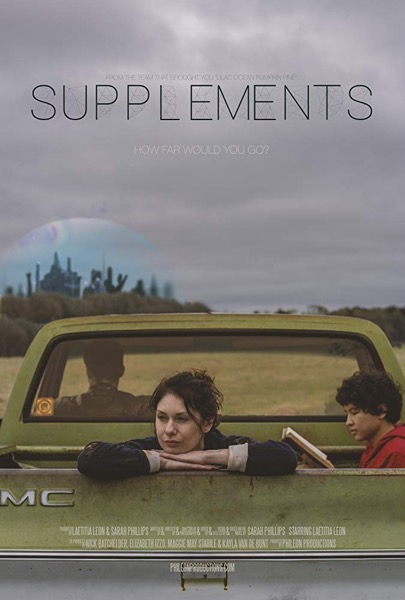
The year is 2289, and all that’s left on Planet Earth is the domed city Old Centauri, roaming sun flares that scorch the land, and the nomadic tribes that mitigate the two. Kiirke comes from one such tribe, and she must travel to Old Centauri, along with her stowaway younger brother, to seek a small fortune to save her family – But the only way to make money as a newcomer to the city is to enroll in Supplements Labs as what the locals call a “lab rat”.
Subscribe to Rosanne’s Channel and receive notice of each new video!
This one allowed me to riff on some of my favorite female science fiction writers across time, whether they be novelists or television writers. It also opened up a good conversation on what art we support and include in our lives – and what that art says to us and about us. — Rosanne
Transcript:
George Lucas writes Star Wars himself and directs it and decides he doesn’t like writing so much. He’s not sure of it. That doesn’t work for him, right? He likes the directing part and the casting, all that fun stuff. So he gets somebody else to write the sequel to his big hit movie that nobody expected to be hit and he hires Leigh Brackett because he wants what she can bring to the table, both in science fiction and in strong male characters oddly enough. She is contribute she is credited for contributing a lot to the creation of who Han Solo became because the first movie he’s kind of just swagger really cool. It’s just Harrison Ford wearing a cute uniform right? He gets much more developed in the second film and she wrote a lot of cowboys and if you think about the Han Solo we know in the second and continuing films he’s pretty much a space cowboy, but you know cool.
* A portion of each sale from Amazon.com directly supports our blogs ** Many of these books may be available from your local library. Check it out!
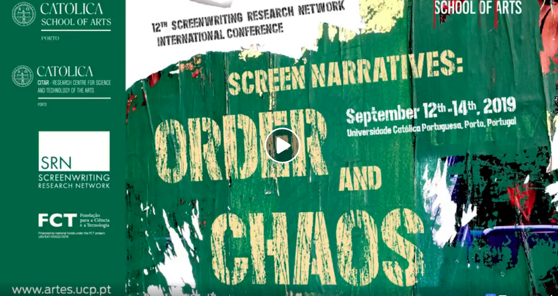
I’m so excited to have been invited to be the keynote speaker at the 10th Screenwriters´(hi)Stories Seminar being held on the campus of the Universidade Presbiteriana Mackenzie in São Paulo, Brazil – NEXT WEEK!
It’s all thanks to my friend and colleague from the Screenwriting Research Network (who is actually the president of the network this year) Carmen Sofia Brenes who suggested me to the committee planning the seminar.
I’ll be speaking on “Why Researching Screenwriters (has Always) Mattered” which will be focused on the importance of storytellers in all cultures, and how screenwriters have become this last century’s most powerful storytellers thanks to the reach of technology.
It’s a daunting thing to be asked to be a keynote speaker and I’ve been writing my speech for a few weeks now, still in a bit of a fog that such a fun thing should happen – but the tickets came today so now it’s a reality. I have to finish this speech (and the Google Slides that goes with it) – and PACK!
Here is a summary of my talk. I hope to have it recorded, too. Watch this space for information on a possible live stream of this event.
SUMMARY
To understand the world we have to understand its stories and to understand the world’s stories we must understand the world’s storytellers.
A century ago and longer those people would have been the novelists of any particular country but since the invention of film, the storytellers who reach the most people with their ideas and their lessons have been the screenwriters. My teaching philosophy is that: Words matter, Writers matter and Women writers matter. Therefore women writers shall be my focus. Why? Because they have been the far less researched and yet they are over half the population. We cannot tell the stories of the people until we know what stories the mothers have passed down to their children. Those are the stories that last. Now is the time to research screenwriters of all cultures and the stories they tell because people are finally recognizing the work of writers and appreciating how their favorite stories took shape on the page long before they were cast, or filmed, or edited. But also because streaming services make the stories of many cultures now available to a much wider world than ever before.
In celebration of Columbus Day/Indigenous Peoples’ Day, all Mentoris Project Books, including my own — America’s Forgotten Founding Father — will be on sale as Amazon Kindle eBooks for just 99¢. Check out all the books now and buy them on Monday, October 14, 2019!
His loyalty lasted a lifetime…
Surgeon, merchant, vintner, and writer Filippo Mazzei influenced American business, politics, and philosophy. Befriending Benjamin Franklin and Thomas Jefferson, Mazzei was a strong liaison for others in Europe. Mazzei was Jefferson’s inspiration for the most famous line in the Declaration of Independence: “All men are created equal.”
Clearly, Mazzei had a gift of language and often used his words to share his ideas about religious freedom. Mazzei encouraged other Italians still living overseas to join him in a country rich with opportunity and promise. Often, when returning from Italy, he booked passages on ships for people who desired to travel to America and employed them on his estate—just to ensure a better, more fruitful life for everyone. During those travels, Mazzei found himself at the center of many fights for freedom.
He was truly a friend to freedom around the world.
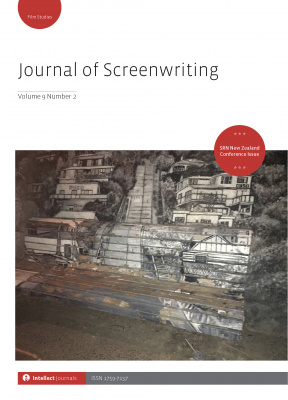
Highlighting the articles in the latest edition of the Journal of Screenwriting, of which I am the Book Reviews Editor. Hopefully these abstracts will entice you to did a little deeper into the history and future of screenwriting. — Rosanne
Re-writing theatrical documentaries: The broadcast version Phoebe Hart
In the funding matrix for major theatrical documentaries, television networks are often sought out as commissioners, particularly in territories such as Australia, where a plan in the form of distribution agreement and/or broadcaster pre-sale is required to access screen agency funds. As part of the deals with the broadcaster, there are mandated deliverables in the form of a ‘broadcast version’ of the documentary film, typically one hour in length or as a series. For producers, this arrangement raises much-needed production finance and capitalizes on the property’s reach and earning potential by exploiting the various distribution windows available. However, these deals lead to vexatious practical concerns in re-versioning for broadcast as documentary screenwriters are challenged to make changes while attempting to maintain the tone of their work. This research delves into the creative and cognitive processes as experienced by screenwriters who must ‘cut down’ a theatrical version of a documentary for broadcast. The research presents three case studies drawn from in-depth interviews, which are examined via a thematic analysis methodology to understand the processes of re-writing, including changes to narration, tone, style, character and narrative arcs, and thematic treatment. The research examines what is sacrificed due to time restrictions and viewer sensibilities, and whether or not the key intentions of documentary screenwriters can be preserved.
The Journal of Screenwriting is an international double-blind peer-reviewed journal that is published three times a year. The journal highlights current academic and professional thinking about the screenplay and intends to promote, stimulate and bring together current research and contemporary debates around the screenplay whilst encouraging groundbreaking research in an international arena. The journal is discursive, critical, rigorous and engages with issues in a dynamic and developing field, linking academic theory to screenwriting practice.
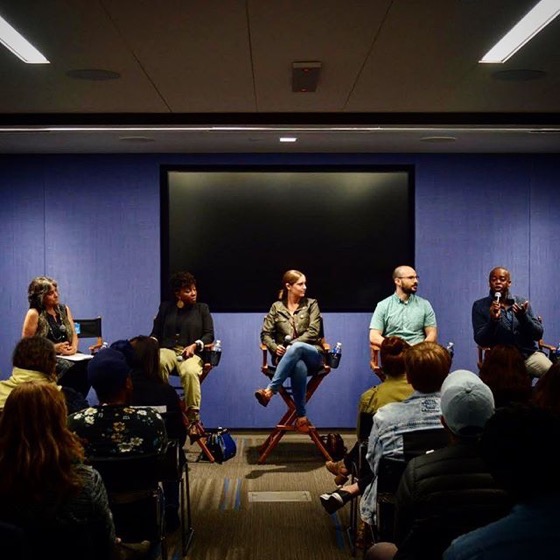
We team up with @ColumbiaChi to talk about how locations inform and impact characters on TV with @qu33nofdrama, @SparksAnthony, Matt Lutsky, @RosanneWelch and Connor Kilpatrick.
* A portion of each sale from Amazon.com directly supports our blogs ** Many of these books may be available from your local library. Check it out!
Bri Castellini is an award-winning independent filmmaker based in Brooklyn. She has an MFA in Writing and Producing for Television and a B.A. in creative writing, studying in New York and Oregon, respectively.
By day, she’s a crowdfunding specialist for Seed&Spark, the community director for Stareable, and an adjunct professor for Long Island University-Brooklyn and Stephens College. She is known for the short films Ace and Anxious (2017, writer/director) and Buy In (2019, director/co-writer) and the web series Brains and Sam and Pat Are Depressed (2015-2016, 2017-present respectively, creator/writer/star) as well as the upcoming web series Better With You (2019, director). She has been described by collaborators as a “human bulldozer” and is honestly kind of flattered.
Subscribe to Rosanne’s Channel and receive notice of each new video!
Transcript:
And when The Great Gatsby came out it was a flop. The book fails. It survived because there were so many extra copies in a warehouse that weren’t sold that when they started sending packages –care packages — to soldiers in World War I they threw in these books nobody wanted and all the soldiers ended up reading it and coming home thinking that was the greatest novel they’d ever read and it became this centerpiece of American literature while her books never gone out of print right and yet we don’t teach it to kids in high school which I can’t fathom. It’s the same era. It’s the same attitude. Anyway she’s very famous for many many films, San Francisco, The Women, which was remade about six years ago by Diane English from the Murphy Brown show and Anita’s version is better. It is really quite lovely and it has a classic line in it. They’re watching two dogs fight and somebody says “What do you call them?” and she says “Witches, with a different letter.” So you know exactly. So Anita Loos deserves to be more famous.
Dr. Rosanne Welch discusses the women in her new book “When Women Wrote Hollywood” which covers female screenwriters from the Silents through the early 1940s when women wrote over 50% of films and Frances Marion was the highest paid screenwriter (male or female) and the first to win 2 Oscars. Yet, she fails to appear in film history books, which continue to regurgitate the myth that male directors did it all – even though it’s been proven that the only profitable movies Cecil B. de Mille ever directed were all written by Jeannie Macpherson film ever won for Best Picture was written by Robert E. Sherwood (who people have heard of, mostly due to his connection to Dorothy Parker) and Joan Harrison.
* A portion of each sale from Amazon.com directly supports our blogs ** Many of these books may be available from your local library. Check it out! † Available from the LA Public Library
Wherever you go, you find Monkees fans and the Denver Popular Culture Con was no different. Amid rooms full of caped crusaders and cosplay creations, I was initially not sure how many folks would attend a talk on a TV show from the 1960s – but happily I was met by a nice, engaged audience for my talk on Why the Monkees Matter – and afterward they bought books! What more could an author ask for?
Subscribe to Rosanne’s Channel and receive notice of each new video!
Transcript
If you think about it, we know that Dr. Timothy Leary — who was famous for dropping a little acid back in the day — he already was watching the program and saying, there is a whole lot going on here that no one else is paying attention to. So this isn’t information that I invented years later. People already we’re saying these things but the network television guys weren’t really listening. They thought it was a show about four guys who wanted to be a band and there was a good way to sell music. It was synergy, right? It was the big mood of the day. So that’s what they thought, but when you think about what they were talking about on the show — this particular song Randy Scouse Git is a song that Mickey wrote. It hit number one on the charts in the UK and made it to like number three in charts in the United States. Came in the second season also in the second season their clothing began to change. They went from JCPenney matching band uniforms to the poncho, the more hippie attire, looking more like they looked in their real lives. .
A hit television show about a fictitious rock band, The Monkees (1966-1968) earned two Emmys–Outstanding Comedy Series and Outstanding Directorial Acheivement in Comedy.
Capitalizing on the show’s success, the actual band formed by the actors, at their peak, sold more albums than The Beatles and The Rolling Stones combined, and set the stage for other musical TV characters from The Partridge Family to Hannah Montana. In the late 1980s, the Monkees began a series of reunion tours that continued into their 50th anniversary.
This book tells the story of The Monkees and how the show changed television, introducing a new generation to the fourth-wall-breaking slapstick created by Laurel and Hardy and the Marx Brothers.
Its creators contributed to the innovative film and television of 1970s with projects like Bob & Carol & Ted & Alice, The Mary Tyler Moore Show, Laugh-In and Welcome Back, Kotter. Immense profits from the show, its music and its merchandising funded the producers’ move into films such as Head, Easy Riderand Five Easy Pieces.

![20 More On Leigh Brackett from The Sisterhood of Science Fiction – Dr. Rosanne Welch [Video] (46 seconds)](https://rosannewelch.com/wp-content/uploads/2019/10/scifi-rmw-cpp-20.jpeg)



![22 More On Anita Loos from “When Women Wrote Hollywood” with Dr. Rosanne Welch [Video] (1 minutes)](https://rosannewelch.com/wp-content/uploads/2019/10/csuf-rmw-w3h-22.jpeg)
![07 Timothy Leary and the Counterculture from “Why The Monkees Matter: Even 50 Years Later [Video] (54 seconds)](https://rosannewelch.com/wp-content/uploads/2019/10/monkees-popcon-2019-07.jpeg)