Dr. Rosanne Welch Speaks at the 2021 Stephens College MFA in TV & Screenwriting Commencement [Video]

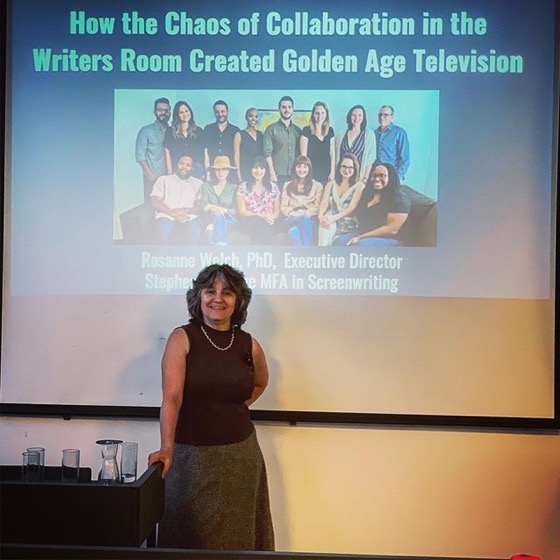
Dr. Rosanne Welch gave the welcoming remarks at this year’s commencement ceremonies for the Stephens College MFA in TV and Screenwriting for the Class of 2021, reminding everyone of the program’s motto:  Write. Reach. Represent.

Dr. Rosanne Welch Speaks at the 2021 Stephens College MFA in TV & Screenwriting Commencement [Video]

Where’s Her Movie? Gymnast, Dianne Durham – 22 In A Series

“Where’s HER Movie” posts will highlight interesting and accomplished women from a variety of professional backgrounds who deserve to have movies written about them as much as all the male scientists, authors, performers, and geniuses have had written about them across the over 100 years of film.  This is our attempt to help write these women back into mainstream history.  — Rosanne

Where's Her Movie? Gymnast, Dianne Durham  - 22 In A Series

Dianne Patrice Durham (June 17, 1968 – February 4, 2021) was an American artistic gymnast. In 1983, she won the all-around senior title at the women’s US National Championships, becoming the first African American athlete to do so. She was Béla and Márta Károlyi’s first elite athlete in the United States, helping establish their coaching credentials outside of the state-sponsored program of their native Romania, and trained with Mary Lou Retton, who called Durham her “best competition”. After injuries and competition stipulations prevented her from competing in the 1984 Summer Olympics, Durham retired from competition in 1985. She later ran the Skyline Gymnastics school in Chicago.. — Wikipedia

25 Video Game Writer’s Rooms from There And Back Again: Writing and Developing for American TV [Video]

25 Video Game Writer's Rooms from There And Back Again: Writing and Developing for American TV [Video]

Thanks to the gracious invitation from my Screenwriting Research Network colleague Paolo Russo – and a grant he was able to procure (and in the before-Covid time) I was able to spend a week at Oxford Brookes University working with the screenwriting masters students in Paolo’s course. At the culmination of the week, I gave this lecture on how writers rooms worked in the States.

Transcript:

So the thing about writer’s rooms is they had to evolve over time right? I was — it was interesting to watch them grow. So these are a couple of, you know, empires. I mentioned today. The new thing is that video game writers are using writer’s rooms and that’s huge. These gentlemen, Ralph and George, are with Blizzard so if you know Overwatch, right, and Diablo and those things. They came out of television. They were hired by the video game companies. They are now looking for television writers because they want people who understand how a writer’s room works and they were explaining at their writer’s room — most writers rooms now five six people — theirs go to 10 or 12 because they’ve got guys who are lore experts who are going to remind you of what this character did 15 years ago with his stepsister from the other kingdom whatever that is. They have to have people who are storyboard artists who are going to show you what the new characters look like. What their weaponry looks like. They are the historians who tell you what else should be happening in this village at this time. They have a giant room full of people plus about five or six writers who are creating the story lines for these characters. So it’s really a brilliant thing to be part of.

Watch this entire presentation

Subscribe to Rosanne’s Channel and receive notice of each new video!


* A portion of each sale from Amazon.com directly supports our blogs
** Many of these books may be available from your local library. Check it out!
† Available from the LA Public Library

From The Journal Of Screenwriting V5 Issue 1: Where are you from? Place as a form of scripting in independent cinema by J. J. Murphy

Highlighting the articles in the past editions of the Journal of Screenwriting, of which I am the Book Reviews Editor. Hopefully these abstracts will entice you to did a little deeper into the history and future of screenwriting. — Rosanne


Where are you from? Place as a form of scripting in independent cinema by J. J. Murphy
 
Large-budget Hollywood studio productions generally prefer a high level of fabrication in creating a film’s setting, either through the building of sets or through special effects, because it gives the production team greater control. Yet that’s often been less true of indie films historically. For a variety of reasons, the setting or location of independent films often becomes a central part of the scripting of a film. It is obviously cheaper to use what already exists in reality rather than to attempt to create a location through set design or art direction. Beyond issues of budget, however, my interest here is in exploring how ‘place’ can actually function as a key element in the scripting process, especially one that is rooted in visual storytelling, by taking into account the myriad ways that a film’s setting can contribute to and enhance the narrative beyond the use of generic, decorative or touristic locations. Using examples drawn from independent cinema, the article argues that place can have an intrinsic, integrative, stylistic, structural, conceptual and thematic function.

From The Journal Of Screenwriting V5 Issue 1: Where are you from? Place as a form of scripting in independent cinema by J. J. Murphy


Journal of Screenwriting Cover

The Journal of Screenwriting is an international double-blind peer-reviewed journal that is published three times a year. The journal highlights current academic and professional thinking about the screenplay and intends to promote, stimulate and bring together current research and contemporary debates around the screenplay whilst encouraging groundbreaking research in an international arena. The journal is discursive, critical, rigorous and engages with issues in a dynamic and developing field, linking academic theory to screenwriting practice. 

Get your copy and subscription to the Journal of Screenwriting Today!


* A portion of each sale from Amazon.com directly supports our blogs
** Many of these books may be available from your local library. Check it out!
The Civil War On Film – 32 in a series – “…because it was insufficiently sympathetic to the Confederate point of view.”

The Civil War On Film - 32 in a series -

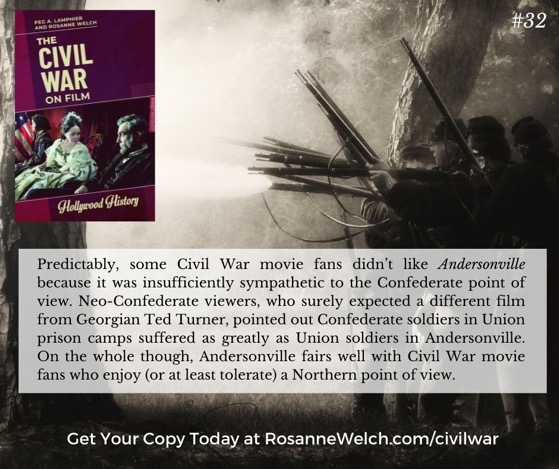
Predictably, some Civil War movie fans didn’t like Andersonville because it was insufficiently sympathetic to the Confederate point of view. Neo-Confederate viewers, who surely expected a different film from Georgian Ted Turner, pointed out Confederate soldiers in Union prison camps suffered as greatly as Union soldiers in Andersonville. On the whole though, Andersonville fairs well with Civil War movie fans who enjoy (or at least tolerate) a Northern point of view.

Movies profiled in this book:

TikTok Response to comment from @itsmeimgarbage : Polly Platt [Video]

@drrosannewelch

Response to @itsmeimgarbage : Polly Platt ##screenwriting ##movies ##history ##women ##lastpictureshow ##film

♬ original sound – Dr. Rosanne Welch


TikTok Response to comment from @itsmeimgarbage : Polly Platt [Video]

A Woman Wrote That – 28 in a series – The Birdcage (1996), Witten by Elaine May

This new “A Woman Wrote That” post is an echo of the Writers Guild campaign of a few years ago (“A Writer Wrote That”) where they noted famous movie quotes and credited the screenwriter rather than the director.  The difference here being that we will be posting lines from films written by female screenwriters.  Feel free to share! — Rosanne

A Woman Wrote That - 28 in a series - The Birdcage (1996), Witten by Elaine May

ALBERT

There’s no need to get hysterical. All I have to remember is I can always get more toast.

12 Kenny Johnson from How The Chaos Of Collaboration in the Writers Room Created Golden Age Television [Video]

With the full recording of “How The Chaos Of Collaboration in the Writers Room Created Golden Age Television”

 from How The Chaos Of Collaboration in the Writers Room Created Golden Age Television [Video]

Subscribe to Rosanne’s Channel and receive notice of each new video!


When the folks hosting the conference announced their theme as “Screen Narratives: Chaos and Order” the word ‘chaos’ immediately brought to mind writers rooms. I offered a quick history of writers rooms (the presentations are only 20 minutes long) and then quoted several current showrunners on how they compose their rooms and how they run them.

Transcript

Kenny Johnson brought science fiction more seriousness, right? So he started The Bionic Woman. He moved on to The Incredible Hulk, then V, and then Alien Nation. A beautiful show about an alien nation and assimilation into new cultures all done through science fiction. So he brought social justice to science fiction and that was a very distinct way that his voice worked. I got to be his assistant for a while.

For more information on the Screenwriting Research Network, visit

Screenwriting Research Network Conference, Porto, Portugal, All Sessions


Ready to present my talk yesterday at the Screenwriting Research Conference here in Porto, Portugal via Instagram

Follow me on Instagram


* A portion of each sale from Amazon.com directly supports our blogs
** Many of these books may be available from your local library. Check it out!

Where’s Her Movie? Scientist, Valerie Thomas – 21 In A Series

“Where’s HER Movie” posts will highlight interesting and accomplished women from a variety of professional backgrounds who deserve to have movies written about them as much as all the male scientists, authors, performers, and geniuses have had written about them across the over 100 years of film.  This is our attempt to help write these women back into mainstream history.  — Rosanne

Scientist, Valerie Thomas

Valerie L. Thomas (born February 8, 1943) is an American scientist and inventor. She invented the illusion transmitter, for which she received a patent in 1980. She was responsible for developing the digital media formats image processing systems used in the early years of the Landsat program. — Wikipedia

Drs. Rosanne Welch and Sarah Clark discuss The Monkees “Monkee Chow Mein” episode on the Zilch Podcast’s Monkees 101 Series [Audio]

My co-host, Dr. Sarah Clark and I usually host a segment on Zilch: A Monkees Podcast where we break down episodes of The Monkees in terms of history and popular culture of the time in which is was written, filmed and aired. 

For this episode, however, we tackled the problem with an episode we consider to be a sad outlier to the usual mix of positive energy and creativity. The title alone will tell you the problem with the episode –  Monkee Chow Mein. Sadly, against the show’s youthful promise to celebrate how “we’re too busy singing to put anybody down” the title tells you laughs were wrung from doing exactly that so in this discussion Dr. Clark and I try to understand how that happened.

RMW Rosanne Signature for Web

Drs. Rosanne Welch and Sarah Clark discuss The Monkees “Monkee Chow Mein

Monkees News and “We need to talk about monkee chow mein”. Farewell tour, it looks like this is it.

Dolenz Sings Nesmith, a collection of songs featuring Micky paying tribute to the songbook of Michael Nesmith.

Listen Now

Get Rosanne’s Monkees Book – Why The Monkees Matter!